Showing posts sorted by relevance for query lab girl. Sort by date Show all posts

Friday, March 10, 2017

One Hope for Science

Review by Bill Doughty

Dr. Hope Jahren asks us to plant a tree while she plants a forest of ideas in this remarkable book. Part autobiography in the very cool shade of science essays, "Lab Girl" (Alfred A. Knopf, 2016 by A. Hope Jahren), is a perfect book for Women's History Month.

Michiko Kakutani compares Jahren's style of poetry and scientific imagination to Oliver Sacks and Stephen Jay Gould. I smiled – and laughed – at passages that sounded like Mary Roach. And I read and reread beautiful passages that brought E.O. Wilson and Rachel Carson to mind.

But, to be clear, Hope Jahren is a unique voice, humble but fearless in what she reveals. This book that is ultimately an extended love letter to the world, to life, to "the transcendent value of loyalty," and to her imagined granddaughter.

I enjoy reading short chapters of "Lab Girl" to my young grandkids. Here's an excerpt from her chapter on seeds (and more):
"A seed knows how to wait. Most seeds wait for at least a year before starting to grow; a cherry seed can wait for a hundred years with no problem. What exactly each seed is waiting for is known only to that seed. Some unique trigger-combination of temperature-moisture-light and many other things is required to convince a seed to jump off the deep end and take its chance to take its one and only chance to grow ... Each beginning is the end of a waiting. We are each given exactly one chance to be. Each of us is both impossible and inevitable. Every replete tree was first a seed that waited."
Anomalocaris pictured in a Cambrian sea.
Here's a passage the kids and I enjoyed that sets the stage for life on earth – before plants. This one sent us to Google for a look-see at Anomalocaris and a sidebar to YouTube to see how the history of the earth can be understood using a football field, thanks to NPR's Skunk Bear. Just sharing.
"For several billion years, the whole of the Earth's land surface was completely barren. Even after life had richly populated the oceans, there is no clear evidence for any life on land. While herds of trilobites wallowed on the ocean floor, preyed upon by Anomalocaris – a segmented marine insect the size of a Labrador retriever – there was nothing on land. Sponges, mollusks, snails, corals, and exotic crinoids maneuvered through nearshore and deepwater environments – still nothing. The first jawed and jawless fishes appeared and radiated into the bony forms we know today – still nothing ... Sixty million more years passed before there was life on land that constituted any more than a few single cells stuck together within the cracks of a rock. Once the first plant did somehow make its way onto land, however, it took only a few million years for all of the continents to turn green, first with wetlands and then with forests."
Gorilla at Monkey Jungle
Dr. Jahren is heart-achingly honest and belly-achingly funny in describing roadtrips, the Monkey Jungle, dancing at a glacier, finding something special in hackberry seeds, finding love, being pregnant, and confronting mortality.

Along most of the way she introduces us to  her fraternal soulmate, fellow scientist and lab partner, Bill. We get a bit of history about Armenia and Norway, as relates to Bill's and Hope's families respectively.
Another theme of this book is self-awareness and self-acceptance, as expressed in this found haiku about her life's confusing and sometimes unstable path toward enlightenment:

being what you are
while knowing that it's more than
people want to see
In advice for any parent, leader, scientist or sailor, Jahren writes, "People are like plants. They grow toward the light."
Her writing is often pure poetry in prose:
"In Minnesota, the spring thaw happens all at once when the frozen ground yields to the sun in one day, wetting the spongy soil from within. On the first day of spring, you can can reach into the ground and easily pull up great, loose clumps of dirt as if they were handfuls of too-fresh devil's food cake and watch the fat pink earthworms come writhing out and fling themselves joyfully back into the hole. There is not even a hint of clay within the soils of southern Minnesota; they have lain like a rich black blanket over the limestone of the region for a hundred thousand years ... but the growing season is short, so there's no time to be wasted."
In "Lab Girl" we travel with indefatigable Jahren to her birthplace in Minnesota to places like California, Alaska, the American South, Maryland, Norway and Ireland, then finally to her new home and lab – often the same thing – at the University of Hawaii at Manoa in Honolulu, where she was a tenured professor when "Lab Girl" ends.

Among her studies and achievements: In 2009 she and her team were in the third year of conducting forensic analysis of chemical aftermath of a terrorist attack. "Our idea was to compare, and perhaps link, the chemical fingerprint of post-blast residue with that of the chemical traces gathered from surfaces where the explosives might have been constructed – a kitchen countertop, for example." She achieved success with "a definite dataset, made with integrity and interpreted honestly."
What makes this book so perfect for Women's History Month is the inspiring story behind Jahren's success as a woman in the traditionally man's world of science. She overcame significant roadblocks and obstacles – with toughness, grit and her namesake optimism.

Jahren writes about being stereotyped and second-guessed – knee-deep in chauvinism in a male-dominated world.
"Public and private organizations all over the world have studied the mechanics of sexism within science and have concluded that they are complex and multifactorial. In my own small experience, sexism has been something very simple: the cumulative weight of constantly being told that you can't possibly be what you are."
Global climate change and the urbanization of the planet is a big concern for Jahren. "Viewed from space, our planet appears less green with each passing year," she warns. And, "Humans are actively creating a world where only weeds can live and then feigning shock and outrage upon finding so many."

Baobob tree at University of Hawaii, Manoa.
In a recent study, Jahren and her team are showing that sweet potatoes can grow larger as carbon dioxide increases as predicted for the next several hundred years. 
"This is not a surprise. We also saw that these big potatoes were less nutritious, much lower in protein content, no matter how much fertilizer we gave them. This was a bit of a surprise. It is also bad news, because the poorest and hungriest nations of the world rely on sweet potatoes for a significant amount of dietary protein. It looks as if the bigger potatoes of the future might feed more people while nourishing them less. I don't have an answer for that one."
Hope Jahren takes a clear-eyed look at the real longterm threats to our world and breathes beauty into the nature of reality (and reality of nature) with practical advice: "plant a tree."


This is another book I heard about on the great podcast, Tom Ashbrook's "On Point."

Monday, September 13, 2021

‘It Got Me Thinking’ … More!


Review by Bill Doughty––

Hope Jahren quotes a bit of eye-opening graffiti at the very end of her latest book, “The Story of More: How We Got to Climate Change and Where to Go from Here” (Vintage Books, Penguin Random House; 2020).


Jahren –– gifted scientist, teacher, painter of words, and author of “Lab Girl” –– looks all around for inspiration, and she finds it in trees, fish, cornfields, slaughterhouses, sanitation systems, memories, history, prehistory, and, yes, graffiti. More about the graffiti in a moment.


Ford, Edison, and Firestone –– and trees.
In this beautiful, funny, but melancholy personal reflection on climate change, Jahren examines the survivability of our species and the choices we make. Can we help each other and the planet we share? She’s not sure. But Hope drives her points home: use less, share more.

“The Story of More” opens with a meeting between Thomas Edison, Henry Ford, and tire magnate Harvey Firestone. Edison said, as a brilliant insight, “The sun and solar energy. What a source of power! I hope we don’t have to wait until oil and coal run out before we tackle that.” Then, Jahren imagines Ford and Firestone, after listening to Edison’s insight, “nodded politely, finished their drinks, and went straight back to motorizing the planet.”


By the way, Jahren admits her disdain for the automobile:

“While pursuing the ever-elusive more, we inadvertently trapped ourselves into metal boxes. Now we spend our mornings and our evenings maneuvering among the other metal boxes, watching each other through the glass.”

But she really, really hates “crap cars.” She’s convinced, rightfully so, that most Americans (especially those over the age of forty) have a story of a “crap car” from college with doors that would fall off, windows that wouldn’t crank open, starters that wouldn’t start, or, as in the case of Jahren's car described in "Lab Girl," where you could look down while driving and see the street whizz by.


Hope and beloved dad celebrate her birthday.
There are other ties to her wonderful first book “Lab Girl” –– her childhood in the heartland; Coco, the family Chesapeake Bay Retriever; co-worker Bill; and loving memories of her scientist dad who loved to always say, when served a Coke with lunch, “Coke with chow; wow!”

Of course, her fond memories and other ties to the past are her way to tie in science. “Coke with chow; wow!” leads to discussion of sugar production and consumption. When Coco jumps into Kailua Bay and swims toward the waverider buoy, it’s a disarming way to discuss a scientific instrument that measures sea levels and shows a rise of seven inches since 1969, the year Jahren was born. That's around the time I read Paul Ehrlich’s “The Population Bomb” and Rachel Carson’s “Silent Spring.”


The 1960s is when “ecology” first became a buzzword in high school and college campuses, and a year before Earth Day started, recognizing the damages of overpopulation, fossil fuel production and consumption, and a decline in forests and animal species.


Jahren speaks frankly that we are on the way toward a sixth mass extinction, with 25 percent of species expected to be extinct by the year 2050:

“All species will go extinct eventually, even our own: it is one of nature’s imperatives … [but] we still have control over our demise –– namely, how long will it take, and how much our children and grandchildren will suffer. If we want to take action, we should get started while it still matters what we do.”

What can we do?


Jahren provides the answers in one of the book’s several appendices, with steps to examine values, gather information, consider personal activities, evaluate personal investments, and see how to move institutions “toward consistency with your values.” Imagine how big a difference can be made if each person makes enlightened decisions to doing something to counter climate change, environmental destruction, and mass extinctions.


“Knowledge is responsibility,” Jahren says, and people can have hope, but “having hope requires courage” not fear or “lazy nihilism” as an excuse not to roll up our sleeves and make personal choices –– even as simple as what foods we choose to eat, how much water we use, and where we get our energy and how we use it. 

It’s also important to consider the source of information we receive. What’s believable? What’s backed by science –– even if scientists can be “both right and wrong,” as she illustrates early in the book. She examines claims by Aristotle, Thomas Malthus, M. King Hubbert, and Henry George, who “came the closest to being right about population growth” –– population kept up with food production (at least so far). Also, according to George:

“Most of the want and suffering that we see in the world today originates not from Earth’s inability to provide but from our inability to share.”

Jahren also examines claims from a Norwegian explorer and U.S. Navy experts.

“Back in 1969, the Norwegian explorer Bernt Balchen noticed a thinning trend in the ice that covered the North Pole. He warned his colleagues that the Arctic Ocean was melting into an open sea and that this could change weather patterns such that farming would become impossible in North America ten to twenty years hence. The New York Times picked up the story, and Balchen was promptly shouted down by Walter Whittman of the U.S. Navy, who had seen no evidence of thinning during his monthly airplane flights over the pole.

“As is the case with most scientists most of the time, Balchen was both right and wrong in his claims. By 1999, the submarines that had been cruising the Arctic Ocean since the 1950s could clearly see that polar sea ice had thinned drastically during the twentieth century –– thinned by almost half. Nevertheless, it’s been fifty years since Balchen graced the pages of the Times and American agriculture has yet to feel the full effect of any melting. Which, technically, means that Whittman was also both wrong and right.”

Jahren says that it’s not good science or good strategy to incite panic about fossil fuels running out. “Scientists have been accused of crying wolf since 1939, when the director of the Naval Petroleum Reserves informed Congress that America’s oil reserves would not outlast another world war.”


Scientists are better off when they maintain their skepticism, humility, and sense of awe in the face of chaos and the unknown. “Studying biology,” Jahren writes, “is like studying a Hieronymous Bosch painting: The chaos that you sense from a few steps back only increases as you lean forward to examine it more closely.” Case in point: Bosch's "Garden of Earthly Delights":


And it’s important, Professor Jahren says, to teach and not preach. “My own goal is to inform and not to scare you, because teaching has taught me to know and respect the difference. I’ve found that fear makes us turn away from an issue, whereas information draws us in.”

“An effort tempered by humility will go much further than one armored with righteousness,” she concludes.


Which brings us back to the humble line of graffiti she credits in the acknowledgements at the end of “More.” Along with tons of scientific papers, journals, and other sources she cites is this random bit of wisdom at the corner of Blindernveien and Apalveien in her home of Oslo, Norway:

“We worship an invisible god and slaughter visible nature –– without realizing that this nature we slaughter is the invisible god we worship.”

Jahren thanks the anonymous author and concludes, “It got me to thinking.”


In “The Story of More” Hope Jahren presents a wake up call to people who might otherwise prefer to sleep through reality without thinking –– or deny the nightmare of environmentally devastating climate change.


(It was a career highlight to sponsor Hope Jahren for a visit to Pearl Harbor in 2017, where she spoke at NOAA's Daniel K. Inouye Regional Center about many of the same themes in this book and the need to address climate change. Jahren toured USS Halsey (DDG 97) and learned how the Navy helps protect the environment while protecting the nation.)


Above: Dr. Hope Jahren, a geobiologist and New York Times bestselling author, speaks to audience members during a science and leadership seminar April 10, 2017 at the National Oceanic and Atmospheric Administration facility in Pearl Harbor. Jahren's visit was part of an open discussion on science, leadership and facing challenges in the workplace, as well as readings from her book "Lab Girl,"which documents her adventures studying plant life throughout the course of her career. (MC2 Jeff Troutman)

Top photo: Airman Apprentice Nicole Duquet, aviation machinist mate, left, and Seaman Kimberly Usrey, boatswain's mate, both assigned to Transient Personnel Unit Norfolk, plant flowers during a base-wide Earth Day cleanup in 2009 at Naval Station Norfolk. (PO3 John Suits)

Sunday, April 1, 2018

Science Evangelist: Climate Blasphemy?

Hope Jahren presents to a joint audience at NOAA, Pearl Harbor, April 10, 2017 (MC1 Troutman),
Review by Bill Doughty

Friend of Navy Reads, Hope Jahren, author of "Lab Girl," edits "The Best American Science and Nature Writing 2017" (Houghton Miflin Harcourt Publishing Company, 2017).

Jahren reminds us that "science is essential and frivolous, jubilant and despairing, lovely and brutal, perfect and broken – all at the same time – just like the scientists who fashion it." 

She brings us essays on emerging fields of study, changing areas of our world, and the "real life" of scientists, warts and all, who wonder, discover, contemplate and explain.

In her introduction Jahren focuses on a theme that runs throughout this book and appeared in "Lab Girl": the effects of increasing carbon in our atmosphere and the resulting climate change and inevitable impacts: hotter summers, more severe storms and rising seas.

Hayhoe quotes from authors of the Bible such as Peter and John.
Sounds Old Testament, right? Which is fitting because one of the best works in this collection is by Sonia Smith, "Unfriendly Climate," from Texas Monthly, about a compelling scientist named Katharine Hayhoe who uses the Bible to explain why people should care about climate change, not just as a scientific issue, but also "a moral issue." Hayhoe consults for DOD and other agencies.

Called by others a "climate-change evangelist," Hayhoe says, "I feel more like a Cassandra, or an Old Testament prophet spreading bad news." 

But Hayhoe, we learn, is also optimistic about the opportunity to preach about renewable energy and the potential for solar and wind energy to eclipse our reliance on fossil fuels – especially in her home state of Texas.

The CoServ Solar Station in Krugerville, Texas. (Photo by Ken Oltmann)
Author Sonia Smith writes: "Over the past 15 years, climate change has emerged as one of the most polarizing issues in the country, ahead of guns, the death penalty and abortion." Yet, the basic science was worked out more than a century ago when scientists Joseph Fourier, Jon Tyndall and Svante Arrhenius came up with and proved the greenhouse effect of carbon dioxide in the atmosphere.
"Today there is robust scientific consensus that global warming is 'real, caused by humans and dangerous'; a study found that 97 percent of climate scientists agree with those conclusions. The Department of Defense calls climate change a 'threat multiplier,' because it exacerbates existing problems. And the year 2015 was the warmest on record, breaking the previous mark, which was set in 2014."
Katharine Hayhoe hopes. (Photo by M. Voelker)
Hayhoe, we read, uses passages from the Bible in her slide presentations to make her point, including this New Testament quote from John 13:34-35" "Let me give you a new command: Love one another. In the same way I loved you, you love one another. This is how everyone will recognize that you are my disciples – when they see the love you have for each other."

Agnodike (or Agnodice), Greek scientist.
In another essay we learn about ancient women scientists who contributed to their societies in Greece, Egypt and Babylon: Agnodike, Aglaonike, Hypatia, Aspasia, Merit Ptah, Tapputi, Artemisia and En Hedu-Anna.

The writers who contributed to this volume take us from the mountains and jungle of Virunga to the icy edge of the Arctic, from Assateague Island on the East Coast to Houston and Los Angeles, from the Marshall Islands south to the Chukchi Sea north, from our own DNA to the Milky Way and beyond.

We explore a wide spectrum of topics: effects of overuse of antibiotics, study of rats in Vancouver, hot Santa Ana winds, evolution of altruism, wave piloting, use of public wilderness lands, darkness studies, gravity and quantum theory, space exploration, and down-to-earth investigations of sexual harassment in the workplace.

Elizabeth Kolbert and Eric Rignot in Greenland, where Kolbert reports on the shrinking ice sheet.
But the stifling threats to the world's climate resurface time and again throughout this book. Elizabeth Kolbert's remarkable "A Song of Ice," published in the New Yorker, explains calving and melting ice in Greenland, at the U.S. Army outpost Camp Century and beyond. "I keep finding myself drawn back to the ice – to its beauty, to its otherworldliness, to its sheer, ungodly significance," Kolbert writes.
"I first visited the Greenland ice sheet in the summer of 2001. At that time vivid illustrations of climate change were hard to come by. Now they’re everywhere—in the flooded streets of Florida and South Carolina, in the beetle-infested forests of Colorado and Montana, in the too warm waters of the Mid-Atlantic and the Great Lakes and the Gulf of Mexico, in the mounds of dead mussels that washed up this summer on the coast of Long Island and the piles of dead fish that coated the banks of the Yellowstone River."
In a New York Times Magazine piece by Nathaniel Rich, "The Invisible Catastrophe," we read that "the World Health Organization has called climate change the greatest health threat of the 21st century." Rich writes about the godawful health effects to people and pets from methane gas pollution in Aliso Canyon, Orange County, California.
"The most dangerous threats to our species are precisely those that are most difficult to visualize: long-term, slow-to-emerge, amorphous. These threats include not only warming temperatures but also mutating viruses and political corruption and tend to be invisible, dimensionless and pervasive, like death. Like natural gas."
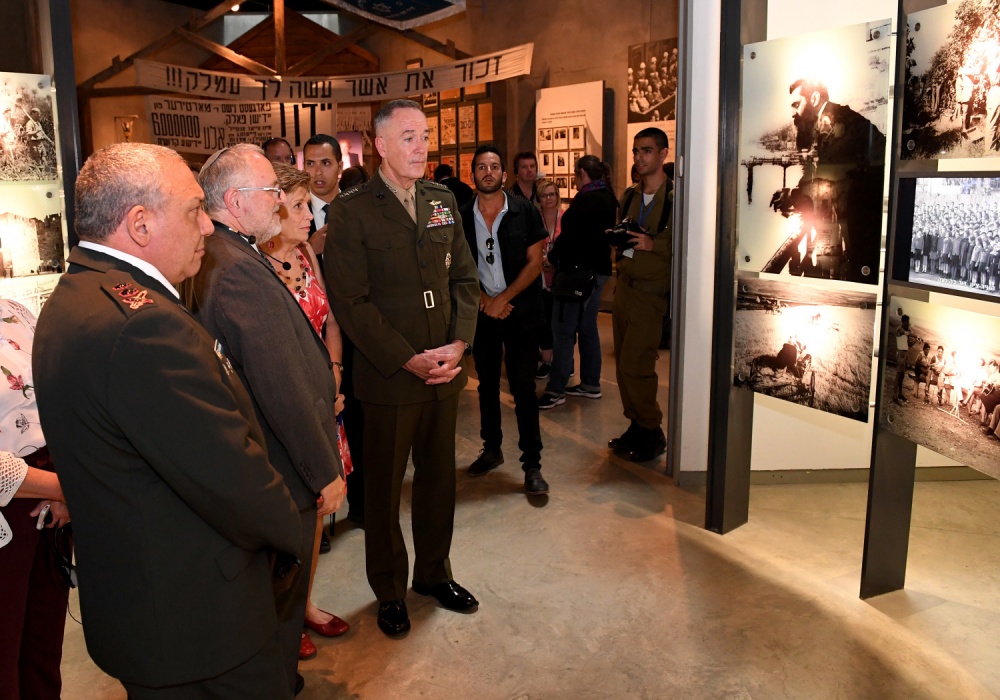
CJCS General J. Dunford tours Yad Vashem Holocaust Memorial Museum May 9, 2017.
Tim Folger is the series editor for "The Best American Science and Nature Writing," and he writes a passionate plea for freedom of research, respect for the truth, and the need to heed reality. He compares attacks on science to events in Germany in the 1930s, when mobs of young men burned the works of scientists and Jewish writers considered blasphemous to the Nazis. Authoritarianism thrives when the free press, justice system and electoral process are threatened.
"One measure of the health of any modern society must be the degree to which it supports its scientists. A few days before I started to write this foreword, hundreds of thousands of people in dozens of cities across the country participated in the March for Science. It was an event at once inspiring and worrisome: inspiring because so many took a stand for rationalism ... worrisome because who would have thought that in the 21st century scientists and citizens would feel the need to gather in support of something so self-evidently valuable as unfettered scientific research?"
Hope Jahren joins a roster of other great science writers who have helmed the series since it began in 2000, among them: Oliver Sacks, Steven Pinker, Edward O. Wilson, Richard Dawkins, and another friend of Navy Reads, Mary Roach.

In Jahren's introduction to this volume, she jumps into a charge of "allegorizing human endeavors by way of plant biology," something that makes "Lab Girl" so personal and relatable. Jahren studies how extra carbon dioxide in the atmosphere helps some plants thrive, and she tests how much may be too much.

"Right here, right now, I'll suggest that the Internet is like carbon dioxide for science writers, who are themselves like plants, and that we are living in an unprecedented era of diverse and thriving journalism in the service of science – albeit one that could be cut off and mowed down if we don't actively value and defend it."

Sunday, December 9, 2018

New York Says What to Read. Wait, What?


Review by Bill Doughty

The trouble with a book that recommends 1,000 books for your bucket-list is this: What prism is the editor/compiler looking through.

"A Thousand Books to Read Before You Die" (Workman Publishing, 2018, New York, NY) is a beautiful book offering an impressive spectrum of colorful titles and great authors.

You'll find great writers and thinkers like Isaac Asimov, Ulysses S. Grant, Maya Angelou, Stephen J. Gould, George Orwell, Mark Twain, Leo Tolstoy, Oliver Sacks, Homer, Dorothy Parker, D.H. Lawrence, J.K. Rowling, Jon Krakauer and Agatha Christie.

There are a relative handful of selected books that would appeal to Navy readers, including Tim O'Brien's "The Things They Carried," Tom Clancy's "The Hunt for Red October," Erich Maria Remarque's "All Quiet on the Western Front," "The Personal Memoirs of Ulysses S. Grant," Shelby Foote's "The Civil War," Robert Hughes's "The Fatal Shore," William Manchester's "Goodbye Darkness," John Keegan's "The Face of Battle," David McCullough's "Truman," David Halberstam's "The Best and the Brightest," Herman Melville's "Moby Dick," Ernest Hemingway's "The Old Man and the Sea," Kurt Vonnegut's "Slaughterhouse Five," Joseph's Heller's "Catch-22" and Orson Scott Card's "Ender's Game":
"...Just try to put it down. Tracing Ender's path to Battle School – a space center in which the best and the brightest children are trained for high-tech war – and, ultimately, to Command School, on the edge of the interstellar front lines. Orson Scott Card's novel is riveting... Ender's fierce initiation reveals his unparalleled gifts for warfare. As the stakes mount, the simulated battles he dominates are transformed from complex and dangerous games into sinister – and spectacular – realities."
Author James Mustich features his one thousand books, mentions many others and merely names a slew of extras. In other words, there are thousands of books discussed in this readable, interesting and hefty offering: a beautiful book about books.

So, what's the problem?

BM3 Ivan Naranjo reads aboard USS Anchorage (LPD 23), 2018. Photo by MC3 Ryan M. Breeden
As great as this book is, the personal lens of the editor understandably distorts reason, trumps objectivity, and begs questions as to how some of the authors and their works were selected. 

I mean, Anne Rice? Moss Hart's show business autobiography? Richard Ford's adventures in making artisan bread and pizza? "Adventures on the Wine Route: A Wine Buyer's Tour of France"? "When French Women Cook"? "Between Meals: An Appetite for Paris"? "The Auberge of the Flowering Hearth"? 

Mustich, a New York bookseller with an apparent deep love of fashion, fine dining, Broadway, the Big Apple, Provence and France, all but admits his bias and certainly is upfront about his selections not being perfect. "Hot dogs to haute cuisine," as he says. But if comfort foods of literature are allowed, where are Edgar Rice Burroughs, Mario Puzo, Louis L'Amour and Zane Grey?

Stephen King gets "Carrie" and "11/22/1963," but where are "The Stand," "The Shining" and "Cujo"?


William Shakespeare
As one would expect from a polished bookseller, this is like a bookstore readers can hold, complete with a detailed general index and 1,000 book checklist.

Overall, Mustich does a pretty good job of ensuring diversity, including different age groups and interests – both fiction and non-fiction; poetry and philosophy; youth and adult; U.S. and international; escapist and pay-attention-this-is-important.

The Bhagavad Gita, Bible and The Book of Job find themselves co-located, thanks to alphabetical listings, as are Plato, Pliny the Younger and Plutarch. Shakespeare is the overall winner in number of works listed, with 13 titles.

Nice surprises include personal favorites such as Gould's "The Panda's Thumb," Loren Eiseley's "The Immense Journey," Larry McMurtry's "Lonesome Dove," Richard Dawkins's "The Selfish Gene," "Portable Dorothy Parker," Taylor Branch's "Parting the Waters," "Narrative of the Life of Frederick Douglass, an American Slave," Carl Sagan's "Dragons of Eden," Edward O. Wilson's "The Naturalist," and Charles Darwin's "The Voyage of the Beagle."

Thankfully there's a heavy helping of science, including Thomas's wonderful collection of essays, "The Lives of a Cell":
"Every genre has its native charms, and the allure of the essay is its easy way with rumination. In the best examples of the form, the essayist communicates not just learning, but thinking, inviting the reader to share the satisfactions of a mind at play on a field of observation or experience. When an essay's author is as masterful as Lewis Thomas, it can shine like a jewel, glittering with truths small and large."
But where are shining lights by Christopher Hitchens, Steven Covey, Desmond Morris ("The Naked Ape"), John Hersey ("Hiroshima"), Thomas Paine ("The Age of Reason"), Steven Pinker, William Zinsser, Mary Roach, Craig Symonds, Jared Diamond, Nathaniel Philbrick, Erik Larson, James D. Hornfischer, Hector Hugh Munro a.k.a. Saki, Doris Kearns Goodwin, Thomas Friedman, Noah Yuval Harari and Stephen Hawking?

It's a tragedy that Mary Roach and Hope Jahren ("Lab Girl") are missing.

So many great authors are left on forgotten shelves, so many books. It can be difficult to choose any individual one. That's where a book like this can help. Perhaps there will be more versions of "1,000 Books to Read" – even someday "1,000 Navy Books to Read."

Bazelon, Richardson and Plotz of Slate's Political Gabfest.
This book first came to my attention after hearing it recommended by David Plotz, anchor of Slate Magazine's Political Gabfest podcast with Emily Bazelon and John Richardson.

Plotz said this about editor Mustich: "He's a reader of such joy and bouyancy. ... He has a real knack for recognizing what in a book is wonderful ... He's a spirit you'll want to spend time with."

And Plotz said this about the book itself: "Over 948 magnificent pages, well-illustrated. The familiar and the highly unfamiliar ... It's so much fun."

Gabfest's John Dickerson said, "So, does that make it a thousand and one?"

The best endorsement may be through the prism of writer, historian, producer Ken Burns: "If you've ever doubted that books were the greatest invention of all time, and that they carry within them our collective memories and dreams as well as any semblance of intelligence we have as a species, pick up this book and start reading."

Wednesday, August 21, 2019

Toni Morrison and War Against Error (and Fascism)

by Bill Doughty

Toni Morrison wrote:
"I think it is time for a modern War Against Error. A deliberately heightened battle against cultivated ignorance, enforced silence, and metastasizing lies. A wider war that is fought daily by human rights organizations in journals, reports, indexes, dangerous visits, and encounters with malign oppressive forces. A hugely funded and intensified battle of rescue from the violence that is swallowing the dispossessed." 
Those are Morrison's words in the essay "The War on Error," presented as a lecture in Edinburgh, Scotland, August 29, 2004, one year after the United States invaded Iraq in response to 9/11 – under the pretense that Saddam Hussein had weapons of mass destruction.

Toni Morrison, 1931-2019 (Photo taken by Timothy Greenfield-Sanders)
Morrison's essay is one of 43 works published in "The Source of Self-Regard: Selected Essays, Speeches, and Meditations," Alfred A. Knopf, 2019.

The book includes both poignant reflections and occasional musings about people, art/literature, nature, history and race from the winner of the Nobel Prize in Literature.

From another essay, "Racism and Fascism," published in The Nation in 1995 – nearly twenty-five years ago! Morrison writes about the warning signs and steps to fascism:
  1. Construct an internal enemy, as both focus and diversion.
  2. Isolate and demonize that enemy by unleashing and protecting the utterance of overt and coded name-calling and verbal abuse. Employ ad hominem attacks as legitimate charges against that enemy.
  3. Enlist and create sources and distributors of information who are willing to reinforce the demonizing process because it is profitable, because it grants power and because it works.
  4. Palisade all art forms; monitor, discredit or expel those that challenge or destabilize processes of demonization and deification.
  5. Subvert and malign all representatives of and sympathizers with this constructed enemy.
  6. Solicit, from among the enemy, collaborators who agree with and can sanitize the dispossession process.
  7. Pathologize the enemy in scholarly and popular mediums; recycle, for example, scientific racism and the myths of racial superiority in order to naturalize the pathology.
  8. Criminalize the enemy. Then prepare, budget for and rationalize the building of holding arenas for the enemy – especially its males and absolutely its children.
  9. Reward mindlessness and apathy with monumentalized entertainments and with little pleasures, tiny seductions: a few minutes on television, a few lines in the press; a little pseudo-success; the illusion of power and influence; a little fun, a little style, a little consequence.
  10. Maintain, at all costs, silence.
Morrison writes, "In 1995 racism may wear a new dress, buy a new pair of boots, but neither it nor its succubus twin fascism is new or can make anything new. It can only reproduce the environment that supports its own health: fear, denial and an atmosphere in which its victims have lost the will to fight."

Fascism can come from the left or right, liberal or conservative. "We must not be blindsided" by different labels for "domination agendas," Morrison writes, "because the genius of fascism is that any political structure can host the virus and virtually any developed country can become a suitable home." It's not about ideology, she contends, it's about power.

Signs of fascism as evidenced by the White Power movement and White Nationalism.
Can it happen here? Are we susceptible to what she calls "the forces interested in fascist solutions to national problems"? Do those forces try to make us see immigrants and nonwhites as the Other, worthy of contempt, fear and hate? Will we counter those forces with greater emphasis on education and critical thinking? That's at the heart of Morrison's works and a reasoned response to a "war on error." 

Here's something she wrote about migration, eight months after the attacks of 9/11 (from "The Foreigner's Home" – presented in the Alexander Lecture Series, University of Toronto, May 27, 2002): 
"The spectacle of mass movement draws attention inevitably to the borders, the porous places, the vulnerable points where the concept of home is seen as being menaced. by foreigners. Much of the alarm hovering at the borders, the gates, is stoked, it seems to me, by 1) both the threat and the promise of globalization; and 2) an uneasy relationship with our own foreignness, our own rapidly disintegrating sense of belonging."
President Obama presents Toni Morrison with the Presidential Medal of Freedom in 2012.
After Morrison's death at 88 earlier this month, former president Barack Obama said, "Toni Morrison was a national treasure. Her writing was not just beautiful but meaningful — a challenge to our conscience and a call to greater empathy." 

He continued: "And so even as Michelle and I mourn her loss and send our warmest sympathies to her family and friends, we know that her stories—that our stories—will always be with us, and with those who come after, and on and on, for all time."

The former commander-in-chief began publishing his reading lists during his presidency and continues the tradition. On Aug. 15, Obama shared a list of recommended summer reading books, beginning with the works of Toni Morrison. 

"To start, you can't go wrong by reading or re-reading the collected works of Toni Morrison," he wrote. "'Beloved,' 'Song of Solomon,' 'The Bluest Eye,' 'Sula,' everything else — they're transcendent, all of them. You'll be glad you read them," Obama said.

Here are other books recommended by Obama this year:
"Lab Girl," by Hope Jahren"The Shallows," by Nicholas Carr"Inland," by Téa Obreht"American Spy," by Lauren Wilkinson"Wolf Hall," by Hilary Mantel"Exhalation," by Ted Chiang"Maid," by Stephanie Land"How to Read the Air" by Dinaw Mengest"Men Without Women" by Haruki Murakami"The Nickel Boys" by Colson Whitehead
CNO Richardson meets with future CNO Gilday in 2017.
Reading promotes critical thinking. And preventing another War on Error requires critical thinking. 

Tomorrow, Aug. 22, Adm. Mike Gilday is scheduled to become the new Chief of Naval Operations, as Adm. John Richardson steps down. During his tenure Richardson has championed reading and thinking. "Remember to never stop striving to expand your mind," he advised on the Navy Professional Reading Program site.

"Warfare is a violent, intellectual contest between thinking and adapting adversaries. The team that can think better and adapt faster will win," Richardson said, adding, "...we must do more to sharpen our thinking, learn the lessons from history, and expand our minds. It is our responsibility as leaders to continue to grow and to always question the status quo."


Sunday, April 23, 2017

Accelerating Change: How to Survive and Thrive

Review by Bill Doughty

The Navy operates in an age of acceleration in a "post-post-Cold War" era. Scientists show we're moving headlong from the Holocene into the Anthropocene, where human population growth, globalization, climate change, and loss or biodiversity are forcing change at exponential speed, and where the United States, China and Russia continue to compete for influence and resources. Meanwhile, Islamist extremists like ISIS coalesce and threaten thanks to social networking and cell phone technology.

That's some of the scene Thomas L. Friedman sets in his latest, "Thank You for Being Late: An Optimist's Guide to Thriving in the Age of Accelerations" (Farrar, Straus and Giroux, 2016). Friedman is author of "From Beirut to Jerusalem," "The World Is Flat," "Hot, Flat, and Crowded," and "That Used to Be Us."
Globalization affects the interconnected economies of the world. Carbon (now above 400 ppm) causes changes in the atmosphere and biosphere. And Moore's law explains how technology grows exponentially. Combined, these forces bring us to either a precipice or a new beginning – a chance for the United States and the world to "reimagine how we stabilize geopolitics," according to Friedman.
Three-time Pulitzer Prize winning journalist/author Thomas Friedman speaks to a packed auditorium
 in Ingersoll Hall, Naval Postgraduate School, June 24, 2016. (Photo by Michael Ehrlich)
"It's important to remember that America is such an important player on the world stage that even small shifts in how we project power can have decisive impacts. And it's this combination of shrinking American power in one part of the world plus the reshaping of the world more broadly by the accelerations in the Market, Mother Nature, and Moore's law that defines the era we are in today, which I call the post-post-Cold War world. It is a world characterized by some very old and some very new forms of geopolitical competition all swirling together at the same time. That is, the traditional great-power competition, primarily among the United States, Russia, and China, is back again (if it really went away) as strong as ever, with the three major powers again jockeying over spheres of influence, along golden-oldie fault lines such as the NATO-Russia frontier or the South China Sea. This competition is propelled by history, geography, and the traditional imperatives of great-power geopolitics, and is reinforced today by the rise of nationalism in Russia and China. It's contours will be determined by the balance of power between these three big nation-states."
As evidence of exponential acceleration of change, Friedman presents the work of Will Steffen published in Anthropocene Review, March 2, 2015, that concludes, "We are now in a no-analogue world." The danger is in how we've (1) breached, (2) almost breached or (3) are about to breach "nine key planetary boundaries": climate change, biodiversity, deforestation, geochemical flows, ocean acidification, freshwater use, atmospheric aerosol loading, introduction of novel entities, and stratospheric ozone layer.


The latter boundary – ensuring the ozone layer is appropriately thick enough to reduce the threat of harmful UV radiation – is a success story and a sign of hope, according to Friedman. "After scientists discovered an ever-widening ozone hole caused by man-made chemicals – chlorofluorocarbons – the world got together and implemented the Montreal Protocol in 1989, banning CFCs, and, as a result, the ozone layer remains safely inside its planetary boundary of losses not greater than 5 percent from preindustrial levels."


Both Mother Nature and humankind can innovate and be highly adaptive, Friedman contends. Nature evolves through natural selection. Humans have the capability to learn, control and adapt their behavior if they have the knowledge, wisdom and will.

In growing acceleration within societies, we see examples of rapid changes. Typewriters are antiques (to be collected by Tom Hanks). Cassette players are now used as a quaint plot devices in movies like "Guardians of the Galaxy." The Confederate Flag came down in South Carolina after the shooting in Charleston in 2015. In recent years the U.S. military changed its attitude about lesbians, gays, bisexuals, and transgender people and their rights to equality. The future will reward resiliency and entrepreneurial adaptability.

Those who will survive and thrive during and after the great acceleration are those who embrace innovation, science and education, based on a bedrock of truth and trust, says Friedman. The future belongs to lifelong learners willing to constantly better themselves and unwilling to accept the average or mediocre.
"We have to make our newfound power of one, the power of machines, the power of many, and the power of flows our friends – and our tools to create abundance within the planetary boundaries – not just our enemies. But organizing ourselves to use them that way will require a level of will, of stewardship, and of collective action the likes of which we have never seen humanity display as a whole. Every day there are new breakthroughs in solar energy, wind power, batteries, and energy efficiency that hold out the hope that we can have clean energy at a scale and price that billions can afford – provided we have the will to put a price on carbon so these technologies can rapidly scale and move down the cost-volume curve. As environmentalists have often noted, we have been great at rising to the occasion after big geopolitical upheavals – after Hitler invaded his neighbors, after Pearl Harbor, after 9/11. But this is the first time in human history that we have to act on a threat we have collectively made to ourselves, to act on it at scale, to act before the full consequences are felt, and to act on behalf of a generation that has not yet been born – and to do it before all the planetary boundaries have been breached."
While Friedman is optimistic, he's also realistic. Rapid acceleration and globalization is a double-edged sword.
"Globalization has always been everything and its opposite – it can be incredibly democratizing and it can concentrate incredible power in giant multinationals; it can be incredibly particularizing – the smallest voices can now be heard everywhere – and incredibly homogenizing, with big brands now able to swamp everything anywhere. It can be incredibly empowering, as small companies and individuals can start global companies overnight, with global customers, suppliers, and collaborators, and it can be incredibly disempowering – big forces can come out of nowhere and crush your business when you never even thought they were in your business. Which way it tips depends on the values and tolls that we bring to these flows."
Recent headlines and scandals about online misbehavior show the challenge to leaders in the accelerating world Friedman describes.
"It turns out that social networks, cheap cell phones, and messaging apps are really good at both enabling and impeding collective action. They enable people to get connected horizontally much more easily and efficiently but they also enable individuals at the bottom to pull down those at the top more easily and efficiently – whether they are allies or enemies. Military strategists will tell you that the network is the most empowered organizational form in this period of technological change; classical hierarchies do not optimize in the flat world, but the network does. Networks undermine command-and-control systems – no matter who is on top – while strengthening the voices of whoever is on the bottom to talk back. Social media is good for collective sharing, but not always so great for collective building; good for collective destruction, but maybe not so good for collective construction; fantastic for generating a flash mob, but not so good at generating a flash consensus on a party platform or a constitution."
A U.S. Navy EA-6B Prowler refuels in Operation Inherent Resolve mission March 20, 2017,
an extended fight against ISIS. (Photo by Senior Airman Joshua A. Hoskins)
Speaking of double-edged swords and "collective destruction"... Misplaced values in the name of what some call a deranged interpretation of Islam and the Koran is at the heart of radical extremists like Daesh/ISIS/ISIL and similar groups that form a "diffuse movement," one that can best be defeated by other Muslims standing up to the death cults, Friedman shows. Till then, the rise of the terrorists has created a "new balance of power."
"During the Cold War, if you wanted to assess the global balance of power you would likely look at the annual survey "The Military Balance," published by the London-based International institute for Strategic Studies, and self-described as the most 'trusted military data on 171 countries: size of armed forces, defense budgets, equipment.' That book would tell you the relative strengths of their armies, navies, and air forces (their hard power), and their 'soft power': the relative strengths of their economies, their societal appeal, and the degree of entrepreneurship in their culture. And if you added up all those numbers, you would have a rough measure of the balance of power between different nation-states. Not anymore. Assessing today's balance of power requires a much wider lens."
Trees grow tall in suburbs in Minnesota, anchoring Friedman's optimism.
Getting to that wider lens requires us to not act like the proverbial frog being slowly boiled and lulled into unconsciousness (put a frog in boiling water and it jumps out; put it in cool water and gradually raise the temperature, and the frog might not act till it's too late). "We are hardwired to consider nature limitless because for so many years nature seemed so limitless – and we were so relatively few and so relatively light a force upon it; how could it be that we cannot devour as much as we want." 

Friedman tells a great story about his encounter with a parking lot attendant (and blogger) at the beginning of "Thank You for Being Late." Throughout the  book he enlightens us with topics as diverse as in Syria, artificial intelligence, Madagascar, Hadoop, generative design, and Brandi Carlile, among dozens of others.

He concludes this book with a personal and heartfelt story about his "anchoring" roots, symbolized in the trees he remembers in his hometown of St. Louis Park, Minnesota.
"Those trees and I had both grown up and out from the same topsoil, and the most important personal, political, and philosophical lesson I took from the journey that is this book is that the more the world demands that we branch out, the more we each need to be anchored in a topsoil of trust that is the foundation of all healthy communities. We must be enriched by that topsoil, and we must enrich it in turn."
During a recent visit to Joint Base Pearl Harbor-Hickam, geobiologist and author Hope Jaren ("Lab Girl") invited us to think about how plants – seeds, roots, trees, etc. – are depicted and reflected in books. Of course that came to mind in reading the last few pages of Friedman's latest must-read. Highly recommended.

For more on how the Navy must operate in a rapidly accelerating world, branch out and read the CNO's "Design for Maritime Superiority."