Showing posts with label Australia. Show all posts

Friday, August 11, 2023

Found Haiku in 'Believer'

Review by Bill Doughty––

Did the pilot encounter a UFO before losing contact with air traffic control? What do people, including his fiancé, believe happened to Frederick Valentich on Saturday, October 21, 1978, over Bass Strait, Australia? And what did Valentich report he saw and experienced just before his transmission cut off, the pilot never to be heard from alive again?


It’s one of the true stories explored by master writer Sarah Krasnostein in “The Believer: Encounters with the Beginning, the End, and Our Place in the Middle” (Tin House, 2022).

In “The Believer” we meet UFOlogists, an abuse survivor who hired a hitman, members of a Mennonite choir who perform in a New York subway, a “death doula” who helps individuals and families, ghost hunters who search for evidence in haunted places, a geologist who wants to believe the earth is 6,000 years old, and others following and sharing their beliefs. Throughout, Krasnostein presents characters in ways that make us care about them. The sometimes floating, sometimes strobe-like stories are often deeply painful but always thought-provoking, poetic and profound.


Her writing unfolds the biggest of issues: life, death, hope, reality, existentialism.


“From the absurdity of our deepest paranoias to the radical coherency of our highest art, we are compulsive converters of fact into meaning.”


UAP screen shot by a naval aviator (U.S. Navy)
She visits the Creation Museum in California, discusses the cantina scene in Star Wars, shares the beauty of Wynton Marsalis’s “Canon for Three Trumpets and Strings,” and considers the science of oneness and shared atoms with religious fundamentalists, noting, “…they believe I am going to Hell, and I believe they may already be living in one…”

This is a book of fascinating encounters and deeply personal contemplation.


As if taking a book from a library shelf, Krasnostein quotes works by great minds such as Hanna Arendt and her “warning against mistaking knowledge for thought, and truth for meaning;” Haruki Murakami who contemplates “existential reality of nonexistence;” and Martin Rees’s observation that “absence of evidence is not evidence of absence” (now pertinent to discussion of Unidentified Aerial Phenomena, including recent revelations by U.S. military pilots and former naval aviators).


She spotlights Alvin Toffler, author of “Future Shock,” who in 1970 identified “the dizzying disorientation brought on by the premature arrival of the future.”Midway in the last century telephones were just for calling people. Computers were the size of large rooms. TVs had three channels –– all black-and-white, mostly white. 


Krasnostein writes about some of the people in their early sixties and late fifties who experienced Toffler's future shock: “Over the span of their lives to date, LP records disappeared and then cassettes. Reel-to-reel, Beta, VHS. Carbon copies, typewriter ribbons. The black tongue of film inside a camera, every frame precious.”


Ahhh, an unexpected “found haiku” –– a five-seven-five-syllable stanza of words. Poignant. Exquisite. Unintentionally a poem:


…ribbons. The black tongue

of film inside a camera,

every frame precious


Other found haiku emerge as we read Krasnostein’s investigation of religion, alien abductions, and other beliefs.


She investigates UFO sightings, events, and conspiracies in Australia, including the Westall event of 1966. She visits with a sect of fundamentalist Christians in their homes and at their services, including in the dead of winter. She befriends a dying woman and her family, who allow her to share in the process of saying goodbye. And she follows the life of a convicted repentant murderer who helps homeless people stay alive.


Some found haiku in "The Believer":


Green-white flash moving

extremely quickly across

the sky. Metallic…


Over long winters

of short days when nothing thawed

or melted away


The railing is iced

with a thin line of fresh snow

as I climb the stairs


Through which a chill wind

blew: grief frustration closer

to strangulation


Inside, I add my

wet Nikes to the dozens

of similar pairs
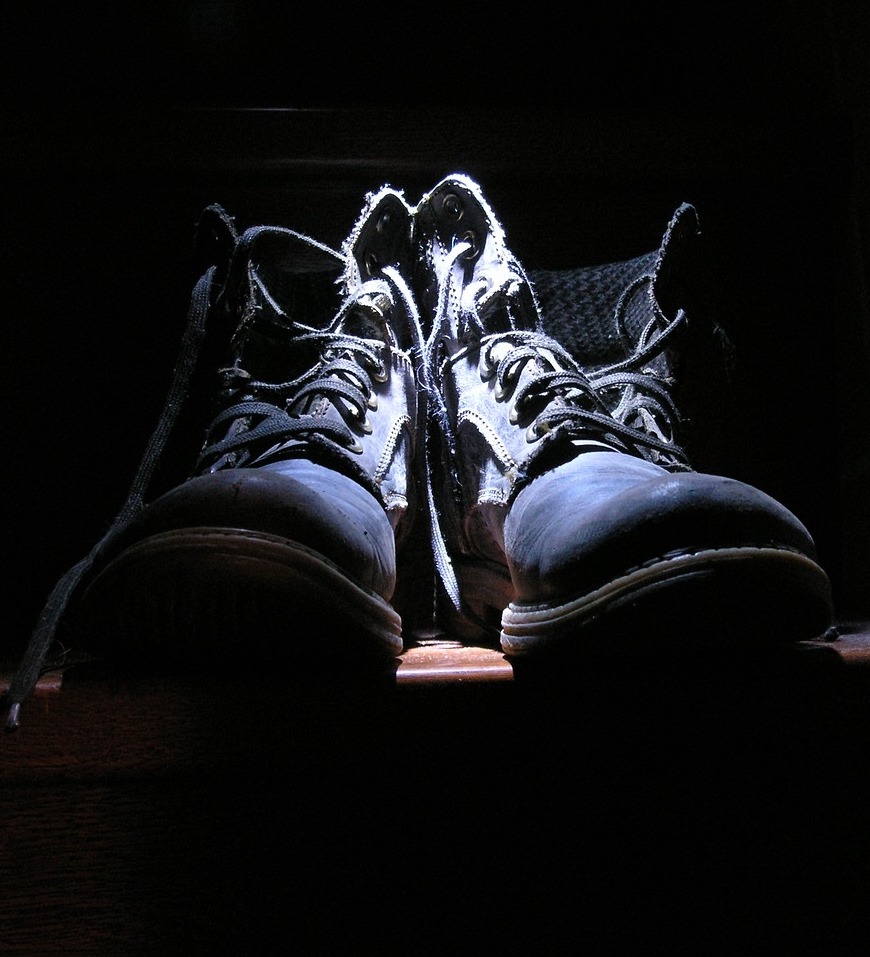

On the sofa where

they lean towards each other like

a pair of old boots


Air is cold through the

clean pane as he looks up at 

the blackness he knows


Of the clock face laid

bare as each hour came once, and

vanished forever


Salting of stars so

thick it reminded me we

are floating in space


How close the remote

past is: we live inside it

the light is the same


Self … rumination

carving neurological

tracks deep as canyons


Krasnostein examines the choices we make in our noble but vain attempt to find answers to every question. She sees how some believers accept certain inevitabilities. Reaching for more books, she cites other authors and thinkers, including Elizabeth Kübler Ross, Stephen J. Gould, George Orwell, Charles Darwin, James Baldwin, Ralph Waldo Emerson, and Jorge Luis Borges. Borges imagined Paradise “as a kind of library,” one that Krasnostein contemplates visiting.


“...I always imagined that library as an Eden where all the operating instructions are filed. Not only all the books ever written, but also each of our stories: the past meeting the future, everything indexed and logically related, a return to when the world was as seamless and whole as an apple. I suppose this reflected a belief in the world as a certain kind of text; a faith that, if I could only ask the right questions, I could finally understand.

“To believe in the world as this type of text is to believe that all lives –– regardless of whether they resolve happily –– make sense. To have faith in context and causation. To insist that people for the most part are intelligibly coherent in the sense of being predictably inconsistent and that they are capable, within reasonable bounds, of incredible insight and meaningful growth as they learn, painfully, to bend themselves around reality instead of expecting reality to miraculously bend itself around them.”


To have such an exquisite belief about people, she says, is just wrong. But adds, “what other choice do we have?”

Hannah Arendt is a touchstone in "Believer." Especially Arendt's "The Life of the Mind" "in which she explored the powers and limitations of our cognitive function. Arendt believed that every civilization is founded on the capacity to ask unanswerable questions. Krasnostein says, "In other words, our social survival –– even our physical survival –– is bound up with our spiritual survival and it might rely, as a matter of first principles, more on the aspirations underlying our questions and our ability to tolerate uncertainty than on our proficiency at defending solutions just for the sake of having them."

Could it be that commonality in our very atoms and shared place in space and time here "in the middle" is more profound than superficial differences –– despite indoctrination, amygdala influence, and ego issues?

I couldn’t help but notice that the subtitle of this wonderful book is, itself, a found haiku:


Encounters with the

beginning, the end, and our

place in the middle


(We have featured Navy Reads posts with other found haiku over the years, including from President Abraham Lincoln and Senator John S. McCain.)

Friday, April 22, 2016

The Worst and the Best – of the Pacific

Review by Bill Doughty

Tragedy and triumph. "Collision" and cooperation. War and Peace. 

Simon Winchester, author of "Atlantic," explores the yin and yang of the world's biggest ocean in "Pacific: Silicon Chips and Surfboards, Coral Reefs and Atom Bombs, Brutal Dictators, Fading Empires, and the Coming Collision of the World's Superpowers" (2015, HarperCollins). "Pacific" is a great read for Earth Day.

Winchester's clear-eyed assessment ranges from atmospheric testing of nuclear weapons, garbage gyres, el Niño and the "Ring of Fire" to the joys of surfing in a book he calls "a description of the modern Pacific Ocean" that begins at the end of the Second World War.

Japan rose from the ashes of Hiroshima and Nagasaki to become an innovative and inventive world power, creating the transistor and transforming business. The Japanese people rejected an authoritarian military-controlled government to "display a mettle quite unimaginable in its scope, heft, and range" in the Pacific theater:
"In those first months after the surrender, the country was gripped by a spasm of self-repair, of make-do and mending, of precipitous institutional about-faces and adaptations. Factories that had weeks before been making war materials switched their production lines to start making items needed not by generals and admirals, but by the bone-tired civilians and by the ragged menfolk returning from the battlefields. So bomb casings became charcoal burners, sitting neatly upright on their tail fins and helping households get through that first bitter winter. Large-caliber brass shell cases were modified as rice containers, while tea caddies were fashioned from their smaller shiny cousins. A searchlight mirror maker turned out flat glass panes to repair thousands of smashed Tokyo windows; and for country dwellers, a fighter plane engine piston maker turned his factory to building water pumps. A piston ring fabricator named Soichiro Honda took small engines used during the war as radio generators and strapped them onto the frames of Tokyo's bicycles – the resulting Bata-Bata motorcycles, the name being onomatopoeic, later evolved into a brand of bike still famed from 1950s Japan as the Dream. Its popularity and commercial success heralded the birth of today's automobile giant, the Honda Motor Company."
Supercyclone Tracy bears down on Darwin, Australia in 1974.
The end of empires casts a long shadow in this book: Imperial Japan and especially the British Empire – and how the monarchy's influence faded in Hong Kong and Australia.

Darwin, Australia becomes a focal point in a discussion about Pacific storms and the effects of global climate change. "During the war, more Japanese bombs rained down on Darwin than on Pearl Harbor," Winchester writes. But when Supercyclone Tracy turned from the sea toward Darwin on Dec. 25, 1974, it destroyed 80 percent of the city. "There has never been a more dreadful and destructive event in recorded Australian history."

Winchester mentions how the Joint Typhoon Warning Center in Hawaii tracks storms in the Pacific, including Typhoon Haiyan in 2013, which "devastated much of the Leyte Gulf region of the southwestern Philippines." 


Northern Lights seen in ICEX 2016. Photo by Aerographer's Mate 2nd Class Zachary Yanez
He quotes former U.S. Pacific Commander Adm. Samuel Locklear III, who, three months before Haiyan, said changes in the climate were causing increased typhoon activity. "Significant upheaval related to the warming planet is probably the thing most likely to happen ... and that will cripple the security environment," Locklear said. "Probably that will be more likely than the other scenarios we often talk about."

Winchester discusses coral bleaching, first seen on the Great Barrier Reef in late 1981, "under threat from a rise in sea temperature and acidity." He also describes the Pacific garbage patch, effects of plastic pollution on birds, efforts to stop overfishing, and rising sea levels in Kiribati.


Staff Sgt. Skinowski from the 3rd Tactical Fighter Wing watches Mt. Pinatubo eruption, June 1991.
The explosion of Mt. Pinatubo, accompanied by a devastating typhoon in 1991, is described as a pivotal moment in the history of the region. Winchester reports how the USS Midway (CV 41) and USS Abraham Lincoln (CVN 72) were diverted to the Philippines to help with evacuation and recovery (Operation Fiery Vigil) and of the vacuum created by the loss of Clark Air Force Base and Subic Naval Base.

The U.S. Navy figures prominently in "Pacific," from the USS Pueblo incident with North Korea in 1968 at the height of the war in Vietnam and during the Cold War to deployment of littoral combat ships today to Singapore. 

Winchester shows how the border for North Korea was created by a grease pencil on a National Geographic map early in the Cold War and what that meant for those affected by the "wretched annoyance" of the "pariah state."


Exploring with science and helping try to understand the origins of life: HOV Alvin.
The author takes us aboard the Navy-commissioned, civilian-operated Human-Occupied Vehicle HOV Alvin, a submersible that made a startling discovery 39 years ago.
"On a Thursday morning in mid-February 1977, this doughty miniature research submarine, so precisely engineered and so heavily armored as to allow three explorers to be brought down into the ocean deeps and then drive safely back to the surface, was lowered into the warm blue waters of the eastern Pacific for the 713th logged dive of her career. What she would find later that day, in the abyssal gloom almost two miles down, would laser-etch her name into oceanography's history books as having made perhaps the greatest maritime discovery of all scientific time. For she discovered down in the dark a whole new undersea universe, a previously unimagined dystopia of crushing pressures and scalding temperatures, of curious topography and even more curious life-forms, all gathered around a family of hitherto unknown phenomena that were immediately named for the gaseous torrents that they spewed ceaselessly out into the sea. Alvin, on that midwinter's day in 1977, first discovered the existence of what were to be called deep-ocean hydrothermal vents, gushings of gas and superheated water in places where all was believed to be cold and dark and dead."
The Navy, with Woods Hole Oceanographic Institution aboard Alvin, had discovered new forms of life that existed through chemosynthesis, providing "information about the origins of life itself."

While he focuses primarily on the United States, Japan and Australia, Winchester presents an enlightening discussion about China and it's "new Great Wall" at sea, saying the founding of the People's Republic "would eventually turn the Pacific into a cauldron of contention," challenging ships in international waters with claims of sovereignty.
"And still the contagion spreads, and becomes ever broader. In recent years, China's dominance of the South China Sea has been followed by attempts to impose similar hegemonic control over the East China Sea. A long-standing claim made by the Chinese to the disputed Diaoyu Islands, an uninhabited cluster northeast of Taiwan that the Japanese have long called the Senkaku Islands, was suddenly backed up in 2013 when the Beijing government declared the airspace overhead a restricted area, and demanded that all aircraft, civilian and military, report and seek permission before entering it."
Past and future. Destruction and renewal. Fear and hope. Symbolism and stark reality. The yin and yang of "Pacific" rides on warships and surfboards.

Through the words of Jack London and Mark Twain and his own storytelling, Winchester introduces us to surfing icons George Freeth, Hobie Alter and Duke Kahanamoku – "a swimmer to beat all and a surfer to crown all, and if not the father of surfing ... its greatest of ambassadors, to America and beyond." His writing about the sport comes alive:
"The Pacific is a liquid place, and on most of its inhabited coastlines this liquid is warm and ultramarine and inviting. It is also by its very nature ceaselessly in motion. For centuries native peoples who lived on many of the islands of the ocean's tropical interior have made great use of all this motion in ways that provided them with the purest joy imaginable. they rode out on long wooden boards through the beachside surf and spume and waited, floating, for a wave to lumber in from the ocean, and then stood up on the boards, toes gripping the leading edge, and from the wave's summit crest, rode the boards down its steep green face, all the way back into shore."
The love for the sea becomes transcendent and expansive in "Pacific's" epilogue, "The Call of the Running Tide," as he describes the "duty of humanity" for Malama Honua, "to care for our island Earth." Malama Honua. That's the name of the three-year worldwide voyage of traditional waʻa, or sailing canoe, Hōkūleʻa, sailing with, as Winchester points out, "No compass. No extant. No radar. No radio. And certainly no GPS."
"They have left the Pacific behind. The crew have now to divine their way across seas – the Indian Ocean, the Mediterranean, the Atlantic Ocean, the Caribbean Sea – that are very different from their home waters. They will pass beneath skies and patterns of stars quite strange to them. Whether or not they succeed, those aboard all keenly believe that their simple attempt will serve as a powerful reminder of the sea's singular importance. That is what all on the boat and back in Hawaii believe lies at the heart of their venture. Malama Honua: that all should be urged to care for a body of water that nourishes every living thing on earth, that gave it life in the first place, and yet that is now wearily compelled to absorb all the excesses of the humans who live beside and around it."
Winchester concludes:
"It seems to me there is even more potent symbolism to the Hōkūleʻa's journey, symbolism that relates quite specifically to the ocean where the boat was born, where her crew members revived and then learned their skills, and from where she came to venture out to the rest of the planet. The Pacific occupies a unique position among the world's seas; the Hōkūleʻa's journey has served as a reminder of why."
At the end of this insightful book about the modern history of the Pacific, readers can be excused for wanting more stories from the author. But as one considers China, North Korea, global climate change – and the hopefulness of Malama Honua – history is still being written.

From www.Hokulea.com today:  "After arriving in Newport News on Friday, April 22, Hōkūleʻa will (be) celebrating Earth Day with the Mariners’ Museum at the James River Fishing Pier on Saturday April 23rd. Canoe tours will be available to the public from 10 am to 2 pm. Enjoy fun and engaging educational activities for families, learn about traditional Polynesian voyaging and wayfinding, and meet the crew of Hōkūleʻa."

Saturday, November 29, 2014

Haunting Defiance in 'Ship of Ghosts'

Review by Bill Doughty


In "Ship of Ghosts: The Story of the USS Houston, FDR's Legendary Lost Cruiser, and the Epic Saga of Her Survivors" by James D. Hornfischer (2006, Bantam Dell) the author takes readers to sea, to POW camps and into the jungle as he examines key chapters of World War II.


FDR aboard USS Houston 1935.
Ultimately, this book is about unspeakable horrors of war but also the triumph of the human spirit.

Hornfischer begins by showing why USS Houston (CA-30) was President Franklin D. Roosevelt's favorite ship and how FDR knew many of the crew by name. The president would go fishing with Houston's Sailors.

Then the author shows how Japan's search for natural resources fueled the start of the war and set the stage for Imperial Japan's ultimate downfall, despite earlier victories against America's ally China: "A failure of foresight and a shortage of materiél sealed their doom."

That need for oil and other resources continued throughout the war, as Hornfischer writes:
"It was all about China. A world war engulfed the Pacific because Japan had struggled to subjugate its mainland neighbor. Franklin Roosevelt's economic sanctions and oil embargo were punishment for Japan's assault on China, Asia's keystone in the economic world order. Japan's earliest offensives in the southwestern Pacific grew from is need for oil to pursue its war on the continent. Now Japan aimed to strangle China by cutting its essential lines of supply from India and Burma, kept open by threadbare British and American armies."
Japan's army, with its "rigidly hierarchical and ruthless system," where "conceit seemed to flow from the highest levels of the Japanese command," guided the government and justified actions based on ancient martial codes (Bushido) and religious dominion under a belief that the emperor was a descendent from heaven. Those who controlled the military believed God was on their side.
Hornfischer writes powerfully about the sinking of HMAS Perth and then USS Houston in the Battle of Sunda Strait off Java just as he did in "Last Stand of the Tin Can Sailors." We hear the wrench of metal, smell the smoke, see the destruction, feel the loss of equilibrium and experience the fear as Sailors fight and struggle to survive.

Sinking of USS Houston (CA-30) in the Battle of Sunda Strait, 1 March 1942.
Painting by Joseph Fleischman, 1950. Naval History and Heritage Command
Memorable characters include PFC John WIsecup, Cmdr. Arthur L. Maher, Sgt. James "Pack Rat" McCone, S1C Melfred "Gus" Forsman, S2C Otto Scwarz, Sgt. Frank Fujita, Dr. Henri Hekking, Col. Yoshitada Nagatomo, and Capt. Albert H. Rooks and his extended family, among dozens more.

Hornfischer describes life in the POW camps scattered throughout Asia, where "the trick to being in Japanese captivity was to navigate the divide separating subservience and defiance."

Among the stories of torture, disease and death are tales of survival and sabotage against the guards – from stealing supplies, urinating in the captors' bathwater, tampering with equipment and hiding a radio to more serious acts against the enemy at the Nagasaki shipyard and on the railway in Thailand. Hornfischer tells the true story of the construction of the railway for the bridges over Tamarkan and River Kwai – Kwae Noi Bridge.

"One of the traits the Americans seemed to have in common with the Australians was a boundless sense of the possible," according to Hornfischer. Two survivors, 2nd Lt. Roy E. Stensland and Pack Rat McCone, are described as having "a raging mind, mercury in the blood, and a visible unconcern with the personal consequences of rebellion."


Overall, those who had a positive attitude were more likely to survive the ordeal of captivity and the rigors of slave labor. One trick was to frame the experience as "endure" rather than "suffer." POW Frank Fujita saw an opportunity to study anatomy and contemplate life and death. Ray Parkin experienced "a naturalist's reverie" in the teak forest where he found that non-dogma "faith and hope are a couple of unclassified vitamins."
"Even as it tried to kill him, Ray Parkin was enthralled by the wilderness all around him, by the cool blue-green bamboo, by the slapping wings of Asiatic nightjars and hornbills, by the swarms of brownish butterflies, by 'hooded lilies, several iris-like orchids, wild ginger, and banana (which bears no edible fruit), clumps of orchids in the branches of trees like corsages of yellow jonquils. There are waves of perfume in the bush which we sometimes walk into. Cinnamon, chocolate, and one honey-sweet like clematis. Sometimes the early morning dew on the dry bamboo leaves smells like the Australian bush – or is it just nostalgia.' 
"Parkin's 'unclassified vitamins' were all around him, and his obsession to catalog them was the kind of force that gave a man a reason to stay alive. 'Vines are leaping with bright new green leaves a foot or so across. They are heart-shaped – some are like two hearts alongside each other. Trees are blossoming. One purple like lilac, and growing like a giant ti-tree ... There are more bird calls' monkeys call like Swannee whistles – flutelike on a slurred scale. All nature moves and has its bing, and we seem to sit on it like a scab.'"
Hornfischer's prose and choice of colorful quotes are at times artful imagery or – especially in the latter part of the book – careful chronology and documentation, preserving the memory and history of POWs from the War in the Pacific, where Pearl Harbor looms throughout the book and throughout the war as a beginning beacon for all of the war's ghosts.

During the war, in POW camps in Asia service members, treated like slaves, dealt with malaria, cholera, tropical ulcers, monsoons, snakes and primitive dental care – tree sap fillings!


Frequent beatings, abuse and unreasonable expectations, combined with inadequate food rations, were a way of life – and death. Their captors regularly violated the Geneva Convention by placing prisoners next to military targets or transporting them with materiél in "hell ships" subject to attack by American submarines. As the war neared an end the POWs feared they would be killed en masse by their guards.

In 1945 militarists in Japan tried to continue to fight on, still believing in Japan's divine destiny. But as the empire crumbled and B-29s leveled cities in the homeland, Imperial Japan found itself "choking to death on the fumes of the hemisphere-wide wildfire it had started three and a half years before."

Hornfischer proves why he is a favorite with navy leaders, historians and veterans, including Pearl Harbor survivor Ed Vezey. Filled with historical photos, first-source references and an extensive biography, but punctuated with colorful descriptions and vignettes, "Ship of Ghosts" is a top read for anyone interested in WWII history in the Pacific. Read my other reviews and a contribution by the author to Navy Reads.