Showing posts sorted by relevance for query jmsdf. Sort by date Show all posts

Saturday, December 23, 2017

Competitive Cooperation, Civilian Control – History of JMSDF

Sailors train Nov. 17 in Annual Exercise 2017 in the Philippine Sea. (Photo by MC2 J. Graham)
Review by Bill Doughty

How did the JMSDF come about, what is its role now, and what will the future bring for Japan's "nonmilitary" military? What is the value of civilian control of the military? These are some of the questions explored in Sado Akihiro's "The Self-Defense Forces and Postwar Politics in Japan" (2006, 2017, Japan Publishing Industry Foundation for Culture).

Strictly speaking, and in keeping with Japan's laws, the Self-Defense Forces in Japan have not been considered a military, according to Sado.

Vice Adm. Hoshina Zenshiro
Japan's aversion to the military and war is understandable, he explains, considering what the country went through under a military-controlled government that invaded Korea, China and Indochina and started a war with the United States in the last century.

Many Imperial Japanese naval leaders, unlike the army, were reluctant to start a war with the United States prior to 1941. 

After the war, with the help of the United States, Japan established a constitution, a democratic government and a free and open society built on international relations, competitive cooperation and commerce.

Veterans of the smaller, tighter Imperial Japanese navy maintained close ties after the war. Vice Adm. Hoshina Zenshiro, who had been director of the Navy Ministry of his nation's Bureau of Naval Affairs, took the initiative with a core group of former naval officers.

Working with Hoshina, America's military helped build the Japan Maritime Self-Defense Forces:
"One remarkable characteristic of the former Imperial Navy group's rearmament plan was its emphasis on the importance of relations with the United States. This group was foresighted enough to make Nomura Kichisaburo, who had been well connected with the U.S. military, the center of its efforts. As a result, such U.S. Navy leaders as Vice Admiral Charles Turner Joy, Commander Naval Forces, Far East; Chief of Staff Ralph A. Ofstie; and Deputy Chief of Staff Arleigh A. Burke, who later assumed the highest post in the U.S. Navy, chief of naval operations, became powerful supporters of the efforts by Nomura, Hoshina, and their associates. As eloquently revealed in Nomura's remarks to U.S. Secretary of State John Foster Dulles, who visited Japan for the peace treaty negotiations, that 'the most important foundation is the U.S.-Japan military alliance,' the Nomura group's emphasis on relations with the United States put the military alliance first. Moreover, when Hoshina briefed the Study Group on Rebuilding the New Japanese Navy plan to Arleigh Burke, one of the most outstanding Japan sympathizers in the U.S. Navy, he declared  that the new Japanese navy would be 'an object of cooperation with the United States Navy.' Thus, Hoshina revealed that the group was planning to build a navy that, within the framework of the U.S.-Japan military alliance, could collaborate with the U.S. Navy. It is an important point to be kept in mind that these ideas were at the foundation of the establishment of today's Maritime Self-Defense Force."
JMSDF CNO Adm. Yoshikawa (right) and then-Commander Naval Forces Japan Rear Adm. J. Kelly
salute Adm. Arleigh Burke at the U.S. Naval Academy May 16, 2007. (MCSN Chris Lussier)
Senior JMSDF leaders who visit the U.S. Naval Academy at Annapolis stop and pay their respects to Adm. Arleigh Burke. Ten years ago JMSDF Chief of Naval Operations Yoshikawa Eiji led a wreath-laying ceremony at Burke's gravesite at the academy's cemetery in 2007.

Sado introduces us to dozens of influential prime ministers and other officials who helped shape the self-defense forces over the years: Miki, Ohira, Nakasone, Mori, Hosokawa, Koizumi and Abe.

Under President Reagan and again under President Clinton ties between the two nations deepened especially in U.S.-Japan defense cooperation and support of Peacekeeping Operations (PKO).
"One thing to be pointed out first is the great role the MSDF played in U.S.-Japan defense cooperation. It can be said that the MSDF, which had been created and developed on the premise of joint actions with the U.S. Navy, well lived up to the U.S. Navy's expectations by exerting its capabilities in full. The cooperation between the U.S. and Japanese naval forces was so close that some diplomacy experts claim the essence of U.S.-Japan security cooperation to 'navy to navy' relations. This degree of closeness, however, also meant that MSDF activities regarding bilateral defense cooperation stood out starkly from the other branches of the JSDF. Truth be told, even with the Defense Agency, the defense of sea lanes was predominantly perceived as defense of shipping lanes ... It appears that the MSDF had gone ahead with substantive cooperation with the U.S. Navy to a degree beyond the inner bureau's assumption. It can be said that the MSDF was indeed engaged in defense cooperation with the U.S. Navy one step ahead of other branches of the JSDF."
We see how events shaped the JSDF, especially during and after the Cold War, Vietnam and the Gulf War. In modern Japanese history, the people of Japan have seen their self-defense services as being strictly defensive but able to respond to disaster relief and other humanitarian missions.


"Along with disaster relief activities, which became increasingly important for the JSDF after the Great Hanshin Earthquake in 1995, international cooperation has now become one of the most important post-cold war activities of the JSDF," Sado writes.
"Instances of the JSDF being dispatched overseas are likely to continue to increase. Nevertheless, there remains a risk that the JSDF's presence overseas may fail to receive as much high esteem from the international community as expected due to the numerous constraints on its activities and its lack of self-defense capabilities. The obstacles mentioned above to dispatching the JSDF still have to be overcome. Meanwhile, today dispatch of the JSDF overseas is no longer contained to PKO activities; nowadays the JSDF is mobilized to assist overseas anti-terrorist activities. Thus, it should be said that a limit has already been reached for Japan to continue to dispatch the JSDF in the same fashion as in the past."
The end of the Soviet Union signaled the end of the Cold War and what Japan saw as its greatest threat. But since then, new threats have arisen in the world. Because the bulk of this book was written prior to 2006, there is scant mention of the rise of nuclear threats from North Korea. Sado also lightly touches on the various controversies surrounding Okinawa ever since a rape incident occurred there in 1995, "although it is beyond the scope of this book on the JSDF." He does, however, devote considerable time on international terrorism and the ripple effects of 9/11 on Japan and the JSDF.

China's expansion and the nine-dash-line in the East China and South China Seas are examined in what Sado calls, "tenacious arguments with China."

In 2011 the JSDF proved its worth and gained a nation's respect for how it responded in the wake of the earthquake and tsunami that hit Fukushima. "The JSDF ended up playing an outstanding role at this time of crisis," Sado writes.

Researchers will be disappointed with the sparse index in this volume. On the positive side, this book presents a comprehensive history of the origins and development of the maritime force and has extensive appendices with a deeper dive into what's on the horizon for Japan's defense development and closer partnership with the Republic of Korea, Australia and other U.S. allies.
The Japan Maritime Self-Defense Force destroyer JS Ashigara (DDG 178), foreground, the Arleigh Burke-class guided-missile destroyer USS Wayne E. Meyer (DDG 108) and the Ticonderoga-class guided-missile cruiser USS Lake Champlain (CG 57) transit the Philippine Sea April 28, 2017. (MC2 Z.A. Landers)

As for the future of the JSDF, Sado discusses "The Modality of Security and Defense Capability of Japan: Outlook for hte 21st Century." And in Appendix I, he prints this from "National Defense Program Guidelines for FY2014 and Beyond," of Dec. 17, 2013:
"Japan will promote various initiatives to improve the global security environment on a regular basis in cooperation with the international community. Japan will continue strengthen various initiatives concerning arms control, disarmament, nonproliferation and capacity building assistance in order to respond to global security challenges, including regional conflicts, expansion and spread of international terrorism, failed states, proliferation of weapons of mass destruction and problems related to the sea, outer space and cyberspace, while regularly cooperating with its ally and relevant questions with which it shares security interests and with international organizations and other relevant bodies. In this respect, Japan will further strengthen its cooperation with the European Union (EU), North Atlantic Treaty Organizations (NATO), the Organization for Security and Co-operation in Europe (OSCE) and with the United Kindgom, France and other European countries and will work with them in responding to these challenges. Japan will also promote cooperation and exchanges with regard to equipment and technology with these countries and organizations."
JMSDF and U.S. Navy sailors meet at RIMPAC 2016. (MC1 Jeff Troutman) 
In fact, in the past decade the JMSDF earned key leadership roles in the Rim of the Pacific exercise, training with the U.S. Navy and international participants primarily in the waters around the Hawaiian Islands and building understanding and cooperation.

Appendix J is "The Guidelines for Japan-U.S. Defense Cooperation" of April 27, 2015 offering a "general framework and policy directions," strategies for strengthening bilateral cooperation, a commitment to "cooperation for regional and global peace and security" and a plan to contribute to space and cyberspace security.

After World War II, Japan reconstituted a national defense system – first called the National Police Reserve, then the National Safety Forces, before becoming the JSDF. As mentioned, Japan set up its democratic system of government (including its constitution) based on that of the United States – and under an important American concept: civilian control of the military.

"It seems beyond doubt that a system of civilian control that is suitable for the new age has to be explored," Sado opines. Nevertheless, a civilian government's control of the military is considered a war preventive, WWII being a case in point, in which the military controlled the governments in Japan and Germany. While there may be benefits in further integrating the three services, as Sado points out, there is a reason for a separation of military forces, just as there is in the branches of government – to protect a balance of power.


USS Carl Vinson (CVN 70), foreground, the Japan Maritime Self-Defense Force destroyer JS Ashigara (DDG 178), left, and the Japan Maritime Self-Defense Force Murasame-class destroyer JS Samidare (DD 106), back, transit the Philippine Sea April 26, 2017. The U.S. Navy has patrolled the Indo-Asia-Pacific routinely for more than 70 years promoting regional peace and security. (U.S. Navy photo by Mass Communication Specialist 2nd Class Sean M. Castellano)

Sunday, September 11, 2022

September Remember: USS Midway in Japan

by Bill Doughty––

I was attending school in Tokyo and living in Yokosuka in 1973 when USS Midway (CV-41) arrived in Yokosuka –– the first U.S. aircraft carrier to be stationed in Japan as part of the Forward-Deployed Naval Forces. It was a big deal, less than thirty years after World War II, and just months after the U.S. military departed Vietnam.


Midway was commissioned 77 years ago, Sept. 10, 1945, just eight days after Imperial Japan surrendered. Stationing the ship in Japan was hugely symbolic; Midway is named for the historic and pivotal battle in 1943 that turned the tide in WWII.


USS Midway (CV-41) arrives in Yokosuka, Oct. 7, 1973. Photo from Midway cruise book. (Ryo Isobe, DVIDS)
But that’s only one reason the carrier’s arrival in Yokosuka was opposed by many Nihonjin, sometimes violently.

Hundreds of Japanese citizens, loudly opposed to America’s war in Vietnam, came to Yokosuka in 1973 to protest the arrival of Midway.

I remember scores of demonstrators in headbands and helmets, faces covered, white-knuckled fists gripping bamboo poles. The demonstrators assembled by the Yokosuka JNR station and marched to the closed gates of the base. Japanese police in riot gear formed a human shield. Marine guards stood ready behind them. Some radical demonstrators attacked the police and were repelled with fire hoses.


Midway had been a recent (and repeated) participant in what was then called the Vietnam Conflict, a war for which the ship received the Presidential Unit Citation from President Nixon in early 1973.


Two years later, Midway would join with other ships of the U.S. 7th Fleet in Operation Frequent Wind, the evacuation of Saigon.


Three years after Midway’s arrival in Yokosuka, the United States celebrated its bicentennial, 1776-1976. By then, I was just out of college and contributing stories to the Seahawk base newspaper on my way to becoming editor and eventually a public affairs officer.

Early in its career, Midway participated in historic operations in the Caribbean, near the Arctic, throughout the Mediterranean, and in both the Atlantic and Pacific, including near North Korea.

Midway would go on to participate in various peacekeeping operations, including Operation Desert Shield and Desert Storm, after Iraq failed to obey a United Nations ultimatum to withdraw from its invasion of Kuwait.


Just as it did in the evacuation of refugees after the fall of Saigon, Midway played a key role with other ships in rescuing evacuees from the Philippines in Operation Fiery Vigil after the eruption of Mt. Pinatubo. That was in June of 1991.


I was still living in Yokosuka and working for the Navy when USS Midway departed Yokosuka for the final time in August 1991. The workhorse aircraft carrier was headed to retirement 31 years ago this month –– via Pearl Harbor, Seattle, and Bremerton –– eventually to San Diego.


USS Midway arrives in Pearl Harbor, August 23, 1991.
By 1991, more Japanese people came to realize the value of having a strong U.S. Navy presence, working cooperatively with the Japan Maritime Self-Defense Force to maintain freedom of the seas. 

Just as the United States Constitution was a model for Japan’s form of government, the United States Navy served as a model for the JMSDF –– with direct help and guidance from Adm. Arleigh A. Burke.


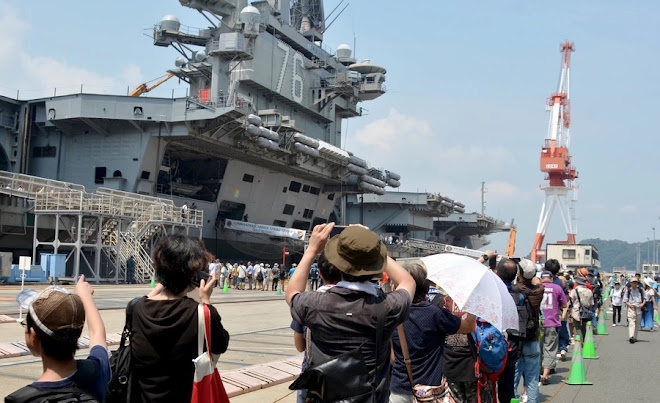
Over many years, Yokosuka has held hugely popular base open-house events, inviting tens of thousands of Japanese citizens onto the base to participate in games, enjoy food booths, attend concerts, and go aboard U.S. Navy ships.


The most popular draw at base open-house events? Tours of an aircraft carrier.


After Midway’s departure, other carriers followed its lead to become forward-deployed in Japan: USS Independence (CV-62), USS Kitty Hawk (CV-63), USS George Washington (CVN-73), and USS Ronald Reagan (CVN-76).


Japanese guests line up to board USS Ronald Reagan (CVN-76), October 10, 2015, during Yokosuka's Friendship Day open-base event. (MC1 Peter Burghart)

Open-base events were suspended for a time in the aftermath of attacks on the United States by religious zealots –– Islamist terrorists –– on September 11, 2001. (I remember the gates being locked down for weeks. Everyone who lived off base were required to park a few miles away and were offered rides to work or schools on base in carefully screened shuttle buses.)


In September 2003, USS Midway departed its temporary home of Bremerton, WA, to become a museum and memorial in San Diego. It welcomes an average of more than one million visitors per year. As with the USS Arizona Memorial in Pearl Harbor, many of the visitors to the USS Midway Museum include people from Japan who come to pay respect and learn about history.


Operation Sandy (Midway Museum Archives)
The museum offers a robust website highlighting the ship’s proud legacy, including operations in the Arctic, Taiwan Strait, and Vietnam, among others. I found some fascinating Midway photos available for download from Flikr, courtesy of the Museum. Some of the photos on the museum’s site include ringside views of Operation Sandy, the world’s first test-firing of a ballistic missile from a ship at sea.

There are numerous resources on the museum’s website, including videos and first-person accounts. This line stands out: “When history speaks, turn up the volume.”


In reading the history of the USS Midway, we can see the evolution of the modern Navy, from the immediate postwar, through the entire Cold War, and operations in Vietnam. But the ship is remembered most fondly, perhaps, for its role in helping people and promoting peaceful protection, especially for eighteen years in Yokosuka, Japan.


USS Midway’s strategic role in the Cold War, is a key part of James D. Hornfischer’s fascinating “Who Can Hold the Sea: The U.S. Navy in the Cold War, 1945-1960” (Bantam Books, 2022).


I have a two-part review of Hornfischer's final work posted in recent weeks. Hornfischer has been a favorite over the years. In May 2012, he offered a guest mini-review of five books he recommended to Navy Reads.


Sunday, March 27, 2022

A Goal for Women

Review by Bill Doughty––

I can only imagine the disappointment of the authors of this book, Ruth Margolies Beitler and Sarah M. Gerstein, for what they left out of their assessment of women in the world’s militaries.


Their “Women and the Military: Global Lives in Focus” (ABC-CLIO, LLC; 2021) is part of an ambitious series looking into issues such as health, violence, religion, sexuality, sports, education, technology, and more.


The goal of the series is spelled out in a foreword:

“The goal of the ‘Women and Society Around the World’ series is to depict the roles of women worldwide by exploring the major issues they face and the accomplishments they have made, especially in terms of bridging the gap in gender inequality and fighting for basic human rights. While readers will learn about the challenges that half of the world’s population face, they will also discover the empowering ways women succeed and overcome social and cultural barriers in their daily lives.”

The series and this contribution about the world’s militaries examines the “challenges, issues, and achievements women around the world face” in a still largely male-dominated world.

This book about the world's militaries is divided into eight regions: United States and Canada, Latin America and the Caribbean, Europe, North Africa and the Middle East, Sub-Saharan Africa, Central and East Asia, and Oceania. The authors admit that “exploring the role of women in militaries across the globe is a daunting task,” especially considering the depth, breadth, and diversity of nations and cultures.


Still, as good as this volume is, we can’t help but be dismayed about one country which has been left out. More on that in a moment.


First, let’s look at what’s really noteworthy. The authors conclude that “women are playing a larger role in militaries across the globe, but especially in the West.” Another conclusion: “When women have proven competent in their positions, and their male colleagues trust their abilities, the negative stereotypes connected to gender decrease.”


Culture change is occurring throughout much of the world as traditional roles for women change. Still, in many countries, it is forbidden for women to serve in the military.


But throughout Europe and in many international organizations, legislation dealing with gender equality has accelerated transformation.

“The UN’s adoption of UN Security Council Resolution 1325 in 2000 pushed most international organizations dealing with security issues, such as the European Union and the North Atlantic Trade (sic) [Treaty] Organization (NATO), to prioritize gender mainstreaming and the integration of women into militaries across the globe. When exploring Europe, it is critical to examine how the European Union impacts its member states’ armed forces, particularly with regard to security and gender. Each member state has different political institutions and public cultures that influence their policies on gender (Eulriet 2012, 30). At times, the legal structure of regional and international organizations affects the legal structure of states.”

Beitler
Beitler and Gerstein discuss issues such as conscription, physical strength, pregnancy, unit cohesion, combat arms, and sexual harassment as they compare attributes, traditional values, customs/laws, and roles.

Along the way, they naturally unearth some fascinating factoids:

  • In Indonesia, women who join the military have a “requirement for a virginity test.”
  • After the Sierra Leone civil war, many women there who reported they served as soldiers had been raped, and they were “encouraged to allow grandparents to raise their children or to marry their rapists.”
  • South Africa fully integrated ethnic and gender minorities after apartheid and is “an example for other nations to follow.”
  • Norway was the first country to create an all-female special forces unit, in 2014, called Hunter troops.
  • Australia and New Zealand militaries opened all roles to women at the beginning of this century, earlier than the US or UK.
  • Russian women in uniform conduct a popular beauty pageant for their strategic missile forces called “Makeup Under Camouflage.”
  • Restrictions for women exist in Japan “due to the domestic Labor Standards Law, which protects women from substances that could affect pregnancies.”


The Independence-variant littoral combat ship USS Gabrielle Giffords (LCS 10) exercises with the Japan Maritime Self-Defense Force (JMSDF) training ships JS Kashima (TV 3508) and JS Shimayuki (TV 3513), June 23, 2020, in the South China Sea. Gabrielle Giffords was on a rotational deployment, operating in the U.S. 7th Fleet area of operations to enhance interoperability with partners and serve as a ready-response force. (MC2 Brenton Poyser)

Beginning with the direct influence of Adm. Arleigh S. Burke, the U.S. Navy and the Japan Maritime Self-Defense Force have had close and lasting ties. Considering the number of American sailors and marines serving in Japan, the section on Japan’s military may be of particular interest to the naval community.

“In 2013, two women took command of the naval destroyers, JS Shimayuki and JS Setoyuki, for the first time since Japan’s modern navy began. Commander Miho Omani and Commander Ryoko Azuma were responsible largely for training missions but could be called upon for surveillance, anti-submarine warfare and anti-ship missions, as well as detecting and shooting down aircraft and ballistic missiles (Spitzer 2013). Just a few years after her successful command of the naval training destroyer, Commander Omani took command of the Yamagiri destroyer, overseeing a crew of 220. Just ten of those crew members were women. She was also one of the first female graduates at the National Defense Academy. After seeing images of the Gulf War on the news and a newspaper ad for the National Defense Academy, she joined the military, expecting some resistance. She quickly realized that opposition would emanate much closer to home. Her father was reluctant for her to join the military. Her path to success was challenging and after her marriage, she was asked when she would be leaving her job. She is currently married to a fellow destroyer captain and has been forced to make hard decisions about who would care for her daughter when both are out to sea (Demetriou 2016). Women in the Japanese military can take up to three years off after the birth of a child, though the Japanese culture has discouraged women from taking that time.”

The excerpt above gives us an idea of the personal and professional insights presented in this book, which also offers extensive “for further reading” lists, a chronology of history of women in the world’s militaries since 1572, and a fulsome bibliography.


There are surprising inclusions of various militaries: Nepalese, Zairian, Sri Lanka, Madagascar, Ecuador, Burundi, Seychelles, and Barbados, to name a few. Which makes it even more glaringly disappointing about the absence of …


... Ukraine.


There is no discussion about the Ukraine military and women’s role in the armed forces in a country currently confronting Putin’s atrocities. Today, Ukraine’s men are required to defend their homeland against the unprovoked Russian invasion in Putin’s war, but women are also increasingly picking up arms and finding other ways to fight back.


According to a report on NPR from March 19, “The combat spirit in Ukraine right now appears to be pretty robust. Only men face conscription. But lots of them haven't even been called up yet, because the military has already been inundated with volunteers — of all genders.”


The only mention of Ukraine in “Women and the Military” is in the context of conscription –– but in the Swedish armed forces (ironic considering Ukraine's deep history with Sweden, centuries ago)
.

“With changes in Swedish culture espousing gender equality, retaining the military as an all-male domain was unrealistic. The Swedish government never implemented universal conscription, and by 2010 Sweden eliminated compulsory military service. Only 5,000 soldiers were being drafted with conscription perceived as a relic of previous times (Chandler 2017). However, by 2017, the Swedish government announced the reinstatement of conscription due to Russian activity, including its aggressive behavior in Ukraine and the annexation of Crimea. Sweden also accused Russia of breaching its airspace and executing cyberattacks in Sweden (Chandler 2017). The draft includes both men and women.”

Of course, Beitler and Gerstein could have little idea that Ukraine would be the center of the world’s attention in 2022, the year after their book was published.


As for nations such as Sweden, Finland, and others near Russia, there’s a renewed desire to strengthen their nations’ defenses. According to an article by analyst Dan Kochis, posted by the Heritage Foundation, “Putin is pushing Finland and Sweden closer to NATO membership.”


While this book leans in with an Army bias, there is a broad-brush approach to various branches and to world regions. (Dr. Beitler is a professor of comparative politics at the United States Military Academy, West Point, where Maj. Gerstein is an assistant professor of international relations.)


It’s nice to see a volume about women and the military in this ABC-CLIO series that purports to present a global perspective about women. Volumes are meant to be read alone or cumulatively. The series foreword notes, “The volumes are ideal for high school students doing projects, undergraduate students writing research papers, and even general readers interested in learning about women’s lives.” Another good source of information for Women’s History Month!


––––––––––––––––––––––––––––


We remember the great political scientist and diplomat Madeleine Albright, who was the first woman to serve as United States Secretary of State. Albright died last week at 84. Albright spoke at the Pentagon on June 30, 2016, after then-Secretary of Defense Ash Carter presented Albright with the Department of Defense Medal for Distinguished Public Service. (DoD photo by Senior Master Sgt. Adrian Cadiz)

Albright was a child when her family emigrated out of autocratic Communist Czechoslovakia to the United States.


She warned of the signs of growing autocracy, tyranny, and fascism.


I posted a review of Albright's "Fascism: A Warning" in September 2018 and showed her strong connections with Navy veteran and U.S. Senator John McCain. Both stood up to fear-mongering authoritarianism.


Here again are Albright's ten questions about leaders we need to ask as either reassurance or a warning. In the case of Putin's Russia, Albright's insights were a clear warning more than four years ago:

  • Do they cater to our prejudices by suggesting that we treat people outside our ethnicity, race, creed, or party as unworthy of dignity or respect?
  • Do they want us to nurture our anger toward those who we believe have done us wrong, rub raw our grievances, and set our sights on revenge?
  • Do they encourage us to have contempt for our governing institutions and the electoral process?
  • Do they seek to destroy our faith in essential contributors to democracy such as an independent press and a professional judiciary?
  • Do they exploit the symbols of patriotism – the flag, the pledge – in a conscious effort to turn us against one another?
  • If defeated at the polls, will they accept the verdict or insist without evidence that they have won?
  • Do they go beyond asking for our votes to brag about their ability to solve all problems, put to rest all anxieties, and satisfy every desire?
  • Do they solicit our cheers by speaking casually and with pumped up machismo about using violence to blow enemies away?
  • Do they echo the attitude of Mussolini: 'The crowd doesn't have to know,' all it has to do is believe and 'submit to being shaped'?
  • Or do they invite us to join with them in building and maintaining a healthy center for our societies, a place where rights and duties are apportioned fairly, the social contract is honored, and all have room to dream and grow?
In "Fascism: A Warning," Albright described Russia's Putin, as "small and pale, so cold as to be almost reptilian." 

Last week President Biden, after visiting American troops defending NATO allies and partners, described Putin as a brutal "butcher" who must be stopped. Albright warned us; stopping the growth of fascism and authoritarianism should be a goal for everyone.

President Biden visits and takes selfies with U.S. Army paratroopers of the 82nd Airborne Division, March 25, 2022 in Rzeszów, Poland. (Sgt. Gerald Holman)