Sunday, December 6, 2020

’Warship Builders’ & Lessons of Pearl Harbor

Review by Bill Doughty

A failure of imagination by Imperial Japan’s military-dominated government led to the attack on Oahu Dec. 7, 1941 after leaders ignored a warning by wise IJN Vice Admiral Yamamoto Isoroku:

“Yamamoto, who had witnessed America’s economic might during his tour of duty as Japan’s naval attaché in Washington during the early 1920s, had warned Japanese warmongers before Pearl Harbor, ‘Anyone who has seen the factories of Detroit and oil fields of Texas knows that Japan lacks the national power for a naval race with America.’ Like many observers of the U.S. industrial landscape, Yamamoto neglected to mention America’s shipyards, whose products not only overwhelmed the Imperial Navy but also played a major role in the Battle of the Atlantic and the amphibious landings in the Pacific, the Mediterranean, and Normandy. Their production formats and shop floor practices had little in common with Detroit’s vaunted assembly lines that so impressed Yamamoto and eventually historians of industrial mobilization.”

Author Thomas Heinrich writes a self-described “revisionist” history of the way the United States succeeded in the breathtaking buildup that started even before the war in his new book “Warship Builders: An Industrial History of U.S. Naval Shipbuilding, 1922-1945 (Naval Institute Press, 2020). “Naval expansion coincided with a merchant shipbuilding boom after the outbreak of war in Europe” during the 1930s. It peaked in 1943 and 1944.

Heinrich reveals that rather than relying strictly on cookie-cutter rigid designs and “design freezes,” shipbuilders used innovation, flexible specialization, batch formats, disintegrated production, and skilled and agile labor.


Then-Under Secretary of the Navy James V. Forrestal with RADM William R. Furlong (right), Commandant of Pearl Harbor Navy Yard, and another officer, meet aboard the capsized hull of USS Oklahoma (BB-37) in the early stages of salvage at Pearl Harbor, 6 September 1942. Courtesy of the Naval Historical Foundation. (NHHC)


Also, shipbuilders and government leaders forged public-private relationships and enforced ethical principles and core values to ensure shipyards produced warships on time. Managerial incompetence was dealt with quickly by President Franklin D. Roosevelt, Secretary of the Navy James 
Forrestal, and other senior leaders.


That’s what makes this book relevant and interesting: How did they do it?


USS CASABLANCA (CVE-55), right, about to be launched at Henry J. Kaiser's shipyard, Vancouver, Washington, on 5 April 1943. Two of her 49 sister ships are under construction at left. (NHHC)


Heinrich provides tables, charts, figures, maps and illustrations along with extensive notes. He discusses design and construction, contracting methods, procurement, personnel, engineering, specialization, and welding methods, among other topics.


This book will be interesting to business people, and it is invaluable to anyone connected to Navy and civilian shipyards, ship repair facilities, Navy Supply Corps, Naval Facilities Engineering Systems Command –– as well as WWII history buffs.


I enjoyed the comparison of American shipyards and shipbuilding methods with those of Great Britain, Germany, and Japan. Heinrich gives a close look at wartime Yokosuka, with its vertically integrated system of five slipways, six dry-docks, shops, foundries, furnaces, and specialty shops.


Mr. Henry J. Kaiser, right, presents President Franklin D. Roosevelt with a model of the escort carriers he is constructing at Vancouver, Washington, 18 March 1943. Kaiser built 50 of these CASABLANCA class carriers CVE-55-104 in 1943-44. (NHHC)


Another fascinating insight was the role of the first shipbuilder named in the book (and mentioned throughout), Henry J. Kaiser, described as “a publicity-savvy construction magnate” who had a frosty relationship at best with U.S. Navy brass, who considered him a “showboat.” Nevertheless, Kaiser delivered hundreds of Liberty ships as part of a public-private partnership.

“Private firms delivered the bulk of the fleet that fought in World War II, but their achievements would have been impossible without massive government assistance. Though shipyards that had survived the interwar years constituted major industrial assets, many had suffered underinvestment into physical plant and shop floor equipment that had to be rectified before builders could begin to construct the two-ocean navy. The federal government responded with a variety of initiatives from tax incentives to direct Navy investments, all of which vastly enhanced the private sector’s ability to construct technologically advanced combatants. Recipients of government largesse included not only shipbuilding firms, but also subcontractors responsible for the manufacture of specialty parts in disintegrated batch production formats.”

Yamamoto’s prediction was right. The United States had not only the resources and capabilities but also the will and the unity to persevere. Heinrich writes, “During the war, American builders delivered eight million tons of naval combatants, more than their British, Japanese, and German combatants combined.” Industry, supported by FDR’s government, was an underpinning of American seapower that led to victory, especially in the Pacific.


On Pearl Harbor Remembrance Day 2020, the United States is losing nearly the same number of citizens killed by COVID-19 as American sailors, marines, soldiers, and civilians lost on Dec. 7, 1941.


Unexpected lessons in “Warship Builders” are how we can mobilize to build better, using flexibility and agility; how we can demand honesty, integrity and ethical principles in public-private ventures; and how we can come together as one nation, indivisible, in order to defend against –– and defeat –– any enemy.


Above photo: Less than five months from keel-laying to launching ceremony was the record set by SS Patrick Henry, a Liberty Ship, with time reduced to sixty days in the construction of her sister ships of the Liberty Ship design. On 27 September 1941, SS Patrick Henry, the first U.S. Liberty ship, was launched at Baltimore, Maryland. Numerous other vessels were launched on that day, known as "Liberty Fleet Day.”

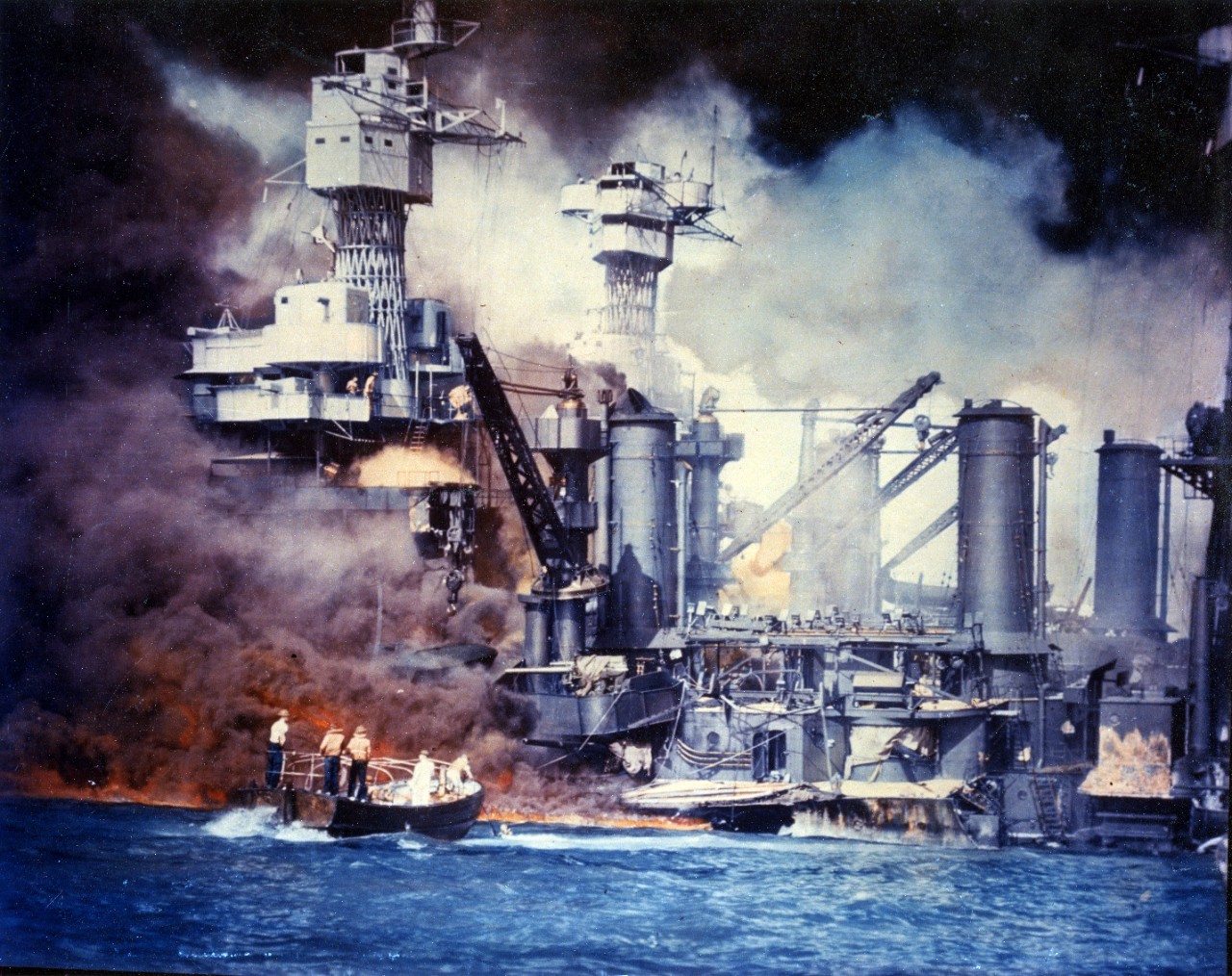
Top photo: Sailors in a motor launch rescue a survivor from the water alongside the sunken USS West Virginia (BB-48) during or shortly after the Japanese air raid on Pearl Harbor. USS Tennessee (BB-43) is inboard of the sunken battleship. This is a color-tinted version of Photo # 80-G-19930. Photograph from the Army Signal Corps Collection in the U.S. National Archives.

Wednesday, December 2, 2020

History Has Its Eyes on – Hong Kong

Review by Bill Doughty–

The soundtrack to Joshua Wong's account of the trials and tribulations in Hong Kong can be found in Lin Manuel Miranda's "Hamilton."

"Unfree Speech: The Threat to Global Democracy and Why We Must Act, Now" by Joshua Wong (Penguin Books, 2020) is written by a young man who is "young, scrappy and hungry" and ready to "rise up." He seems to echo Hamilton: "I'm not going to waste my shot."


Wong's is the voice of a boy becoming a man –– a self-described "diehard fanboy" of Gundam, OnePiece, Marvel and DC comics, as well as a student of Gandhi and MLK. He and his close friends Agnes Chow and Ivan Lam (top photo) were sentenced to prison this week by a court in Hong Kong for a pro-democracy protest they held last year.*

Wong offers a brief history of the situation in Hong Kong since the time of the transfer of sovereignty from Great Britain to China, July 1, 1997: The recession in '97, the SARS outbreak in 2002, "misguided housing policies," the National Security Bill, the barring of political organizations, growing demands for more democracy, and the rise of the Umbrella Revolution/Movement.

"The movement didn't happen in a social vacuum. The broken promise of electoral reform and subsequent police crackdown catalysed the unrest, but they didn't cause it. It took decades of pent-up frustration over income inequality, social immobility and other injustices for public anger to finally boil over. Martin Luther King Jr famously said that freedom is never voluntarily given by the oppressor and that it must be demanded by the oppressed. The Umbrella Movement was our way of making our demands heard."

"The movement's symbol, the yellow umbrella, captured both the humility and humanity of the non-violent protesters," Wong writes. From Hamilton: "I was aiming for the sky," "Forgiveness, can you imagine it?" and "Tomorrow there'll be more of us."

As important as the history is Wong's explanation of structure of Hong Kong's government: The Executive is chosen by Communist Party loyalists and controlled by Beijing. The Legislature is not truly representative (two 35-member chambers: GC-geographical, chosen by region, and FC-functional, chosen by Beijing-friendly business and industry. The Judiciary, supposedly independent, is becoming more deferential to the executive, where "the criminal justice system is increasingly used as a political tool to silence dissent."


Voter suppression, election interference and punishment of free speech are hallmarks of Communist China's war on democracy. "Hong Kong is gradually becoming an autocracy," Wong writes. He calls it ominously like Star Wars's "The Empire Strikes Back."


Much of this book, disjointed and rough at times, comes from his diary from prison, both at the Stanley Prison for adults and earlier while at the Pik Uk Correctional Institution for juveniles. He gives a commentary on friends, prison food, entertainment, and hunkering down during a hurricane. Again from Hamilton: "In the eye of a hurricane, there is quiet" ... "Blow us all away" ... "Look around, look around" ... "I'll write my way out, overwhelm them with honesty."


Wong describes a "perfect storm" building, and even though this book was published this year, it was before COVID-19 was part of that storm.


Agnes Chow
Wong and many of his fellow protesters, including Lam and Chow, began their activism at a tender age. They venerate earlier freedom advocates such as Ai Weiwei, who writes this book's introduction, and they commemorate the young students killed in the Tiananmen protests and massacre of June 4, 1989.


The cover of the book features a quote from Greta Thunberg: "Together we are one loud voice that cannot be silenced." Young people are at the heart of global calls for freedom and equality. Wong was inspired by Malala's memoir. We're reminded of the young people of Parkland, Florida who sparked a movement for gun safety in the wake of the killing of 17 people at Marjory Stoneman Douglas High School. 


The subtitle of this book is "The Threat to Global Democracy and Why We Must Act, Now."

"From Turkey and Ukraine to India, Myanmar and the Philippines, citizens are pushing back oppressive regimes in defence of their diminishing rights. But nowhere else in the world is the struggle between free will and authoritarianism more clearly demonstrated than here. In the new trans-Pacific cold war, Hong Kong is the first line of defence to stop or at least slow down the dangerous rise of a totalitarian superpower. Like the canary in the coal mine or the early warning system on a tsunami-prone coastline, we are sending out a distress signal to the rest of the world so that countermeasures can be taken before it is too late. As much as Hong Kong needs the international community, the international community needs Hong Kong. Because today's Hong Kong is the rest of the world's tomorrow."

Wong points out Russia's aggression and annexation of Crimea, India's invasion of semi-autonomous Kashmir, and Turkey's military regime's imprisonment of journalists and displacement of millions of Kurds. "Their motivation is singular: self-perpetuation. To consolidate and maintain power," he writes.


Military power is flexed, Wong writes, to impress and intimidate –– and so leaders can remain in power. "Oceans rise; empires fall" ... "The world was wide enough for both."


Ensign Ashley Welker, a Los Angeles native, along with other Sailors, speaks to a tour group visiting Arleigh Burke-class guided-missile destroyer USS Sterett (DDG 104) during the ship’s port visit to Hong Kong, May 2, 2017. (MC1 Byron C. Linder)


In a call to action, Wong offers a 10-point action plan for civil action. He expresses appreciation to and for the United States and speaks glowingly of the support he received in Washington D.C. In September of 2019 he testified to the U.S. Congressional-Executive Commission on China (CECC).


U.S. Speaker of the House Nancy Pelosi and Wong
He received support directly from Speaker Nancy Pelosi, Sen. Marco Rubio, Rep. Jim McGovern, and Rep. Eliot Engle. Rubio sponsored the "Hong Kong Human Rights and Democracy Act." Pelosi told Wong, "You are an inspiration to young people everywhere. Thank you for your courage and resolve."


As "Hamilton" says, "It must be nice to have Washington on your side."


"Who lives, who dies, who tells your story,” in the words of Lin-Miranda.


Wong and U.S. Senator Marco Rubio
The late U.S. Representative John Lewis personified democracy and called for the "good trouble" as practiced by Wong and friends. Lewis, of course, played a pivotal role in passage of the Voting Rights Act signed into law by President Lyndon B. Johnson in 1965. And he advocated strongly for each reauthorization of the Voting Rights Act in 1970, 1975, 1982, and 2006.


In the face of voter suppression in some states, the House of Representatives passed Bill HR 1 –– The "For the People Act" in 2019. But "wait for it," as Hamilton intones: HR 1 is still awaiting a vote by the U.S. Senate.


*(Wong was sentenced to 13.5 months in prison; Chow, called the “Goddess of Democracy,” was sentenced to ten months in prison; and Lam received a sentence of seven months for inciting the pro-democracy protest.)

Tuesday, November 24, 2020

China – Control Over Freedom

Chinese and American citizens greet People’s Liberation Army-Navy ships CNS Jinan (DDG-152), CNS Yiyan (FFG-548), and CNS Qiandaohu (AOE-886) arriving in Hawaii for a scheduled port visit Dec. 13, 2015. As part of a planned series of military-to-military exchanges between two nations, Chinese and U.S. Navy officers conducted dialogues to build confidence and mutual understanding. Sailors toured each other’s ships and participated in sporting events. (Photo by MC1 Nardel Gervacio)

Review by Bill Doughty––


China is growing its navy to control sea lanes and sea lines of communication after sailing a “Century of Humiliation” with boatloads of victimization, anxiety over food security, and obsessions about containment, demarkation, and entitlement.


“Control” is the operative word; “freedom” is not –– which mirrors the Communist Chinese Party’s overall philosophy of leadership in the People’s Republic of China. 


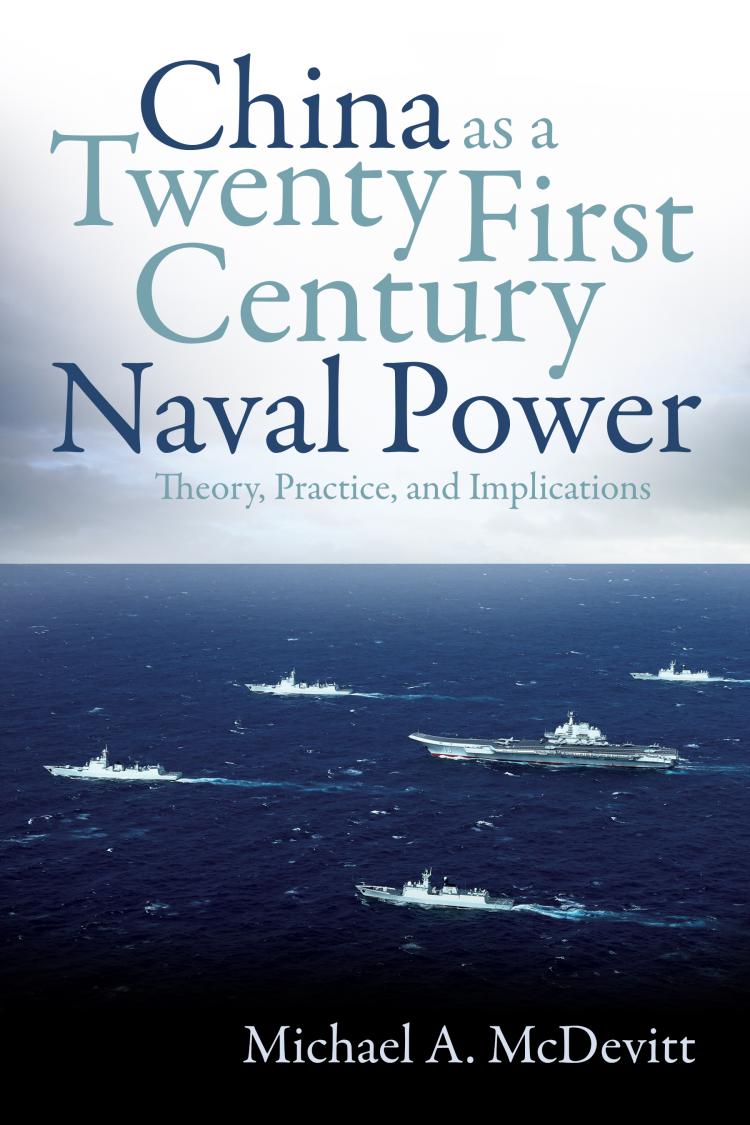
President Xi and the People’s Liberation Army Navy are actively building a “world-class” blue water naval force as they fortify rings of islands, build a “Belt and Road Initiative,” and create anti-access and area denial capability. Michael A. McDevitt explains how in “China as a Twenty First Century Naval Power: Theory, Practice, and Implications” (Naval Institute Press; 2020).

Rear Adm. (ret.) McDevitt keeps the history lesson to a minimum and instead maximizes discussion of current and future development of PLAN resources, strategies, and capabilities.


He offers careful and couched predictions with humility about the “big uncertainty” of 2035 maritime goals of both China and the United States.


But he makes a bold statement about what the PLAN has already achieved in 2020:

“When one considers all the categories that collectively add up to the comprehensive maritime power –– navy, coast guard, militia, merchant marine, port infrastructure, shipbuilding, fishing –– one sees that China is already a global leader, or is among the top to or three in the world. No other country can match China’s maritime capabilities across the board. For example, the United States has the world’s leading navy, but in terms of quantity, and some cases quality, its shipbuilding, merchant marine, coast guard, and fisheries pale in comparison with China’s. In 2013, China caught 16.3 million tons of fish compared to the American 5.2 million tons. The comparison of coast guard cutters (those of over five hundred tons) is equally stark: Chinese Coast Guard, 225, versus U.S. Coast Guard, 40.”

This combined public-private power translates to a “formidable” force in home waters, and “China as a Twenty First Century Naval Power” expounds on that thesis with two appendices –– “The China Coast Guard: A Uniformed Armed Service” by Ryan D. Martinson and “China’s Maritime Militia: An Important Force Multiplier” by Andrew S. Erickson and Conor M. Kennedy.


Lt. j.g. Darel Dorsey, of USS Blue Ridge (LCC 19), observes PLAN ship CNS Quilianshan (LPD 999) as the ship departs Zhanjiang, PRC, April 24, 2015. Blue Ridge conducted a port visit to Zhanjiang to build naval partnerships with China's South Sea Fleet to ensure peace and prosperity for the entire region. (MCSA Timothy Hale)

McDevitt explores the growth of PLAN’s surface navy, carrier development, and submarine deployment, as well as shipbuilding, replenishment, command and control, training and basing capabilities. He takes the reader from the western Pacific to the South China Sea and Indian Ocean; from the Philippines and India to Djibouti and Ethiopia, as the PRC finds ways to prevent what it perceives as containment –– and continue to control freedom, including in some cases freedom of naval operations in what are considered international waters.


Taiwan's Tsai Ing-wen
McDevitt understandably spotlights Taiwan (Republic of China), where CCP’s deep desire for reunification meets head-on with ROC citizens’ demand for freedom and democracy.

“At this writing, tension has increased across the Taiwan Strait for a number of reasons, primarily among them the fact that Beijing simply does not trust Taiwan’s ruling party, the Democratic People’s Party (DPP), which has long advocated eventual independence. Beijing especially does not trust the current president of Taiwan, Madam Tsai Ing-wen, who helped craft the independence language in the DPP Party Charter and who in January 2020 won a second term in a landslide. This vote has been interpreted, correctly in my view, as a massive rejection by the citizens of Taiwan of Beijing’s '1C2S' [one country, two systems] strategy. Nonetheless, preliminary indications suggest Xi is unlikely to back away from IC2S, implying Beijing believes that it has time on its side.

Meanwhile, PRC continues to aggressively build and strengthen its navy.


Martial arts schools parade down a street in Taiwan. (2nd Lt. Dustin Brown)
There are several mentions of the Trump administration in this book, which makes us wonder how the incoming Biden-Harris team will deal with China.

Shortly before his election Biden wrote about his support for Taiwan and commitment to freedom and democracy.


“We’re a Pacific power, and we’ll stand with friends and allies to advance our shared prosperity, security, and values in the Asia-Pacific region,” President-elect Biden proclaimed in the Chinese-language newspaper World Journal.“That includes deepening our ties with Taiwan,” Biden noted.


The Voice of American reports, "But analysts expect fewer arms sales and nearby naval voyages and less anti-China language from a Biden administration.


In an announcement of key cabinet positions today, Nov. 24, Biden reinforced a pledge of support to allies and partners. He said, “That’s how we truly keep America safe, without engaging in needless military conflicts, and our adversaries in check, and terrorists at bay. And that’s how we counter terrorism and extremism, control this pandemic and future ones, deal with the climate crisis, nuclear proliferation, cyber threats in emerging technologies that spread authoritarianism.”


Biden’s incoming Secretary of State Blinken said this week he will approach his job with “equal measures of humility and confidence.”


With then-U.S. Secretary of State John Kerry looking on, U.S. Vice President Joe Biden raises his glass to toast Chinese President Xi Jinping at a State Luncheon in the Chinese President's honor at the U.S. Department of State in Washington, D.C., September 25, 2015. (State Department photo)

Tuesday, November 17, 2020

Armenia? Azerbaijan? Russia!


Marine Corps Gen. Joseph F. Dunford Jr., then-chairman of the Joint Chiefs of Staff, meets with Col. Gen. Zakhir Hasanov, Azerbaijan Minister of Defense, and Col. Gen. Najmaddin Sadikhov, chief of General Staff of Azerbaijani Armed Forces, to discuss the status of the relationship between the military forces of the United States and Azerbaijan at the Ministry of Defense in Baku, Azerbaijan Feb. 16, 2017. (Dept. of Defense photo by Navy Petty Officer 2nd Class Dominique A. Pineiro)
Review by Bill Doughty––

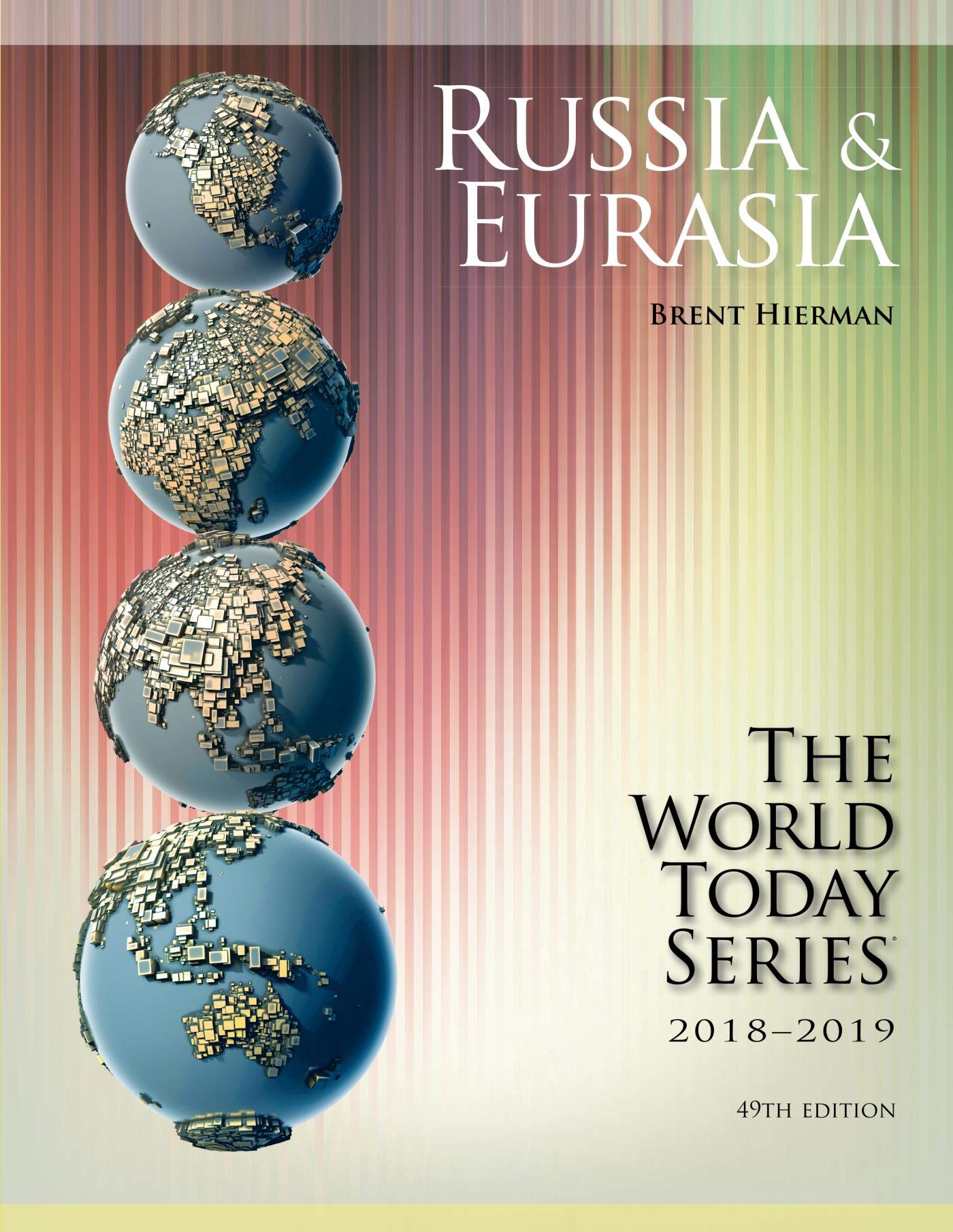
In an effort to understand the flaring conflict between two former Soviet satellites, I picked up “Russia and Eurasia” by Brent Hierman (The World Today Series, 2018-2019, 49th edition; Rowman & Littlefield, 2018)., a book that predicted the current situation between Armenia and Azerbaijan, two of the three Transcaucasian Republics (Georgia being the third).


This book offers an objective and informed view of not only Armenia and Azerbaijan, but also the Russian Federation, the Commonwealth of Independent States, Western Republics, and Central Asian Republics.


Like detailed State Department and CIA studies, this book compares geopolitics, climate, ethnicity, religion, and national idiosyncrasies with maps, history lessons, and statistics.


Soldiers with the Armenian Armed Forces Peacekeeping Brigade received certification as a NATO partner following an exercise in the Republic of Armenia Sept. 15-18, 2015. The brigade earned the certification by passing the second-level evaluation of the Operational Capabilities Concept of NATO's Partnership for Peace program. The certification solidifies Armenia's capabilities to support NATO peacekeeping operations, culminating years of preparation with assistance and guidance from the Kansas National Guard through the National Guard Bureau's State Partnership Program. (U.S. Army National Guard photo by Sgt. Zach Sheely)


For example, Armenia is a landlocked dry highland, slightly smaller than Maryland, with a population of about three million. The language is Armenian and the religion is Armenian Apostolic Christian, from Roman Empire times. Per capita annual income is around $9,000. Armenia is east of Turkey.


Azerbaijan, by comparison, is a dry sub-tropical nation facing the Caspian Sea. It’s about the size of Maine, with a population of ten million Azeri who speak Azerbaijani and who are primarily Islamic (Shi’a), from Persian Empire influence. Per capita annual income is $17,400. Azerbaijan is north of Iran.


The primary source of conflict is the extremely mountainous and isolated area that associates itself with Armenia but which is landlocked within Azerbaijan  –– Nagorno-Karabakh, a remnant of the Ottoman Empire.


Armenian Americans have strong ties to Armenia.  “Amid the swirling events that ultimately resulted in the end of the Ottoman Empire, Armenians claim that 1.5 million of their people were mercilessly slaughtered by the Turks in western Armenia in the late 19th and early 20th centuries, and a substantial number of them migrated to the U.S.”


Centuries of conquest carved up the region by many empires, including the Persian, Arab, Byzantine, Seljuk Turk, Georgian, Mongolian, Russian and Soviet –– which makes it remarkable that the Armenians only established their ministry of defense in 1992, creating an army equipped with tanks mainly from Soviet forces.

“The war between Azerbaijan and Armenia widened somewhat in the spring of 1992, when forces within Nagorno-Karabakh extended their control over areas formerly occupied by Azerbaijani forces. These same forces then overran Azerbaijani territory lying between Nagorno-Karabakh and Armenia, creating a corridor connecting the enclave with Armenia at the post where the two territories are the closest together. This had a military significance, since Armenia, which had been shifting supplies in by air up to this point, could begin bringing supplies in by truck.”

Destruction in Armenia in 1988 (Photo courtesy USAID)
The two countries have fought over energy resources and now water resources. Their conflict is exacerbated by their cultural, historical and geopolitical differences. Both countries have confronted Communism and Islamic terrorism.


Azerbaijan, though Islamic, is fearful of the fundamental extremism of radicals in Iran. The head of state has become more autocratic, solidifying power and embracing nepotism: making his wife vice president and arranging for his son to take his place. Facing deteriorating economic woes after fixing its wealth to fossil fuel extraction, Azerbaijan has suppressed human rights and faces protests across the country. 


Armenia, meanwhile, has undergone its own form of “velvet revolution” in which the people have taken to the streets to demand more representation. But, because Armenia hosts two Russian military bases, it cannot be a full member of NATO.


A Soldier with Company A, 2nd Battalion, 116th Cavalry Brigade Combat Team, Idaho National Guard, fires his M240b machine gun at opposing forces during a situational training exercise at Saber Guardian July 31, 2016. (Capt. John Farmer)


Both Armenia and Azerbaijan have participated in joint exercises, including Saber Guardian, a multinational military exercise. According to DoD, Saber Guardian in 2016 included Armenia, Azerbaijan, Bulgaria, Canada, Georgia, Moldova, Poland, Romania, Turkey, Ukraine and the United States. “The objectives of this exercise are to build multinational, regional and joint partnership capacity by enhancing military relationships, exchanging professional experiences, and improving interoperability between the land forces from the participating countries.”


U.S. Air Force Tech. Sgt. Randy Daniels, right, with the 116th Civil Engineer Squadron, Georgia Air National Guard, works with an Armenian plumber repairing pipes in the basement of a Yerevan elderly institution during a European Command Humanitarian Civic Assistance project in Yerevan, Armenia, May 13, 2016. During the project, Airmen from the 116th Civil Engineer Squadron and the 461st Air Control Wing, wing staff, worked in partnership with the Armenian people to renovate a Yerevan elderly institution. The renovation provided crucial skill set training for the civil engineers while continuing the long-lasting friendship between the Armenian people and the citizens of the United States. (U.S. Air National Guard photo by Senior Master Sgt. Roger Parsons)


The United States military has ties with both nations and has assisted in training, de-mining, and humanitarian missions.


Russian troops have moved into the region to enforce a peace treaty, with Armenians forced to leave their homes in the region they call Artsakh.

In a recent report by the New York Times: “Nearly 2,000 Russian forces will patrol the line between Azerbaijani- and Armenian-controlled regions for at least five years, under the deal brokered by President Vladimir V. Putin.”


As both countries face challenges and conflict in 2020, with thousands of casualties, Russia continues to loom large. Russia eyes the region along with China, according Hierman. 


This book helps answer questions about the future by explaining the past and showing the present differences and challenges between Armenia and Azerbaijan and situational awareness of Russia’s actions in the region.

Wednesday, November 11, 2020

Veterans Day Courage: ‘Rain of Steel’

Review by Bill Doughty––

The courage it takes: fighting on the other side of an ocean, often at night, relying on relatively primitive radar and spotty information, facing death-cult suicidal attacks from a fierce enemy unwilling to accept the reality of defeat.

Such was the fate of Sailors and Marines at the end of World War II, fighting in the Battle of Okinawa. Stephen L. Moore describes the warfare in “Rain of Steel: Mitscher’s Task Force 58, Ugaki’s Thunder Gods, and the Kamikaze War off Okinawa” (Naval Institute Press, 2020).


In many ways, his narrative is a tribute to courage, which makes this a great read for Veterans Day. This is also a fitting tribute to a titan of U.S. Naval aviation, Vice Adm. Marc Andrew Mitscher.

“The wrinkles in his pug face, chiseled from years of wind exposure and chain-smoking, creased as the short, frail-looking man tugged hard on another cigarette. A sly smile nipped at the corners of his mouth as the morning breeze rushed across the open air wing outside Flag Plot, his tactical control center high atop his flagship aircraft carrier. Sporting a signature duckbilled hat to protect his hairless scalp and shade his eyes from the sun, he was a staple figure, frequently sitting on a stool on the elevated island structure of his ship to watch the takeoffs and landings of the naval aviators he commanded.”

Adm. Marc Mitscher
"Rain of Steel" presents a narrative of Naval Academy bad boy Mitscher (reminiscent of John S. McCains, especially McCain III) taking on the stoic samurai and follower of a suicidal pact, Matome Ugaki, leader of kamikaze pilots. We see the role of Senator McCain’s grandfather, Adm. “Slew” McCain, Adm. Raymond A. Spruance, Fleet Adm. Chester Nimitz, and other brown shoe and black shoe leaders in the Pacific War.

But, Moore also gives us the heroic narratives of American veterans –– patriots like Dean Caswell, Gene Valencia, Clinton Lamar “Smitty” Smith, Archie Glenn Donahue, James Joseph “Jocko” Clark, Harris “Mitch” Mitchell, Frank Sistrunk, Dean Caswell, Tilman “Tilly” Pool, Charles Edward “Billy” Watts, and Marshall Ulrich Beebe. In fact, the book’s prologue opens with Beebe being awakened at 0400 for his Composite Squadron 39 (VC-39) call of duty.


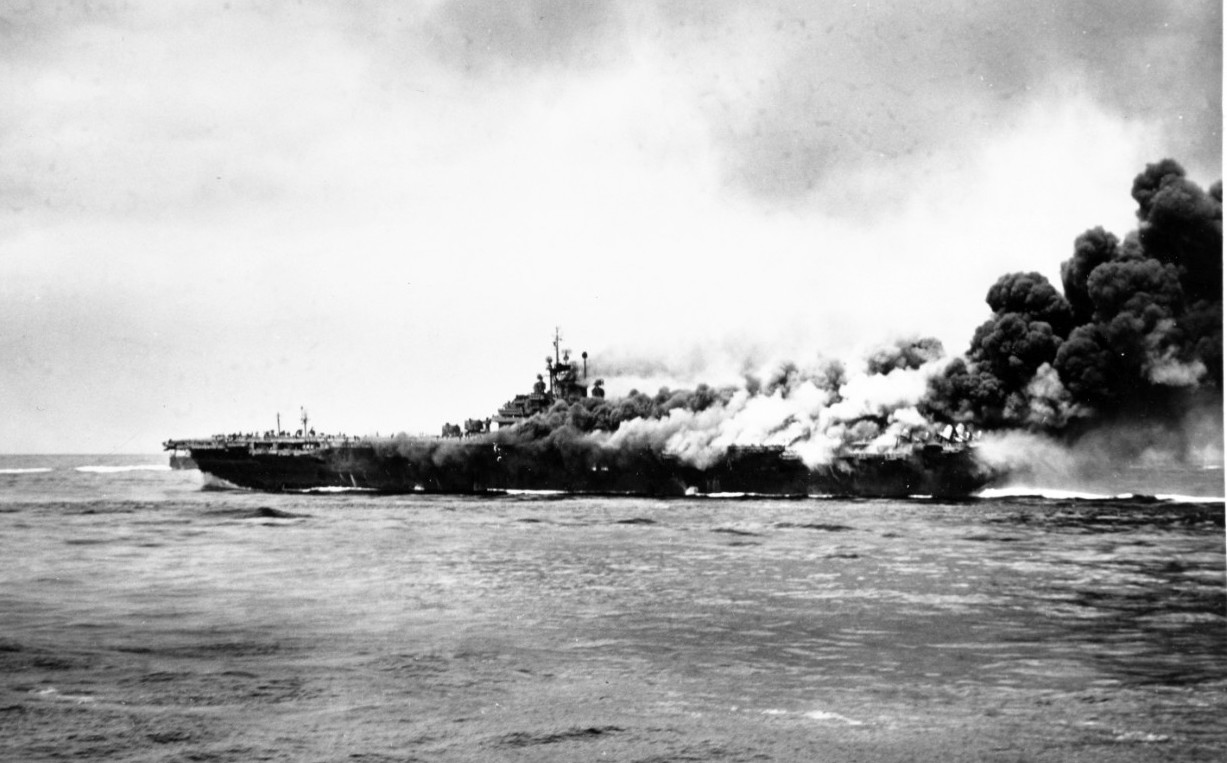
USS Bunker Hill (CV-17) burning after being hit by a Kamikaze, off Okinawa, 11 May 1945. Photographed from USS Bataan (CVL-29), NHHC.


The danger to the warfighters is palpable and their courage and commitment is inspiring.

“Berube’s F6F was smoking badly, its engine was sputtering, his canopy was so badly shattered that the hatch was jammed closed and unable to be jettisoned, and the rest of the plane was riddled with holes. The ensign announced to Clark that he would crash-land on Okinawa. Before friendly territory could be reached, however, his engine died, and Berube was forced to ditch. The impact must have torn off his copy, for in about twenty seconds he emerged from the cockpit with his Mae West inflated.

Clark circled Berube and broadcast his position over the radio to a lifeguard submarine until an acknowledgment was received. Despite his Hellcat being badly damaged as well, Clark selflessly dropped his own life raft. His heart sank as he saw the deflated raft sink before Berube could reach it. Clark remained in radio contact with the lifeguard sub, finally dropping his dye markers as he headed home due to low fuel, going up with another Essex pilot en route … A PBY rescue plane scoured the seas at the last-reported position of the downed VF-84 pilot, but Ensign Berube was never seen again.”

Marines on Okinawa, 1945.
Moore tells the story of the last great battle of the War in the Pacific with masterful grace. His detailed narrative is factual and specific, and includes dozens of Marine Corps and Navy squadrons, U.S. air groups, task groups, and task forces.

He features the courage of Marines on the ground, often in hand-to-hand combat, as well as Sailors aboard, among others, USS Essex (CV 9), USS Hancock (CV 19), USS Hornet (CV 12), USS Bennington (CV 20), USS San Jacinto (CVL 30), USS Yorktown (CV 10), USS Lexington (CV2/CV16), USS Enterprise (CV 6), and USS Belleau Wood (CVL 24).


Fortunately, we get both the U.S. an IJN (Imperial Japanese Navy) perspectives, as Mitscher and Ugaki face off even as “Japan’s once mighty carrier fleet was a ghost of its former self.”


Ugaki Matome
With hardened resolve despite their obvious defeat, the IJN aviators –– believing they were fighting with God’s providence as a “divine wind” –– crashed their planes into Allied targets, aiming especially to disable American aircraft carriers. Courage on both sides is obvious and profound.

Moore’s work is clearly a labor of love, describing a one-of-a-kind, now-unimaginable warfare coordinated by a peerless leader in Adm. Mitscher. This book is packed with extensive notes, references, photos, glossary, and information from both historical records and witness interviews. Moore provides context and nuance in an objective and steady style that is a pleasure to read, especially on this Veterans Day 2020.


A little more than two months after the thunderous Battle of Okinawa, but not until more lives were lost on both sides, Japan accepted defeat. That acceptance of defeat led to the end of revanchist colonialism, military controlled government, and divine leader worship –– replaced by constitutional democratic rule of law in the Land of the Rising Sun.


Commodore Arleigh Burke, Mitscher's chief of staff and future Chief of Naval Operations, would help Japan develop its own naval service, modeled after the United States Navy: the Japan Maritime Self-Defense Force.


Commodore Arleigh Burke and Adm. Marc Mitscher