Sunday, March 10, 2019

Stone Cold Killer: 'One of Us'

Review by Bill Doughty

Former Marine, Army National Guardsman and now Coast Guardsman Hasson w/ weapons cache.
Captured U.S. Coast Guardsman Lt. Christopher Hasson said he was inspired to plan mass murder and mayhem after reading the manifesto of Anders Breivik. Hasson was arrested last month for allegedly plotting mass murder as well as targeted killings of elected officials and members of the U.S. media who had done critical reporting about President Trump.

Hasson is one of the most recent terrorists or would-be terrorists to be inspired by Breivik, a self-declared Norwegian white nationalist who killed or injured hundreds of men, women and especially children nearly eight years ago in the bombing of a government building and shootings at a youth camp on Utoya Island.

Breivik also apparently influenced Newtown shooter Adam Lanza before Lanza shot and killed twenty children and six educators at Sandy Hook Elementary School. We see similarities in the terrorist actions and/or plans of Dylann Roof in Charleston, South Carolina; Robert Bowers in Pittsburgh; and Nikolas Cruz in Parkland, Florida, with some direct ties to white supremacism and anti-semitism.

Who was Breivik, why did he shoot dozens of helpless young people, and how could people choose to follow in his footsteps.

Breivik's life, behavior and crime are thoroughly documented in "One of Us: The Story of Anders Breivik and the Massacre in Norway" by Asne Seierstad (Farrar, Straus and Giroux, 2013).

This is a true crime account of an evil act by an author who is experienced reporting from war zones, especially Iraq and Afghanistan. 

It's nearly inconceivable how Breivik could influence others, especially a career U.S. Coast Guard officer. Reading it may help show how this kind of violent philosophy and hate-filled mindset can take root.

Seierstad's book also presents a history of cultural change in Norway beginning in the 1970s, including the impact and consequences of immigration, rise of women's equality and backlash by right-wing extremists. We get deeply affecting portrayals of the lives of some of the victims and their families.
"I offer heartfelt thanks to those who shared the most," Seierstad writes. "Bayan, Ali, Mustafa and Lara Rashid. Gerd, Viggo and Stian Kristiansen. Tone, Gunnar and Havard Saebo. And Viljar Hanssen and his family. They have told me about the worst thing of all: losing someone they loved."
Remembering the victims of Utoya shooting.
At the center of the story, of course, is the killer Breivik. We learn of his bullying, ostracism, cruelty to animals, lack of parental discipline and the effects of being virtually abandoned and then disowned by his father.

Seierstad documents Anders Breivik's "career" as a graffiti tagger (under the moniker of Marvel Comics's executioner, the Morg). She reveals details about his quasi-legal and failed business providing fake diplomas, his debt to financial institutions and tax evasion, and his obsession with violent video games such as "World of Warcraft."

Anders Behring Breivik, in uniforms, from his manifesto.
In WoW, he was "awarded the title of Justitiarius. It was a title that took a long time and a lot of killing to achieve." In the real world he became obsessed with guns, uniforms and how he was perceived by others.

He was inducted into the Freemasons, and he considered himself a Christian "crusader" against Muslims and Marxists. He believed Christianity should be taught in school.

Breivik he saw the news media as enemies of the people. In Breivik's words, "The media dehumanizes the conservatives. They've been doing that ever since the Second World War: continuous abuse of the cultural conservatives," Breivik said.

From his addiction to violent video games, he fell into the world of "white pride, world wide" supremacy and right-wing extremism. He was anti-political-correctness, anti-feminism, anti-immigration and anti-socialism. For Breivik, it was "us against them."

Breivik said he was inspired by Timothy McVeigh, the Oklahoma City bomber, who deployed a fertilizer bomb to kill 168 men, women and children in 1995.

Petty Officer Timothy McVeigh?

According to "American Terrorist," Timothy McVeigh, who served in the U.S. Army, nearly joined the Navy to become "one of us." He impressed recruiters, as reported in "American Terrorist: Timothy McVeigh & the Oklahoma CIty Bombing" by Lou Michel and Dan Herbeck (HarperCollins, 2001):  
"In May 1988, McVeigh decided to join the military ... On the math exam in business school, he missed only one question on the military vocational aptitude test that recruiters use to screen walk-in candidates. Recruiters from the Navy, Air Force, Marines and Army all showed interest in him. With that kind of test score, the Navy man told him, he could become a nuclear-propulsion specialist, working on a nuclear submarine or a carrier. That offer interested him, but McVeigh chose the Army."
McVeigh
Coast Guardsman Hasson previously served in the U.S. Marine Corps and on active duty in the Army National Guard.

So, is there a legitimate concern that members of the military, including veterans like McVeigh and Hasson, are prone to kill civilians and conduct mass murder because of their military training? Are we right to be concerned there are other many white nationalists or "crusaders" in uniform committed to bringing about civil war or armageddon?

Not according to Lt. Col. Grossman, author of "Assassination Generation: Video Games, Aggression, and the Psychology of Killing" (Hachette Book Group; Little, Brown and Company, 2016). Grossman, a former West Point psychology professor, references the Norway killings and speaks directly about Army veteran Timothy McVeigh's military experience and its relevance to his heinous crime:

Grossman says, "The retiring veteran is less likely to use his skills inappropriately than a member of the same age and sex."
"Bureau of Justice Statistics' data demonstrating that our returning veterans from World War I, World War II, Korea, Vietnam, and the Gulf War were less likely to be incarcerated than nonveterans ... The same is true of our veterans of the wars in Iraq and Afghanistan. These soldiers put the leadership, logistics and maintenance skills they learned in the military to good use in the civilian world, and they give up their deadlier skills as soon as they return home."
According to Grossman, "The finest killers who ever walked the face of this earth were the soldiers who came home from these major wars, and yet they were less likely to use those skills than nonveterans. The reason is clear: combined with learning to kill, they acquired a warrior discipline – and that is the safeguard in a soldier's life."

Breivik taunts with his white power salute.
Breivik never served in Norway's military. He obtained an exemption.

Modern history shows: Those who are quick to send men and women to war have never been there, while combat veterans cooperate to defend peace.

It's worth studying how Coast Guardsman Hasson could apparently lose his core values and turn from protector of peace to projector of hate and violence.

Asne Seierstad, shows us how a person without honor can become enthralled with a belief system that dehumanizes others and promotes killing.

"One of Us" starts at a pace exceeding the speed limit and barely slows down. We get the heartbreaking perspective of the victims. The violence is told in excruciating forensic detail.

"For me," Seierstad writes, "it was important to describe for posterity exactly how that day was."

Deliver Us from Evil

In "One of Us" there is room for beautiful prose, too, as Seierstad paints a scene at the remote farm in Osterdalen where Breivik processed ingredients for his fertilizer bomb and prepared weapons for the attack in the summer of 2011.
"Below the farm, the cold waters of the Glomma rushed onward. The river had a powerful force to it, swollen by the meltwater it was carrying down from the mountains. Wherever you were on the farm, you could hear it roar. When he took over the place at the start of May there were still a few chunks of ice sailing by, having broken off from the ice fields north of Glombrua. The spring flood usually lasted far into June. It would be July before the river calmed. Then it grew idle and drowsy, scarcely bothering to flow at all in the summer heat.But it was still a long time until July."
Gloma River, Norway

Also, in the midst of the horror of Breivik's killing we get this unexpected and beautiful "found" haiku – a verse from an unnamed bedtime story. The words came to a young victim as she was about to be shot by Breivik.

Our dear little moon
shines down on those who have no
bed and have no home

Stoltenberg
Another unintended haiku is from Norway Prime Minister Jens Stoltenberg, who called for more democracy, freedom and national unity in the aftermath of unrepentant Breivik's attack:

Evil can kill a
human being but never
conquer a people

On many levels, "One of Us" reveals the power of books and words.

Lessons Considered

Some of the themes explored in this book: the effects of World War II on Europe and Asia; the impact of al-Qaida, both to immigrants and nationalists; the cost of family separations to the psyche of children; the impact of the media; and the connection between extreme violence in video games and real life. We read and wonder how Breivik's strange and suspicious behavior leading up to July 22, 2011 wasn't reported to authorities.

Journalist/writer Seierstad
Seierstad shows the failures by officials in the minutes and hours after Breivik's attacks began – errors in communicating, responding and conducting command-and-control in an emergency. In part, the poor response contributed to the huge number of casualties that day: 77 killed and at least 209 wounded.

Breivik believed white Europeans were victims, threatened by socialist/Marxist immigrants. He comes across as a narcissist who confounded psychiatrists and psychologists at his trial, where "flattery was the style he adopted," according to Seierstad.

Stone-cold killer Breivik, who referred to himself as "Commander of the Norwegian anti-Communist Resistance Movement," demanded martyrdom in the hope he would inspire others.

Thursday, February 28, 2019

'The Great Stain' on Our Nation

Review by Bill Doughty

Author Noel Rae brings us face to face – and nose to nose – with the horrors of the great stain and stench on our nation's history.

In "The Great Stain: Witnessing American Slavery" (The Overlook Press, 2018) Rae succeeds takes us back hundreds of years. He shows us, using source materials from various perspectives, "the everyday reality of life as experienced by the slaves themselves – and the way to this was to accumulate as much eyewitness material as I could find – in the words of those who were there."

Those eyewitnesses include African and European slave dealers, New England and Confederate slave holders, American abolitionists, black sailors and soldiers and, of course, slaves themselves. We read their first-person accounts of brutality, dehumanization, escape, resistance and war in letters, diaries, newspaper stories, travel journals and other personal histories.

The assault on fellow humans is an assault on the senses, especially in the "horrible conditions aboard slave ships when crossing the Atlantic and the brutal way slaves were sold on arrival."

Here is how former slave Olaudah Equiano, who was purchased by a Royal Navy lieutenant but eventually found freedom in England, described the conditions:
"At last, when the ship in which we were had got in all her cargo, they made ready with many fearful noises, and we were all put under deck so that we could not see how they managed the vessel. But this disappointment was the least of my grief. The stench of the hold while we were on the coast was so intolerably loathsome that it was dangerous to remain there for any time, and some of us had been permitted to stay on the deck for the fresh air; but now that the whole ship's cargo were confined together, it became absolutely pestilential. The closeness of the place and the heat of the climate, added to the number in the ship being so crowded that each had scarcely room to turn himself, almost suffocated us. This produced copious perspiration so that the air soon became unfit for respiration, from a variety of loathsome smells, and brought on a sickness among the slaves of which many died, this falling victims to the improvident avarice, as I may call it, of their purchasers. This deplorable situation was again aggravated by the galling of the chains, now become insupportable; and the filth of the necessary tubs [latrines], into which the children often fell and were almost suffocated. The shrieks of the women and the groans of the dying rendered it a scene of horror almost inconceivable."
Abolitionists learned that 12.5 percent of slaves died in the voyage from Africa across the Atlantic. A ship's doctor, Alexander Falconbridge, testified to an abolitionist-inspired committee of England's Privy Council in 1789:
"During the voyages I made I was frequently a witness to the fatal effects of (the) exclusion of fresh air ... But the excessive heat was not the only thing that rendered their situation intolerable. The deck, that is, the floor of their rooms, was so covered with the blood and mucus which had proceeded from them in consequence of the flux that it resembled a slaughter-house. It is not in the power of the human imagination to picture to itself a situation more dreadful or disgusting. Numbers of the slaves having fainted, they were carried up on deck, where several of them died ... The place allotted for the sick Negroes is under the half-deck, where they lie on the bare planks. By this means those who are emaciated frequently have their skin, and even their flesh, entirely rubbed off by the motion of the ship from the prominent parts of the shoulders, elbows and hips, so as to render the bones in those parts quite bare. The excruciating pain which the poor sufferers feel from being obliged to continue in such a dreadful situation, frequently for several weeks, in case they happen to live that long, is not to be conceived or described."
Greedy slavers, owners and apologists justified their actions, including severe beatings and family separations, in various ways: even in slavery, blacks would have a better life in the West Indies or British Colonies than in Africa; conservatives argued, "it was vital to the nation's security by training sailors who in time of war could be recruited into the Royal Navy;" a slave-economy was supposedly a good, harmonized economy; and Christian slave traders and owners believed they were saving souls. They based their convictions on the Bible, especially the Old Testament.

Early Portugese naval vessel crews were motivated "for the holy purpose to seek salvation for the lost souls of the heathen." The Vatican, which indirectly profited, endorsed capturing "idolators." The English came "in their usual vigorous and self-righteous manner – a drawn sword in one hand and a Bible in the other." In the New World, Cotton Mather based his justification of slavery and New England witch hunts against Africans and American Indians on his faith in God. 

Reverend Thornton Stringfellow said in his book "The Bible Argument, or Slavery in the Light of Divine Revelation" evidence of God's authorization was in plain sight. It could be found in the Bible, including in Paul's Epistle to the Ephesians; Genesis IX, 18-27;  Exodus 21, 16; and the Ten Commandments.

Stringfellow claimed that "servant" equaled "slave" in the Bible and noted that Abraham owned hundreds of slaves, Stringfellow wrote, "The next notice we have of servants as property is from God himself, when clothed with all the visible tokens of his presence and glory, on the top of Sinai, he proclaimed his law to the millions that surrounded the base: 'Thou shalt not covet they neighbor's house, though shalt not covet they neighbor's wife, nor his man-servant, not his maid-servant, not his ox, nor his ass, nor any thing that is thy neighbor's." Servant meant slave, he said.

On the other hand, reformed Christianity helped inform some of the abolitionists, who found other interpretations to make their case against slavery. We learn of the colorful abolitionist and Protestant Benjamin Lay, and we get this "found" haiku from enlightened free-thinker (and, like George Washington, flawed former slave owner) Benjamin Franklin: 

Slavery is such
an atrocious debasement
of human nature

Frederick Douglass
The "charismatic leader" of American abolitionists, Frederick Douglass, made a conflicted peace with religion, choosing to base his views on logic, human values and civil rights earned from personal experience.

"The Great Stain" provides first-person accounts of resistance, mutiny and insurrection, as well as harrowing escapes, in which slaves would use the stench of Indian turnips, turpentine and onions to throw dogs off their scent. The narrative continues with an assault to the senses.

John Warren, who escaped from Mississippi to Canada, described how he disguised his scent from the dogs: "I could do it with red pepper. Another way I have practised is to dig into a grave where a man has been buried a long time, get the dust of the man, make it into a paste with water, and put it on the feet, knees, and elbows, or wherever I touched the bushes. The dogs don't follow that."

U.S. Air Force graphic by Tommy Brown
"The Great Stain" concludes with the Civil War – a war fought to end slavery – and descriptions of the heroism of William Tillman, Robert Smalls, and the Massachusetts 54th regiment in the attack on Charleston and assault on Fort Wagner. "Fort Wagner, said the New York Tribune, would be to black Americans what Bunker Hill was to white Americans."

Two Douglass speech excerpts close the book. 

Douglass urged all Americans to fight for the Union and "resolutely struggle on in the belief there is a better day coming, and that we by patience, industry, uprightness, and economy may hasten that better day."

Thursday, February 21, 2019

John Kerry's Character Forged in Vietnam

Review by Bill Doughty

After returning to the States, decorated Swift Boat skipper John Forbes Kerry took a stand against the Vietnam War nearly 50 years ago. Some fellow veterans of the "America, Love It or Leave It / America, Right or Wrong" mindset never forgave him.

On the other hand, Kerry believed this about America: "When right, keep it right, and when wrong, make it right."

He believes the truth, like freedom and democracy, is worth fighting for.

"Every Day is Extra" (Simon & Schuster, 2018) is a remarkably readable and compelling personal journey of a life dedicated to service, honor, diplomacy and keeping America great.

Kerry, like most Americans, is from an extended family of immigrants. "Perhaps the sea was in our blood," he writes. "Not only did our passions always stay connected to the ocean, but the original journey by which we came to America (was also) by sea..." Kerry's love of the sea informed his choice on which service he joined. 

"On February 18, 1966 I raised my right hand and took the oath to enlist in the U.S. Naval Reserve." Kerry prepared to attend Officer Candidate School in Newport Rhode Island.

But he remembered Mark Twain's admonition: "Never let school get in the way of an education."

Kerry's Naval Education

His first ship was USS Gridley (DLG 21), which was "an introduction to hands-on responsibility. The first thing I noticed when I stepped aboard was how big and clean it was."
"I took the Gridley responsibilities seriously. One of the most important lessons learned in OCS is that you don't walk in as the new kid with a pair of bars on your shoulder and start ordering people around. I've seen so many guys screw up, thinking that just because they're an officer, they're automatically in charge. Wrong. The bars represent an opportunity to learn how to be an officer. Some guys don't see it that way, and folks resent the hell out of them. The sergeants in the Marines and the chief petty officers in the Navy are the guys who know the ropes. You just have a college degree and four months of OCS; you really don't know anything, especially compared with the chief petty officers twice your age who have been in the Navy for twenty years. To be successful, listen to them."
Kerry in Vietnam
Another thing Kerry learned in the Navy is "that no one prospered unless everyone prospered. One of the great lessons of the service is that no one does well or right by doing alone."

He recounts his first full deployment:
"When we set out from San Diego in February 1968, I was full of anticipation for the adventure. We sailed away from the California coast in a four-ship group – one frigate, Gridley, and three destroyers – steaming in formation to Pearl Harbor. Just getting one or two nights away from the coast was magical. In all our training runs we had stayed pretty close to California. Now we were cranking up speed, heading west across the Pacific Ocean, honking along with the ship plowing through rolling waves as the sunset lit us up in bursts of crimson and orange. We created an enormous wake. I stood on the fantail feeling the ship vibrate and churn beneath my feet, watching the ocean race by at a pretty good clip."We were the squadron flagship for this convoy, so we took the lead position in a diamond formation. Standing on the bridge on a 535-foot Navy frigate moving at over 20 knots; sensing the harmony of ship, ocean and sky; feeling the ship shudder as it rises and falls with the waves; and watching the sun set into the horizon and looking for a green flash is a pretty damn good sight. It's why people go to sea and never get over it, why, as John Masefield wrote, men 'must go down to the seas again, for the call of the running tide, / Is a wild call and a clear call that may not be denied.'"
Kerry takes us aboard his swift boat and into bone-jarring combat in 1969, including a heart-pounding description of how he chased and killed an enemy combatant.


Admiral Elmo Zumwalt, future Chief of Naval Operations, then-commander of all naval forces in Vietnam, said Kerry's mission that day, "stood out among heroes as acts of total heroism."
Lt.j.g. Kerry stands with his swift boat crew in Vietnam.

In Vietnam, Kerry remembers how he received news of the deaths of friends and the assassinations of Bobby Kennedy and Martin Luther King Jr. in 1968. MLK's self-described "maladjusted" stand for justice – and against the war in Indochina – influenced Kerry's thinking.

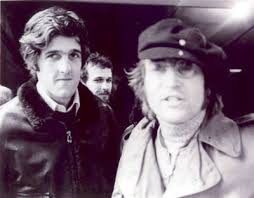
At a peace rally, young John Kerry introduced John Lennon.
The mid to late 60s was a watershed time for the United States as the nation dealt with Civil Rights, the Vietnam War and "electrifying change" in culture brought about by Dylan, the Beatles and the Rolling Stones.

Kerry's "maladjustment" flowered after his return Stateside. 

John Kerry's Found Haiku

Remembering his fallen comrades and the service members still serving in Vietnam, he marched, spoke and eventually testified to Congress against the war, offering this "found" double haiku:

How do you ask a
man to be the last man to
die in Vietnam?

How do you ask a
man to be the last man to
die for a mistake?

His leap into politics eventually led to a successful campaign to become the junior senator of Massachusetts.

Kerry was sworn in to the Senate by then-Vice President George H. W. Bush, who "loved the Navy as I did," Kerry remembers.

Kerry and McCain
He describes the vivid characters he worked with as a fellow senator: Max Cleland, Ted Kennedy, John McCain, John C. Stennis, Joe Biden, Robert Byrd, Jesse Helms, Strom Thurmond and John Glenn, among many others.

He remembers a time of collaboration, cooperation and compromise in Congress, when senators placed the needs of the nation above their own, including during investigations. He also relearned lessons from Vietnam: to compartmentalize in order to stay on track.

An Early Mueller Prosecution

Oliver North, USMC
Kerry, along with Senators Inouye, Mitchell, Nunn and Sarbanes, served at the heart of the Senate's Iran-Contra investigation during President Reagan's second term. Col. Oliver North had arranged for arms sales to Iran to fund military support to the cocaine-growing Contras in Nicaragua's civil war.
"I knew of Oliver North. We were the same generation and had both fought in Vietnam. He had come home from the war a decorated combat vet, with a Silver Star, Bronze Star, and two Purple Hearts. I didn't know what his politics were, but I respected his service and his courage. I wondered how someone with his credentials could be led down a path of illegality. The Marines live by a code. If what we were hearing was true, a Marine should have been horrified."
As part of the investigation, Kerry followed the money.

Robert Mueller, USMC
"We discovered a shady and unsavory bank with an innocuous acronym: BCCI. It stood for the Bank of Commerce and Credit International. BCCI was a dream for criminals and money launderers, and it was hiding in plain sight ... We learned that the CIA had prepared hundreds of reports outlining the criminal connections of BCCI. Thankfully, the Department of Justice soon had a new head of its criminal division: my St. Paul's classmate, a Vietnam veteran and a diligent law enforcement professional named Bob Mueller. Our subcommittee's two staffers had exposed the perfidy of BCCI, and I felt vindicated when Mueller assigned thirty-seven prosecutors to the case. By July 1991, regulators had seized the bank. BCCI was dead."
The ghost of BCCI would later come back a decade later in the wake of 9/11 in how al-Qaeda funded its terrorism. "When my investigation and Robert Mueller's prosecution shut down BCCI, it cut off Osama bin Laden's foothold in Sudan; now we needed to go after the entire dirty financial network that operated in the shadows," Kerry writes.

Smears and Retaliation

In 1996, Kerry was challenged for reelection by William Weld, former governor of Massachusetts. During the campaign, political operatives and a reporter, who was classmate of Weld, questioned Kerry's military record.

Kerry and Zumwalt.
In response, Admiral Zumwalt led a contingent of commanders who had oversight of swift boat shoreline operations to set the record straight. They conducted a press conference at the Charleston Navy Yard, "where USS Constitution stands as a reminder of our country's naval origins."

"Every Day Is Extra," includes a contemporaneous message about Kerry's key swift boat operation from then-Capt. Roy Hoffmann commending the mission: "The extremely successful raid and land sweep conducted along the Rach Dong Cung which demonstrated superb coordination and aggressive tactics stands as a shining example of completely overwhelming the enemy."

Decades later, when Kerry ran for president against George W. Bush, Hoffmann was recruited by anti-Kerry forces. Those forces were led by several principals: Ted Sampley, a "self-appointed POW activist (who) profited grossly" from myths and lies about POW/MIAs; John O'Neill, an ally of Nixon and Chuck Colson; and Jerome Corsi, an anti-Obama birther theorist and close associate of Roger Stone.

Kerry visits Afghanistan April 9, 2016. (Photo by SSgt Tony Coronado, USAF)
O'Neill and Corsi wrote the smear-book, "Unfit for Command," which was discredited by Zumwalt's previous statements, Navy and Coast Guard records, John McCain's testimony, and Sailors who served with Kerry during the missions for which he was decorated.

"It was extraordinary," Kerry writes about Hoffman, Sampley, O'Neill and Corsi. "They were lying about me, lying about themselves, lying about history – a history they knew was documented, in some cases by themselves, but always by the Navy they purported to love and respect."

To Tell the Truth

Respect for truth, honor and justice is a theme that runs through Kerry's life and this book.

For example, he explains why he felt it was important to take on BCCI with Robert Mueller:
"Because if you start backsliding and trimming on the rule of law, you contribute to the inexorable deterioration of democracy. Corruption is cumulative. I believed the rule of law has to mean something in the United States. If we knowingly turn a blind eye on the rich and powerful, enabling them to escape accountability while two-bit criminals go to jail for years, we create a tiered system of justice. That is no justice at all."I had learned a great deal as an investigator, both in Iran-Contra and in BCCI. I'd been reminded that when you push hard for truth, people who are invested in lies or in convenient avoidance resist, and they retaliate. But truth is worth fighting for; truth is the American bottom line."
"Every Day Is Extra" opens with a poignant recounting of the death of Kerry's father. Scattered throughout the book are the shadows of combat deaths, cancer diagnoses and the losses of friends and family members "...so many of life's sad, sudden turns."

Senator John Kerry participates in a remembrance ceremony at Utah Beach, June 6, 2011. Kerry joined paratroopers from the U.S. Army, U.K, Germany, and France in honoring those who fought and died in Operation Overlord, the D-day landings. Senator John Kerry, chairman of the Senate Armed Force Committee, was the senior U.S. representative at the ceremony. (Photo by Staff Sgt. Felix Fimbres, U.S. Army)
A deeply personal encounter comes with Kerry and Teresa Heinz Kerry visiting Normandy Beach. I won't ruin the experience, made better with Kerry's context and nuanced prose, but you can find the passage on page 209 of the 2018 hardbound edition.

A thorough report of John Kerry's time in Vietnam and his journey to warrior diplomat and healing with friend and colleague John McCain is presented in Douglas Brinkley's "Tour of Duty: John Kerry and the Vietnam War" (HarperCollins, 2004).

According to Thomas Cutler, author of "Brown Water, Black Berets," "Douglas Brinkley's vivid rendition of brown-water operations in 'Tour of Duty' rings true, with all the sights, the sounds, and the smells that make it such a unique experience. But this is far more than another war story. It is an account of a young man's journey through his own 'heart of darkness,' ultimately emerging with his soul intact and his need to serve undiminished, ready to wage a different kind of war."

U.S. Secretary of State John Kerry crosses the brow of the Avenger-class Mine Countermeasures ship USS Devastator (MCM 6) April 7, 2016 at Naval Support Activity Bahrain in the U.S. 5th Fleet area of operations. (U.S. Navy photo by Mass Communication Specialist 2nd Class Ryan D. McLearnon)

Secretary of State John Kerry lays a wreath Aug. 13, 2014 at the USS Arizona Memorial. Kerry visited U.S. Pacific Command to discuss cooperation strategy in the Asia-Pacific region. (U.S. Navy photo by Mass Communication Specialist 1st Class Jay M. Chu)

Kerry signs the Paris Climate Agreement while holding his granddaughter, Apr. 22, 2016.

Monday, February 18, 2019

Green New Deal Imagined in 'This Moment on Earth'

Review by Bill Doughty

Vietnam branded John Kerry. His missions in the Navy, as a senator and as Secretary of State informed his life. And his confrontation with mortality brought insight and wisdom.
Kerry focuses that perspective on his most important mission on "protecting the planet." That's the last chapter in his new autobiography, "Every Day is Extra," and it's the subject of a book he and wife Teresa Heinz Kerry wrote in 2007, "This Moment on Earth" (PublicAffairs, Perseus Books).

Kerry and Gore at Yale University.
If the seeds for the Green New Deal were first planted by Ralph Waldo Emerson, Theodore Roosevelt, Marjory Stoneman Douglas and Rachel Carson – and in 1970 with the world's first "Earth Day" – those seeds were certainly watered and given sunshine by Bill McKibben (350.org), Al Gore ("An Inconvenient Truth") and the Kerrys.

"This Moment on Earth" is a call for action, acknowledging the reality of global climate change, the hazards of relying on fossil fuels for our energy, and the poisoning of earth's air and water. The authors offer a number of examples of individuals and communities – from Pittsburgh and the Carolinas to New Mexico, Washington State and Portland – taking responsibility and action.

United States Marines to the Rescue

Former Marine Bob Boyle organized fellow fishermen and helped clean up the Hudson Bay, inspired "by their growing disgust about the deterioration of the environment and our poor stewardship," demonstrating how Americans are a government of, by and for the people.

Former United States Marine Rick Dove, a Riverkeeper enforcer.
Another Marine, Rick Dove, a retired colonel, took on the unregulated hog farming industry and their political supporters.
"Listening to Rick talk about his work is inspirational. Sixty-seven years old – a marine – he could have been doing almost anything else; he'd earned it. But his personal sense of responsibility and love for the river kept him on the job. 'Semper Fi' – 'Always faithful' – the motto of the Marines, was his for life. His story conclusively demonstrates the connection between the choices we make and health of our communities. Few of us likely give much consideration to how our everyday choices – such as the seemingly straightforward decisions we make at the grocery store to provide food for our families – may have an impact on people we will never meet, in places we may never visit."
Americans Connected
"In recent times, particularly since the 2000 presidential election, we have generally bought into the idea of blue states and red states. But it takes people like Rick to remind us that, regardless of how we vote or which party we align ourselves with, we all share many very basic ideals. All of us certainly want clean water. No fisherman should be sickened by toxins in the water. No mother should worry that her child will become sick from swimming at the local beach. Nobody among us – young or old, farmer or artist, Democrat or Republican – should demand anything less than safe, available water. This is not a matter of politics; it is a matter of common sense, morality, and responsibility."
True conservatives are conservationists, by their very name. "Evangelicals talk of "creation-care" – that any damage that we do to God's world is an offense against God," an idea that "appeals to all religions of the world and to anyone with a moral guidepost."

President John F. Kennedy and First Lady Jacqueline Kennedy watch the first race of the 1962 America's Cup from aboard the USS Joseph P. Kennedy, Jr. Also pictured: Hugh D. Auchincloss; Under Secretary of the Navy, Paul "Red" Fay; Jamie Auchincloss; Janet Auchincloss; John Forbes Kerry; Press Secretary, Pierre Salinger; Naval Aide to the President, Captain Tazewell Shepard; Rep. Fernand St. Germain (Rhode Island). Newport, Rhode Island. (JFK Library)
In his recent autobiography, "Every Day Is Extra," Kerry reprises a JFK quote also published in "This Moment on Earth" in a chapter called "The Water of Life." 
"As (Navy veteran) President John F. Kennedy said in a speech he gave in Newport, Rhode Island, in 1962: 'All of us have in our veins the exact same percentage of salt in our blood that exists in the ocean, and therefore, we have salt in our blood, in our sweat, in our tears. We are tied to the ocean. And when we go back to the sea – whether it is to sail or to watch it – we are going back from whence we came.' Water accounts for up to 90 percent of the weight of cells in the human body and three-fourths of the body's total weight. Essential to our survival, so powerfully linked to our history and culture, such a precious resource ought to receive the highest level of protection – nothing short of uncompromising stewardship."
John Kerry speaks of books and "storytellers of the sea" and rivers that influenced him over the years: Herman Melville's "Moby Dick," Rudyard Kipling's "Captains Courageous," Sebastian Junger's "The Perfect Storm," Richard Henry Dana's "Two Years Before the Mast," and Mark Twain's "Huckleberry Finn."

A Call for Boldness: 'The Green Rush is On'

John Kerry and Teresa Heinz Kerry
Kerry's "This Moment on Earth" with Teresa Heinz Kerry – along with the final chapter of "Every Day Is Extra" – calls for the acknowledgment, will and action to combat climate change. His call, to include "an innovative and strategic national energy policy," is reflected in calls for a Green New Deal.
"There's no excuse for inertia. Even if, contrary to all science, the proponents of action on global climate change were proven wrong, what harm would the actions to combat global warming cause? We would have produced healthier people with cleaner air, sustainable farming and fishing practices, more healthful food, and more effective sources of cleaner energy, all of which adds to greater security. But if those who deny climate change get their way and then are proved wrong, we will suffer catastrophe beyond description."
The U.S. Army Corps of Engineers uses solar energy at a remediation project at the former Nebraska
Ordnance Plant – energy-saving technology to treat groundwater and power equipment. (U.S. Army)
A Green New Deal would push innovation and ingenuity. "That ingenuity is alive and well among individuals and corporations engaged in the discovery of new and better ways to address our energy challenges" in a "post-carbon period," Kerry writes. "Americans have always pushed the frontier of discovery. We didn't become the most powerful economy on Earth by holding back. Innovation after innovation has unfolded because the American spirit has always pushed the limits. Innovation is in the American DNA."

The Kerrys call for individual action and offer to appendices: "The Energy Plan" and "What You Can Do," with a list of sites to get more information and get involved.

Saturday, February 2, 2019

What's Up-Down in Venezuela

"Crude Nation: How Oil Riches Ruined Venezuela" by Raul Gallegos (2016, Potomac Books)

Review by Bill Doughty

What are the "odd things" that happen when toilet paper disappears? When did Venezuela become an "oil-drunk" nation and the "world's craziest economy"? How did this once-richest South American nation implode with hyperinflation and food and water (and toilet paper) shortages? Will the United States military be sent to intervene in the current crisis?

Raul Gallegos answers most of these questions and explores the history of Venezuela from the time oil – what one leader eventually called "the devil's excrement" – was discovered just over 100 years ago.

"This is a country where money simply oozes and bubbles out of the ground almost effortlessly, with very little human intervention," Gallegos writes.

A nearly worthless 100-bolivar note is now nearly worthless.
For years Venezuelans consumed gasoline like water in "4x4 sport utility vehicles, Humvees and fast cars" and "dilapidated gas-guzzlers from the 1970s" serving as taxis. Citizens spent money on plastic surgery, direct TV and brand clothing. The government did not invest in infrastructure, and few people saved for the future.

Gallegos writes, "For decades Venezuelans have been brought up to think that saving money in a bank is the fastest way to lose it, because oil riches are unpredictable and, with time, money becomes worthless."

Chavez's memory, policies and Chavismo kept alive under Maduro's clenched fist.
Under former and late dictator Hugo Chavez's Chavismo form of authoritarian socialism, "the government has lavished billions of dollars on fighter jets, helicopters and advanced military technology for armed forces that have never fought a war."

The government provided subsidies unequally to the richest families and haphazardly gave free housing to some poor people. This decreased self-reliance and created greater inequality in the face of hyperinflation. In February 2016 the government began printing higher denomination bolivar notes.
"Other countries have been down this path before, and it doesn't end well. it usually leads to episodes of hyperinflation such as those in Austria, Germany and Hungary after World War I, the Philippines under Japanese occupation during World War II, and even China when the Yuan Dynasty printed cash to finance its wars. The most notable hyperinflation episodes in history have occurred in countries trying to recover from a war or attempting to finance a military campaign. Venezuela is a country at peace, and the runaway spending that left the country with triple-digit inflation cannot be explained away by a military conflict."
Chavez and his successor Nicolas Maduro are only the latest in a chain of corrupt, greedy and/or incompetent leaders who came to power under questionable circumstances, a far cry from the freedom-loving founder of the nation, Simon Bolivar. 

Juan Vicente Gomez
Kleptocratic leaders have included Gen. Marcos Perez Jimenez, Carlos Andres Perez and the first Venezuelan leader who seized power just before oil was discovered, Juan Vicente Gomez. 

"There was no real government and no clear rule of law. Gomez was the state; he was the law; he was God. And Venezuela was his personal Eden," Gallegos writes.

The problem then was not socialism but a form of distorted capitalism.
"Oil became a godsend for Gomez. World War I was under way, and the navies of the world powers had converted from coal to oil as a source of fuel. The oil industry had begun in Pennsylvania some sixty years earlier, and oil was no longer used just to light kerosene lamps. Henry Ford had been producing his Model T for six years when the Zumaque oil well began production. Crude was a prized resource that brought Venezuela instant wealth and gave Gomez enough power to rule the country in one form or another for twenty-seven years. He allowed foreign companies to drill for oil, paying nothing in taxes and royalties, and they backed his dictatorship. He would first grant oil concessions to friends, family, and business cronies, who would later resell them to foreign companies for profit. This racket afforded him many friends and allowed him to build an immense personal fortune. By the time he died peacefully in bed in 1935, Gomez had become one of Latin America's richest men. He owned vast tracts of land and controlled paper, soap and cotton production, to name a few industries. At one point, every time a Venezuelan ate meat, drank milk or lit a match, Gomez would grow richer. He had little patience for dissent. Opponents would disappear or be tortured or poisoned in prison, because dictatorship seemed necessary at the time."


Today, the country ranks highest in the misery index. Gallegos shows how Venezuela ranks "dead last" in wastefulness, ethics and corruption rankings of the World Economic Forum's 2015-2016 Global Competitiveness Report. He compares the Andean nation with Qatar, United Arab Emirates, Finland and Norway, nations that have invested rather than squandered their resources.

In "Crude Nation," Gallegos suggests pegging Venezuela's bolivar to the dollar to bring rationality back to the economy.
"The first step in managing Venezuela's addiction to spending oil money uncontrollably is admitting the problem. Venezuela's long tradition of trying to spend more oil money than it can safely digest has deformed its economy, its institutions, and its society. Venezuela has become an upside-down world where politicians are not accountable to voters but to themselves, and voters have learned to beg their government for a living. The military is run by entitled generals who have never fought a war but who demand privilege, shiny new planes, and power over civilians. Businesses expect abnormally high profits without being competitive or efficient. Credit-card-happy consumers have no incentive to save any money but go into debt to shop compulsively instead. Poverty and inequality are legitimate concerns in Venezuela, but the country's underlying problem is wealth mismanagement. No amount of money has even been enough for Venezuela to become a stable, well-managed country. No amount of money has helped Venezuela consistently reduce poverty. In fact it often seems as if the more money Venezuela earns, the worse off it becomes. Venezuela has become a country with no future that lives only in the present."
But a therapeutic intervention does not necessarily mean a military intervention.

Stavridis
Retired Adm. James Stavridis said this on the Morning Joe show Jan. 31: 

"This is the country that Simon Bolivar centered. This is the Bolivarian Republic of Venezuela. This is where democracy began in the Americas. So, at the end of the day, the tragedy here is not Nicolas Maduro, the current leader; it's Hugo Chavez, who preceded him, invented this half-baked socialist strategy called Chavizmo named after himself, and destroyed the oil industry, cratered the economy and then died just as oil prices went down, and handed the whole mess to a bus driver named Nicolas Maduro. If there was ever an example of Karl Marx's line that history always repeats itself first as tragedy then as farce, it's Venezuela going from Chavez, the tragedy who destroyed the country, to Maduro, the farce ... There's not a good military option here. There'll be temptations to steam a carrier battlegroup down there or put the 82nd Airborne on alert. Wrong, wrong, wrong. This is political, economic, diplomatic ... I think there's a two in three chance we can sort this thing out reasonably, but us loading up the military and launching it is not the right next move," Stavridis said.

Gallegos sums up "Crude Nation" as "a tale of how hubris, oil dependency, spendthrift ways, and economic ignorance can drive a country to ruin." Unfortunately, a lack of toilet paper is the least of the problems facing the people of Venezuela today.