Showing posts sorted by date for query snyder. Sort by relevance Show all posts

Monday, January 20, 2025

‘On Freedom’ Found Haiku, Finding Wisdom

Review by Bill Doughty

Timothy Snyder dedicates “On Freedom” (Crown New York, 2024) “to those who wish to be free.” He attempts to define “freedom” –– positive freedom –– as not destruction and absence of things, but creation and presence of values, including the right kind of moral and political values.


“Virtue,” he writes, “is an inseparable part of freedom.”


So, too, is accountability, honesty, humility, and rule of law.


His book begins on a train in Ukraine, one of three trips to the democratic country he writes about after Putin’s Russia invaded its neighbor.

Snyder takes us along as he travels to and through Ukraine and contemplates the birth of the idea of freedom and democracy in ancient Greece. His writing is beautiful, poignant, and painful –– especially in light of the current state of affairs in the United States and the world where storm clouds seem to be gathering.


He condemns the rise of autocracy, oligarchy, inequality, and what he calls “sadopopulism.” And he offers prescriptions for standing up to greed, grift, and the abuse of power.

“As the future crashes in, we can panic and blame others. Those predictable reactions make us part of the mob and the catastrophe. Or we can, as free people, take responsibility, look deep into Earth’s past, and save the world.”

Freedom must be fought for. It is not a birthright, and it is not preordained. “The moment you believe that freedom is given, it is gone,” he warns.


A recurring theme in “On Freedom” is the need to confront racism in a free country. The military, up till now, has made a concerted effort to increase diversity and reject racism.


World War II was a watershed event: defeating fascism and creating democracies in Japan and Germany while also confronting bigotry, prejudice and discrimination on the home front. Snyder cites examples of veterans of the Second World War who returned to face hate and segregation. He discusses the Freedom Fighters of 1961 and the role of Martin Luther King Jr. and John Lewis in the peaceful fight for freedom, equality, and voting rights. 


We must engage, he asserts, writing on a train ride within Ukraine.


Snyder
And we must reject complacency, supplication to authority, leaders' hypocrisy, and our own lazy thinking, including confirmation bias (treating information as evidence only when it confirms what we already believe).

It is also important to recognize “the false tragedy of choice” presented by social media algorithms — between entrepreneurship and social justice, for example.


“On Freedom” includes an appendix that compares positive and negative freedom. The positive view: Government must be made for freedom; the negative view: Government must be dismantled for freedom. Science is either (positive) how we engage with the world or (negative) “one opinion among others.” Racism is either a historical fact requiring reflection or strictly “personal, irrelevant to freedom.”


Extrapolating from the appendix, security and prosperity are achieved through rule of law and accountability (positive freedom) or strictly imposed through strong-arm policing (negative).


We cannot sacrifice liberty for safety, Snyder advises.


“We believe that we can trade freedom for security. This is a fatal mistake.” A government of, by, and for the people should not be shunned or belittled.


Snyder writes, “We enable freedom not by rejecting government, but by affirming freedom as the guide to good government. Reasoning forward from the right definition of freedom, I believe, will get us to the right sort of government.”


He describes “five forms of freedom” as the “logical, moral, and political links between common action and the formation of free individuals.”

“The five forms are sovereignty, or the learned capacity to make choices; unpredictability, the power to adapt physical regularities to personal purposes; mobility, the capacity to move through space and time following values; factuality, the grip on the world that allows us to change it; and solidarity, the recognition that freedom is for everyone.”

Sometimes the best way to see oneself is through the eyes of others. That applies to people specifically and nations generally. Snyder says his book is for the United States, but, as a historian, he draws comparisons with western Europe, eastern Europe, the Soviet Union, and Nazi Germany.


Synder relies on other Western historians, philosophers, and critical thinkers: Frantz Fanon, Václav Havel, Leszek Kolakowski, Edith Stein, and Simone Weil. And he calls on more familiar names such as Socrates, Thomas Jefferson, George Orwell, and Ray Bradbury to help illustrate his point.

This vital book answers some of the questions brought up in Snyder’s “On Tyranny.” 


In this follow-up, he shows how to fight oligarchy (reject disinformation) and confront climate change (embrace to search for fusion power).


He champions actual infrastructure initiatives, real freedom of speech, and a commitment to civil rights.


We discover hidden unintentional “found haiku” in Snyder’s writing. Seventeen syllables, 5-7-5, displayed in three lines, that capture and focus an insight or truth like a laser. Here are a few:


Freedom is not just

an absence of evil but

A presence of good


Empathy is a

precondition for certain

knowledge of the world


Overconfidence

makes us vulnerable to

the propaganda (of tyrants)


A free person sees

the world in color, as through

a kaleidoscope


Synder’s prose travels effortlessly through countries, eras, and moods, both light and stormy. One moment he writes of oppression in the former Soviet Union and hope in Cold War-era Czechoslovakia; the next moment he expounds on the roots of rock and roll, the Velvet Underground, Louie Louie, and Frank Zappa’s Mothers of Invention. “On Freedom” is a fun, enlightened, but ultimately serious ride on Snyder’s train of thought. 


(Top photo of Ukraine's Carpathian Mountains courtesy of Pixabay)

Friday, January 27, 2023

Navy Reads Holocaust Remembrance

By Bill Doughty

Over the years, we’ve offered a number of reviews and commentaries about anti-semitism, Nazism, fascism, and the holocaust. Today, we remember the victims, warning signs, and parallels today on Holocaust Remembrance Day, January 27, 2023.


Among the champions of critical thinking we have featured on Navy Reads who have addressed the horrors of the Holocaust: Hannah Arendt, author of "The Origins of Totalitarianism;” Diane Ackerman, author of “The Zookeeper’s Wife: A War Story;” and Timothy Snyder, author of “On Tyranny;” among others.


Snyder observes similarities between Russia’s aggression and “genocide” in Ukraine with Nazi Germany’s targeting of Jews in the Holocaust. He warns that it could happen here; the rise of Nazism began with a Big Lie, too, that Jews were responsible for Germany losing the First World War. Feelings of victimization can lead to disorder, violence, authoritarianism, and terrorism.


Snyder says U.S. military contributions to the defense of Ukraine, confronting Putin's terrorism and genocide are an investment in peace – both in Europe and as prevention of war in Asia. China, he notes, is watching the resolve of free nations in the West to help support the people of Ukraine.

Sunday, September 18, 2022

Not Forgotten: Adm. Joseph M. Reeves

Review by Bill Doughty––

“Saratoga’s bow cut through the black water, her stern leaving a luminescent trail in her wake as she moved through the darkness in the early hours of 26 January 1929 … On her flag bridge, standing in the cool night air, stood Rear Adm. Joseph Mason Reeves, the commander of the Aircraft Squadrons, Battle Fleet.”

That’s from the opening paragraph of a book that takes readers back nearly a hundred years to the nascent development of aircraft carrier warfare tactics and strategies: “All the Factors of Victory: Adm. Joseph Mason Reeves and the Origins of Carrier Airpower” by Thomas Wildenberg (Naval Institute Press, 2003).


This not-to-be-overlooked book covers more than a half-century of Admiral Reeves’s service in a Navy uniform and beyond.


Aboard Saratoga, as described in the book’s prologue, Reeves demonstrated the power of a carrier task force. It was “a stunning success of the aerial operations” under his command, according to Wildenberg, who presents an indispensable biography and history of Reeves and his achievements.


The author takes us into the U.S. Naval Academy with Reeves, who became a star on the Navy’s football team, especially against Army. Wildenberg describes how Reeves developed his own football headgear –– made of moleskin –– the first helmet used in collegiate football.


As a junior officer, Reeves saw action in the Spanish-American War at the Battle of Santiago. His career was “intertwined” with that of his colleague and fellow junior officer aboard USS Oregon (BB-3), William D. Leahy. Leahy would later become Reeves’s chief of staff in the spring of 1946.


Reeves and Leahy (NHHC)
This book shows Reeves’s connections with cryptanalyst Joseph Rochefort, well-before the intelligence officer reported to Station Hypo, Pearl Harbor, and cracked the code to help the Navy win at the Battle of Midway. We see the admiral's influence on Adm. "Bull" Halsey, Adm. Marc Mitscher, and Adm. Ernest J. King, among others.

In an unadorned style, Wildenberg introduces us to the people, places, and events that shaped the early days of naval air power and the man considered “the father of carrier warfare” and a stickler for training and preparedness. “[H]e was a major, if not the leading, proponent of readiness in the entire prewar Navy.”


Reeves's aggressive style was a double-edged sword, winning praise from some but alienating others, especially those who were stuck to the past or worried only about making rank. One of the best Reeves quotes is: “A commander who stops to appraise the impact of a military decision upon his personal fortunes has no right to be entrusted with command.”


Prior to USS Saratoga becoming his flag ship, Reeves commanded the U.S. Fleet aboard USS Pennsylvania (BB-38).


Admirals assemble aboard USS Pennsylvania, which would become flagship of Adm. Reeves (front, second from left). The full caption is at the bottom of this post.
Reeves, Wildenberg notes, was the first U.S. naval officer qualified in aviation promoted to flag rank; the first officer in the Navy to carry the title of Carrier Commander, U.S. Fleet; and the first flying officer to be selected as Commander in Chief, U.S. Fleet.

President Franklin D. Roosevelt appointed Reeves to lead “lend-lease” efforts to supply Navy ships to Great Britain.


Lend-lease was FDR’s way to legally equip Churchill’s Royal Navy in the early months of World War II, prior to United States’ entry into the war after the attack by Imperial Japan on Hawaii on Dec. 7, 1941.


Reeves also played a pivotal role for the Navy and the nation in the aftermath of the attack on Pearl Harbor and other targets on Oahu.


SECNAV Frank W. Knox and Secretary of War Henry L. Stimson selected Reeves, along with Admiral William H. Standley, as Navy representatives on a commission directed by FDR to investigate readiness failures at Pearl Harbor. The Army appointed two senior general officers. Supreme Court Associate Justice Owen J. Roberts led the commission.


At Fort Shafter, an Army base near Pearl Harbor, the commission members interviewed their first witness, Lt. Gen. Walter C. Short, commander of all Army forces in Hawaii.

“It was obvious from his responses to the commission’s questions that Short, veteran infantry officer, did not have a good grasp of the Army’s mission to protect the fleet while it was anchored in Pearl Harbor. When Reeves’s turn came, he ‘raked the general over the coals’ with his probing questions about the status of Hawaii’s air defense system, the Army’s inability to detect the threat of a carrier attack, and its communication procedures with the Navy. Short, who had been obsessed with sabotage and training, freely admitted that he had made a serious mistake by not placing his forces on alert against the threat of an all-out attack.”

Adm. Joseph M. Reeves
The commission also heard from Adm. Husband E. Kimmel, the Navy commander of Pearl Harbor who was faulted for lack of preparedness, even though the Navy had held simulated air attacks on Pearl Harbor, led by Reeves himself. Kimmel was faulted for not protecting the harbor against torpedo attacks and his failure to order 360-degree air patrols.

Reeves insisted on the need for accountability for the military’s lack of readiness at Pearl Harbor. Wildenberg writes, “Reeves regarded the debacle at Pearl Harbor as a disgrace to the United States Navy.”


You’ll find captivating vignettes, photos, leadership examples, and a sweep of history in this excellent and timeless book.


In All the Factors of Victory's: epilogue, Wildenberg discusses the leadership qualities that made Reeves a great admiral:

“...knowing the job thoroughly, setting examples, and taking care of one’s personnel, gaining their confidence, and then making them feel stronger than they actually are.” Reeves, he said, could both take initiative and delegate authority, always thinking about new, innovative ways to achieve goals. Wildenberg lists a number of other key qualities Reeves possessed, “well-versed in all aspects of naval science … a teacher and a tactician who had a lifelong commitment to learning.”

“Perhaps Reeves’s greatest legacy to the Navy, however, lay in the contribution he made to carrier warfare. As historian William F. Trimble was quick to note, ‘Reeves more than any other single figure, pointed the way to making carrier aviation an indispensable part of the fleet.’ He was a farsighted man who did more to shape the future role of carrier aviation than any other officer in the Navy. His ‘Thousand and One Questions’ fostered the development of a host of innovative doctrines and tactics that laid the foundations for all of the major tenets of modern carrier doctrine. He was the first flag officer to employ the aircraft carrier as an offensive weapon that could be used to mount long-range attacks on an enemy’s coast. Under his leadership, carrier commanders began to exercise the freedom of movement that later [would] become the hallmark of U.S. naval operations in the Pacific during World War II. Most important of all, Reeves deftly fashioned an offensive role for carrier aviation that did not threaten the supremacy of the battleship, thereby assuring that the resources needed to further the development of carrier-borne air power would continue to be allocated during the lean years of the Depression.”

In other words, Reeves’s insistence in readiness and training, coupled with his commitment to innovation in carrier aviation, would lead to the U.S. Navy’s success in the Pacific War, especially in the Battle of Midway. That success would be carried forward into the Cold War by USS Midway (CV-41), among other great aircraft carriers.


USS Reeves (CG-24) underway in the Indian Ocean, Aug. 20, 1975. (PH1/AC R. H. Green, NHHC)
I was working for the Navy when USS Reeves (CG-24), namesake of the great admiral, transferred from Pearl Harbor, Hawaii, to Yokosuka, Japan, arriving Aug. 14, 1980. Reeves swapped with USS Worden (CG-18), to become “the Only Cruiser in Town” of the Forward-Deployed Naval Forces.

Reeves was the anti-aircraft warfare (AAW) picket for Battle Group Alpha for Midway.


USS Pennsylvania photo caption: Aboard USS PENNSYLVANIA, flagship of the U.S. fleet. Quoted from the Long Beach Press-Telegram: The largest gathering of flag officers of the United States Fleet was recorded aboard the USS PENNSYLVANIA. Twenty Rear Admirals, Vice Admirals, and Admirals assembled at the request of Admiral David Foote Sellers, Commander in Chief of the Unites States Fleet, to discuss final details of the Atlantic Cruise which begins Monday morning. L to R (seated): Vice Admiral Harris Laning, COM Cruisers, Scouting Force; Admiral Joseph M. Reeves, COM Battle Force; Admiral Sellers; Vice Admiral Frank H. Brumby, COM Scouting Force; Vice Admiral Walton R. Sexton, COM Battleships, Battle Force. (Standing): Rear Admiral Manley H. Simons, Chief of Staff to Vice Admiral Laning; Rear Admiral Sinclair Gannon, Ordered AS COM Minecraft, Battle Force; Rear Admiral A.E. Watson, COM Destroyers, Scouting Force; Rear Admiral H.E. Lackey, COM CRUDIV 4, Scouting Force; Rear Admiral Edward B. Fenner, COM CRU Battle Force; Rear Admiral John Halligan, COM Aircraft, Battle Force; Rear Admiral Henry V. Butler, COM Battleship DIV 3; Rear Admiral Charles P. Snyder, Chief of Staff to Admiral Sellers; Rear Admiral Thomas T. Craven, COM Battleship DIV 1; Rear Admiral W.T. Tarrant, COM 11th N.D; Rear Admiral E.C. Kalbfus, COM DES, Battle Force; Rear Admiral C.E. Courtney, Ordered as COM CRU, Battle Force; Rear Admiral Frederick J. Horne, COM Base Force; Rear Admiral Adolphus Andrews, Chief of Staff to Admiral Reeves; Rear Admiral W.S. Pye, Chief of Staff to Vice Admiral Brumby. Photo taken April 6, 1934. (NHHC)

Tuesday, February 22, 2022

‘On Tyranny’ Twosday


Review by Bill Doughty––

When Timothy Snyder’s “On Tyranny: Twenty Lessons from the Twentieth Century” was first published several years ago it was the size of a large slice of bread. Now, with stunning art by Nora Krug, it’s been republished by Ten Speed Press (an imprint of Random House, 2021) in a stunning graphic edition and is accessible to visually oriented readers.


Sandwiched between the covers –– in both hardbound and softbound versions –– are colorful nuggets of history, information, wisdom, and outright warnings. Speaking of history…


Today, Tuesday, 2/22/2022 “Twosday,” may be remembered in history as the day the Western world confronted Vladimir Putin’s further invasion of Ukraine. Europe, UK, and US immediately announced sanctions against last night’s actions by Russia in Ukraine’s Donbas region.

Using pretexts and distorted history as justification for his aggression is nothing new to Putin, who previously invaded Crimea and occupied Georgia, with his sights set on other former Soviet areas.


Timothy Snyder gave us warnings about Putin, showing how the Russian president came to power as a “terror manager,” targeting Muslims in Chechnya, seizing control of private media, removing elected regional governors, and invading Ukraine in 2014 with his own paramilitary force of soldiers with insignia removed from their uniforms.

“In the campaign for the Donbas region of southeastern Ukraine, Russia deployed Chechen irregulars and sent units of its regular army based in Muslim regions to join the invasion. Russia also tried (but failed) to hack the 2014 Ukrainian presidential election. In April 2015, Russian hackers took over the transmission of a French television station, pretended to be ISIS and then broadcast material designed to terrorize France … In early 2016, Russia manufactured a moment of fake terror in Germany while bombing Syrian civilians and thus driving Muslim refugees to Europe.”

Of course, Putin also interfered in U.S. elections, especially in 2016. Snyder warns that accepting radical untruths [and a Big Lie] “requires a blatant abandonment of reason.” As featured in other Navy Reads reviews, Snyder promotes books and reading as an antidote to post-truth tyranny.


Snyder defines various “isms,” including patriotism. He says authoritarianism takes root when people choose to be bystanders; one person can make a big difference. Beware of symbols worn or shown as gestures of pride that separate instead of unite. Understand the tie between greed and corruption. And know the importance of clear and concise language.


German American artist Nora Krug employs, in her words, “a variety of visual styles and techniques to emphasize the fragmentary nature of memory and to acknowledge the emotive effects of historical events.” Her illustrations give Snyder’s words a poetic feel.


Here are some related “found haiku” from “On Tyranny”:


Most of the power

of authoritarianism

is freely given


What might seem like a

gesture of pride can be a

source of exclusion


Billionaire is some-

one who can pay neither his

taxes nor his debts


Make an effort to

separate yourself from the

Internet. Read books


Authoritarians want to ban books and control media. “More than half a century ago, the classic novels of totalitarianism waned of the domination of screens, the suppression of books, the narrowing of vocabularies, and the associated difficulties of thought.


The bread and butter of resisting authoritarians is this: read more.


Retired U.S. Navy Admiral James Stavridis is a great author and curator of books and author. His latest book is "Sailor's Bookshelf," published at the end of last year by Naval Institute Press. Here’s what Stavridis had to say today on MSNBC’s “Morning Joe,” about Putin’s further invasion of Ukraine last night: “This would be like the United States deciding that the Canadian provinces of British Columbia and Alberta had historical resonance for the United States because American fur trappers operated up there, because we speak the same language; therefore we ought to be able to impose our will on those provinces. It’s absurd.”


Putin observes an exercise in the Black Sea off Crimea last year. (VOA file)

Stavridis says it’s time to “lower the hammer” with significant sanctions as part of deterrence efforts, and that we should “continue to rally the international community. Every nation, every democratic nation oughta stand up and oppose this.”


“On Tyranny” comes with some big-name endorsements, including Ken Burns and J.J. Abrams:


“Timothy Snyder is brilliant. On Tyranny is a must read, a clear-eyed guidebook for anyone seeking to learn from history to help us understand the present. It is a manual for how to protect and preserve Democracy. The past teaches us that we, as individuals, must act to reaffirm and protect the freedoms and institutions that we collectively cherish. Listen, learn, be kind and courageous. This stunning new edition beautifully illustrated by Nora Krug makes the lessons jump off the page, into our hearts, filling us with the urgent imperative: act now, before it is too late.”—Ken Burns

“A more concise, profound, or essential book on the subject does not exist. Snyder’s masterwork is a stunning reminder of the myriad, insidious forms oppression takes. Now beautifully illustrated by Nora Krug, On Tyranny is a bellwether for what we must be awake to, and fight against.”—J.J. Abrams, filmmaker, Star Trek and Star Wars: The Force Awakens

(Top Photo: U.S. President Joe Biden holds virtual talks with Russia's President Vladimir Putin amid Western fears that Moscow plans to attack Ukraine, Situation Room at the White House in Washington, Dec. 7, 2021 –– Pearl Harbor Remembrance Day)

Saturday, October 10, 2020

‘Stand Back and Stand By’ for Autocracy

Review by Bill Doughty

Praising lawlessness of supporters, demonizing the media, lying to the public, threatening free elections, changing the meaning of words, and destroying institutions are clear signs of autocracy.


That’s according to two authors who discuss the threat to democracy in the fall of 2020: Masha Gessen in “Surviving Autocracy” (Riverhead Books, Penguin; 2020) and Anne Applebaum in “Twilight of Democracy: The Seductive Lure of Authoritarianism” (Doubleday; 2020). These books are literary grandchildren of Hannah Arendt’s “The Origin of Totalitarianism” and close cousins of Timothy D. Snyder’s “On Tyranny.” Snyder, in fact, endorsed the books and authors as “extraordinary,” “penetrating, and “indispensable.”


Gessen takes a scholarly approach in laying out the case for an imminent threat to American democracy. He quotes from the works and words of Arendt, George Orwell, Michiko Kakutani, Ronald Reagan, and Confucius.

He pinpoints President Trump’s “contempt for excellence” and corruption. “Trump’s incompetence is militant. It is not a factor that might mitigate the threat he poses: it is the threat itself.” He adds, “Trump not only doesn’t know what he’s doing –– he did not even know what he was not doing.”


If impeachment had succeeded in removing Trump from office, Gessen writes, “it would have constituted a triumph of institutions over the autocratic attempt. It did not.”


Trump’s embrace of white nationalism and his failure to acknowledge the threat of white power terrorists –– including his call to arms to “stand by,” to “LIBERATE MICHIGAN,” and to come to polling places on election day –– are all part of a pattern.


Trump’s contemptuous disregard for military justice is also part of the picture. Gessen writes:

“The hero Trump chose during the fall of his impeachment was Navy SEAL Chief Petty Officer Edward Gallagher. In the summer of 2019, Gallagher faced trial for allegedly killing an unconscious, unarmed captive in Iraq. The Navy fumbled the investigation, and in the last minute a witness who had been granted immunity testified that he, not Gallagher, had killed the young man; Gallagher was acquitted on most charges … After Gallagher was acquitted, Trump congratulated him by tweet. He then intervened to reverse the Navy’s decision to discharge Gallagher without honors –– once again demonstrating that the commander in chief can issue orders by tweet. Trump reinstated Gallagher’s rank and pay, and stripped the prosecutors in the case of their Navy medals. Ultimately, the struggle over Gallagher’s fate cost the secretary of the Navy, Richard Spencer, his job.”

Gallagher and Trump; SECNAV Spencer boxed in.
Gessen notes that Gallagher was turned in by members of his platoon, who were interviewed saying he was “freaking evil” and “perfectly okay with killing anybody that was moving,” intentionally targeting women and children, saying he “just wants to kill anybody he can.” Trump invited Gallagher to his residence at Mar-a-Lago and praised him as an American hero.


According to Gessen, Gallagher embodied the essence of the presidency: raw, unchecked power, contempt for rules, laws and norms, and an unbridled desire to act out of hatred.


Gessen writes, “Raw power can overtake moral authority, and perhaps today it is easier than ever before, but a determined effort to preserve ideals when they are under attack can serve as a bridge to the future.”


In “Twilight of Democracy,” Applebaum –– who describes herself as “educated conservative elite” –– takes a denser and more global view, building her own bridge from the past to the present and future to explain how autocracy continues to thrive.


She takes the reader on a tour of Poland, Hungary, England, EU, Spain, and France before landing in the United States. Like Gessen, she relies on Arendt and Orwell as bedrock literature, but she also cites Graham Greene’s “The Quiet American,” Marcel Proust’s “Remembrance of Things Past,” and Svetlana Boym’s “The Future of Nostalgia.”


Applebaum laments that the “party of Reagan became the party of Trump,” noting, “Reaganite optimism disappeared and slowly hardened into apocalyptic pessimism shared by so many others.” Echoing Gessen, Applebaum quotes Reagan’s UN ambassador, Jeanne Kirkpatrick, who said, “To destroy a society, it is first necessary to delegitimize its basic institutions.”


In a timely insight, Applebaum warns of the threat of autocracy and tyranny in the time of a pandemic. “Throughout history, pandemics have led to an expansion of the power of the state: at times when people fear death, they go along with measure that they believe, rightly or wrongly, will save them –– even if that means a loss of freedom,” she writes.


She explains, “People are often attracted to authoritarian ideas because they are bothered by complexity.” “Restorative nostalgics” see the world in black and white, without nuance; they want a return to what they perceive as a simpler past:

“Restorative nostalgics don’t just look at old photographs and piece together family stories. They are mythmakers and architects, builders of monuments and founders of nationalist political projects. They do not merely want to contemplate or learn from the past. They want, as Boym puts it, to ‘rebuild the lost home and pitch up the memory gaps.’ Many of them don’t recognize their own fictions about the past for what they are: ‘They believe their project is about truth.; They are not interested in a nuanced past, in a world in which great leaders were flawed men, in which famous military victories had lethal side effects. They don’t acknowledge that the past might have had its drawbacks. They want the cartoon version of history, and more importantly, they want to live in it, right now.”

Applebaum shows that tyranny can rise from the radical left as well as the radical right. But extreme right-wing domestic terrorism is the greatest threat in the United States now, according to the FBI. There is a connection between racism and defending the Confederacy, Confederate monuments, and gun-carrying vigilantes.


Later in her book she shows how that world view, exemplified in “America First,” is a siren call to white nationalism and radical right-wing terrorists. 

“Like those who live on the extreme edges of the American far left, some of those who live on the extreme edges of the far right have long been attracted to violence. There is no need to rehearse here the history of the Ku Klux Klan, to tell the stories of Oklahoma bomber Timothy McVeigh and Charleston shooter Dylan Roof, or to describe the myriad individuals and militia movements who have plotted mass murder, and continue to plot mass murder, in the name of rescuing a fallen nation. In 2017, an Illinois militia set off a bomb at a Minnesota mosque. In 2018, a man who believed Jews were plotting to destroy white America murdered eleven people at a Pittsburgh synagogue. In January 2019, a group of men calling themselves ‘the Crusaders’ plotted to put a bomb in an apartment complex in Garden City, Kansas, because they hoped to murder a large number of Somali refugees. These groups and movements were also inspired by a confection that democracy is worthless, that elections cannot bring real change, and that only the most extreme and desperate actions can stop the decline of a certain vision of America.”

Governor Whitmer at her Oct. 8 press conference.
Just this past week, the FBI and Michigan State Police busted a plot by right-wing terrorists to kidnap and possibly kill the governor of Michigan, Gretchen Whitmer. Whitmer thanked law enforcement and called out President Trump for his dog whistle calls to those among his supporters who are white nationalists.

In a press conference Oct. 8, Whitmer said, “Just last week, the president of the United States stood before the American people and refused to condemn white supremacists and hate groups like these two Michigan militia groups. ‘Stand back and stand by,’ he told them. ‘Stand back and stand by.’ Hate groups heard the president’s words, not as a rebuke, but as a rallying cry, as a call to action. When our leaders speak, their words matter. They carry weight. When our leaders meet with, encourage, or fraternize with domestic terrorists, they legitimize their actions and they are complicit. When they stoke and contribute to hate speech, they are complicit.”


Both Gessen and Applebaum cite Reagan’s openness to immigration and focus on optimism for the future.


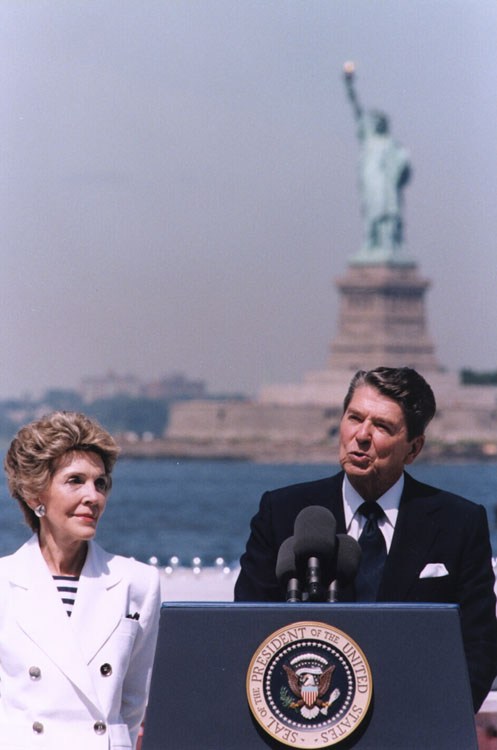
President Reagan and First Lady Nancy Reagan.

Whitmer herself brought up the 40th president of the United States: “In 1981, President Ronald Reagan spoke to the NAACP’s annual convention, and his comments stand in sharp contrast to what we have seen on the national and state level from his own beloved party in 2020. He said, ‘A few isolated groups in the backwater of American life still hold perverted notions of what America is all about.’ Recently, in some places in the nation, there’s been a disturbing recurrence of bigotry and violence.  Then Reagan sent a direct message to those who still adhere to senseless racism and religious prejudice: ‘You are the ones who are out of step with our society,' he said. 'You are the ones who willfully violate the meaning of the dream that is America. And this country, because of what it stands for, will not stand for your conduct.’”


Applebaum offers this chilling conclusion that provides the title for her book: “It is possible we are already living through the twilight of democracy; that our civilization may already be heading for anarchy or tyranny, as the ancient philosophers and America’s founders once feared…”


But, like Gessen, she offers explicit and implicit antidotes to a muddy downward slide toward autocracy. Explicitly: Build cooperation and coalitions; embrace allies; promote “rational thought, rule of law and integration;” and be “rooted to a place and yet open to the world.” Implicitly: become educated, practice critical thinking, and take the high road –– in the face of hate and anger, show love and kindness.