Showing posts sorted by date for query mike mullen. Sort by relevance Show all posts

Tuesday, June 24, 2025

Escape in Avoiding WWIII

Review by Bill Doughty

Armed missiles incoming. Artificial Intelligence at the controls. USS Gerald R. Ford (CVN 78) is the target. A hit…


Punk’s Force, a novel by Ward Carroll and Tony Peak (Naval Institute Press, 2025) hits hard from the very start and builds to a nail-biting climax. This book will especially appeal to tail-hook warfighters and the military’s test-and-evaluation community.


But, in the tradition of Tom Clancy and Stephen Coontz, Punk’s Force is also accessible and rewarding to civilian readers, especially anyone interested in international espionage and contemporary issues facing the United States in general and U.S. Navy in particular. It’s a jolt of a thrill ride.

Former Chairman of the Joint Chiefs of Staff Admiral Mike Mullen, USN (Ret.), agrees:


Punk’s Force is a tour de force of international intrigue and edge-of-your-seat flying action,” says Mullen. “It also accurately captures the high-stakes challenges facing the U.S. Navy today. I couldn’t put it down.”


Among the novel’s topical issues and themes: drones, hypersonic missiles and counter technology, cryptocurrency, and use of kompromat to corrupt leaders.


Some key lines that stick:

  • Avoid “the cardinal sin of underestimating rivals,”
  • AI abuse means “Dr. Frankenstein has lost control of his monsters,” and 
  • Bad guys profit even though “war, climate change, and injustice would destroy the planet if allowed to continue unchecked.”

The authors present believable characters with complicated psychological challenges and 3D family dynamics. Readers will enjoy the fun call signs, strong women characters, and realistic portrayal of life aboard an aircraft carrier: “That smell –– a combination of fuels, metal, and humanity.” Smells evoke other senses for any reader who has been aboard a CV or CVN –– the sounds of heavy metal punctuated by the 1MC; the sight of clean bulkheads and dirty hands; the feel of ladder rails and non-skid surfaces.


Realistic rivalries are also themes, including Navy vs. Air Force and brown shoe officers (aviators) vs. black show officers (surface warriors). Pecking orders within the military and between individual services are not only rank-based.

But true leadership is shown when there is universal respect and selfless support. The admiral participates in a FOD (foreign object debris) walk-down on the flight deck; he dines with junior enlisted Sailors and Chief Petty Officers; and he volunteers as a patient in a medevac drill.


The authors work in a reference to “the COVID Cruise” with details (but no names mentioned) of the heroic self-sacrifice of Capt. Brett Crozier, CO of USS Theodore Roosevelt (CVN 71), and how he took care of his Sailors in the early weeks of the pandemic. Such leadership is heralded in the writings of Stavridis, McRaven, and McChrystal.


Character counts in large amounts.


Ultimately, this book is a yin-yang of good vs. evil, service vs. greed, and devotion vs. betrayal. All the while, it builds with action and intrigue in a shadow of avoiding WWIII and the sinking of America’s lynchpin aircraft carrier. This is a good summer read and a proper escape from current chaos.


A blurb by former Director of Air Warfare Rear Adm. Mike “Nasty” Manzanir, USN (Ret.) reads, “From the throat-catching first chapter through the twists and turns, loops and breaks you’ve become used to flying with Punk, Punk’s Force is a constant full-grunt catsuit. Whether you’ve read all the books in the series or just pick this one up for your flight, you won’t put it down.”


In the authors' Acknowledgements, Ward Carroll, creator of the Punk series, thanks his wingman, Tony Peak, a gifted science fiction writer. Peak, in turn, thanks both Carroll and USNI: The Naval Institute's pedigree is impeccable, and I feel privileged to become a part of it."


Top photo: Aviation Boatswain's Mate (Aircraft Handling) 1st Class Sam Smith, assigned to air department aboard the world's largest aircraft carrier, USS Gerald R. Ford (CVN 78), directs an E/A-18G Growler, attached to the "Grey Wolves" of Electronic Attack Squadron (VAQ) 142, on the flight deck, April 14, 2025. (U.S. Navy photo by Mass Communication Specialist 3rd Class (Photo by MC3 Tajh Payne)

Second photo: An F/A-18E Super Hornet, attached to the "Tomcatters" of Strike Fighter Squadron (VFA) 31, launches from the flight deck of the world’s largest aircraft carrier, USS Gerald R. Ford (CVN 78), April 14, 2025. (Photo by MC2 Maxwell Orlosky)


Sunday, May 28, 2023

Memorial Day Sacrifice: True Patriotism

By Bill Doughty––

After reading the comprehensive January 6th Report by the Ninetieth Congress House of Representatives select committee, I keep reflecting on a line in one of the report’s forewords. Committee chairman, Bernie Thompson, wrote this: We can never go backward in the progress we have made through the sacrifice and dedication of true patriots. We can never and will never relent in our pursuit of a more perfect union, with liberty and justice for all Americans.”


Memorial Day, is an opportunity for all Americans to reflect on the sacrifices of individuals and families who paid the ultimate price for freedom and upholding of the Constitution and rule of law as true patriots.


On Friday, May 26, Secretary of Defense Lloyd Austin served as keynote speaker at Annapolis and delivered the commencement address to the 2023 graduating class at the U.S. Naval Academy.


Austin told the new Navy ensigns and Marine Corps second lieutenants they can be justifiably proud of their achievements, commitment to serve, and willingness to defend the Constitution and uphold an honorable ethos. 


“You seek wisdom. You practice discipline. You treat others with dignity and respect. And you will defend our democracy with honor, courage, and commitment. You know, those values aren’t just words that you recite. Those values are who you are. And that’s how I know that you are ready for the challenges ahead,” Austin said.


“As one of your predecessors once said, ‘We must adjust to changing times and still hold to unchanging principles.’That was President Jimmy Carter, Class of 1947,” Austin said, to applause. “And I’m proud that one of this school’s most distinguished alumni—a man of deep faith and a champion of human rights—is now honored on the Yard with the naming of Carter Hall.”


Austin also cited other distinguished graduates of the Academy, including Secretary of the Navy Carlos Del Toro, Adm. Michelle Howard, Adm. Mike Mullen, and John McCain.


Austin invoked the memory of sacrifices of military service members in past wars. “Ladies and gentlemen, look around you,” he said. “This stadium reminds us of the great battles in which those who came before you fought to defend democracy. Belleau Wood. Guadalcanal. Iwo Jima. Inchon. But what you don’t see here is all the battles that never occurred, all the wars that never erupted—because American Sailors and Marines showed up. They deterred conflict. They kept the watch. And they reminded the world of what America stands for.”


Austin added, “Class of 2023, wherever your career takes you, remind the world of what you stand for—and what America stands for: Honor, Courage, and Commitment. Democracy, Liberty, and the rule of law.” As true patriots.


The next day, Vice President Kamala Harris delivered a commencement address to the U.S. Military Academy at West Point’s 2023 graduating class. She said, “Each and every day, America's service members demonstrate extraordinary skill, dedication, and discipline. They are willing to sacrifice everything to protect the lives and liberty of people they may never meet. And I believe there is no more noble work that a person can do than to serve our nation in uniform. And today, then, to the Class of 2023: You join the greatest fighting force the world has ever seen … Our military is a force that underwrites global stability and our national security.”


Harris, who is the first woman to give a commencement address in West Point’s history, told graduates they are “leaders of character” will be tasked with essential leadership roles in defending the nation’s highest ideals.


She advised them to be guided by their oath to the U.S. Constitution “in all that you do.”


"You will take an oath to ‘support and defend the Constitution of the United States of America’ and, by extension, to support and defend our most sacred ideals: freedom, democracy, and rule of law.”


(American flag watercolor image courtesy of Francine Sreca, Pixabay.)


Thursday, September 9, 2021

BJR2: ’The World As It Is’ post-9/11

Review by Bill Doughty––

A "found haiku" while reading Ben Rhodes:


the tension between

the world as it is and … the

world that ought to be


“After the Fall” (reviewed in the previous Navy Reads post) drops onto book shelves three years after writer Benjamin J. Rhodes’s other reflections, similarly profound and just as achingly personal: “The World As It Is: A Memoir of the Obama White House” (Random House, 2018), where Rhodes dissects, among other things, the “forever war.” This is a sweeping look back at the United States after September 11, 2001.

In announcing the beginning of bombing of Afghanistan twenty years ago, just weeks after 9/11, then-President George W. Bush told military service members: “Your mission is defined; your objectives are clear; your goal is just. You have my full confidence, and you will have every tool you need to carry out your duty.” Then, in 2003, Bush and neoconservatives invaded Iraq under false pretenses.


Unfortunately, the original mission to fight terrorists in Afghanistan morphed into a long-term counterinsurgency initiative and a doomed nation-building effort in the middle of a perpetual virtual civil war, with no end in sight.

While some progress was made in Afghanistan over two decades, especially for women and girls, the changes were neither deep nor long-lasting, as evidenced by the immediate fall of the government and Afghan military and ascension of the Taliban.

Just as Reagan invited the mujahideen to the White House in the early 80s (photo above), Trump invited the Taliban and Afghan government to Camp David two years ago this week, a secret meeting that was canceled at the last minute after it became public knowledge. Then, Trump and his Secretary of State Mike Pompeo made a deal with the Taliban but did not include the Afghanistan government. Trump announced there would be a U.S. withdrawal by May 2021, but Biden postponed the withdrawal till the end of August.


Future historians likely will not question whether the American war in Afghanistan should have continued after twenty years; rather, they will dissect how the end of the war evacuation was conducted. Some have already asked why the United States stayed so long, left so much infrastructure and equipment behind, and provided (albeit unintentionally) so much combat training to the Taliban and regional terrorists. Why didn’t we leave sooner?

In “The World As It Is” Rhodes takes us back to nearly the mid-point of the twenty-year war in Afghanistan, to Obama’s Afghan Review. Rhodes was in the room where it happened. In fact, he provided a critical role as an advisor to Obama. Other advisors who weighed in as part of the Afghan Review included Vice President Joe Biden, Secretary of State Hillary Clinton, Secretary of Defense Robert Gates, CIA Director John Brennan, General Stanley McChrystal, General David Petraeus, and Chairman of the Joint Chiefs of Staff Admiral Mike Mullen*.


Rhodes writes:

“Gates argued that he wasn’t for a CT (counterterrorism) strategy or a full COIN (counterinsurgency) strategy –– he was for something in between, something that promoted a strong, effective government that delivers services to the people. When the shortcomings of the Afghan government were pointed out, Gates said that we should not give ‘one dollar or soldier’ for a corrupt government –– even though that’s exactly what we were doing. Petraeus said our goal was not to defeat the Taliban but to deny them population centers. Mullen talked about the psychological piece –– the need to create the impression that the Taliban will lose. For the same reason, Clinton said that putting in troops wouldn’t work but you still need to put in troops. It seemed to sum things up perfectly: We had created political pressure on ourselves to send in troops based on a theory of COIN; the review was determining that COIN couldn’t succeed; but all of the arguments still pointed to sending in the same number of troops. We are not going to defeat the Taliban, Obama kept saying. We need to knock them back to give us space to go after al Qaeda.”

Vice President Joe Biden was against any escalation, and CIA Director John Brennan recommended a limited surge just in order to target al Qaeda. When Obama asked Rhodes for his opinion, Rhodes said he agreed with Brennan –– and Obama. “Target, train, transition” became their framework for their strategy and tactics.

“Ultimately, Obama decided to send thirty thousand American troops to Afghanistan, with NATO getting us the rest of the way to forty thousand. We would announce it as a temporary surge –– in eighteen months, the troops would start to draw down. We’d secure Afghanistan’s major population centers, then shift to training and counterterrorism –– essentially endorsing the Petraeus-McChrystal approach for two years, and then shifting to the Biden-Brennan approach sooner than the military wanted. At Biden’s suggestion, Obama had all the principals memorialize their agreement with the plan in writing. It felt like a big much, but his was the lesson from Vietnam: Limit escalation.”


Prior to Biden, three presidents were unable to end the war in Afghanistan. But Obama ended the war in Iraq, ordered the killing of Osama bin Laden, and greatly reduced the cost of lives and cost of war in Afghanistan. Rhodes notes:

“Obama wanted to extricate the United States from the permanent war that had begun on 9/11. On the day he took office, there were roughly 180,000 troops in Iraq and Afghanistan. By late 2014, the number of troops in Afghanistan was down to 15,000. All U.S. troops were out of Iraq. These were meaningful achievements; they saved American lives, as casualty numbers fell from nearly a hundred Americans killed each month to nearly zero, and the cost of war shrank by tens of billions of dollars.”

*Rhodes now cohosts the podcast Pod Save the World. On a recent episode he noted how former CNO and CJCS retired Adm. Mike Mullen (pictured below with then-SECDEF Gates) expressed regret for not ending the American war in Afghanistan sooner.


In an interview with veteran journalist Martha Raddatz on ABC’s This Week, Mullen said, regarding the Afghanistan government and security forces, ” I thought we could build the army and give them a chance to create structures which would run a country in a much more modern fashion. That just is not the case.” Mullen added, “What I thought we could do and I advised President Obama that –– accordingly is I thought we could turn it around. Obviously, I was wrong.”

Mullen said, “I don't think it was possible for us to just abruptly walk away right after we killed bin Laden. But, clearly, we could have gone earlier than we did. As I look back and -- and a lot of people are critical of the president right now, President Biden had it right back then. He was focused singly on counterterrorism. His advice was along those lines. And he certainly said that. And I give him credit for that.”


(Ben Rhodes is President Obama’s former National Security Advisor for Strategic Communication and Speech Writing.)


Top photo: President Barack Obama meets with his national security team on Afghanistan and Pakistan in the Situation Room of the White House, June 23, 2010. Seated at the table are, from left, General David Petraeus, head of US Central Command, Admiral Michael Mullen, Chairman of the Joint Chiefs of Staff, Defense Secretary Robert M. Gates, Vice President Joe Biden, the President, National Security Advisor Gen. James L. Jones, Secretary of State Hillary Rodham Clinton, Chief of Staff Rahm Emanuel, Deputy National Security Advisor Tom Donilon, and John Brennan, Assistant to the President for Homeland Security and Counterterrorism. (Official White House Photo by Pete Souza)

Monday, June 7, 2021

Cutler Dawson: Truth, Trust & People First


Review by Bill Doughty

Thirty years ago this month, the guided-missile cruiser USS Princeton (CG 59) was undergoing repairs after being severely battle-damaged by an Iraqi mine while on patrol in the Persian Gulf during Operation Desert Storm. Princeton’s new CO, then-Capt. Cutler Dawson, quickly realized some of his crew members were as damaged as their ship.


While Princeton was being repaired in the shipyard, Dawson set out to help his sailors and their families recover from the shock and despair they were experiencing.

"The Princeton was in very bad shape, and so were some of the sailors. In addition, we had to work with a lot of strangers –– the shipyard workers –– who were in our spaces all day and night all over the ship.”


To prevent and counter any animosity between his sailors and the civilian shipyard artisans, Dawson went to the deckplates and got to know the workers, acknowledging their hard work and showing his and his crew’s appreciation.

“Our crew hosted picnics for the shipyard workers and we singled out the ones who were doing a really good job by writing thank-you notes to them and their supervisors. With a smile, I would tell all the technical representatives who came aboard to fix our radar and combat systems that I would house and feed them as long as it took to fix the problem and that my crew was ready and willing to assist. I wanted to foster a sense of teamwork and motivate them with encouragement, not criticism. After all, we were somewhat codependent on this project to be successful and, as the saying goes, ‘You get more with honey than you do with vinegar.’”

To paraphrase Dawson in another metaphor in his book “From the Sea to the C-Suite: Lessons Learned from the Bridge to the Corner Office” (Naval Institute Press, 2020): when it comes to carrots or sticks, choose carrots!

He offers leadership advice from his perspective as a retired vice admiral and former CEO of the Navy Federal Credit Union. He shows the value of passion and compassion, energy and empathy, and incentivizing and innovating. Most of all, he demonstrates the importance of truth, trust, and putting people first.

“If you can demonstrate to your crew members that you care about them and truly understand the difficulty of their tasks, they will do remarkable things for you; by contrast, if they think you are there just to further your own career, they will do no more than the minimum.”

While USS Princeton was being repaired Dawson kept his crew busy preparing for exams and certifications, staying positive and focused on trying to achieve work-life balance. He instructed his executive officer to organize recreational outings, and he promoted training on nutrition and leading healthy lifestyles. At NFCU, he instituted some of the same strategies –– including smoking cessation, yoga, and running 5Ks –– while nurturing a family culture not only for employees but also for customers, who are called “members” of the credit union.


Dawson checks an NFCU machine at Camp Lemonnier, Djibouti.
NFCU members include sailors and marines and their families as well as DOD civilians and other military personnel and their families. Dawson quadrupled membership and grew the business exponentially –– even to Djibouti on the Horn of Africa –– while demanding the highest standards of integrity and customer service. He says he demands “honesty and transparency from my employees.” “As I always say, I want to hear the truth, even though I may not always like the truth.”

Some surprising nuggets in this book include a connection with Rear Adm. George Morrison, father of the Doors’s Jim Morrison; a visit the USS Midway in the Sea of Japan; an attempt to expand library hours for his sailors after work; an order to one of his officers to get in the bosun’s chair; and reflections about two separate collisions by Navy ships in the Pacific in 2017.


The USS Princeton shipyard vignette is just one of the many sea stories and some of the salty logic Dawson offers in this remarkable book. For example, he explains the concept of “Unodir” (unless otherwise directed), remembers what he learned from “holystoning” a teak deck, and tells why leaders must look beyond their "lifelines."


He references poignantly, more than once, what it was like to have a thoughtless, uncaring, and mean-spirited CO as a boss. You can learn how not to be when you’ve seen a bad leader in a senior leadership position.


Builder Constructionman Matthew Best, from Stockton, Calif., assigned to U.S. Naval Mobile Construction Battalion (NMCB) 3’s Detail Tinian, reaffirms the proper placement of a gable-end on a Southwest Asia hut being constructed on Camp Tinian, Northern Mariana Islands, July 28, 2020. (CBSN Marcus Henley)

Finally, Dawson puts a big spotlight on the power and ethos of the Seabees (Construction Battalion engineers/Sailors) –– “Be a Seabee and find a way to ‘get to yes.’” He shows how the Seabees’ “can do” attitude as warriors, builders, and humanitarians accomplished the seemingly impossible in World War II, the Korean War, in Vietnam, and in the Middle East. And they continue to build on their legacy.


RDML Annie Andrews and Dawson
In other salty references he cites the influences of the biography of John Paul Jones, the history of USS Constitution, and the education provided at the U.S. Naval Academy. Dawson is a distinguished graduate of the class of 1970. “The lessons I learned in the Navy were directly transferrable to the business world,” Dawson says.

A lot of Dawson’s hands-on leadership advice mirrors that of retired Navy Captain David Marquet in his landmark book, “Turn the Ship Around” –– another highly recommended Navy read.


“C-Suite” is endorsed by Adm. (ret.) Mike Mullen, Adm. (ret.) Robert J. Natter, Army Gen. (ret.) Barry R. McCaffrey, and Adm. (ret.) James Stavridis, among others. It’s not surprising that many of the insights, including “follow your North Star,” are reminiscent of Mullen (“Look. Listen. Learn.”) and Stavridis, who often speaks of sailing "True North."


“Having a strong commitment to public service was at my core,” Dawson writes. His North Star is “Always do the right thing” –– Demand truth, develop trust, and always keep people first.


At the end of each chapter of “From the Sea to the C-Suite” is a “Foot Stomper,” in maritime lingo a synopsis of his key point for added emphasis. The book’s foreword is by Vice Adm. (ret.) John A. Lockard, chairman of the board of the Navy Federal Credit Union. The book was written with Taylor Baldwin Kiland, who has authored, edited, or ghostwritten 18 books, “including two about our nation’s Vietnam POWs.”


In January 2019 Dawson handed the reins as NFCU CEO to Mary McDuffie, former Chief Operating Officer of Navy Federal Credit Union.

Monday, April 19, 2021

Earth Day & ‘Ten Lessons for a Post-Pandemic World’

Review by Bill Doughty

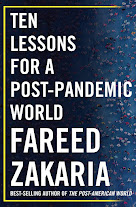
Fareed Zakaria takes a global look at the past to predict the future in “Ten Lessons for a Post-Pandemic World" (W.W. Norton & Company, 2020). In fact, Zakaria takes an out-of-this-world look at the impact of disease, pollution, and climate change on human survival:

“Climate scientists who warn of the dangers of our current path are unconsciously mirroring Nobel laureate Joshua Lederberg’s warnings to us about viruses, back in 1989. Like him, they are urging us to assume that nature is a benign force that has any particular interest in the survival of life on this earth. The climate doesn’t care about us; it is simply an accumulation of chemical reactions that could easily get out of control and destroy the planet and all who live on it. Millions of other planets in other celestial systems may have suffered the same fate. In our own solar neighborhood, NASA’s recent computer modeling suggests that Venus (above) might have been habitable for around 2 billion years, after which a ‘runaway greenhouse gas effect’ led to the scorched and sterile conditions on the Venus of today. We can mitigate the forces that are pushing the earth in a similar direction. If that is not a sound reason for cooperation, then we will not find another.”

Non-cooperation within and between nations can be life-threatening.


Cooperation, on the other hand, can be lifesaving. That’s a chief lesson of the COVID-19 pandemic: telling the truth, marshaling resources, and cooperating together can reduce the number of cases and prevent deaths.


“If people cooperate, they will achieve better outcomes and more durable solutions than they could acting alone,” Zakaria writes, in what sounds a lot like Adm. Mike Mullen’s ‘A Cooperative Strategy for 21st Century Seapower’ from 2007. Zakaria continues, “If nations can avoid war, their people will lead longer, richer, and more secure lives. If they become intertwined economically, everyone ends up better off.” Updated versions of the U.S. Maritime Strategy continue to note the interconnectedness of nations sharing the same oceans.

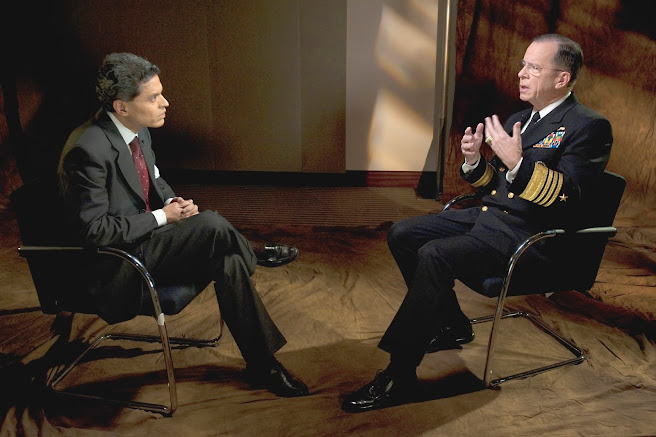
Zakaria interviews then-Chairman of the Joint Chiefs of Staff Adm. Mike Mullen in 2010. They discussed, among other topics, a drawdown of troops in Afghanistan.

Such idealism is not blindfolded. With China’s saber-rattling toward Hong Kong and Taiwan, as well as it’s maritime claims in the South China Sea, the world may be on the verge of another Cold War. Yet Zakaria writes, “Tensions between the United States and China are inevitable. Conflict is not.”

Zakariah shows how a “deeply interconnected” world can prevent wars despite “a real-life butterfly effect,” in which a fluttering butterfly’s –– or bat’s –– wing can supposedly influence the wind and eventually weather patterns on the other side of the world.

“There is a paradoxical feature of pandemics: even though they have come to be named for specific locations, they are decidedly not contained by borders. This has been true for centuries, since the Silk Road caravans and merchant galleys of the medieval world, and especially over the past 150 years since the age of steamships and trains. There was the ‘Russian flu’ of 1889-90, the ‘Spanish flu’ of 1918-19, the ‘Asian flu’ of 1957-58, the ‘Hong Kong flu’ of 1968-69, the ‘Middle East Respiratory Syndrome’ (MERS) of 2012, and now the ‘Wuhan virus’ of 2019-21. By revealing obsession with foreign labels, these names –– even when incorrect as to the origin of the virus –– betray the diseases’ much wider reach. The urge to view a pathogen as coming from abroad is strong, but of course, those diseases have rarely been known by those monikers in the places they’re named for. In Spain, the ‘Spanish flu’ was just the flu.”

Naturally, Zakaria –– a voracious reader –– cites numerous authors and books: William Maxwell’s “They Came Like Swallows,” Katherine Anne Porter’s “Pale Horse, Pale Rider,” Thomas Friedman’s “The Lexus and the Olive Tree,” Francis Fukuyama’s “Political Order and Political Decay,” and Michael Lewis’s “The Fifth Risk,” for example.

Other writers and thinkers he cites include Shakespeare, Clausewitz, Ian McEwan, Yuval Noah Harari, and Doris Kearns Goodwin.


Zakaria quotes Apple CEO Tim Cook, who, like Henry J. Kaiser in the past century, believes that his company’s “greatest contribution to mankind … will be about health.” (Kaiser, who helped shape history in the American West and in World War II, is featured in the most recent Navy Reads post earlier this month.)


It’s in his evaluation of history that Zakaria makes his most insightful conclusions about the importance of international cooperation in the wake of the pandemic –– and toward continued world peace.

“Franklin Roosevelt was assistant secretary of the navy in Woodrow Wilson’s administration and a great admirer of Wilson’s vision of a world ‘made safe for democracy’ He watched that idealism collapse in the years after World War I, leading to an even wider war during his own presidency. But the lesson FDR drew from Wilson’s experiences was to try international cooperation again, this time with America at the center of the new system –– and this time giving the great powers stronger practical incentives to fully commit themselves to the peace. A few months after America entered World War II, when victory was still uncertain and distant, FDR began formulating plans to create international institutions and systems of collective security that made future world wars unlikely. His longtime secretary of state, Cordell Hull, having seen how the trade wars of the 1930s spiraled into hot war, singlemindedly championed a new, international free trade regime. His successors realized this vision in the years after 1945 –– first through the General Agreement on Tariffs and Trade, which evolved into the World Trade Organization.

Roosevelt was known to be an idealist at heart, but his successor, Harry S Truman, had no such reputation. Truman is credited as the hard-nosed realist who dropped the atomic bombs on Hiroshima and Nagasaki, created NATO, worked to contain the Soviet Union, and waged war in Korea. But Truman was also a deeply idealistic man, and he too had drunk from the well of Wilsonian internationalism.”

Truman, when asked why he strongly supported the United Nations, would quote from Alfred Lord Tennyson’s poem Locksley Hall,” a poem which foresaw a world where cooperation reigned and nations formed a federation based on peace, commerce, and “universal law.”


Twice in this book, Zakariah recalls Dwight D. Eisenhower’s visit to the U.S. military cemetery at Colleville-sur-Mer in Normandy (above) on the twentieth anniversary of D-Day. In an interview with Walter Cronkite, Eisenhower, who as president had called for abolishing nuclear weapons worldwide and strengthening the UN, spoke to Cronkite about the 9,000 American bodies buried there: “These people gave us a chance, and they bought time for us, so that we can do better than we have before … So every time I come back to these beaches, or any day when I think about that day 20 years ago now, I say once more we must find some way to work to peace, and really to gain an eternal peace for this world.”


“Ten Lessons” advocates for people listening to experts –– and experts listening to people. One lesson is that “what matters is not the quantity of government but the quality.” Another is about the reality of virtuality: “Life is digital.” Still another is recognizing the rise of ultranationalism and that “the world is becoming bipolar” as well as more unequal.

U.S. Marine Corps Cpl. Larry Hunter, an energy NCO with Headquarters Battalion, Marine Corps Base Hawaii, monitors as a child spins a questionnaire spin wheel during an Earth Day event, Apr. 23, 2019 about the importance of energy conservation, recycling, and protecting the environment. (Sgt. Zachary Orr)


But the most important lesson, one that permeates the whole book, is the importance of the world’s interconnectedness and need for cooperation.


George W. Bush initiated a war on AIDS in Africa. Obama/Biden led the global battle to contain the Ebola virus in Africa. Unfortunately, in early 2020, despite declaring war on COVID-19, the Trump administration failed to acknowledge and confront the threat and provide a centralized plan for testing, tracing, and telling the truth.

“By the middle of 2020, tragically, with the pandemic raging across most of its fifty states –– long after Europe and East Asia contained their outbreaks –– America had no attention for anything or anyone else, except to bash Beijing. The Trump administration is not wrong to critique China’s handing of COVID-19. But coming from such a messenger, the message lands with a thud. A lifelong friend of America, the former Australian prime minister Kevin Rudd wrong in Foreign Affairs of his horror and disappointment over how far America has fallen: ‘Once there was the United States of the Berlin airlift. Now there is the image of the USS Theodore Roosevelt (CVN-71) crippled by the virus, reports of the administration trying to take exclusive control fo the vaccine being developed in Germany, and federal intervention to stop the commercial sale of personal protective equipment to Canada. The world has been turned on its head.’”

At the beginning of March, 2020, only a few people in the United States had died from COVID-19, but the number of cases was beginning to grow exponentially. By the end of April, just after the United States commemorated the 50th anniversary of Earth Day, there were more than 1 million cases in the U.S. and more than 60,000 deaths –– despite messages from President Trump that everything was under control, the virus would go away, people should take Hydroxychloroquine, and we should try injecting bodies with disinfectants (one year ago this week).

A runner pushes through the last 100 meters of a 5K Earth Day Fun Run at Marine Corps Air Ground Combat Center, Twentynine Palms, April 2014. (Cpl. Ali Azimi)

One year later, on Earth Day 2021, there have been nearly 570,000 American deaths. But a coordinated vaccination campaign is working now to reduce cases and fatalities. Unfortunately, the world has suffered 3.1 million deaths due to the novel coronavirus pandemic, and new variants threaten everyone.

“Ten Lessons” presents the stark realities and possibilities ahead; Zakaria warns about the near certainty of another pandemic this century in a connected world. But he also presents an optimistic message about the possibilities ahead if the nations of the world become more educated, more equal, and more committed to cooperation to confront existential threats, including global climate change.


Idealism is not dead. Hope is alive. And the opportunity for lifesaving cooperation is here now despite –– and because of –– the pandemic.