Sunday, October 18, 2009

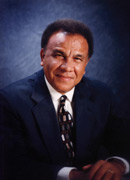
Dr. Betances: "You Can't Lead if You Don't Read"


How important is reading?
Ask Dr. Samuel Betances, diversity advisor to Chief of Naval Operations Adm. Gary Roughead, and three U.S. presidents...Betances, who conducted "Strengthening the Navy Through Diversity" training for nearly 1,000 people at Pearl Harbor, Hawaii, Oct. 13-15, talks about the power of books...and words...and mentors...and, most importantly, diversity.
The cover of Pulitzer Prize winner David McCullough's book John Adams flashes on the screen early in one of Dr. B's training, along with this quote from Adams:
"Freedom is a wonderful thing, provided you have the courage to defend it."

So there it is, plain and simple. Diversity is freedom...

* Freedom from discrimination, from harassment and from a hostile workplace.

* Freedom for an equal opportunity to achieve.

* Freedom to be respected.

Two books about respect that Dr. Betances recommends:
Back off by Martha Langelan and Diversity Toolkit by William Sonnenschein.

In his training, Dr. Betances shares his personal journey from high school dropout to educated scholar with two post-graduate degrees from Harvard University, consultant to two U.S. presidents.

His education started with a caring mentor who had the courage to confront him and say, "It's not intelligence you lack; you don't have enough words."

As Dr. Betances points out, people in poverty use an average of 1,500 words. People in the middle class, especially those who were read to as children, use 3,500 words.

In order to succeed, one must read...

As a very young man, Betances was encouraged to read "the literature of resiliency" - the memoirs of others who faced difficulties: people in death camps, under slavery or in relocation camps.

Two books he says changed him forever:
The Narrative of an American Slave by Frederick Douglass ("a book to share with your entire family") and Man's Search for Meaning by Viktor Frankl.

These books opened his mind and helped him sharpen his critical thinking.

As a better thinker he is able to recognize cultural shifts, discard faulty assumptions and recognize not only the letter of the law but also the spirit of the law.

By the way, that's the difference between equal opportunity and diversity, according to Dr. B.
EO is the law; diversity is the spirit of the law.
It's not good enough to enforce laws against illegal discrimination; we must actively prevent legal discrimination, where members of a preferred group are included in a so-called "circle of trust," to which outsiders are not welcome.

Are there good and bad Circles of Trust?

As Dr. Betances points out, studies revealed in the works of
Malcolm Gladwell (author of Blink, Tipping Point and, especially, Outliers) prove that those who are included in a group - for whatever reason - are
more likely to succeed.

Those who are included and made to feel welcome in an organization will succeed.

Those who get informal coaching in a complex organization like the Navy are better equipped to retain what they learn in a classroom.

And, "If your organization is complex," says Betances, "you need diversity."

As part of his training, Dr. B. plays a
CSPAN clip of The Director of National Intelligence, Retired Adm. Dennis Blair, former Commander in Chief of U.S. Pacific Command.

Admiral Blair recognizes the benefits of "being as diverse as possible so that we can better understand people around the world."

Such thinking should be intuitive, and intuition is often undervalued. So says Malcolm Gladwell in
Blink.

Gladwell is mandatory reading at the
Naval Academy, under the leadership of Vice Adm. Jeff Fowler.

This year the Naval Academy has achieved record-breaking numbers of minority accessions - more than one-third of the class of 2013. The people who have the biggest advantage at the academy, according to Betances, are the children of military families, regardless of gender, economic background or other factors.

Why?

Because those children from military families are part of a greater, wider circle of trust; they are made to feel welcome in the organization. They get the informal coaching and mentoring and one-on-one time with experienced people who care.

"We increase our cultural competencies in informal networks," says Betances. And cultural competencies are keys to success.

Want your child to succeed?

In a sidebar discussion between training sessions, Dr. Betances shared this advice: "Have your son or daughter become a tutor. Have them teach someone. The person they help will leapfrog forward, and the tutor, your son or daughter, will catapult to the front."

Dr. Betances: "You can only keep what you give away."

Back to books...

Is that one of the hidden benefits of reading, that books - often freely available, filled with insights and ready to teach us - can be our mentors?

(I'll have to read more about that...)

Other books discussed or recommended by Dr. B.:

The Nature of Prejudice by Gordon Allport

The Disuniting of America by Arthur M. Schlesinger, Jr.

Making the Impossible Possible by Bill Strickland

Shattered Sword by Jonathan Parshall and Anthony Tully

Women in the Military by Maj. Gen. Jeanne Holm, ret.

Future Think by Edie Weiner and Arnold Brown

Go For Broke by C. Douglas Sterner

Rising Sons by Bill Yenne

Women Pilots of World War II by Jean Hascall Cole

Reel Bad Arabs by Jack G. Shaheen

The Other Face of America by Jorge Ramos

Our Separate Ways by Ella LJ Edmondson Bell and Stella M. Nkomo

Cane Fires by Gary Y. Okihiro

Leading from the Front by Angie Morgan and Courtney Lynch

The World is Flat by Thomas L. Friedman

Hot, Flat, and Crowded by Thomas L. Friedman

Ten Steps to the Head of the Class by Samuel Betances

How important is reading?

"If you don't read, you can't lead."

The
Navy Reading Program recommends titles tailored to various levels of leadership.

Sunday, September 20, 2009

"Negotiating With Iran: Wrestling the Ghosts of History"

NPR's Scott Simon interviewed John W. Limbert, professor of International Affairs at the U.S. Naval Academy, this weekend about his new book, Negotiating With Iran: Wrestling the Ghosts of History. Ambassador Limbert, who was held as an Iranian hostage for 444 days 30 years ago, offers his perspective on a dialog with Iran. Is negotiation equivalent to surrender or appeasement or weakness? NPR's Michele Kelemen interviewed Limbert for a story late last month, too, focusing on the importance of listening, showing respect and demonstrating a willingness to engage... President Barack Obama says he would like to make some kind of direct contact. This weekend, Defense Secretary Robert M. Gates says changes to the U.S. missile defense plan will offer better protection than a previous proposal even if intelligence forecasts on Iran prove wrong.

Monday, September 7, 2009

Here Comes Everybody by Clay Shirky


Review by Bill Doughty

Superfreakonomics comes out soon, as we learned earlier this month when our blog and Roxanne Darling’s photo from USS Nimitz were featured on the New York Times .com’s Freakonomics blog. Meantime, here’s a book in a similar vein...

Here Comes Everybody grabs you from the first chapter. What happens when someone loses her phone in the back seat of a taxi and the finder of the phone refuses to give it back?

The unfriendly, recalcitrant phone-finder gets a virtual butt-whupping, thanks to the power of social media to share information, encourage cooperation and foster collective action. The story is hilarious.

Clay Shirky fills this topical book about social networking with lots of stories, anecdotes and reports that illustrate the tectonic (“tech-tonic”?) shift we’re experiencing thanks to technology. Among his examples:

  • How collective action exposed the Catholic priest sex abuse (and institutional coverup) scandal because of shared information via the Web, e-mail and blogs in 2002.
  • How airline passengers who experienced poor customer service pooled information and resources to bring about a passengers’ bill of rights in 2006.
  • How, thanks to Twitter and QQ (China’s largest social network), the world quickly became aware of the massive earthquake in Sichuan Province on May 12, 2008. Shirky reports that a Wikipedia page was created 40 minutes after the quake. The page provides a comprehensive review of the quake and its aftermath, including the controversy surrounding construction of the buildings and access to information within China.

Coming after publication of this book is another illustrative example of social media’s power: street protests in the wake of this year’s elections in Iran, fueled by Twitter and other sites.

Shirky explains how shared awareness can bring about social action in the information age.

In 1989 small protests in Leipzig, East Germany grew steadily till 400,000 people turned out as a “flash mob,” pictured above, leading to the downfall of the communist government and the destruction of the Berlin Wall.

The lesson for repressive states was: “Don’t let even small protests start, and don’t let the documentation get out.” Reading this gives you an appreciation for our founders’ wisdom about freedom of expression and freedom of assembly, among the inalienable rights of all people.

As Shirky puts it, “With the arrival of globally accessible publishing, freedom of speech is now freedom of the press, and freedom of the press is freedom of assembly.”

But, to paraphrase Spider-Man creator Stan Lee, with great freedom comes great responsibility.

Shirky notes that social systems cannot be of value without some sort of governance, and the best form of control is self-control from a feeling of love and devotion.

Wikipedia shows the overall effectiveness of collective governance out of a passionate devotion to truth. Individuals can edit, but a group can provide democratic oversight.

Free expression through collaboration and cooperation has replaced a great deal of institutional planning and bureaucratic control -- another part of that tectonic shift we’re all experiencing.

Shirky provides an example from military history:

In May 1940, the German army was smaller than France’s. The Panzer III and IV tanks were smaller and less armored than the French Char Bs. But, Germany won decisive victories in its Blitzkrieg, or “Lightning War” attacks because of one difference -- radios.

Communication transformed standalone tanks in to a coordinated, networked group weapon that required a much higher degree of autonomy among commanders coordinating actions in the field.

Which is not to say the Germans in 1940 had the right message... just better technology and tactics for their time.

Technology can be abused by people, whether invading another country or refusing to return a cell phone.

Social media can be misused by cyber-vandals posting false information on Wikipedia or bullying someone on Facebook.

But, collective goodness in people can police the commons, tell the truth and provide governance; that’s ultimate freedom. Freakonomics comes to a similar optimistic conclusion about collective goodwill.

Other cool stuff in Here Comes Everybody:

  • Homophily and “Small World” pattern show the effects of probability underlying the six degrees of separation.
  • Social media can connect everyone through a disproportionately few people, called “connectors” by Malcolm Gladwell in Tipping Point.
  • The “Nash Equilibrium,” Pareto as relates to social networking, the “Birthday Paradox,” and homeostasis of group structures, among other laws and principles.

The last two words of Here Comes Everybody are “epochal change,” a great way to describe our collective experience as the millennial generation comes of age.

This is a time in history when those of us born prior to 1980 need to unlearn much of our assumptions, according to Shirky: that news about politics and announcements about jobs come from newspapers; that music comes from stores; that conversations are only by phone; that complicated things like software and encyclopedias have to be created by professionals.

Luckily, as Here Comes Everybody makes clear literally and tangibly, for people of all ages there is still a place in this world for books.

Note: My friend Nancy Harrity, introduced me to this book, along with Groundswell by Charlene Li and Josh Bernoff, another really good read on a similar topic, written from a business organization standpoint. In September 2009 Nancy is finishing a gig as public affairs officer for Pacific Partnership 2009, a Navy mission with international partners that builds friendship and promotes peace. Here Comes Everybody is not on the Navy's Professional Reading Program, but it would be of interest to anyone in or out of the military trying to put social media in context.

Friday, August 14, 2009

Freakonomics - A Rogue Economist Explores the Hidden Side of Everything by Steven D. Levitt and Stephen J. Dubner

Review by Bill Doughty
I would not recommend Freakonomics to anyone who knows exactly how the world works. Don't read it if you already have the answers to all of life's questions. It's not for people who are easily offended, either. However, for the rest of us, read on...

(Freakonomics at sea)


Written by a completely out-of-the-box economist named Steven Levitt, with help from New York writer Stephen Dubner, Freakonomics challenges conventional wisdom and assumptions on both sides of all fences.


Freakonomics
key points:


"Knowing what to measure and how to measure is the key to understanding modern life," and "if morality represents the ideal, then economics represents the actual world."

Through measurements and analysis, and without being moralistic, Levitt spends most of the book presenting evidence of dishonesty in the actual world - cheating by Japanese sumo wrestlers, Chicago school teachers, day care parents, online daters, funeral directors, and bagel buyers, among others.
His conclusions are based on facts, metrics, and other data, and they are compelling.

The bad news: Many people will lie, cheat, and abuse power.


The good news: With the right incentives, the vast majority of people are, and remain, honest.


So what are the right incentives?


What do you think?


Freakonomics
teases the reader to formulate his or her own opinion, but provides ways to step up and see over the fence.

Challenging conventional wisdom and superstition, this book promotes critical thinking. Take, for instance, the issues of abortion and gun control and their relevance to crime. Without making any outwardly moral judgments, Freakonomics explores these and other red-hot issues like the death penalty, crack cocaine, discrimination and the role of parents in raising children.
Some chapters may make you laugh, shake your head, or read passages aloud to your friends and family. A friend of mine couldn't resist writing arguments in the margins of his dog-eared copy.

Here are a few things you can discover in Freakonomics:


You'll see evidence that drug-dealing gangs have a similar business structure and hierarchy as McDonald's.


You'll learn that the Ku Klux Klan was a largely ineffectual group by the late 1950s, undermined by a children's television show.


You'll read the story of Robert Lane and two of his sons - one he named Winner and the other Loser. Which young man did well in life? How important is the name your parents gave you?


You'll see whether having lots of books in the home contributes to success later in life - which is intriguing information for supporters of the Navy's Professional Reading Program.


Freakonomics
delves into the science of "cause and effect," "correlation," "nature and/or nurture," "fear," and the power of incentives in influencing behavior.


The three "basic flavors" of incentives according to Levitt are economic, social and moral. They are often most effective when combined such as in the U.S. anti-smoking campaign.


But, as asked earlier, what are the "right," most effective incentives in life?


Though not stated outright in the book, here’s what Freakonomics suggests: You can incentivize honesty, hard work, and good will by trusting in people, listening to them, and showing them love.

It’s that simple and that profound.


You don’t have to agree with all of the conclusions in Freakonomics in order to appreciate the authors’ courage in raising controversial questions, challenging assumptions and opening a dialog about critical, skeptical thinking.

Freakonomics is one of many great reads at the Navy Professional Reading Program. You can learn more about the program here.

For a cool Freakonomics essay by Tipping Point author Malcolm Gladwell click here.

To follow the Twitter-like Freakonomics blog at The New York Times, click here.

Special thanks to Roxanne Darling and Nathan Kam for use of their photos from an August 2009 embarkation to USS Nimitz. Roxanne left a really nice comment after the July 12 interview post with Prof. Jackson. I hope you'll scroll down and take a look.

Sunday, August 2, 2009

What Warriors Read -- to Learn, for Escape?

By Bill Doughty

Catching up this week, after the interview with Professor Jackson, manager of the Navy Professional Reading Program. I want to highlight comments received by two Sailors a while back that I didn’t want to get “lost in the sauce”...

“Christine,” a public affairs officer, and CAPT Hansen, officer in charge of Navy embedded training teams, posted these comments to my review of The Kite Runner in May. In a few words they say so much -- about religion, father-son relationships, diverse viewpoints and book recommendations for families when loved ones are deployed -- above all, putting things in context:

I don't know if these are universal, but before I left, people recommended "Lone Survivor," which is Marcus Luttrell's account of the battle that killed the rest of his Seal team in the mountains of Afghanistan. Also recommended were A Thousand Splendid Suns and Three Cups of Tea. I'll confess that I've only gotten to Lone Survivor myself (I read The Kite Runner awhile back), but the others are on my list.

I'm a huge reader -- my Kindle is my prized possession here, right behind my laptop. I don't watch a lot of television, and I haven't even looked at the 300gb of movies I brought with me. Instead, I read a lot of fluff -- pure escapist nonsense. Some of it with more literary merit than others. I do like to read the books that I learn something from, but it's also important to have the fun reads.
Christine
========================================

Your comment wrapped up Kite Runner like the crib notes of a good book report. I like the way that you tied up the analogies for me. The book was riveting for me on two personal paths - spiritual and relational. It was interesting to reflect on my adherence to and divergence from my religious beliefs. Seeing the son attempting to be himself and please his father, whom he respected immensely brought me to reflecting on my relationship with my father, growing up, and my relationship with my son.

The Thousand Splendid Suns is even more poignant regarding the place of women in Afghan society.

Both books are must reads to get prepared for a deployment here. The service member must remember though that people are individuals. Although there is societal adherence to Islam, there is some variation as to how conforming people are just as in the U.S. people profess one religion or another, but live varying degrees of it.

Three Cups of Tea is recommended for those deploying too. It is much more positive than the other books mentioned here. Spouses and loved ones remaining behind should read Three Cups so that they have something positive to contemplate in the absence of their service member.

Dennis M. Hansen
OIC NAVY ETT

Other perspectives...

From Tikrit, Iraq a friend wrote to me that folks he knows are reading escapist books like Twilight and Clash of Kings. He said in an email, “We just read the books people send us.” Graphic novels are a hit with some of the Americans serving there. Speaking of Twilight, I heard on a podcast last week that, with the U.S. economy in a downturn, romance novels are back in vogue.

Like Christine said, fun reads are important too.

Back at my office in Hawaii, my colleagues and I sometimes talk about books around the watercooler, where a co-worker suggested reading Lionel Trilling. I checked out Trilling’s Beyond Culture: Essays on Literature and Learning and found a fascinating thinker. Trilling’s decades-old essays were well worth dusting off and examining. He dissects T.S. Eliot, George Orwell, Mark Twain and Hemingway, among many others.

Mark Twain could help readers escape and learn... Was he America’s greatest writer?

Sunday, July 12, 2009

A Conversation with the Creator... of NPRP

Captain John Jackson, SC, USN (ret) has been the program manager for the Navy Professional Reading Program since the program was first envisioned by the CNO. Jackson is a full professor at the Naval War College, in Newport, Rhode Island. Prior to his retirement from the Navy in 1996, he was a supply and logistics specialist with more than 27 years of experience both afloat and ashore. He holds advanced degrees from Providence College and Salve Regina University; is a graduate of the Management Development Program at Harvard University; and he completed the College of Naval Command and Staff in 1983. His doctoral research addresses the influence of technology on the human condition. We interviewed him exclusively for Navy Reads blog but encourage others to publish this interview about the origins of the Navy Reading Program.


How did the NPRP get started? Who had the idea for it; what was the spark that got it started?

Shortly after being named as CNO, ADM Mike Mullen requested the Naval War College to develop a Professional Reading Program that was more than just a list of suggested titles of books to read. Over the fall of 2005 and the spring of 2006, we developed the “matrix” structure of what became the Navy Professional Reading Program (NPRP). The Program consists of 6 areas of skills/competencies needed by all Sailors:

- Critical Thinking
- Joint and Combined Warfare
- Regional and Cultural Awareness
- Leadership
- Naval and Military Heritage
- Management and Strategic Planning

Within each of these areas, books are recommended for various grade levels, although every Sailor is encouraged to read any book in the NPRP Library, as well as other books of merit. The overall library is divided into various collections, as an aid to those readers who are looking to focus their reading on books of particular relevance at their particular career point. The collections are:

• Junior Enlisted Collection
• Leading Petty Officer Collection
• Division Leaders Collection
• Department/Command Leaders Collection
• Senior Leaders Collection

We formed a Navy Professional Reading Program Advisory Group, and nominated 60 primary titles to the Chief of Naval Operations for his approval. Once approved by ADM Mullen, we obtained funds, purchased over 65,000 books, and distributed them to 900 locations around the fleet. The official kick-off was in October 2006, when the Navy gave itself a birthday present: The NPRP.

The first complete NPRP Library was hand delivered to the oldest ship in the Navy, USS Constitution, in celebration of the Navy’s 231st Birthday.

The “spark” that got it started came directly from the Chief of Naval Operations, and it continues to have the personal interest and support of ADM Roughead and Master Chief Petty Officer of the Navy Rick West.

How many people collaborated on recommending books in 2006?

The NPRP Advisory Group included representatives from the Naval Academy, the Naval Postgraduate School, the Naval War College, the Naval Historical Center, and the Senior Enlisted Academy. We also got input from the U.S. Naval Institute, the Commander, Naval Installations Command (which operates base libraries) and other sources. Altogether, over a dozen individuals considering several hundred books before the final 60 titles were approved by CNO. Many of the books that did not make the cut for the primary library are now listed as “Supplementary Suggestions” on the NPRP website.

What were some of the criteria for selecting titles?

• The books must be currently in print, and thus available for purchase and distribution.
• All titles must address one or more of the skills/competencies in the program matrix.
• The books should cover topics and issues of enduring value.

Do you have any anecdotes or stories about how the NPRP helped individuals? Have senior Navy leaders told you the program is helpful?

In 2007, a survey was conducted by the Navy Personnel Research, Studies, and Technology organization. Seventy-five percent of the senior leaders surveyed said that “The NPRP will make the Navy of tomorrow better than the Navy of today.” Aboard USS Vella Gulf (CG-72), the CO established a “Heritage and History Leadership Essay” contest where Sailors could win cash awards for writing about books from the NPRP. The skipper of USS Stockdale (DDG-106) asked for a NPRP library during their pre-commissioning work-up, since he felt these books would help shape his crew into the cohesive fighting unit they are destined to become.

You've quoted CNO Adm. Gary Roughead as saying the NPRP should be used as a "starting point." Can you give us short list of recommended additional titles, beyond what's on the original 2006 list?

In February 2009, CNO released the first revision to the NPRP, which we call NPRP 2.0. This revision added five great new titles to the NPRP library:

Lone Survivor by Marcus Luttrel
Aircraft Carriers at War by James L. Holloway, III
The Elephant and the Dragon Robyn Meredith
Forgotten Continent by Michael Reid
Six Frigates by Ian Toll

We also recommend Wired for War by P.W. Singer (about the robotics revolution) and Three Cups of Tea by Greg Mortensen (about promoting peace through education).

Who is recommending additional titles as the program evolves? Would you accept recommendations from Sailors and Navy civilians? (If so, how could they make those recommendations?)

The Program Office at the Naval War College receives emails and letters nearly every day with book suggestions. Our Advisory Group also exchanges messages about new books, and we get suggestions from faculty members at NWC, NPS and USNA. Suggestions can be forwarded to us at: navyreading@nwc.navy.mil.

What's on the horizon for the NPRP?

We are experimenting with e-book readers such as the Kindle to see if this technology is a good way to get our books in the hands of our readers. We have purchased “Playaway”-brand audio-books for patients in Navy hospitals who cannot read, or hold a book, but still want to participate in the NPRP. We are hoping to sponsor author book signings with our partners at the Navy Exchanges, and we continue to make our website www.navyreading.navy.mil as interesting and functional as possible.

You've said elsewhere that you encourage people to renew their fighting spirit through the power of professional reading. Would you expound on why reading is important for our Navy and our nation?

In early 2009, CNO noted in a Navy-wide message:

“Reading, discussing, and understanding the ideas and concepts found in the NPRP will not only improve our critical thinking, it will also help us become better Sailors, better leaders, and better citizens. As President John Adams once warned, "A fighting spirit without knowledge would be little better than a brutal rage." I encourage all personnel to renew their fighting spirit through the power of professional reading.”

Reading is important because it allows people to benefit from the lessons learned by others, going back literally thousands of years. An old sage once said “You can never live long enough to make all the mistakes yourself”! Good books entertain, illustrate, and educate. They open a door to the past, they explain what is happening today, and they project what may happen in the future. You only need to read about the actions of the men and women in Navy-blue who went before you to understand that we are all part of an organization much bigger than ourselves, and with a tremendous legacy on which we can build. Thomas Jefferson once wrote: “I cannot live without books”! Every avid reader feels the same way.

Do you think books could become "dinosaurs" in the age of social media, electronic games and cable/Internet TV?

Modern technology is great, and any tools which improve communications between individuals are positive things. Even so, the book (in hard-copy, electronic format, or in audio) still has a place in everyone’s life. A book provides a level of detail on a subject that no movie can match; it energizes the reader’s imagination, so the concepts are tailored to the experiences and expectations of each individual; and a printed book is compact, permanent, easy to carry, and needs no batteries!

What are some brand new titles you'd recommend as good Navy reads?

Six Frigates by Ian Toll (fairly new) - about founding of the U.S. Navy; Leave No Man Behind by George Galdorisi and Thomas Phillips about Combat Search and Rescue; Shattered Sword by Jonathan Parshall and Anthony Tully about the Battle of Midway; and Lincoln and His Admirals by Craig Symonds about President Lincoln’s relationship with his naval commanders during the Civil War.

Any final thoughts you’d like to share about the Navy Professional Reading Program?

Every indication is that the NPRP has been warmly embraced by our Sailors who are interested in their professional development. In addition to the books which are widely available in lending libraries aboard all ships, in squadron ready-rooms, and at base libraries and liberty centers around the fleet, these books are available for sale at reduced prices in all Navy Exchanges and by using the NEX on-line and telephone ordering systems. Since the program began, over 60,000 books have been purchased by Sailors who wanted to create their own professional libraries.

You can read them in hard-copy…. You can read them as e-Books…. You can listen to them as audio-books. The Navy Professional Reading Program is accessible to everyone who wants to participate and as the program’s motto says, it will help “Accelerate your Mind.”

Special thanks to Professor John E. Jackson. Read more from Professor Jackson at the Naval War College. We welcome readers' comments about NPRP and the books in the various collections; also, your suggestions for this blog are always appreciated. -- Bill Doughty

Friday, July 3, 2009

Honor, Courage, Commitment In 1776

1776 by David McCullough

Review by Bill Doughty

One of the many benefits of the Navy’s Professional Reading list is finding books that bring history to life.

Such is the case with David McCullough’s 1776, a compelling, lively story of the fragile beginnings of our nation and how the United States nearly didn’t make it.

McCullough introduces us to George Washington, King George III, and Benedict Arnold, as well as lesser-known but equally colorful characters like Major General Charles Lee, Washington’s deputy.

About Lee: “He was a spare, odd-looking man with a long, hooked nose and dark, bony face. Rough in manner, rough of speech, he had nothing of Washington’s dignity. Even in uniform he looked perpetually unkempt . . . He had been married to an Indian woman, the daughter of a Seneca chief,” writes McCullough. “Lee was also self-assured, highly opinionated, moody, and ill-tempered (his Indian name was Boiling Water), and he was thought by many to have the best military mind of any of the generals, a view he openly shared.”

Using hundreds of quotes from archived letters, diaries, and newspaper accounts of the time, McCullough shows how the honor of individuals – Americans, “Loyalists,” and the British – was tested in battle. He describes the commitment of leaders and volunteers in fruit orchard battles, city sieges, and long marches through forests in the dead of night. He reveals the courage of the mostly volunteer militia against overwhelming odds, facing the British army and Hessian forces.

Honor, courage and commitment come together in the story of Henry Knox of Boston. Knox was a self-educated bookseller from Boston who enjoyed reading about the “military art” and who became a colonel in Washington’s army.

“Colonel Henry Knox was hard not to notice,” writes McCullough. “Six feet tall, he bulked large, weighing perhaps 250 pounds. He had a booming voice. He was gregarious, jovial, quick of mind, highly energetic – ‘very fat, but very active’ – and all of twenty-five.”

McCullough writes: “The army that had crossed in the night from Brooklyn was, in the light of day on August 30, a sorry sight to behold – filthy, bedraggled, numb with fatigue, still soaked to the skin, many of them sick and emaciated. The army that had gone off to Brooklyn cheering was no more.”

Knox had the idea of bringing 58 mortars and cannon from Fort Ticonderoga in New York to the outskirts of Boston.

Traveling over snow-blanketed hills and across ice-covered rivers, cutting down trees and using sleds, Knox and his team succeeded in bringing the heavy guns (believed to be 120,000 pounds in total) to Washington. Knox’s heroic act helped deal a powerful and demoralizing early blow to the British.

1776 shows the few victories, but it includes painful details of the losses and the almost hopelessness of the situation at times.

The capture of more than a thousand American prisoners in Brooklyn was part of a terrible campaign in New York, including a retreat into New Jersey.

Thomas Paine famously wrote in The American Crisis:

“These are the times that try men’s souls. The summer soldier and the sunshine patriot will, in this crisis, shrink from the service of their country; but he that stands it now, deserves the love and thanks of man and woman. Tyranny, like hell, is not easily conquered; yet we have this consolation with us, that the harder the conflict, the more glorious the triumph. What we obtain too cheap, we esteem too lightly: it is dearness only that gives everything its value.”

Paine's writings unquestionably inspired the leaders, warriors and patriots of the time. Washington is said to have ordered Paine's words read throughout the Continental Army.

The tide for Washington turned, thanks to freak weather conditions, some political crises on both sides of the Atlantic, and a timely capture of British vessels carrying resources all helped turn the tide for the colonies.

Logistics played a key role in determining the outcome of the war, according to military leaders and historians worldwide, and the story of 1776 and logistics still resonates with allies of the United States today.

In 2007, Vice Adm. Yoshinari Kawano, Commander of the Maritime Materiel Command of the Japan Maritime Self Defense Force, spoke at the Supply Corps Birthday Ball at Yokosuka, Japan. He talked about the heroism of 1776 from a logistics perspective.

Kawano said he thinks Americans won the Revolutionary War for these reasons: Britain’s long supply lines, blockades against British supply vessels by America’s allies (France, Spain, and the Netherlands), and George Washington’s leadership in capturing British ships laden with provisions and ammunition.

“With this triumph in the campaign, Washington made the Congress acknowledge the importance of building the Navy, and eventually led to the birth of the Supply Corps,” Kawano said.

“What may be said in the summary of these historical events is that the United States won against the Kingdom of Great Britain because it won the war of supply.”

In the May 2009 issue of Seapower, Admiral Gary Roughead, U.S. Navy’s Chief of Naval Operations, discussed the importance of logistics now and in the years ahead.

“Our ability to move significant amounts of logistics at sea and throughput them at sea is going to be important in the future,” Roughead said.

Learning the lessons of history and putting history in context is one of the benefits of the CNO’s professional reading program.

Our beginnings were so remarkably tenuous...

In 1776, McCullough writes: “The war was a longer, far more arduous and more painful struggle than later generations would understand or fully appreciate.”

“The year 1776 . . . (was) a year of all-too-few victories, of sustained suffering, disease, hunger, desertion, cowardice, disillusionment, defeat, terrible discouragement, and fear, as they would never forget, but also of phenomenal courage and bedrock devotion to country, and that, too, they would never forget.”

The beginnings of U.S. military core values and ethos...

McCullough concludes, “Especially for those who had been with Washington and who knew what a close call it was at the beginning – how often circumstance, storms, contrary winds, the oddities or strengths of individual character had made the difference – the outcome seemed little short of a miracle.”

Reading 1776 made me want to pick up Power, Faith, and Fantasy – America in the Middle East, 1776 to the Present by Michael B. Oren (2007).

Oren’s book shows that while the 13 colonies fought for their independence, American merchant vessels became a target of the mighty British fleet, North African pirates, and other countries’ navies. This set the stage for American naval hero John Paul Jones, Thomas Jefferson’s engagement of what would become the “Middle East,” and the legacy of the Barbary Wars: “. . . to the Shores of Tripoli.”

But that’s another read.

A version of this review was originally published in the Navy’s Supply Corps Newsletter. In researching links for this posting, I stumbled across an amazingly detailed and provocative blog about the history of this period, a Boston perspective: Boston 1775; worth checking out! Coming soon on Navy Reads, an interview with the chief creator of the Navy Professional Reading Program...

Friday, June 26, 2009

Why Women Should Rule the World


Don’t women already rule the world? My first guest blogger on Navy Reads… Lt.j.g. Theresa Donnelly puts Dee Dee Myers’s Why Women Should Rule the World in perspective. For more information on Theresa’s take on women and diversity in the Navy – and a full report on the recent Sea Services Leadership Association symposium – you may wish to visit GI Jess’s blog. No question about Navy's commitment

to diversity.


Guest Perspective on SSLA Symposium


by Lt.j.g. Theresa Donnelly


The Sea Services Leadership Association symposium, held June 18-19, honored women leaders, presented networking opportunities and promoted mentoring in the Navy, Marine Corps and Coast Guard.


For a list of keynote speakers, please check out my more detailed blog post on another friend’s blog (GI Jess). For Bill’s Navy Reads, I wanted to concentrate on how Dee Dee Myers opened my mind to a “woman’s place” in this world.


Dee Dee Myers, who comes from a Navy family, spoke about being the first female White House Press Secretary in the first two years of President Clinton’s administration in 1992 and 1993.


All attendees got free copies of her book, “Why Women Should Rule the World” (for which she kindly stayed afterwards and signed) and in her book, as well as in her speech, she brought up many interesting observations about women in the workplace. For example, women tend to be more collaborative and consensus building than men. Also, companies who employ more women tend to offer more perspectives, fresh ideas and varied experiences. In her book, Myers cites several examples where women have enabled peace processes in war-torn countries and have been crucial to the rebuilding of nations, such as Rwanda after the 1994 genocide. She sites numerous examples of the positive impact women have made in business, politics and education.


But, even with those great examples, I still found some of the statistics about women in business disheartening, like that only 2.6 percent of heads of Fortune 500 companies are women, Or, that only 16 percent of seats in the House and Senate are filled by women.


Even in the Navy, with all the initiatives to facilitate more women in the Navy’s highest positions, the number of female CMCs was quite disappointing. According to Master Chief Jackie DiRosa, director, CMC Management Office “We have 57 female CMCs, out of approximately 760 CMCs total (AC/FTS numbers). We have nearly 160 female Master Chiefs of which 57 are CMCs. However, keep in mind that MCPOs are one percent of the total force...nearly 3000 strong. Yet out of nearly 3000 MCPOs, only 160 are female.”


These numbers alone demonstrate that women still have a long way to go in being equally represented in the workforce. Especially, when one considers that (as mentioned in Myers book), “women (in the U.S.) now earn 60 percent of all bachelor’s and master’s degrees.”


So my question is, if the U.S. has so many educated women, why are they not in the top political, medical, educational, military and other professional positions? The book (which I devoured on my plane ride back to Hawaii) cites many reasons including not enough women who ask for promotions and how many women feel forced to leave their jobs because of their difficulties balancing having a family with their work life.


Much progress has been made in terms of women, but many small subtleties still exist. I feel these can be setbacks to women’s advancement, such as the informal networks men have like a golf outing where talks of promotions can (and do) happen. Or, another example might be when a man re-words an idea that the lone women just said in a meeting. These are the type of barriers we discussed and ways women can overcome these obstacles.


Myers also spoke of her time as press secretary as a great experience, but said she still lacked the authority to really have the kind of power she needed to perform certain functions, and that many times she was left out of some very important decisions she needed to convey to the press. She had many reservations about taking the job because President Clinton assigned George Stephanopoulos as director of communications, making Myers a back-up briefer. This was the first time in history the job was split up in this fashion, and it led to a lot of overlap between job duties.


Stephanopoulous, now chief Washington correspondent and anchor of ABC News’s This Week, writes, “Smart, funny, and tough — Dee Dee Myers may not have ruled the world, but she held her own at the highest levels of the White House. Here she shows how she did it, what she learned, and what all women should know about how to succeed and lead in a world where the deck is all too often stacked against them.”


Mary Matalin, former counselor to President George W. Bush and Vice President Dick Cheney, writes, “Women around the world are rewriting history at a ferocious pace with or without permission. Though provocatively titled, Why Women Should Rule the World is no polemic, but a deeply researched, evocative rendering of this transformation in progress. Dee Dee’s own personal and professional history is a frontline testimonial to women creating their own reality and in so doing changing the world’s.”


Myers’s book follows in the footsteps of Torie Clarke’s Lipstick on a Pig, a great read, also from behind the scenes in the White House.

In Lipstick, Clarke writes about her experience as press secretary to Senator John McCain, serving on the staffs of Presidents Ronald Reagan and George H.W. Bush, and working in the Pentagon as Assistant Secretary of Defense for Public Affairs during President George W. Bush’s first term in office, for Secretary of Defense Donald Rumsfeld. Clarke offers a clear-eyed treatise on the need for honesty and transparency in government. -- Bill Doughty


Saturday, June 20, 2009

Father’s Day Perspective

By Bill Doughty

My grandfather fought in “The Great War,” World War I – the one that was supposed to end all wars... He fought for Germany, and had a jagged scar from a French bayonet that went through his arm, shrapnel in his neck and scars on various other parts of his body.

He remembered the horrors of the trenches – the gas, the terror, the gangrene and the rats. A quiet, creative and spiritual man who before and after the war made a living as a chef in Europe and in the States, my grandfather was also physically very strong and powerful.
He and my grandmother escaped Germany after the war, just as the German economy imploded but, thankfully, before the Third Reich’s talons clawed out of the ashes.
So that they could start a family in the United States, free and safe, my grandparents had to say goodbye to their loved ones in Germany. In most cases it was a forever goodbye.
I was about 10 when my grandfather and I looked at his old black-and-white coffee-table-sized book about WWI. Now, you can find similar types of books, but with better photography, printed on better paper. They’re easy to find in the bargain section at Borders or Barnes and Noble, but in 1964 there were no such mega book franchises, and books were more valued and valuable, or so it seems.
Like today, in 1964 war raged in remote areas of the world, including in a place whose name we were all learning: Vietnam. It was the year the Beatles and the Ford Mustang made their debut in the U.S., plans were announced to build the New York World Trade Center, and Dr. Martin Luther King, Jr. was awarded the Nobel Peace prize.
But, this post isn’t about war and peace, per se, or about that big old picture book, or even about my beloved grandfather.
It’s about perspective.
In a way, it’s about our understanding of history, too.
I was born in 1954, the year the Supreme Court ruled in Brown v. Board of Education that segregation of schools was unconstitutional. It was also the year Tolkien published two of his Rings books, William Golding published Lord of the Flies, and Hemingway won the Nobel Prize for Literature.
If I subtract my current age, 55, from the year I was born, we go back to 1899, the 19th Century! It was the year the Spanish-American War ended (our Senate ratified the Paris Peace Treaty by only one vote on Feb. 6, 1899), the Philippine-American War, also known as the Philippine Insurrection, started and Ernest Hemingway was born. Old Man and the... See?
Back another 55 years – 1844, the year the first telegram was sent, James Polk defeated Henry Clay and the Mexican-American War, though not officially proclaimed, was in full effect. One year later, 1845, the U.S. Naval Academy would be established, the U.S. would annex Texas and Frederick Douglass would ignite the anti-slavery abolitionist movement with his writings, fueled a few years later with the publication of Harriet Beecher Stowe’s Uncle Tom’s Cabin, a book Abraham Lincoln said helped start the Civil War.
Go back one more chunk of 55 years, and it’s 1789, the year of our first presidential election, in which George Washington was elected to the first of his two terms and John Adams became the first vice president – just 13 years after Thomas Paine’s Common Sense and the signing of the Declaration of Independence.
The point is not that I’m old (that’s besides the point)... Getting older gives you perspective.
So, now I imagine the perspective my grandfather had, his understanding of the world and history and the love he had for his adopted country. Like most American families, we enjoy our gifts of freedom because of generations who sacrificed so much.
It’s intriguing to consider some of the great thinkers in literature and science, using my own lifespan so far of (only) 55 years as a yardstick. Those authors’ voices don’t seem so far away. They seem more relevant and alive than ever.
Think how many advances there have been since 1789, 1844, 1899, 1954 – not just in technology but also in our understanding of the mysteries of the universe and the mind. These mysteries can sometimes be revealed in books, now with an even greater diversity of voices from which to learn.
As a nation we are still riding the wave of the Enlightenment and its direct effect: the beginning of the United States of America.
What will we say about 2009? Who can even imagine our world in 2064, 55 years from now?
Will we learn the lessons of the past? Or, as we read from Santayana and Huxley, are we condemned to repeat our history?
I wonder what my late grandfather would say. He and my grandmother certainly applied the lessons of history and, in doing so, provided a better world for their descendants.
Happy Father’s Day, Pop-pop.
Coming soon, an updated review of David McCullough’s 1776.