Showing posts sorted by date for query great influenza. Sort by relevance Show all posts

Monday, December 27, 2021

A Not-Burned Book Helped Create USA

Review by Bill Doughty––

Thomas Jefferson –– America’s first scientist/philosopher president –– reached for a book to hone his thinking about “the pursuit of happiness” in drafting the Declaration of Independence. The book was Titus Lucretius Carus’s “De rerum natura,” “On the Nature of Things” (c 60 BCE).

On his bookshelf Jefferson had five copies of Lucretius’s homage to Epicureanism, a philosophy promoting freedom from fear, including fear from death. The book focuses on enjoyment of life, especially based in reason and critical thinking.


It’s remarkable that copies of “On the Nature of Things” made it through the purge of book burnings in Europe during the Inquisition and Dark Ages and then made its way into Jefferson’s hands centuries later. Pulitzer Prize-winning author Stephen Greenblatt tells how the book, as well as its powerful messages, survived in “The Swerve: How the World Became Modern” (W. W. Norton & Company, 2011).


This is a book about courage. The courage to face fears to find –– and accept –– truth.


In that sense, it meets the criteria laid out by Chief of Naval Operations Adm. M. M. Gilday on the Navy’s Professional Reading Program website, “Read Well to Lead Well.” In order “to outthink our competitors, we must study and apply lessons we’ve learned from our past, Gilday says. It is critically important for our Navy to be a learning organization. And one of the very best ways to do that is to foster an environment where every Sailor deepens their level of understanding and learning.”


Deeper understanding comes, in part, through studying history. While “Swerve” will likely never be part of a CNO’s NPRP list, it certainly dovetails with some of the titles endorsed by Navy and Marine Corps leaders like Mullen, Mattis, Stavridis, and Richardson to enhance critical thinking. Chairman of the Joint Chiefs of Staff Gen. Mark Milley encourages reading books about history and philosophy and learning the perspectives of others.


In “Swerve,” Greenblatt explores the earliest Western seeds of critical thinking from Ancient Greece, how those seeds took root in the Roman Empire, and what it took to reap a harvest of knowledge centuries ago, eventually informing humanists like Thomas Jefferson, Benjamin Franklin, and John Adams. Epicurus was one of the seed planters.

Jefferson statue at U.S. State Department (Sgt. Amber I. Smith)
Jefferson considered Greek philosopher Epicurus his muse: “I am,” he wrote, “an Epicurean.” Roman Lucretius reached back to Epicurus and another philosopher, Democritus, for his inspiration too.

Lucretius’s “On the Nature of Things,” amazingly explores concepts of atoms, chaos theory, and natural selection –– all modern accepted theories of life, science, and laws of the universe. Epicurus and Democritus conceived that all matter was made of invisible, indestructible, and infinite particles. Those ancient Greek thinkers called the tiny particles “atoms.”


While the power of atoms can cause fear, understanding of atoms can be a joy, not just to nuclear engineers, but to anyone who wants the intellectual freedom of knowledge and wisdom. From Greenblatt’s “Swerve”:

“In constant motion, atoms collide with each other, Epicurus reasoned, and in certain circumstances, they form larger and larger bodies. The largest observable bodies –– the sun and the moon –– are made of atoms, just as are human beings and water-flies and grains of sand. There are no supercategories of matter; no hierarchy of elements. Heavenly bodies are not divine beings who shape our destiny for good or ill, nor do they move through the void under the guidance of gods: they are simply part of the natural order, enormous structures of atoms subject to the same principles of creation and destruction that govern everything that exists. And if the natural order is unimaginably vast and complex, it is nonetheless possible to understand something of its basic constitutive elements and its universal laws. Indeed, such understanding is one of human life’s deepest pleasures.

This pleasure is perhaps the key to comprehending the powerful impact of Epicurus’s philosophy: it was as if he unlocked for his followers an inexhaustible source of gratification hidden within Democritus’s atoms … And the enlightenment he offered did not require sustained scientific inquiry. You did not need a detailed grasp of the actual laws of the physical universe; you needed only to comprehend that there is a hidden natural explanation for everything that alarms or eludes you. That explanation will inevitably lead you back to atoms. If you can hold on to and repeat to yourself the simplest fact of existence –– atoms and void and nothing else –– your life will change. You will no longer fear Jove’s wrath, whenever you hear a peal of thunder, or suspect that someone has offended Apollo, whenever there is an outbreak of influenza. And you will be freed from a terrible affliction –– what Hamlet, many centuries later, described as ‘the dread of something after death,/The undiscovered country from whose bourn/No traveller returns.’”

Lucretius
Lucretius wrote “On the Nature of Things” in Latin hexameters. His poetry is rich with “verbal textures,” “subtle rhythms,” and “cunning precision and poignancy of its imagery,” according to Greenblatt, who takes us back not only to Greece and Rome, but also 15th century Germany and England. We meet characters like reformer priest Jan Hus, theologian Jerome of Prague, and Dominican friar Giordano Bruno. All three were burned at the stake for heresy against the Church.

Yet, despite people- and book-burnings, Lucretius’s enlightened work survived destruction. That was thanks to people like calligrapher Poggio Bracciolini, the fascinating hero of this story, who worked for a disgraced flamboyant pope who was eventually imprisoned. Poggio’s rescue of “On the Nature of Things” is fraught with intrigue in a time of great superstition, persecution, torture, and death to nonbelievers. That the book survived “is something one could be tempted to call a miracle.”


Botticelli's "Birth of Venus," inspired by Lucretius: "For you the ocean levels laugh, the sky is calmed and glows with diffused radiance."
“On the Nature of Things” and Lucretian love of beauty and pleasure inspired other great thinkers: Leonardo da Vinci, Francis Bacon, Galileo, Machiavelli, Shakespeare, and Einstein, among hundreds of artists during the Renaissance, including Botticelli.

Freedom in art and through reason became an antidote to a “toxic form of superstition, combining in equal measure absurd arrogance and absurd fear.”


Lucretius embraced science and cold reality of the laws of nature. He envisioned unexpected, unpredictable movement of atoms and codes within matter –– the “swerve.” We see in his philosophy, a garden of ideas about relativity, chaos theory, DNA, natural selection, and the punctuated equilibrium mechanism for evolution. His science wasn’t perfect, but it was perfectly forward-thinking for his time.

While the book and philosophies it describes are deeply rooted in Western thought, there are stunning similarities to Eastern thinking in Epicureanism and its contemporaneous philosophy Stoicism. According to Professor Richard Jenkyns, Epicureanism, “often caricatured as a religion of sensuous self-indulgence, is in reality rather austere.” Jenkyns wrote the introduction to the Penguin Classics “The Nature of Things” by Lucretius (translated by A.E. Stallings, 2007), “If you were looking for an analogy in modern spirituality, you might turn to Buddhism.”


Epicurus
At points in Western history, before and even after Epicurus and Lucretius, people generally believed the sun revolved around the earth, that the earth and sun would last forever, and that humans were given “dominion” over the earth and therefore had a right to plunder the planet and damage the environment.

“In a universe so constituted, Lucretius argued, there is no reason to think that the earth or its inhabitants occupy a central place, no reason to set humans apart from all other animals, no hope of bribing or appeasing the gods, no place for religious fanaticism, no call for ascetic self-denial, no justification for dreams of limitless power or perfect security, no rationale for wars of conquest or self-aggrandizement, no possibility of triumphing over nature, no escape from the constant making and unmaking and remaking of forms. On the other side of anger at those who either peddled false visions of security or incited irrational fears of death, Lucretius offered a feeling of liberation and the power to stare down what had once seemed so menacing. What human beings can and should do, he wrote, is to conquer their fears, accept the fact that they themselves and all the things they encounter are transitory, and embrace the beauty and pleasure of the world.”

In the current era of conspiracies, insurgencies, hubris, and questioning of norms and rules, there is great relevancy in the ancient insights of Epicurus and Lucretius: happiness over anger, pleasure over pain, love over hate.


Today “Epicurean” has come to identify a love of beauty and sensual pleasure in living and especially in food. U.S. Navy chefs and cooks have competed in Epicurean culinary competitions, for example.


Naval Hospital Bremerton's Culinary Specialist 2nd Class Anh Vu and Culinary Specialist 3rd Class Timothy Mitchell participate in the Battling Chef challenge in the Armed Forces Culinary Arts Competition, May 4, 2019, an epicurean event with culinary specialists from varied service branches showcasing their skills in such categories as desserts, garnish displays, chili, gumbo, wings, ribs, gourmet burgers, and a Battling Chef challenge to a panel of judges. (Douglas H Stutz)


Epicurus and Lucretius set the table, so to speak, for a harvest of new ideas that would lead to a Declaration of Independence and the phrase, “pursuit of happiness” as a right later to be guaranteed in the Constitution.


Jefferson, a dedicated botanist, saw the wisdom of Epicurean insights planted in Lucretius’s “On the Nature of Things” and how those liberating ideas could grow a living democracy –– a united republic –– and a government of “We the People.”


The Marine Corps Silent Drill Platoon marches in front of the Thomas Jefferson Memorial , April 12, 2014. (Sgt. Bryan Nygaard)

Of interest to SECNAVs and CNOs: Jefferson also imagined a global maritime strategy for the new nation. He envisioned the development of submarines. And he deployed the first American naval expeditionary force with both Sailors and Marines to fight terrorism overseas.

Jefferson’s ideas of nature –– one of his favorite words, and a word he frequently capitalized as Nature –– led eventually to emancipation and the expansion of civil rights. According to scholar Charles A. Miller in “Jefferson and Nature: An Interpretation” (Johns Hopkins University Press, 1988), “The natural rights doctrines of the antislavery movement sprang directly from the Declaration of Independence.”


Although Jefferson had his own personal ethics issues, especially about equality and slavery, he can be seen as a citizen of his time, where ideas of freedom often outran the realities of culture and society. Yet he helped create a country where Constitutionally guaranteed freedoms could grow; autocracy, authoritarianism and book-burning could be rejected; beauty can be appreciated and the “pursuit of happiness” could flourish.


(A post about "On the Nature of Things" –– "De rerum natura" –– follows this blogpost.

Sunday, November 7, 2021

A Curious Read on the Pandemic

Review by Bill Doughty––

As vaccines and drug treatments turn the tide against the pandemic, numerous books document the initial response by the United States to the novel coronavirus pandemic that began at the end of 2019. This one, by one of the nation’s great contemporary writers, tells the story of some of the key people who helped raise the alarm, write the plan, and show how COVID-19 should be confronted.


A team of talented military veterans were at the heart of the effort.


Michael Lewis is the author of “The Premonition: A Pandemic Story” (W.W. Norton, 2021) on the heels of  “The Fifth Risk.” He says, “…this particular story is about the curious talents of a society, and how those talents are wasted if not led.”

“Curious talents” perfectly describes some of the main characters in this book, especially Veterans Administration doctor Carter Mecher, epidemiologist Richard Hatchett, and California public health doctor Charity Dean. Mecher is described as an intellectual force of nature, who thinks outside the box and who draws other critical/innovative thinkers together through humility, creativity, and honesty. Lewis refers to all three by their first names throughout the book.


Carter and Richard worked as advisers in the Bush43 and Obama administrations and were involved in pandemic response planning under Tom Bossert, President Trump’s first homeland security advisor. Bossert had previously worked with the two public health experts in the George W. Bush administration. (President Bush directed development of a national pandemic response plan after reading John Barry’s “The Great Influenza.”)*


“But then, on April 9, 2018, Trump hired John Bolton as his national security adviser, and the next day, Bolton fired Tom Bossert, and demoted or fired everyone on the biological threat team,” writes Lewis. Funding for pandemic planning was stripped, the team was disbanded, but fortunately Carter and Richard stayed in touch with each other.


Dr. Carter Mecher
Soon after the outbreak occurred in Wuhan, Carter predicted a pandemic and wrote in an email, with H&HS personnel on the string: “History will long remember what we do and what we don’t do at this critical moment. It is time to act and it is past the time to remain silent. This outbreak isn’t going to magically disappear on its own.”

Military readers will be interested to see a team, almost all veterans, who formed around Carter Mecher and Richard Hatchett.

“Seven men, all doctors. All were younger, some a generation younger, than Carter, who about to turn sixty-five. Most had seen combat in Iraq, and all, at one point or another, had worked with Carter in the White House. All except Rajeev Venkayya, who had brought Carter and Richard into the White House in the first place … had served in the military. Duane Caneva and James Lawler had come from the U.S. Navy, Matt Hepburn and Dave Marcozzi from the U.S. Army. And all had a role to play in the event of any pandemic. Lawler ran the Global Center for Health security at the University of Nebraska, for instance. That was a federally funded facility to which any American infected with some deadly new pathogen was likely to be sent to be studied and cared for. They’d treated some of the Ebola patients.”

The team had worked together, usually behind the scenes, for more than ten years combatting MERS, Ebola, and Zika –– and now COVID-19. They were affectionately known as the Wolverines after the 1980s cult film “Red Dawn” (remade in 2012).

The team welcomed their California “Wolverette,” Dr. Charity Dean, after she proved her mettle, demanding to act quickly. She pushed for social distancing, greater testing, and temporary school closures. The Wolverines reached out to her because, in the absence of a federal response to the pandemic, they needed a state to take the initiative. California was it.

“The goal was to find at least one state to take the lead and roll out an aggressive response to the virus, introduce the social interventions outlined in the pandemic plan, and create a domino effect. ‘We had to create an epidemic for an idea,’ said Carter. At some point Duane Caneva realized that he had something to add. He’d been in the shock trauma unit that deployed with marines in Falluja, and not much rattled him, but have also know what he didn’t know. He’d worked with Carter Mecher and James Lawler in the Obama White House, but he didn’t regard himself as really being in the same field … Duane had been invited to the White House for National Security Council meetings to discuss what, if anything, to do about this new outbreak in Wuhan. He was disturbed by the lack of understanding, or even information, those meetings. It was at once shocking and unsurprising to Duane that Carter Mecher, sitting at a desk in his bedroom in Atlanta, was creating a clearer view of a virus in China than anyone in the United States government.”

Duane Caneva put the Wolverines in touch with Charity Dean, the type of person who could “grab hold of an entire state and turn it into an example that might lead the nation.”

Dr. Dean’s story is one of courage, resilience, and commitment. She overcame personal and professional obstacles and developed what would become a California’s plan, taking the state from nearly last to roughly first in testing, for example. Under Gov. Gavin Newsom, California became the first state to implement a stay-at-home order. Charity Dean’s plan would indeed become the national plan, at least for a time.


She wrote, “This is a case for all Americans to rise collectively in the spirit of patriotism with the same vigor and stubborn resolve that our grandparents’ generation rose to meet the moment of WW2.”


Lessons to Learn


The Wolverine team, along with other “curiously talented” characters, including researcher Joe DeRisi, provide some lessons Lewis captures. These takeaways are worth highlighting:

  • “For people to learn the needs to want to learn … People learn, but they might not be learning what you’re teaching them.”
  • “… the way to change minds was by first changing hearts. Carter ceased his appeals to reason and began to appeal to emotion –– which is to say that he stopped making an argument and began to tell a story.”
  • There was a need to develop a global early warning system to identify infectious diseases, but China is a “black hole” because they have “declined to participate.”
  • “The U.S. medical-industrial complex … lurched between lethargy and avarice.”
  • “Corporations were interested only in stuff that made money. Academics were interested in anything worthy of publication, but once they had their paper done, they tended to lose interest. The government was meant to fill in the blanks, but he U.S. government by now mystified Joe.”
  • “The country badly needed a true network … a system.”
  • “The absence of federal leadership had triggered a wild free-for-all in the market for pandemic supplies.”
  • “Among other consequences of the White House’s strategy was that it gutted the credibility of the career federal officials.”
  • “Leaders with the worse judgement smugly claim they have the best.”

Lewis fills “Premonition” with fascinating metaphors –– from firefighting to fake flowers. This is a book that asks to be read from beginning to end to understand the full force of its title and to see how much influence military veterans had in helping to battle the pandemic, especially with help from Charity Dean in California. Crises require leaders who are competent, decisive and truthful.


President Donald Trump watches USNS Comfort (T-AH-20) deploy from Norfolk, VA, to New York City, March 28, 2020. (MCC Mike DiMestico)

Power of Reading


This is also the story of the influence of a great book.* Several times in the narrative, Lewis  reveals the impact of “The Great Influenza” by John Barry, a book we reviewed in March 2020 and an author we then interviewed for Navy Reads in April. Barry’s book about the 1918 pandemic that killed an estimated 50 million people worldwide was a clarion call, and an American president heard the alarm.


President George W. Bush at NIH.
President George W. Bush read Barry’s book in the aftermath of Katrina, and was moved to establish a “whole-of-society plan” to deal with a pandemic. Barry also informally advised President Obama and his administration.

Carter Mecher read "The Great Influenza" and was moved by the different ways two cities handled the crisis in 1918, Philadelphia and St. Louis. Through his remarkable book, Barry influenced the development of the nation’s pandemic response team and plan in place until 2018.


Lewis cites other books that helped the Wolverines. To provide critical thinking skills, the team read James Reason’s “‘Human Error,’ like an owner’s manual of the human mind,” that showed the “best way to guard against error is to design systems with layered and overlapping defenses” –– like slices of Swiss cheese put back together so there are no apparent holes. 


They were also influenced by “Young Men and Fire” by Norman MacLean, author of “A River Runs Through It.”


Charity Dean was moved by William Manchester’s second volume of his biography of Winston Churchill, “Alone,” especially Neville Chamberlain’s failed appeasement policy toward Adolf Hitler after the Nazis invaded Poland and threatened the rest of Europe.


Curiously talented Michael Lewis’s “Premonition” should be read and analyzed by future pandemic fighters for its cool and often mind-blowing insights.

I recommend reading it alongside “Nightmare Scenario” by Yasmeen Abutaleb and Damian Paletta. Theirs is a more detailed, bareknuckled account of the failures of leadership by the Trump administration in confronting the pandemic, especially in the early weeks and months. There is one reference to Carter Mecher and the Red Dawn Wolverines and their emails in “Nightmare” but no mention of James Lawler or Charity Dean. So the books are complementary, each filling in the other’s gaps. And, like John Barry's "The Great Influenza," "Nightmare" shows the biggest needs in a pandemic: a well-led sustained federal response and effective, honest communication to build trust, understanding, and teamwork.


Navy veteran Dr. James Lawler, executive director of international programs and innovation at the Global Center for Health Security at the University of Nebraska Medical Center, gives an overview of the Isolation System for Treatment and Agile Response for high-risk Infections, or ISTARI, to Lt. Gen. Robert L. Miller, U.S. Air Force Surgeon General, Aug. 18, 2021. The ISTARI is located in the Training, Simulation and Quarantine Center in the Davis Global Center at UNMC. (Kent Sievers)

Team Player?

Both books are refreshing to read in the wake of the recent bad news about Aaron Rodgers of the Green Bay Packers. Rodgers, who lost the endorsement this week by Prevea Health over Rodgers's anti-vaccination stance. Rodgers tested positive for COVID even though he said he was immune after reportedly taking various unapproved medications. He said he is taking ivermectin, a drug for treating parasitic worms, because he fears ill effects of the vaccine.

The Associated Press reports, “The COVID-19 vaccines authorized for use in the U.S. were tested in tens of thousands of people and proven to be both safe and effective at dramatically reducing the risk of serious disease and death. The vaccines now have been given to more than 200 million Americans and that real-world use plus extra government safety tracking have made clear that serious side effects are extremely rare — and that any risk is far lower than the risks posed by COVID-19.”

Sunday, February 14, 2021

McCarthyism/Trumpism III: Endless ‘Anxiety’

Review by Bill Doughty

In this third book review (in a Navy Reads trilogy) about Senator Joe McCarthy and his legacy, author Haynes Johnson provides more unintended parallels and links to Trumpism in “The Age of Anxiety: McCarthyism to Terrorism” (Harcourt, 2005).

Anxiety at the time this book was written came from the smoldering memories of 9/11 and fear of ongoing terrorism as the American military waged war in Afghanistan and in Iraq. Haynes makes a connection from 9/11 to the anxiety of communism in the 50s –– which would lead to the Vietnam War debacle.


Today, there are still fears of socialism and communism, as well as anxiety about fascism in the aftermath of a failed insurrection Jan. 6 at the Capitol by Trump supporters.


Presciently, Haynes writes this more than fifteen years ago: “The age of anxiety has not ended, nor is it likely to end soon.”


Here are some more parallels and links, including page numbers in the first edition version of this insightful book:


Like Trump, McCarthy tried to paint his opponents, including democrats, as unpatriotic, irreligious and unAmerican. Both Trump and McCarthy warned of “godless communism” in their speeches calling for their version of patriotism. (p.314)


After an earlier hearing in the Senate in the wake of the Tydings report (somewhat comparable to Trump’s first impeachment hearing) “McCarthy was rebuked, but not rejected. From then until the November elections, he became the Republican Party’s most tireless, sought-after, and effective campaigner.” (p. 188)


“The Democrats remained clueless. They believed that McCarthy’s falsehoods were so transparent and outrageous that they would emerge victorious from any encounter with him.” “McCarthy had poked the tigers of the Senate and showed them to be toothless.” (p.159)


McCarthy sued opponents, including a $2M libel suit against Sen. William Benton, admittedly for intimidation purposes and to “force him to spend money to defend himself.” (p.221)

Eisenhower makes a point with McCarthy
President Eisenhower, who is considered a moderate –– or even liberal –– Republican, worked behind the scenes to fight McCarthy. He “was becoming so frustrated with the obstructionism of McCarthy and other ultraconservatives, [he] … was considering the formation of a new party bringing together all the sensible people in the great middle of American life.” (p.260)

Haynes writes, “Over the decades, a more rigidly ideological Republican Party has emerged, forged by many of the forces McCarthy unleashed or harnessed.” (p.461) 


Navy readers will find a fascinating parallel between the swift-boating of John Kerry  and the smear of another Vietnam veteran Max Cleland, both former Senators who had been awarded multiple Purple Heart medals. (p.498)


In Kerry’s case, in which wealthy Texas Republicans funded TV ads with false claims that Kerry falsely received his combat medals, including the Silver Star. “Constant repetition over cable outlets had an echo chamber effect the greatly magnified the ads’ false charges.” (p.499)


Here’s some irony: McCarthy lied about his service in the Marine Corps, and he falsified records after the war to get Distinguished Flying Cross and Air Medal commendations. “The deceit was breathtaking,” Haynes writes. A later investigation revealed McCarthy had apparently drafted his own letter praising his war record and forged the signature of his CO, Maj. Glenn A. Todd. McCarthy then forwarded the letter to be countersigned by Admiral Chester Nimitz, commander of the U.S. Pacific Fleet, as a matter of routine. (p. 53)


The McCarthy “hearings were a landmark in American History. They were consequential, and they stamped indelible images in the public mind.” (p.388) So was the second impeachment of Donald J. Trump, which included indelible images of bloodthirsty Trump supporters attempting to overturn an election and transfer of power. Rioters were summoned to D.C., incited to fight, directed toward the Capitol, and allowed to attack police and the Capitol itself for hours.


Are McCarthyism and Trumpism names for the same phenomenon, describing ultranationalism, patriarchy, racism, and misguided patriotism? Examples in American history abound: slavery, actual witch hunts, Alien and Sedition Acts, loyalty tests, disallowing women the right to vote, civil rights violations, and family child separations, and others.

Haynes reports about the first Great Red Scare just over 100 years ago as World War 1 was about to end and Lenin and Trotsky came to power in the Russian Revolution. Bombings and riots shook the United States. In 1919, in the middle of the Great Influenza Pandemic, soldiers and sailors stormed the office of a Cleveland socialist newspaper. In Chicago, a sailor shot a man for not standing and removing his hat for the Star Spangled Banner. (p.102)


SECDEF Lloyd J. Austin III
A century later: A remarkable number (reports say 12 percent or more) of insurrectionists and rioters who stormed the Capitol last month had served in the military. New Secretary of Defense Lloyd J. Austin III ordered a 60-day stand-down to confront extremism.

Endless vigilance against violence is required of those who take an oath to protect and defend the Constitution against all enemies, foreign and domestic. As Edward R. Murrow said, “We cannot defend freedom abroad by deserting it at home.”


Haynes gives an excellent presentation of the Army hearings in which the Army's lead defense attorney Joseph Welch confronted and ended McCarthy’s reign of terror with the immortal rebuke: “… You have done enough. Have you no sense of decency at long last ? Have you left no sense of decency?”


Haynes concludes, “McCarthyism remains a story without an ending.” “Extremism –– and the suspicion and hatred it engenders –– may be Joe McCarthy’s most lasting legacy.”


A Presidents Day Postscript:


Haynes writes, “As a way of indicating his own model for statesmanship, McCarthy posted on the wall of his Senate office a copy of Lincoln’s famous remark: ‘If the end brings me out all right, what is said against me won’t amount to anything. If the end brings me out wrong, ten angels swearing I was right would make no difference.’” (p.79)


Conservative anti-communists prevented the performance of “Lincoln Portrait” at Eisenhower’s inauguration, because the composer, Aaron Copland, was loosely associated with “radical causes,” although he did not belong to the Communist Party. “Portrait” includes Lincoln’s memorable and still relevant words, “Fellow citizens, we cannot escape history. We of this Congress and this Administration will be remembered in spite of ourselves.” (p.300)


Democratic presidential candidate in 1952, Adlai Stevenson, echoed Lincoln in a speech about the Republican Party divide over McCarthyism: “A political party divided against itself, half McCarthy and half Eisenhower, cannot produce national unity.” (p.375)


Just a reminder: Navy Reads is an unofficial blog of book reviews and personal views on critical thinking, core values, Constitutional issues, and political-military-diplomatic philosophy.


WASHINGTON (April 15, 2015) -- Aviation Maintenance Administrationman Airman Apprentice Zaine Ahringhoff, assigned to the Nimitz-class aircraft carrier USS Abraham Lincoln (CVN 72), admires the Lincoln Monument during a trip to Washington, D.C. to commemorate the 150th anniversary of President Abraham Lincoln's assassination, April 15.  (MC3 Brenton Poyser)

Saturday, September 19, 2020

‘Biography of Resistance’

Review by Bill Doughty

Viruses and bacteria are different but can be interconnected. As the world races for a vaccine and an effective treatment for COVID-19, we have to be alert to the possibility of other types of pandemics, including the possibility of one caused by bacteria, including antibiotic-resistant bacteria. 


Fortunately, brave men and women dedicate their lives to discovering how bacteria evolve and we can protect ourselves. But we must remain humble in our persistence to understand the nature of disease and how to prevent and fight outbreaks.

“Bacteria cares not at all for the politics of nations or the egos of scientists, and in its unrelenting drive to endure, it cares not at all for the timelines of human beings,” H. Muhammad Zaman writes in “Biography of Resistance: The Epic Battle Between People and Pathogens” (HarperCollins; 2020).


Zaman traces the history of antibiotics from ancient history, starting with Hippocrates and Maimonides, through Hooke, Leeuwenhoek, Klebs, Pasteur, Gram, Kitasato, and Nobel laureate Alexander Fleming through World War II, when British bacteriologist Dr. Mary Barber discovered penicillin-resistant bacteria in London in 1946.


Albert Schatz
Zaman features other Nobel laureates Albert Schatz, who discovered streptomycin; Paul Ehrlich, whose “magic bullet” hypothesis paved the way for chemotherapy; and Joshua Lederberg, who discovered bacterial conjugation.

In remarkably readable standalone chapters, Zaman tells the story of the evolution of understanding of disease and resistance. Brigadier General George Sternberg of the U.S. Army, was an early explorer of the cause of disease from bacteria microbes in the late 1800s. He worked in the shadow of Louis Pasteur, nearly simultaneously making similar discoveries.


In September 1918, Lieutenant Governor Calvin Coolidge of Massachusetts, future president of the United States, signed a proclamation shutting down all schools, parks, theaters and other places of congregation as one hundred Bostonians a day died from the Great Influenza Pandemic of 1918 (misnamed the Spanish flu). That pandemic a century ago would kill more than 50 million people worldwide. It provides an insight into the interconnectedness of viruses and bacteria.

“While the world remembers the Spanish flu as the killer, most people didn’t actually die of the viral disease. They died of complications due to pneumonia, a bacterial infection. The flu virus weakened the immune system, providing an opportunity for the pneumonia bacteria to enter and thrive. In the absence of antibiotics to kill the bacteria, pneumonia proved to be a death sentence.”

Fast forward to post-World War II, and the Navy’s Lt. King K. Holmes, an intrepid and fearless scientist, who served with the Public Health Service Commissioned Corps.


A task group of nuclear-powered surface ships operates in formation in the Mediterranean Sea, June 18, 1964. The ships are the aircraft carrier Enterprise (CVAN-65), left; the guided-missile cruiser Long Beach (CGN-9), center; and the guided-missile frigate Bainbridge (DLGN-25), right. (Naval History and Heritage Command)

Holmes served aboard USS Enterprise (CVN-65) and did research in Pearl Harbor, Hawaii, and Subic Bay, Philippines, during the Cold War and in the middle of the Vietnam War.

“So during the war, Holmes was stationed on the USS Enterprise, a naval vessel with an illustrious past. The name has been reserved for special ships over the course of U.S, History –– eight American naval vessels have been given this name, beginning with a British ship that the Americans captured in 1775. At the height of the Vietnam War, the name had been given to one of the prides of the U.S. fleet, the first-ever nuclear-powered aircraft carrier deployed in the Pacific. Holmes was assigned to the preventive medicine unit on the USS Enterprise, where the doctors encountered the problem of recurring infections among the sailors.”

Dr. King Holmes
Holmes helped write worldwide guidelines for the treatment of drug-resistant gonorrhea throughout the world. “Through his research, Holmes realized that discovering new ways to prevent the spread of infections was just as crucial as discovering new lines of antibiotics,” Zaman writes. Earlier this year Dr. King Holmes, University of Washington’s Director of Research and Faculty Development and inaugural Chair of the UW Department of Global Health, was named Distinguished Professor Emeritus.

Not surprisingly, many discoveries in fighting disease and disease resistance came during times of war.

“Wars and infections have always accompanied each other. In the twentieth century, infecting among the wounded created a new challenge as drug-resistant infections became a serious issue for the patients and the army medics. These resistant infections were seen by Cutler in the battlefields of Europe during World War II, were investigated by Holmes during the Vietnam War, and had now appeared in their nastiest form during the Gulf War. Indeed, it is one of the points of war. Unquestionably, when invading Iraq, America, like invaders from time immemorial intended to degrade the country’s ability to resist. The bombs dropped, the weapons used, were for the purpose of inflicting harm and trauma. And during occupation and enforced international isolation, the goal, again, was to inflict on Iraq harms sufficient to cause it to behave in ways more aligned with American interests.”

Acinetobacter baumannii in Iraq became known as “Iraqibacter,” first seen in field hospitals and eventually even at Walter Reed Army Medical Center. “It’s considered opportunistic because it doesn’t case a disease on its own, but if there is an existing infection –– pneumonia or an infected wound, for example –– it thrives.” Though the problem is no longer affecting military personnel, it persists within the local population, according to Zaman, a possible residue war.

“But is war the cause of resistance? Or is there just a correlation between the two? No one can do a clean experiment here to find out. The answer is unclear and perhaps always will be. And the bacteria don’t care. Causation or correlation, they are presented with circumstances and enough of them take advantage. They evolve, and evolve toward resistance. However material ascertaining blame and responsibility for the problem is (and for those suffering, having the answer would be profound), for the ever-increasing population of resistant bacteria, it is of no interest whatsoever.”


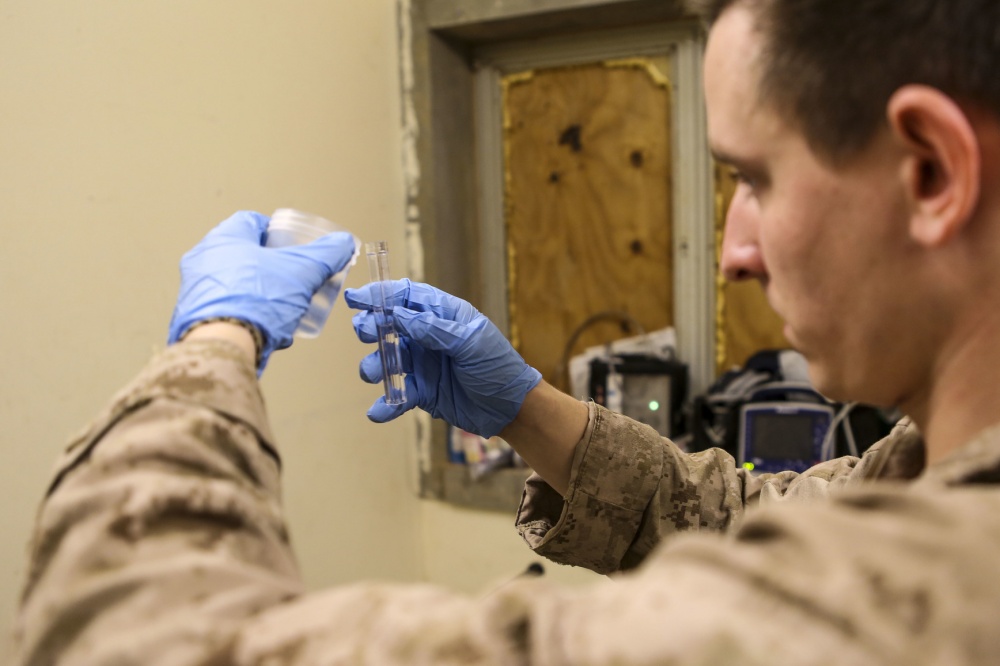
U.S. Navy Seaman Steven J. Madson, a preventive medicine technician, Task Force Al Asad, tests water from a newly functioning well aboard Al Asad Air Base, Iraq, March 3, 2015. The water sample was tested for PH levels, chlorine levels and bacteria to ensure safety of the water supply. (Cpl. Tony Simmons, USMC)

Among the dozens of heroic scientists and thinkers spotlighted in this book is German Wolfgang Witte, who developed vaccines during the Cold War and who faced down pressure from the Soviet Union and German Democratic Republic (East Germany). Witte spoke truth to power about the efficacy of vaccinations against Staphylococcus aureus infections.

“Witte also knew that the Soviets performed unethical clinical trials with its vaccines in orphanages and in prisons, where resistance to TB drugs was particularly high,” according to Zaman. Witte advanced the study of antibiotic resistance in the face of lies of an authoritarian government that tried to control its population with misinformation. Right matters. Truth counts.


Stalinist communism was decidedly anti-genetics and anti-science. Scientists and free-thinkers were persecuted and punished for telling the truth. “But, once more, bacteria don’t care. They obey no borders, harbor no national loyalty, and are always self-preserving, self-advancing, and self-replicating.”


Along the Amazon in Brazil, Dec. 6, 2017. (MC2 Andrew Brame)
“Biography of Resistance” is not only a great history and biography of inspiring scientists, it is also a travelogue throughout the world: Amazon, Mumbai, Western Australia, Mongolia, Nova Scotia, Norway, Denmark, Tokyo, Niger, and Zaman’s home country of Pakistan. Readers discover natures gifts, miracles, and dangers, including the risks of climate change and human manipulation of the food chain using antibiotics on animals.

Zaman writes this about animal-to-human epidemics and pandemics after periodic reports of avian influenza outbreaks in Asia:

“The public was afraid of new diseases jumping to humans from birds, pigs, and cattle. The Food and Agriculture Organization (FAO) saw an opportunity to make animal health and welfare part of the global debate on antibiotic resistance and became an early advocate of One Health, and so did the world Organization for Animal Health (OIE). The CDC also created a One Health office in 2009. For the next several years, pandemic preparedness became an area of focus, including surveillance, diagnostics, and containment.”

Antibiotic resistance became part of the initiative in 2015, and the world became more aware of the dangers of animal-to-human transmission of disease –– and the likelihood of pandemics –– both viral and bacterial, or both. The future depends on understanding and respecting the interconnectedness and interrelatedness of nature.


The Obama-Biden administration staffed and strengthened a pandemic response office that was virtually dissolved by the Trump-Pence administration in 2018.