Showing posts sorted by relevance for query Lincoln found haiku. Sort by date Show all posts

Saturday, February 16, 2013

Abraham Lincoln’s ‘Found Haiku’

by Bill Doughty

Haiku: Insights distilled to three lines of 5, 7 and 5 syllables only.

Originally from Japan and traditionally nature based, haiku are poems that can bring out subtle but deep insights in a few words.  Sometimes, haiku can be found in other people’s words.  The ‘found haiku’ on this page come from the published works of President Abraham Lincoln.  These are his words:

with other pillars
hewn from the solid quarry
of sober reason
(Speech before the Young Men’s Lyceum of Springfield, Illinois, Jan. 27, 1837)

his ruling passion --
a love of liberty and
right, unselfishly
(Eulogy of Henry Clay, July 16, 1852)

steadily as man’s
march to the grave, we have been
giving up the old
(Speech at Peoria, Illinois on Kansas-Nebraska Act, Oct. 16, 1854)

We live in the midst
of alarms, anxiety
beclouds the future
(Speech before the first Republican State Convention of Illinois, May 29, 1856)

In my opinion...
a house divided against
itself cannot stand
(Speech before the first Republican State Convention of Illinois, June 17, 1858)

that if a man says
he knows a thing, then he must
show how he knows it
(Speech at first Lincoln-Douglas debate, Aug. 21, 1858)

Let us have faith that
right makes might; and in that faith
...dare to do our duty
(Speech at New Haven, Connecticut, March 6, 1860)

touched, as surely
they will be, by the better
angels of our nature
(First Inaugural Address, Mar. 4, 1861)

Let us proceed in
the great task which events have
devolved upon us
(First Annual Message to Congress, Dec. 3, 1861)

Slavery is the
root of the rebellion...
it’s sine qua non
(Reply to a committee from Chicago religious denominations, Sept. 13, 1862)

The subject is on
my mind, by day and night, more
than any other
(Reply to a committee from Chicago religious denominations, Sept. 13, 1862)

Sorrow comes to all
and to the young it comes with
bittered agony
(Letter to Fanny McCullough, Dec. 23, 1862)

Peace does not appear
so distant as it did. I
hope it will come soon
(Letter to James C. Conkling, Aug. 26, 1863)

with malice toward none,
with charity for all, with
firmness in the right
(Second Inaugural Address, March 4, 1865)

We shall sooner have
the fowl by hatching the egg
than by smashing it
(“On Reconstruction,” his last public address, April 11, 1865)

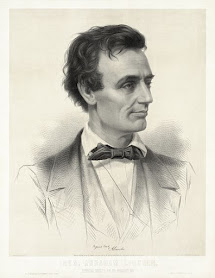
President Lincoln, 1864
Lincoln was a master of prose whose writing feels like poetry.  His Gettysburg Address and his inaugural addresses are some of the finest examples of writing in American History.  As we reflect on the 150th anniversary of the Civil War, Navy Reads will continue to periodically feature works by and about our 16th President. As we end wars in Iraq and Afghanistan, deal with perils of a continuing resolution and sequestration, and even contemplate asteroids and meteors in 2013, Lincoln’s words offer inspiration, perspective and hope.

The haiku in this Navy Reads post were "found" by Bill Doughty from works published in “The Essential Abraham Lincoln,” from the Library of Freedom, published by Gramercy Books, distributed by Outlet Book Company, Inc., a Random House company. The works are from Lincoln’s original papers, collected in The Complete Works of Abraham Lincoln (twelve volumes, 1905), edited by John G. Nicolay and John Hay, and prepared with the cooperation of Robert Todd Lincoln, the president’s son.

Sunday, May 13, 2018

The Found Haiku of John McCain

By Bill Doughty

In recent years Navy Reads  posted blogs on the found haiku of Abraham Lincoln, Mike Krzyzewski, Marshawn Lynch and other leaders, coaches and philosophers. "Found haiku" are discovered in the writings or utterances of others and fit the three-line 5/7/5-syllable rule and goal of communicating deeply but in few words.

Sen. John S. McCain III reenlists Sailor of the Year ET2 Michael Papapietro in Cam Ranh, Vietnam
aboard destroyer 
USS John S. McCain (DDG 56) June 2, 2017. (Photo by MC3 Joshua Mortensen).
Senator and former U.S. Navy aviator John S. McCain III, who was held as a Prisoner of War during the peak of the Vietnam War, has written a number of memoirs and endorsements of others' books, which provide the source for the found haiku that follow.

Like all humans, he is not perfect, and he is the first to admit so. In fact, his self-awareness and self-assessment provide a treasure-trove of words from which to find these found haiku gems.

Most of these words reflect McCain's thoughts about war, service, sacrifice, captivity, character, resilience and reflection. The Vietnam War understandably casts a long shadow in his life as it does for our nation.

Leading with honor
is about putting service
to others ahead

Immortality ...
the aspiration of my
youth has slipped away

Time to examine
what I have done and failed to
do with my career

All people, even
captured enemies, possess
basic human rights

For two centuries
men of my family were
raised to go to war

Freedom: America's
honor, and the honor comes
with obligations

A few stories from
my misspent youth that I had
managed to bury

If you valued them,
and held them strongly, love and
honor would endure

In Vietnam I (came)
to understand how brief a
moment a life is

Defying death's call
in ... (the) bamboo cages of
South Vietnam haunt

There are some stories
of the soul that extend far
beyond prison walls

We paced the open
compound at Plantation Camp
together, waiting

communicating...
affirmed our humanity.
It kept us alive

communicating
was the indispensable
key to resistance

It was best to take
the long view (that) we would get
home when we got home

Glory belongs to
the act of being constant
to something greater

To a cause, to your
principles, to the people
on whom you rely

Before Vietnam
the truth of honor ... courage ...
obscure to many

I learned the truth in
war: there are greater pursuits
than (just) self-seeking.

I have managed to
prevent bad memories of
war from intruding

(I regretted)
I hadn't read more
books so I could keep my mind
better occupied

The headstones bear the
names of people of every
ethnic origin

The final resting
places of professional
soldiers and conscripts

Rich and poor, Christian,
Jew, and muslim; believer
and non-believer

The last three found haiku come from McCain's "13 Soldiers: A Personal History of Americans at War" (Simon and Schuster, 2014, written with Mark Salter). Salter has served on McCain's staff for more than two decades.

John McCain reassesses in 1973.
Other haiku are from McCain's "Faith of My Fathers: A Family Memoir" (Random House, 1999), "Worth the Fighting For: A Memoir" (Random House, 2002), the foreword of "Glory Denied" (by Tom Philpott, W.W. Norton, 2001), the foreword of "Leading with Honor" (by Lee Ellis, FreedomStar Media, 2012) and the Senate Floor statement published in "The Official Senate Report on CIA Torture: Committee Study of the Central Intelligence Agency's Detention and Interrogation Program" (Skyhorse Publishing, 2015).

McCain, with collaborator Mark Salter, just published another memoir, "The Restless Wave: Good Times, Just Causes, Great Fights and Other Appreciations," to be published May 22 and to be featured in a future Navy Reads post.

NPR published an excerpt that brings forth more John McCain found haiku, and in the classic form – bringing forth nature themes:

I'd like to go back
to our valley ... see the creek
run after the rain

cottonwoods whisper
in the wind ... smell rose scented
breeze and feel the sun

I want to watch the
hawks hunt from the sycamore
and then take my leave

Hear the truth, passion and peace in McCain's words and voice. 

McCain's memoirs show how much he revered his grandfather, respected his father and loves his mother, Roberta. He feels especially close to his mom. 

Happy Mother's Day 2018.

John McCain and his mother, Roberta, on NBC's Meet the Press in 2007.


Monday, May 28, 2018

Angels, 'Soul of America' Battle Fear

By Bill Doughty

"Peacemakers" Sherman, Grant, Lincoln and Porter, painted by George Healy, 1848.
The United States Navy is an unintended undercurrent running through "The Soul of America" by Jon Meacham (Random House, 2018). It starts with the book's front endpaper as soon as you turn the cover.

There is Admiral David Dixon Porter sitting next to President Abraham Lincoln and Generals Ulysses S. Grant and William T. Sherman in George Healy's painting "The Peacemakers," memorializing a meeting aboard the War Department's commissioned steamer River Queen.

The War Between the States was a crucible, an identity-defining event for the United States. Sailors of the Federal Navy played a key role in saving the Union and securing liberty for all, as they had done in fighting the British in the Revolutionary War and War of 1812.

Subtitled "The Battle for Our Better Angels," from Lincoln's First Inaugural Address, where the sixteenth president sought to unite a divided nation, Meacham's book shows how the United States has made progress when its leaders and especially its citizens focused energies on hope, optimism and inclusion instead of fear, hate and rejection of others.

"Progress in America does not usually begin at the top and among the few, but from the bottom and among the many," Meacham writes. He shows how good presidents like Lincoln, Grant, Theodore Roosevelt, Franklin D. Roosevelt, Harry Truman and Lyndon B. Johnson were instrumental in America's progress, while other presidents like Woodrow Wilson, Dwight D. Eisenhower and Richard M. Nixon were moved only after being pressured by the American people into expanding human rights and protecting civil liberties.

After every action, there is a reaction and sometimes unintended consequences.

In the aftermath of the Civil War came Reconstruction and "extreme, racism, nativism and isolationism, driven by fear" – a stormy period in America's past that included lynchings, white supremacy and the rise of the Ku Klux Klan.

President Andrew Johnson
President Andrew Johnson undermined the legacy of Lincoln in years after of the War Between the States.

Meacham reports how Johnson "delivered an angry, self-pitying speech" Feb. 22, 1866 at a campaign-style rally on George Washington's Birthday.
"Resentful and impassioned, Johnson also riled up the Washington's Birthday crowd with claims that his opponents were considering having him assassinated. Rather than offering reassurance to an anxious public, then, Johnson chose to foment chaos and promulgate fears of conspiracy."
According to historian Eric Foner, who Meacham cites, Johnson made "probably the most blatantly racist pronouncement ever to appear in an official state paper of an American president." In Meacham's words, Johnson "asserted that blacks were incapable of self-government."

Andrew Johnson, who "never seemed entirely stable," was later impeached, but one vote in the Senate trumped his conviction.

President Grant, on the other hand, "in contrast to Andrew Johnson, appreciated the bigness of his office and of the times." Grant supported the 15th Amendment, granting the extension of voting rights to African Americans. And he cracked down on the KKK's reign of violence and terror in the South.

Confederate naval officers James and Irvine Bulloch, TR's uncles.
A president who continued championing human rights, Teddy Roosevelt, was a former Assistant Secretary of the Navy and a man who, ironically had two uncles who served in the Confederate Navy. One was an admiral who helped build the warship CSS Alabama, and the other was a midshipman who served aboard the Alabama.

A flawed but passionate defender of freedoms, including the First Amendment, TR said, "To announce that there must be no criticism of the president, or that we are to stand by the president, right or wrong, is not only unpatriotic and servile, but is morally treasonable to the American public."

Yet, during times of national stress, particularly during wartime, the "better angels of our nature" have been silent, and leaders have resorted to fear, hate and exclusion.

One hundred years ago President Woodrow Wilson and the Congress enacted the Espionage Act of 1917 and the Sedition Act of 1918 during World War I, "restricting freedom of expression in the name of national security." Wilson's Justice Department indicted and put on trial the Industrial Workers of America.
"Speech itself was under siege. It was illegal, according to the 1918 legislation, to 'utter, print, write, or publish any disloyal, profane, scurrilous, or abusive language about the form of government of the United States, or the Constitution of the United States, or the military or naval forces of the United States.'"
Thanks to strong women such as Elizabeth Cady Stanton, Susan B. Anthony, Sojourner Truth, Carrie Chapman Catt, Lucretia Mott and Alice Paul, women received the right to vote over the intransigence and foot-dragging of President Wilson.

National Endowment for the Humanities composite of Roosevelts.
Teddy Roosevelt's fifth cousin Franklin, also a former Assistant Secretary of the Navy, witnessed the aftermath of a terrorist bombing attack by an anarchist on the home of his neighbor, Attorney General Michael Palmer.

As president, FDR faced twin existential threats to the nation – the Great Depression and the Second World War, brought about by Nazi fascism in Europe and Imperial Japan's attack on Pearl Harbor, Dec. 7, 1941.

FDR feared a military coup by General Douglas MacArthur on the right and Senator Huey Long on the left.

The threat of a coup was real, especially from "America First" isolationists who opposed FDR's behind-the-scenes help to Britain's Winston Churchill, including trading U.S. Navy destroyers for bases and conducting an "undeclared naval war in the Atlantic" during Britain's fight against Hitler's Germany.

American hero Maj. Gen. Smedley Butler, USMC.
In fact, a "small group of rich Wall Streeters" actually attempted to put together a coup. They tried to recruit retired Marine Corps Major General Smedley Butler to remove FDR by force. Butler, ever the hero, reported the plot and plotters to the FBI.

After WWII started, acting out of fear, FDR committed his greatest error when he imprisoned more than 100,000 Americans of Japanese Ancestry.

But FDR, followed by Truman, took a huge step toward integrating the military, instituting the GI Bill of Rights, setting up the New Deal that led to the Fair Deal, and setting the stage for the formation of the middle class and greater prosperity for millions of Americans.

"The product of both government action and of market forces, the creation of the post-WWII middle class was one of the great achievements in history," Meacham writes.

FDR, who designed the porch of his cottage in Warm Springs, Georgia to resemble the prow of a ship, was about the Navy's USS Tuscaloosa (CA-37) for a fishing trip, when he came up with the Four Freedoms speech: Freedom of speech, freedom of religion,  freedom from want and freedom from fear.

Navy Chief Graham Wilson expresses grief at FDR's death in 1945.
When FDR died in 1945, Navy Chief Petty Officer Graham Jackson became America's face of grief, weeping openly.

Fortunately, Presidents Truman and Eisenhower and especially Navy veterans John F. Kennedy and Lyndon B. Johnson righting the residual racism and discrimination of the Lost Cause of the Civil War, pushing for greater equality and voting rights for all. Once again, the people, led by Dr. Martin Luther King Jr., pushed for progress and LBJ listened.

LBJ was "Determined to preach the gospel of inclusion," Meacham writes. "Now was the time, the president said, to rise above racism. 'Whatever your views are, we have a Constitution and we have a Bill of Rights, and we have the law of the land. (LBJ said,) I am not going to let them build up the hate and try to buy my people by appealing to their prejudice.'"

MLK and LBJ meet in the White House Dec. 3, 1963 (Photo by Yoichi R.Okamoto). LBJ Library.
Johnson created the Great Society and signed the Immigration and Nationality Act of 1965 and the landmark Civil Rights Act of 1964.

"Leadership is the act of the possible, and possibility is determined by whether generosity can triumph over selfishness in the American soul," Meacham writes.

Meacham quotes Senator Daniel Webster: "When the mariner has been tossed for many days in thick weather, and on an unknown sea, he naturally avails himself of the first pause in the storm, the earliest glance of the sun, to take his latitude, and ascertain how far the elements have driven him from his true course," Webster said in 1830. "Let us imitate this prudence, and before we float farther on the waves of this debate, refer to the point from which we departed, that we may at least be able to conjecture where we now are."

"The Soul of America" revealed some "found haiku," one by Meacham himself:

The things we hope for
can come to pass. The things we
fear can hold us back

Here's another Abraham Lincoln found haiku (see also Navy Reads Lincoln's found haiku blog):

Cherish a just and
lasting peace among ourselves
and with all nations

And this reflective unintended haiku comes from LBJ:

A president can
appeal to the best in our
people or the worst

In Meacham's conclusion he offers five prescriptions for achieving progress and enlisting "on the side of the angels" in a time of crisis: enter the arena (use your First Amendment rights), resist tribalism (hear and listen to all sides), respect facts and deploy reason (recognize and reject lies), find a critical balance (being humble and open), and keep history in mind (read books and practice critical thinking).

Meacham was inspired to write this book after seeing the white supremacy demonstration in Charlottesville, Virginia in August 2017 that caused the death of counter-protester Heather Heyer and resulted in the the deaths of two Virginia state troopers.

In a rare move, the U.S. military's Joint Chiefs of Staff responded to the Charlottesville tragedy with statements condemning the racism and violence.

Navy Chief of Naval Operations Adm. John Richardson, was the first of the military chiefs to respond. On Twitter he said the events were "unacceptable and mustn't be tolerated." Richardson then called the events "shameful" and said, "Our thoughts and prayers go to those who were killed and injured, and to all those trying to bring peace back to the community. The Navy will forever stand against intolerance and hatred. For those on our team, we want our Navy to be the safest possible place — a team as strong and tough as we can be, saving violence only for our enemies."

Wednesday, May 31, 2023

Abraham Lincoln & January 6th

Review by Bill Doughty––

This “found haiku” comes from Abraham Lincoln’s Lyceum Address in Springfield, Illinois on January 27, 1838:

Reason must furnish

all the materials for

our future support


The speech is quoted in one of the four forewords in the massive “The January 6th Report: Findings from the Select Committee to Investigate the January 6th Attack on the United States Capitol” (December 2022, U.S. Government Publishing Office).


In fact, Lincoln appears on the very first page of the report.

Representative Adam Schiff, author and finisher of the J6 Report, recounts how Lincoln –– then a state legislator in Illinois –– addressed young men about a rebellious time of mob violence, including lynchings, general crimes, and disregard for the rule of law. Lincoln chose to speak about "The Perpetuation of Our Political Institutions.”

In Schiff’s words, Lincoln spoke about internal threats “not the threat of foreign invasion, even though the War of 1812 was only two decades past. It was the danger from within that a young Lincoln identified as our gravest threat.”


Lincoln is also quoted in the second foreword to the book by former Speaker of the House Nancy Pelosi: “Let us always honor our oath to, as Abraham Lincoln said, ‘nobly save or meanly lose, the last best hope of earth.’ So help us God.”


In the third foreword to the book, chairman of the committee Rep. Bernie Thompson says he was advised to remove his lapel pin so he wouldn’t be identified and targeted by attackers who threatened to kill legislators and the vice president. He chose not to remove his pin and thereby showed support for the defenders of the Capitol and against the attackers.


“We can never surrender to democracy’s enemies,” Thompson writes. “We can never allow America to be defined by forces of division and hatred. We can never go backward in the progress we have made through the sacrifice and dedication of true patriots. We can never and will never relent in our pursuit of a more perfect union, with liberty and justice for all Americans.”


Former Representative Liz Cheney, vice chair of the committee, opens the report’s fourth and final foreword with a story about Abraham Lincoln issuing the first call for volunteers for the Union Army in April 1861 and how her great-great grandfather, Samuel Fletcher Cheney signed up for the 21st Ohio Volunteer Infantry.

Cheney, a Republican like Lincoln, writes: “I have found myself thinking often, especially since January 6th, of my great-great grandfather, and all those in every generation who have sacrificed so much for (quoting OVI’s regimental historian Silas Canfield) “the unity of our Nation and the perpetuity of our institutions.”


Cheney says, “At the heart of our republic is the guarantee of the peaceful transfer of power.”


Cheney notes how General George Washington resigned his commission and handed control of the Continental Army back to Congress. (When Washington’s term as president ended, he rejected calls by some to remain in office as dictator.)

This bipartisan report features a comprehensive Executive Summary that encapsulates the main thrust of the investigation and its findings in the report. Within the summary is a list of witnesses, nearly five dozen of whom are registered Republicans. Only one witness, the Secretary of State of Michigan, is identified as a Democrat.


Most of the report, itself, is a “Narrative” in 8 chapters that explores: the Big Lie of a stolen election, the scheme of fake electors, the plan to block certification of the election by the vice president, the invitation of then-President Trump to come to D.C. and march to the Capitol to “fight like hell,” an examination of the role of far right extremists in the insurrection, and “187 minutes of dereliction” in which the commander in chief chose not to call off the rioters nor order DOD to send the national guard to defend the Senate and House of Representatives.

The long “narrative” is excellent writing: True historical storytelling in the tradition of David McCullough; careful citing of facts and sources in the vein of Craig Symonds; and drama and suspense –– especially during the actual lead-up and breaching of the Capitol –– in the style of Tom Clancy. As with the Executive Summary, there are extensive endnotes throughout.


Military readers will be interested in reading two of the appendices: Government Agency Preparation for and Response to January 6th, and DC National Guard Preparation for and Response to January 6th.


The report cites what one witness called “decision paralysis” and “decision avoidance.” Army leaders were “sensitive to the sight of troops near the site of the congressional certification of electoral votes.” The report examines “fears of politicizing the military in an anti-democratic manner” in the wake of the heavy handed National Guard confrontation with protesters in the summer of 2020, which included low-flying military helicopters. The Guard was deployed and used chemical agents to clear Lafayette Square for Trump’s photo-op holding up a Bible at St. John’s Church.


While the report has been criticized by some progressives for not examining the motivation and role of Christian Nationalism specifically, the report does mention QAnon Shaman Jacob “Angeli” Chansley’s leading of a “conspiracy-laden prayer session” at the Senate dais after shouting “Mike Pence is a f—ing traitor” at the spot where Pence had been presiding. Chansley left a note that read: “It’s only a matter of time. Justice is coming.”


The committee thoroughly investigated the actions of other QAnon conspiracy believers and white nationalists. Chapter 6, “Be There, Will Be Wild,” examines extremist militia groups such as The Proud Boys, The Oath Keepers, and The Three Percenters.”

More than 1,000 rioters have been indicted since the insurrection. Many remain in jail and many more have been stained with a criminal record. While some have had their lives ruined, others, like Chansley, who has already been released from prison, are cashing in on their fame and hardening their support with the far right. Some key leaders and planners of the attack are facing much longer prison terms.


Since publication of The January 6th Report, the most serious convictions have occurred among military veterans who in many ways led the attack. On May 4, five members of the Proud Boys were convicted of various charges, including four members convicted of seditious conspiracy.


Last week, on May 25, the Department of Justice announced: “Elmer Stewart Rhodes III, the founder and leader of the Oath Keepers, and Kelly Meggs, the leader of the Florida chapter of the organization, were sentenced today for seditious conspiracy and other charges related to the breach of the U.S. Capitol on Jan. 6, 2021.”

Rhodes, an Army veteran from Texas, was sentenced to 18 years in prison, “the longest sentence, to date, related to the January 6 attack on the Capitol.” Fellow militia leader Meggs received a sentence of 12 years. “This is the first time a court has found that a defendant’s conduct related to the January 6 attack was tantamount to terrorism warranting an upward departure under the sentencing guidelines,” according to DOJ.


“Today’s sentences reflect the grave threat the actions of these defendants posed to our democratic institutions,” said Attorney General Merrick B. Garland. “The United States proved at trial that the Oath Keepers plotted for months to violently disrupt the peaceful transfer of power from one administration to the next. The Justice Department will continue to do everything in our power to hold accountable those criminally responsible for the January 6th attack on our democracy.” 


It’s becoming clear that there is a litmus test for who will be elected as the next President and commander in chief of the military next year: Voters will choose between those who believe in accountability for those who stormed the Capitol and those who promise pardons for the seditionists and rioters such as the Proud Boys and Oath Keepers.


Rep. Adam Schiff
The “Oath Keepers” name seems Orwellian when one considers the actual oath all military service members take to support and defend the Constitution –– and a similar oath civilian leaders take to support the Constitution –– the foundational document that outlines the peaceful transfer of power.

Representative Schiff said this about the Constitution and the oath:

“Even the most brilliant Constitution cannot protect us if the people sworn to uphold it do not give meaning to their oath of office, if that oath is not informed by ideas of right and wrong, and if people are unwilling to accept the basic truth of things. None of it will be enough.

But if we allow ourselves to be guided by facts –– not faction –– if we choose our representatives based on their allegiance to the law and the Constitution, then we should have every confidence that our proud legacy of self-government will go on.”

That’s the accountability, respect for truth and justice, and faith in the rule of law Lincoln spoke about in the Lyceum Address, “The Perpetuation of Our Political Institutions.”


Lincoln believed in an informed electorate, honest leaders, and support for the Constitution and rule of law, which he called “the political religion of our nation.”


with other pillars,

hewn from the solid quarry

of sober reason


Pillars of logic and reason found in the Constitution support our democracy.


There's more “found haiku” from Abe Lincoln and others on Navy Reads.