Sunday, March 27, 2022

A Goal for Women

Review by Bill Doughty––

I can only imagine the disappointment of the authors of this book, Ruth Margolies Beitler and Sarah M. Gerstein, for what they left out of their assessment of women in the world’s militaries.


Their “Women and the Military: Global Lives in Focus” (ABC-CLIO, LLC; 2021) is part of an ambitious series looking into issues such as health, violence, religion, sexuality, sports, education, technology, and more.


The goal of the series is spelled out in a foreword:

“The goal of the ‘Women and Society Around the World’ series is to depict the roles of women worldwide by exploring the major issues they face and the accomplishments they have made, especially in terms of bridging the gap in gender inequality and fighting for basic human rights. While readers will learn about the challenges that half of the world’s population face, they will also discover the empowering ways women succeed and overcome social and cultural barriers in their daily lives.”

The series and this contribution about the world’s militaries examines the “challenges, issues, and achievements women around the world face” in a still largely male-dominated world.

This book about the world's militaries is divided into eight regions: United States and Canada, Latin America and the Caribbean, Europe, North Africa and the Middle East, Sub-Saharan Africa, Central and East Asia, and Oceania. The authors admit that “exploring the role of women in militaries across the globe is a daunting task,” especially considering the depth, breadth, and diversity of nations and cultures.


Still, as good as this volume is, we can’t help but be dismayed about one country which has been left out. More on that in a moment.


First, let’s look at what’s really noteworthy. The authors conclude that “women are playing a larger role in militaries across the globe, but especially in the West.” Another conclusion: “When women have proven competent in their positions, and their male colleagues trust their abilities, the negative stereotypes connected to gender decrease.”


Culture change is occurring throughout much of the world as traditional roles for women change. Still, in many countries, it is forbidden for women to serve in the military.


But throughout Europe and in many international organizations, legislation dealing with gender equality has accelerated transformation.

“The UN’s adoption of UN Security Council Resolution 1325 in 2000 pushed most international organizations dealing with security issues, such as the European Union and the North Atlantic Trade (sic) [Treaty] Organization (NATO), to prioritize gender mainstreaming and the integration of women into militaries across the globe. When exploring Europe, it is critical to examine how the European Union impacts its member states’ armed forces, particularly with regard to security and gender. Each member state has different political institutions and public cultures that influence their policies on gender (Eulriet 2012, 30). At times, the legal structure of regional and international organizations affects the legal structure of states.”
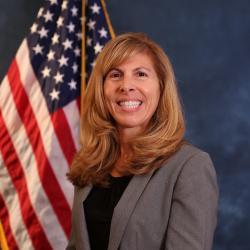
Beitler
Beitler and Gerstein discuss issues such as conscription, physical strength, pregnancy, unit cohesion, combat arms, and sexual harassment as they compare attributes, traditional values, customs/laws, and roles.

Along the way, they naturally unearth some fascinating factoids:

  • In Indonesia, women who join the military have a “requirement for a virginity test.”
  • After the Sierra Leone civil war, many women there who reported they served as soldiers had been raped, and they were “encouraged to allow grandparents to raise their children or to marry their rapists.”
  • South Africa fully integrated ethnic and gender minorities after apartheid and is “an example for other nations to follow.”
  • Norway was the first country to create an all-female special forces unit, in 2014, called Hunter troops.
  • Australia and New Zealand militaries opened all roles to women at the beginning of this century, earlier than the US or UK.
  • Russian women in uniform conduct a popular beauty pageant for their strategic missile forces called “Makeup Under Camouflage.”
  • Restrictions for women exist in Japan “due to the domestic Labor Standards Law, which protects women from substances that could affect pregnancies.”


The Independence-variant littoral combat ship USS Gabrielle Giffords (LCS 10) exercises with the Japan Maritime Self-Defense Force (JMSDF) training ships JS Kashima (TV 3508) and JS Shimayuki (TV 3513), June 23, 2020, in the South China Sea. Gabrielle Giffords was on a rotational deployment, operating in the U.S. 7th Fleet area of operations to enhance interoperability with partners and serve as a ready-response force. (MC2 Brenton Poyser)

Beginning with the direct influence of Adm. Arleigh S. Burke, the U.S. Navy and the Japan Maritime Self-Defense Force have had close and lasting ties. Considering the number of American sailors and marines serving in Japan, the section on Japan’s military may be of particular interest to the naval community.

“In 2013, two women took command of the naval destroyers, JS Shimayuki and JS Setoyuki, for the first time since Japan’s modern navy began. Commander Miho Omani and Commander Ryoko Azuma were responsible largely for training missions but could be called upon for surveillance, anti-submarine warfare and anti-ship missions, as well as detecting and shooting down aircraft and ballistic missiles (Spitzer 2013). Just a few years after her successful command of the naval training destroyer, Commander Omani took command of the Yamagiri destroyer, overseeing a crew of 220. Just ten of those crew members were women. She was also one of the first female graduates at the National Defense Academy. After seeing images of the Gulf War on the news and a newspaper ad for the National Defense Academy, she joined the military, expecting some resistance. She quickly realized that opposition would emanate much closer to home. Her father was reluctant for her to join the military. Her path to success was challenging and after her marriage, she was asked when she would be leaving her job. She is currently married to a fellow destroyer captain and has been forced to make hard decisions about who would care for her daughter when both are out to sea (Demetriou 2016). Women in the Japanese military can take up to three years off after the birth of a child, though the Japanese culture has discouraged women from taking that time.”

The excerpt above gives us an idea of the personal and professional insights presented in this book, which also offers extensive “for further reading” lists, a chronology of history of women in the world’s militaries since 1572, and a fulsome bibliography.


There are surprising inclusions of various militaries: Nepalese, Zairian, Sri Lanka, Madagascar, Ecuador, Burundi, Seychelles, and Barbados, to name a few. Which makes it even more glaringly disappointing about the absence of …


... Ukraine.


There is no discussion about the Ukraine military and women’s role in the armed forces in a country currently confronting Putin’s atrocities. Today, Ukraine’s men are required to defend their homeland against the unprovoked Russian invasion in Putin’s war, but women are also increasingly picking up arms and finding other ways to fight back.


According to a report on NPR from March 19, “The combat spirit in Ukraine right now appears to be pretty robust. Only men face conscription. But lots of them haven't even been called up yet, because the military has already been inundated with volunteers — of all genders.”


The only mention of Ukraine in “Women and the Military” is in the context of conscription –– but in the Swedish armed forces (ironic considering Ukraine's deep history with Sweden, centuries ago)
.

“With changes in Swedish culture espousing gender equality, retaining the military as an all-male domain was unrealistic. The Swedish government never implemented universal conscription, and by 2010 Sweden eliminated compulsory military service. Only 5,000 soldiers were being drafted with conscription perceived as a relic of previous times (Chandler 2017). However, by 2017, the Swedish government announced the reinstatement of conscription due to Russian activity, including its aggressive behavior in Ukraine and the annexation of Crimea. Sweden also accused Russia of breaching its airspace and executing cyberattacks in Sweden (Chandler 2017). The draft includes both men and women.”

Of course, Beitler and Gerstein could have little idea that Ukraine would be the center of the world’s attention in 2022, the year after their book was published.


As for nations such as Sweden, Finland, and others near Russia, there’s a renewed desire to strengthen their nations’ defenses. According to an article by analyst Dan Kochis, posted by the Heritage Foundation, “Putin is pushing Finland and Sweden closer to NATO membership.”


While this book leans in with an Army bias, there is a broad-brush approach to various branches and to world regions. (Dr. Beitler is a professor of comparative politics at the United States Military Academy, West Point, where Maj. Gerstein is an assistant professor of international relations.)


It’s nice to see a volume about women and the military in this ABC-CLIO series that purports to present a global perspective about women. Volumes are meant to be read alone or cumulatively. The series foreword notes, “The volumes are ideal for high school students doing projects, undergraduate students writing research papers, and even general readers interested in learning about women’s lives.” Another good source of information for Women’s History Month!


––––––––––––––––––––––––––––


We remember the great political scientist and diplomat Madeleine Albright, who was the first woman to serve as United States Secretary of State. Albright died last week at 84. Albright spoke at the Pentagon on June 30, 2016, after then-Secretary of Defense Ash Carter presented Albright with the Department of Defense Medal for Distinguished Public Service. (DoD photo by Senior Master Sgt. Adrian Cadiz)

Albright was a child when her family emigrated out of autocratic Communist Czechoslovakia to the United States.


She warned of the signs of growing autocracy, tyranny, and fascism.


I posted a review of Albright's "Fascism: A Warning" in September 2018 and showed her strong connections with Navy veteran and U.S. Senator John McCain. Both stood up to fear-mongering authoritarianism.


Here again are Albright's ten questions about leaders we need to ask as either reassurance or a warning. In the case of Putin's Russia, Albright's insights were a clear warning more than four years ago:

  • Do they cater to our prejudices by suggesting that we treat people outside our ethnicity, race, creed, or party as unworthy of dignity or respect?
  • Do they want us to nurture our anger toward those who we believe have done us wrong, rub raw our grievances, and set our sights on revenge?
  • Do they encourage us to have contempt for our governing institutions and the electoral process?
  • Do they seek to destroy our faith in essential contributors to democracy such as an independent press and a professional judiciary?
  • Do they exploit the symbols of patriotism – the flag, the pledge – in a conscious effort to turn us against one another?
  • If defeated at the polls, will they accept the verdict or insist without evidence that they have won?
  • Do they go beyond asking for our votes to brag about their ability to solve all problems, put to rest all anxieties, and satisfy every desire?
  • Do they solicit our cheers by speaking casually and with pumped up machismo about using violence to blow enemies away?
  • Do they echo the attitude of Mussolini: 'The crowd doesn't have to know,' all it has to do is believe and 'submit to being shaped'?
  • Or do they invite us to join with them in building and maintaining a healthy center for our societies, a place where rights and duties are apportioned fairly, the social contract is honored, and all have room to dream and grow?
In "Fascism: A Warning," Albright described Russia's Putin, as "small and pale, so cold as to be almost reptilian." 

Last week President Biden, after visiting American troops defending NATO allies and partners, described Putin as a brutal "butcher" who must be stopped. Albright warned us; stopping the growth of fascism and authoritarianism should be a goal for everyone.

President Biden visits and takes selfies with U.S. Army paratroopers of the 82nd Airborne Division, March 25, 2022 in Rzeszów, Poland. (Sgt. Gerald Holman)

Sunday, March 20, 2022

‘The Agitators’

Review by Bill Doughty––

Just three lifetimes ago in America, black people throughout the South were kept in chains. And, according to the law throughout the states, women of all ethnicities were considered the property of men.


A controversial bill put forth in the New York State legislature in 1841 was the Married Women’s Property Act.

“Under American law, when a woman married, she turned over to her husband any money, land, or goods she had inherited. The proposed bill, if passed, would grant married women the right to their own property, and it would have a stunning ramification: women who owned property would pay taxes; if they paid taxes, they deserved the right to representation –– and thus the right to representation –– and thus to vote. As one legislator said, the measure raised ‘the whole question of woman’s proper place in society, in the family and everywhere.’”

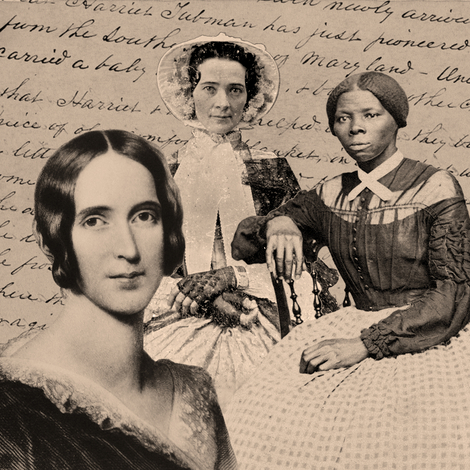
In “The Agitators: Three Friends Who Fought for Abolition and Women’s Rights” (Scribner, 2021), author Dorothy Wickenden takes readers back to the 1800s to meet brave women: Martha Coffin Wright, Harriet Tubman, and Frances A. Seward, united by their abhorrence to slavery and desire for equality for all. "Martha and Frances became Harriet's collaborators and two of her most devoted friends."

Wright and Tubman worked together on the Underground Railroad, helping escaped slaves from the South find freedom in the North, often having to go as far as Canada to avoid recapture. Frances Seward worked behind the scenes to support abolitionists and women’s rights groups. She was the wife of William Henry Seward, who served as governor of New York and later as Secretary of State under President Abraham Lincoln, and Frances played an important role in pushing for the Emancipation Proclamation. She was an early proponent of equal pay for women, and she provided financial support so Harriet could continue humanitarian work.


The story told by Wickenden is not just the friendship and work of three women, but also the wide network of women and men that included Frederick Douglass, Lucretia Mott, John Brown, Elizabeth Cady Stanton, Charles Sumner, Ernestine Rose, William Lloyd Garrison, Susan B. Anthony, and Lucy Stone –– all connected and, though not always united in their priorities and beliefs, totally committed to the cause of freedom.


It's a story of perseverance.


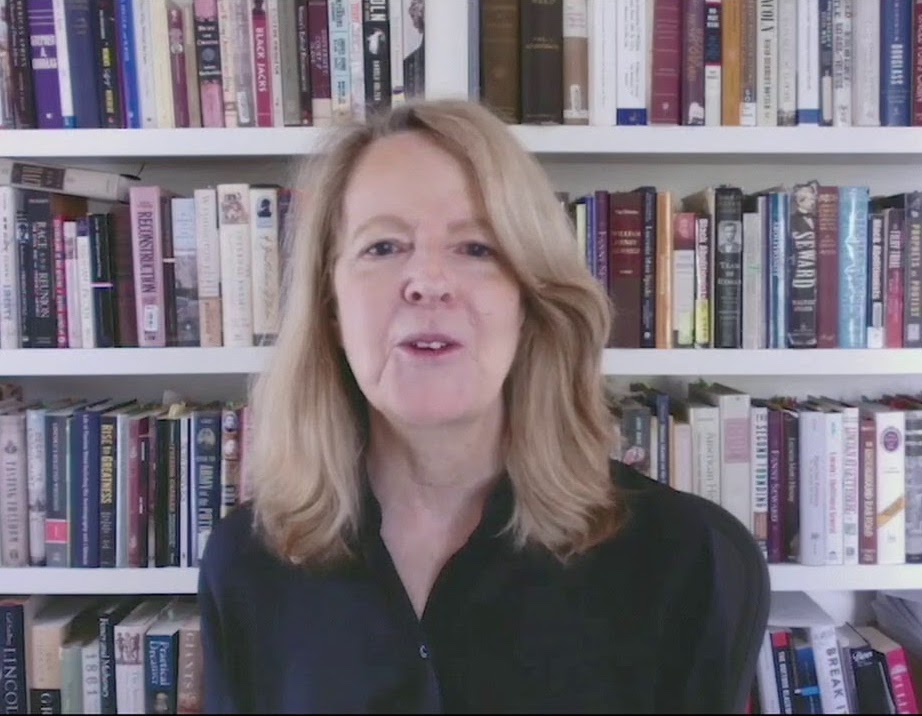
Dorothy Wickenden
Wickenden is a wickedly good writer; these people come alive as feeling, thinking, breathing characters.

Here’s her description of Republican Representative Charles Sumner, who spoke passionately on the floor of the House of Representatives about the sin of slavery:

“Sumner was a six-foot-two, barrel-chested bachelor with blue eyes and wavy brown hair that resisted the taming influence of a brush. He antagonized enemies and sometimes friends, with his vanity and sanctimony … Seward advised him to tone down his speech but Sumner did not follow Seward’s advice.”

Sumner suffered a horrific physical beating in Congress by Representative Preston Brooks, a pro-slavery Democrat from South Carolina. Sumner was scarred for life. Like most of the characters in this book, he had a complicated relationship with others, including his close friends, the Sewards.


Harriet Tubman, despite being unable to read or write, and in the face of her own debilitating scars, demonstrated tireless courage and commitment to freeing enslaved people, including going into battle after the start of the Civil War. We featured "General Moses" Tubman several times on this blog, including revealing how she served as a sailor and nurse for the Union in the Battle of Port Royal and other occasions. [See former Gen. Stanley McChrystal’s tribute to Tubman, featured on Navy Reads three years ago.]


Frances Seward reads in her garden.
Military readers will be interested in Wickenden’s coverage of attempts to prevent secession, the lead-up to war, and then actual battles of the Civil War under the leadership by Lincoln, generalship of Ulysses S. Grant, and advisory role of William Henry Seward, whose own indispensable adviser was Frances Seward.

Although her husband was defeated by Lincoln for the Republican nomination for president, Frances was secretly pleased to not become First Lady, content in her role fighting for abolition and women’s equality, and satisfied to support her husband as Secretary of State during time of war. For his part, on a “team of rivals” that included Secretary of the Navy Gideon Welles, Henry pledged allegiance to Lincoln, using maritime imagery: “I have brought the ship off the sands, and am ready to resign the helm into the hands of the captain whom the people have chosen.”


Seward’s strategic diplomacy kept the British neutral during the war, despite the Confederacy’s efforts to get foreign support for their Lost Cause. Seward successfully argued for a naval siege of southern ports. And he was the only other signer of President Lincoln’s Emancipation Proclamation.


The Seward’s son William “Willy” Seward served at the Battle of Gettysburg, where his infantry battery played a key role in turning the tide against General Robert E. Lee’s forces. He also led with distinction at the Battle of Moncacy, smaller than Gettysburg but also vital. That battle stopped the Confederates under General Jubal Early as the Rebels marched to take over the capital and Capitol prior to Lincoln’s reelection. The Confederates were set on “seizing the U.S. Treasury and White House, perhaps taking President Lincoln and his cabinet as prisoners of war.”


Martha C. Wright
Wickenden describes abolitionist Martha Wright, Lucretia Mott’s sister, as a Quaker woman who did not attend church and did not “properly” discipline her children. “She rarely encountered an institution she didn’t question,” according to Wickenden. Martha’s husband was a veteran of the War of 1812, and she married an open-minded son of a farmer from Bucks County, Pennsylvania, who supported her desire to be part of Harriet Tubman’s underground railroad.

Wright, who had first married just before her eighteenth birthday, “compensated for her abbreviated education by borrowing books from Frances’s [Seward’s] library. She read Mary Wollstonecraft’s “A Vindication of the Rights of Woman,” written in 1792 –– a book which was a bible for the early women’s equality movement. [See Navy Reads review, March 2020, of Wollstonecraft’s iconic work.] Wright also read Sir Walter Scott’s “Kenilworth,” Pope’s “Essays on Man,” and Edward Bulwer-Lytton’s “Last of the Barons.”


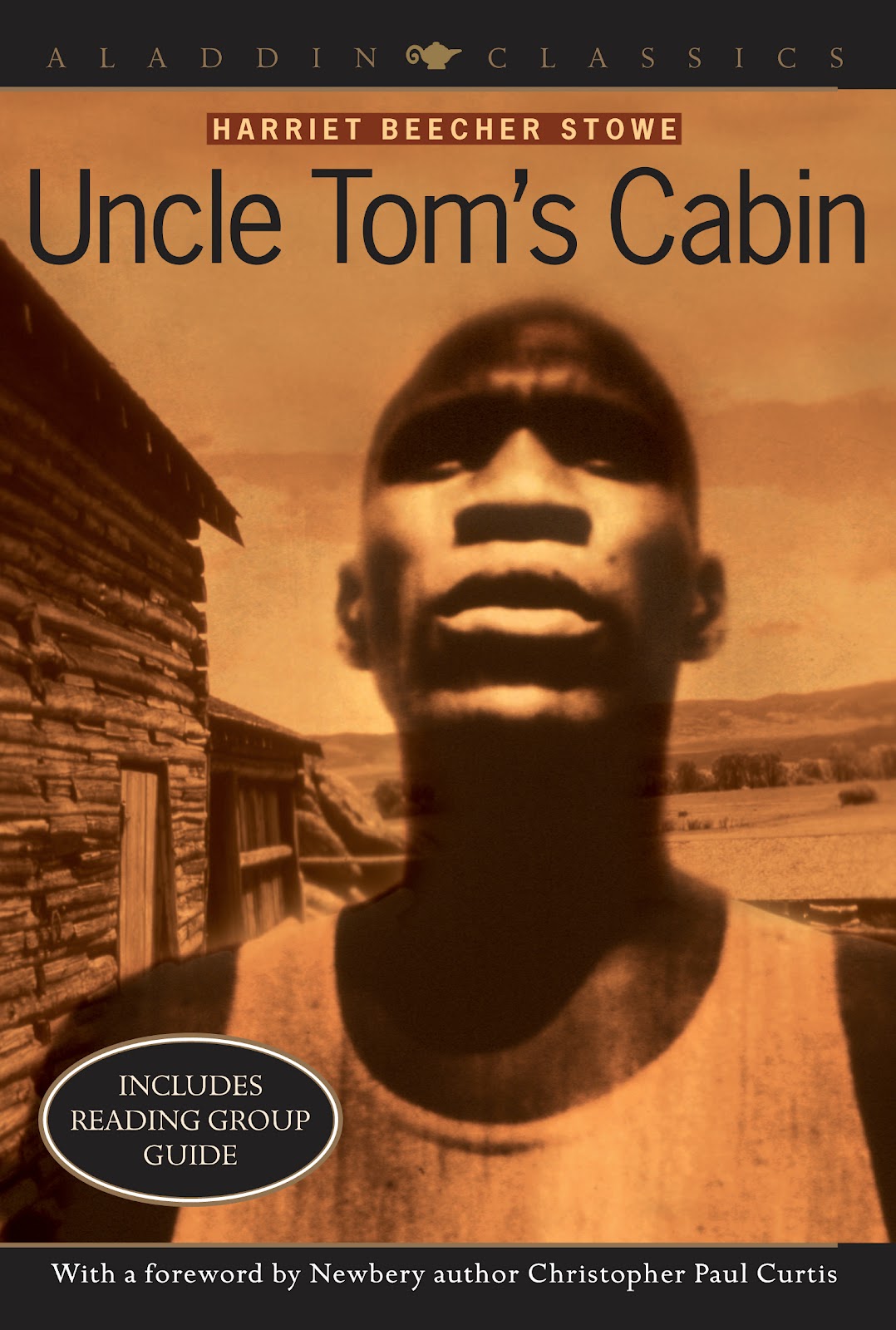
The leaders in the abolitionist movement were inspired by another book, Harriet Beecher Stowe’s “Uncle Tom’s Cabin,” described by Wickenden as “a novel not distinguished by subtlety or fine writing, but it was a powerful polemic at a moment of national reckoning.” Naturally, the book was banned by rightwing media and panned in the South. But Stowe’s influential book, along with the Missouri Compromise, helped ignite a powder keg of anti-slavery and pro-slavery violence in Lawrence, Kansas, triggering violent riots, lynchings, and massacres in the states, directly leading to war.

Wickenden describes draft riots in response the America’s first conscription to fill the military’s ranks. Riots originated among poor Irish and German immigrants who did not want to fight in a war to free black men who could then come north and take their jobs.


The families of all three principals in this book –– Martha Wright, Harriet Tubman, and Frances Seward –– were deeply affected by the Civil War, losing family members or experiencing life-altering injuries to relatives. Today, all three women are buried near each other in Fort Hill Cemetery, high above Auburn, New York.


Today, Frances and Henry Seward are remembered at the Seward House Museum, where their collection of more than 5,000 books are on display. Martha is honored, along with her sister Lucretia Mott, at the Visitor’s Center at Seneca Falls. Harriet Tubman is beloved and remembered at the National Park Service’s Harriet Tubman National Historical Park. Her image will reportedly be featured on the $20 bill in 2030, replacing that of Andrew Jackson.


(courtesy Treasury Dept.)
Back in 1852 –– 170 years ago, or three lifetimes ago –– the network of forward-thinking women held the Third National Woman’s Rights Convention in Syracuse, New York. They were abolitionists and agitators for equality. Some, like Lucy Stone, daringly wore their hair short. Women started to wear bloomer trousers and short jackets, considered inappropriate by conservative clerics, who “always made an appearance at women’s rights conventions” and advised the women to “stick to the domestic sphere, lest they become masculine.” Martha Wright, told him politely, paraphrasing, to mind his own business.

“Rev. Junius Hatch tried to win over the convention with a metaphor about female loveliness. Women should show a ‘shrinking delicacy, which, like the modest violet, hid itself until sought’ –– the same quality that led them to wear long skirts, instead of imitating the sunflower, which lifted its head, ‘seeming to say, come and admire me.’” He was shouted down by the audience who told him to “Sit down! Sit down! Shut up!

Women found their voice just a decade before the Civil War, but it would be another lifetime till they won the right to vote throughout the United States in the 19th Amendment, ratified by Congress in 1920.


“The Agitators” is another great selection for Women’s History Month.


By the way, New York's Married Women’s Property Act, mentioned at the beginning of this post, wasn't passed till 1848, but, once passed, it became the template for other states to follow. And to do the right thing.

Tuesday, March 8, 2022

Russia Scars ‘The Border’

Review by Bill Doughty––

The sunflower is the national flower of Ukraine. It has become a symbol of resistance after a Ukrainian woman confronted a Russian soldier and offered him seeds. She told him to put the seeds in his pocket so sunflowers would grow when he died on Ukraine’s soil. She shouted at him, “You’re occupants, you’re fascists. Take these seeds and put them in your pockets so at least sunflowers will grow when you all lie down here … You are occupiers. You are enemies.”


The sunflower seeds incident is just one of the stories of heroic resistance and resilience in Ukraine inspiring the world for the past two weeks since Putin’s unprovoked invasion.


Erika Fatland
I was interested in learning more about the people and history of Ukraine and was rewarded with a great book by historian and travel writer Erika Fatland, author of “The Border” (translated from the Norwegian by Kari Dickson; Pegasus Books Ltd., 2017).

In Ukraine, Fatland visits Odessa, Gammalsvenskby, Crimea, Mariupol, Kramatorsk, Donetsk, Poltava, Kiev, Lviv, and other areas in her two-year exploration around Russia’s border. After completing her journey –– more than five years ago –– Fatland had a chilling premonition about Putin’s aggression:

“The borders have changed and multiplied time and again over the centuries, most recently in 2014, when Russia annexed Crimea. Borders are not set in stone; the new fibreglass boundary markers are easy to move. The world’s biggest country is low on self-esteem; the economy is failing and the population shrinking. Thus the need to assert itself is even greater.”

“Putin, a former K.G.B. officer, stops at nothing to gain power and influence,” she observes. “Rules are only followed if they are in Russia’s favor.”


Putin justifies his invasion of the sovereign democratic nation of Ukraine because it once was part of Russia. But that view is myopic, at best, considering the long sweep of history. Fatland presents history lessons throughout her narrative, and she provides a helpful annex at the end of her book listing key events in Russian History from 862 to 2015.


With regard to Ukraine, she explains the strong ties with Sweden, the role of religion in the region, and the roles of Rural the Run, Vladimir 1, Grand Prince of Kiev; Genghis Khan and the Mongols; Ivan the Terrible; Napoleon; and various Alexanders, Nicholases, and Vladimirs/Volodymirs. Readers learn about the role of the Tartars, the Turks, the Crimean War, Stalin’s war of famine, and the Putin’s aggression in recent years in Chechnya, Georgia, and Crimea.

Monument to Peter the Great, St. Petersburg, Russia

Two Russian leaders leap out of history for Navy readers: Peter the Great and Catherine the Great, each with maritime interest in Ukraine.

“In 1682, Peter I, better known as Peter the Great, was crowned tsar at the tender age of ten. He was no more than a child and liked to spend his time building and sailing boats. As he grew up, his ambitions also grew, without his losing interest in boats and sailing: Peter the Great’s dream was to make Russia a maritime superpower. He first attempted to conquer the port areas on the Black Sea, but was unsuccessful, so he turned his sights west instead. In 1700, his troops besieged the Swedish-controlled town of Narva, on the current Estonian-Russian border. The clearly inferior Swedish army, led by the then eighteen-year-old Charles XII, were blessed by a snowstorm that blew up behind them and blinded the Russians, who panicked and fled, suffering great losses.”

Catherine II, known as Catherine the Great, continued Peter’s revanchist ambitions:

In 1689, when Peter the Great came to the throne, Russia, despite its size still had only one port, in Archangel. This was frozen over for the greater part of the year and was in the far north. Peter the Great managed to secure Russia’s access to the Baltic Sea and built a new capital, St Petersburg, there. But all attempts to conquer the Black Sea coast failed. It was only at the end of the eighteenth century, under Catherine the Great, that ships flying the Russian flag finally sailed on the Black Sea. Like her predecessor, Catherine the Great was ambitious. Her big dream was to conquer Istanbul, cradle of orthodox Christianity. She was not successful in that, but in the course of two long wars with the Ottoman Empire, she did manage to acquire large parts of what is now South Ukraine, from Odessa in the south to Dnepropetrovsk (now known as Dnipro) in the north, including Crimea.

“After the war with the Turks, which ended in 1774, Crimea was given the status of independent khanate. The freedom was, however, short-lived. In 1783, Catherine the Great announced that the khan in Crimea and his people would henceforth be considered subjects of the Russian tsar.” 

Portrait of Catherine the Great by Alexey Antropov

[By the way, later in his life, with few career options after his military service, American naval hero John Paul Jones entered into the service of Catherine the Great on April 23, 1787.]


Fatland’s book and journey begins in, of all places, North Korea, which shares a tiny border but huge history with Russia. Fatland takes us on a fascinating propaganda tour filled with giant statues of the Kims, choreographed mass dances, school visits, and photo-deleting tour guides. Along the way, she contextualizes places and culture with history.


Navy readers will enjoy her brief discussion of the Russo-Japan War, where Tsar Nicholas II’s Russian fleet was destroyed by the Japanese fleet in the Tsushima Straits, May 27, 1905. President Theodore Roosevelt received the Nobel Peace Prize for helping negotiate peace.


Today, in response to Russia’s atrocities in Ukraine, the free world is imposing  more sanctions against Russia. We can imagine what the future could portend for Putin, as a result of those sanctions, when we consider the effects of Russia’s war on its home front –– in 1905:

“In addition to the many thousands of soldiers who had been killed far away in a war that very few understood, it had also resulted in food shortages in the major ciities. On January 22, several hundred peaceful demonstrators marched on the Winter Palace, demanding reform, better working conditions, and an end to the war with Japan. [Russian police were ordered to open fire on citizens]… More than 130 people were killed in what has gone down in history as ‘Bloody Sunday.’ This, in turn, led to strikes, protests, and revolt throughout the empire. In the autumn, following Russia’s humiliating defeat by the Japanese, all the major cities were brought to a standstill by a general strike … Nicholas II’s inability to accept the fact that times were changing, and that the days of the autocrat were numbered, would cost him dear.”

After Putin the autocrat aggressively annexed the Crimean Peninsula 2014 and fomented unrest in eastern Ukraine, he showed interest in fortifying his relationship with China and North Korea. Just a few months after taking over Crimea, Putin wiped out ninety percent of North Korea’s debt with Russia, according to Fatland. Russia has unrestricted access to North Korea’s mineral resources. In addition to other quid pro quo infrastructure initiatives, Putin arranged for a fifty year lease for the use of Rason, a port in the Sea of Japan.

“The Russian authorities plan to transport goods by rail from Vladivostok, which will then be transferred to ships in Rason, which, unlike Vladivostok, is ice-free all year round. Even though more than two thirds of Russia’s border is maritime, the country has very few deepwater ports. This desire for warm-water ports has been the cause of several wars in Russian history: Peter the Great, Catherine the Great, Nicholas I and Nicholas II all stopped at nothing in their attempts to make the enormous empire a maritime superpower. A leasing agreement with the world’s worst dictator is one of the less dramatic steps Russian leaders have taken to guarantee the country an ice-free port.”

The problem for the Russians in using the port, however lies in the sanctions imposed by the United States, European Union, and many other nations.


Today, President Joe Biden announced the United States was sanctioning oil and natural gas exports from Russia. The U.S. continues to send billions in military aid to Ukraine, and is fortifying NATO allies.


Pallets of ammunition, weapons and other equipment bound for Ukraine wait to be loaded during a foreign military sales mission at Dover Air Force Base, Delaware, Feb. 28, 2022. Since 2014, the United States has committed more than $5.4 billion in total assistance to Ukraine, and reaffirms its steadfast commitment to a secure and prosperous Ukraine and to its sovereignty and territorial integrity. (Tech. Sgt. J.D. Strong II)

There is so much more to discover in this book: meeting the Uyghurs in Xinjiang; taking a group tour to Chernobyl; discovering the connection between explorers Vitus Bering and Captain James Cook and the Arctic; contemplating borders as both real and abstract; and learning more about Putin’s forays into Chechnya, Syria, and Georgia.


The full name of her book is “The Border: A Journey Around Russia Through North Korea, China, Mongolia, Kazakhstan, Azerbaijan, Georgia, Ukraine, Belarus, Lithuania, Poland, Latvia, Estonia, Finland, Norway, and the Northeast Passage.”


Fatland is also author of “Sovietistan,” that, according to Kirkus Review is “A lively, if rarely cheerful, travelogue that fills a yawning knowledge gap for readers concerned with international affairs,” which aptly describes “Border” too. In "The Border," she introduces us to colorful characters, fraught or funny situations, and fascinating landscapes.


Fatland writes with precision and compassion. In Georgia’s Caucasus mountains she visited the Gergeti Monastery, pictured above. She has a poet’s soul, especially when she writes about Georgia:

“Georgia is one of my favorite countries. It is a country that has absolutely everything: some of the highest mountains in Europe in the north, you can swim in the Black Sea in the west and in the east you will find world-class vineyards. Add old, almost untouched architecture (everything from medieval villages where stone towers stand side by side, to some of the oldest churches in the world), a cuisine that can compete with Italian, and people who not only are open and hospitable, but always ready to party and have another drink, and you have Georgia. Were it not for their neighbours, the Georgians would probably be the world’s happiest people”

With her perspective as a citizen of Norway, Fatland has an objective eye, yet she sees the danger of Russian aggression throughout her journeys both on land and through time. “Being Russia’s neighbour has never been easy,” she writes. “Norway is the only one of its fourteen neighbours that has not been invaded or at war with Russia in the past five hundred years.”


“I had travelled through fourteen countries and three breakaway republics,” Fatland writes:

“And none of the countries I had travelled through were without wounds or scars left by their neighbor, Russia. For centuries, the smaller countries and peoples, in particular, had been ground between the millstones of power, torn by wars between the major players, and pulled here and there.

“Nations have not collective memory; nations have no healed wounds. It is the individuals, millions of then, who carry the scars.”

Scars –– deep scars –– are being created right now in Ukraine, where Putin’s Russia is attacking not only military targets, but also schools, hospitals, residential neighborhoods, evacuation centers, and even nuclear power plants, committing war crimes as he spreads disinformation to his own nation.

Analysts say Putin won’t stop in Ukraine unless he is stopped; some say we may already be in World War III –– or WWZ, considering the Russians use of the letter Z as a crooked half-swastika symbol. “The Border” gives us an appreciation of liberty and freedom in the face of authoritarian autocratic governments, and it helps us understand the people impacted by Russian aggression and find the right questions for what's ahead.

“After two years of traveling along Russia’s border –– in real terms, along dusty country roads and across the sea, and in figurative terms, charting its long and complex history –– I now have more questions than answers. Which is not unexpected. My main impression is of a lack of direction and opportunism. The Russian Empire grew to the size it did because tsar after tsar seized any opportunity to expand the empire’s borders, using violence, trickery and war if necessary. And one group of people after another, from the nomadic tribes of Siberia to the Muslim Khanates of Central Asia and Russia’s Slav neighbors, was encompassed by the great empire, willingly and unwillingly. In the borderlands and on the periphery, freedom came and went. History teaches us that those who were once part of the Russian empire are most at risk of falling under its yoke in the future.”

“The Border” is an amazing achievement. Fatland manages to plant dry seeds of history in a compelling, often poetic, travel adventure. At nearly 600 pages, her book is both informative and fun but also melancholy considering the humanitarian catastrophe occurring now in some of the same places she visited –– places where perhaps sunflowers will grow in the future.


Wednesday, March 2, 2022

A Woman’s Voice for Opportunity, Optimism

Review by Bill Doughty––

Here are three reasons to read this amazing book:


Firstly, it helps explain the rise of Russia’s President Putin and the popular support for America’s former President Trump. Secondly, it’s an inspiring account of a woman’s challenge in overcoming obstacles –– perfect for Women’s History Month. And, thirdly, it’s an extremely well-written contemporary history, with practical advice for how to prevent the further rise of authoritarianism and tyranny.

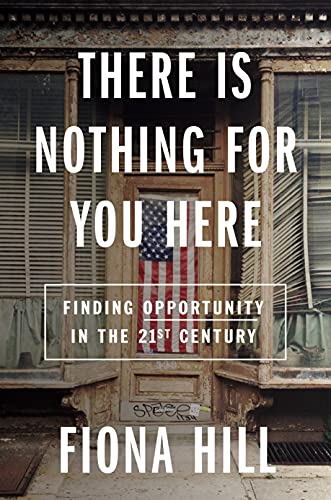
The book is “There Is Nothing for you Here: Finding Opportunity in the 21st Century” by Fiona Hill (Mariner Books, HarperCollins, 2021).


Hill grew up as a coal miner’s daughter in northern England, and she describes her journey “from the coal house to the White House.” Recruited by Fox News’s K.T. McFarland, Hill worked as deputy assistant to the president and senior director for European and Russia affairs on the National Security Council in the Trump administration.


Hill warns of the dangers of populism leading to tyranny. “Russia’s fate and its slide into authoritarianism since 2000 could well be our own.”

“Throughout history, populist have offered compelling narratives for people who feel they have lost their identities and cultural moorings as well as their jobs in an economic downturn and at times of rapid social change and political uncertainty. Populism was a major feature of European and also U.S. politics at pivotal points in the twentieth century: in the 1920s and 1930s during the Great Depression, in the 1960s and again in the 1980s during generational and technological changes. Putin, for example, first came to power in Russia on December 31, 1999, right at the very end of a decade of wrenching economic crisis, political upheaval, and strife, including a war in Chechnya, in Russia’s North Caucasus region. Putin promised to fix this.

“Populists like Putin provide straightforward, plain-speaking explanations for people’s misfortunes. They offer scapegoat, like corrupt bureaucrats and conniving immigrants, or the West trying to keep Russia down, in Putin’s case. They produce memorable catchphrases that encapsulate the ambitious claims that they, and only they, can solve ‘the people’s’ problems and ease their cultural despair. ‘The people’ is also who they say it is –– not everyone, just a specific group that they define. This group of ‘their people” (natshi, or ‘ours’ in Russian) is then divided against the rest of society.”

Hill describes the extreme sexism and discrimination she witnessed in Russia. She also describes how she dealt with numerous incidents of sexual harassment, misogyny, and discrimination –– including wage gaps –– in her career.


Reince Priebus, Trump’s first of several chiefs of staff, nicknamed Hill the “Russia Bitch.”


Hill writes, “I had struggled against sexism throughout my professional life in a seemingly unending effort to realize my potential and do my job effectively” despite the difficulties that somehow seemed intrinsic to being female.” Easily accessible national health care and childcare are seen as essential to promoting education, mobility, and career opportunities, especially for women.


Putin, with Hill to his left
There are several humorous recounts of her direct interactions with Trump, including in the Oval Office. There are also creepy accounts of her sitting next to Putin on several occasions during public meetings. And there is a laugh-out-loud, sad-but-funny reaction as she sat in the audience in Helsinki during a summit between Trump and Putin.

Many people will want to read her account of what it was like testifying to Congress in a hearing for the first impeachment of former President Trump. Hill was a witness to events surrounding Trump's call with the President of Ukraine when Trump withheld defensive arms as leverage for dirt on his political opponent. Hill offers fascinating takes on Ambassador Gordon Sondland, who also testified, and Representative Matt Gaetz, who tried unsuccessfully to stare her down during her appearance at the Capitol.


She praises many women by name who mentored, advised, or otherwise assisted her, including preparing her for her testimony. But she also notes how some women and men treated her unfairly throughout her education and career because of her accent, wardrobe, or humble beginnings in Bishop Aukland, England.


Hill compares the classism she experienced growing up in the UK with the racism she witnessed firsthand after emigrating to the U.S. She shares insights found in author Isabel Wilkerson's landmark book “Caste” (reviewed Jan. 14 on Navy Reads). White supremacy, Wilkerson notes, became memorialized for some after the Civil War and poisoned race relations "for generations.” Hill picks up on the theme:

“This sad history of racial identity being weaponized by the powerful against working people is not limited to the United States. It was also evident in the United Kingdom after both world wars, when race was used as a deliberate tool for divisive policies to benefit the narrow interests of shipyard owners and other big businesses who wanted to hire cheaper and non-unionized immigrant labor to stave off organized British labor demands for Black workers in shipyards and port cities, leading to riots, intercommunal violence, and the deaths of Black seamen and dockworkers who were accused of stealing jobs.”

She make several references to the effects of World War II, especially in post-war England and in the United States, where the G.I. Bill helped not only U.S. warfighters and their family, but also had an indirect influence on people in UK and Europe. The Marshall Plan and other “bold moves” had a direct and positive impact on people yearning for freedom, democracy, and self-determination.


“I mirrored the experience of millions of young Americans after World War II, who found college to be the door to a job and a better life than their parents’.” Her own choice to learn Russian and go into Russian studies hinged on a veteran uncle’s suggestion. The uncle was pained and perplexed to see how former WWII ally Russia had turned to oppressive communism under the Soviet Union and become an enemy to Western ideals.


Books and reading and the help of her community propelled Hill toward a higher education, with the path leading to Harvard’s Kennedy School, named for JFK, a navy hero of WWII. Hill received the Frank Knox scholarship. Knox was Secretary of the Navy during WWII.


Hill notes, “Breaking down racial barriers, as well as other universal or generalized spatial and structural impediments to opportunity, requires large-scale intervention.” The solution continually comes back to education, including the need for post-high school education, either for two-or four years or apprenticeship to learn a technical skill.

“Focusing collective action on education is an important aspect in countering the national security crisis of polarization and fragmentation. Lack of education –– in the sense of acquiring the critical thinking skills that a good K-12 and some form of college education can provide –– breeds suspicion of government, skepticism toward science and expert knowledge, and resistance to the very idea that there are things like basic facts and objective information. Poor educational attainment leaves people vulnerable to populists and political operatives –– a fact underscored by President Trump’s persistently higher ratings among Americans without a college degree.”

Analysts note that Putin’s most fervent supporters come from the rural, more isolated, parts of Russia. In contrast, the brave people who have come out on streets to protest Putin’s unprovoked aggressive invasion of Ukraine are the more educated people of the cities.

We can see the effects of populism leading to autocracy both in the J6 insurrection by Trump supporters at the U.S. Capitol on January 6, 2001 and in Putin’s invasion of Ukraine, a sovereign democracy.

“Russia’s fate over a twenty-year period shows how a country’s political path can turn away from democracy toward autocracy. No state, no matter how advanced, is immune from flawed leadership, the erosion of political checks and balances, and the degradation of its institutions. Democracy is not self-repairing. It requires constant attention and renewal, especially during periods of rapid technological and social change and economic uncertainty.”
I created a short playlist based on song and artists mentions by Hill, primarily from the 80s and early 90s and especially songs big in Britain at the time. High on the list: The Specials’ “Ghost Town,” Nena’s “99 Red Balloons,” and Billy Bragg’s “Waiting for the Great Leap Forward.” Also included, based on mentions by Hill: some acoustic Beatles songs and a group I’d never heard of, Russia’s Nautilus Pompilius. I also included the Scorpions’ “Wind of Change," about the thawing of the Cold War. It was released in 1990, exactly ten years before Putin ascended into power in Russia. Nena's "99 Red Balloons" from 1983 is mentioned several times; it is also considered an anthem protesting the Cold War, and was covered touchingly last week by Kelly Clarkson. It's a tribute to the brave people of Ukraine.


As this review is posted, Putin appears to be trying to lower another Iron Curtain and start another Cold War in his invasion of Ukraine. However, his actions have galvanized the NATO, Europe, and the free world. President Biden’s Department of Defense, led by SECDEF Lloyd Austin, is committing even more defensive support to NATO allies.


Secretary of Defense Lloyd Austin meets with Ukraine's Minister of Foreign Affairs Dmytro Kuleba at the Pentagon, Feb. 22, 2022. (Lisa Ferdinando)

Sanctions are having a devastating effect on Russia, in what amounts to “economic warfare,” according to analysts.

But Fiona Hill, now the director of the Center on the United States and Europe at the Brookings Institution, warns against sending direct military support to Ukraine. It could be falling into a trap laid by Putin, who believes in “escalation dominance” and looks for any excuse (couched as Western threats to Russia) to justify his actions. [On Pod Save the World, Ben Rhodes, former adviser to President Obama, said “Putin is at the vanguard of so much that’s wrong in the world.” But Rhodes also warns against direct military conflict with the Russians, who are threatening to literally “go nuclear.”]

My only complaint with “There Is Nothing for You Here” is minor; I wish it had a photo section. On the other hand, Hill presents a robust notes section, excellent conclusion, and helpful how-to afterword to provide more opportunity and possibilities for people, especially those who are less advantaged. 


Hill's style is easy, her approach is humble (one of her favorite words is “impecunious”), and her insights are refreshingly optimistic. This is a highly recommended book, both as biography and history, for Women’s History Month!