Showing posts sorted by relevance for query pearl harbor visitor center. Sort by date Show all posts

Sunday, December 18, 2016

Diary of Pearl Harbor Survivor – Navy Chief Al Rodrigues

Review by Bill Doughty

Pacific Historic Parks provides this short book at the Pearl Harbor Visitor Center, overlooking USS Arizona and "Battleship Row" next to Ford Island in Pearl Harbor.

The cover reads: "A Native Son of Hawaii's memories of the War in the Pacific while on duty during the surprise attack at Pearl Harbor and while serving on the battleship USS Washington in the Pacific Theater."

This is his wartime diary aboard USS Washington (BB-56) as well as his insights and reflections as a volunteer at the Visitor Center, where his message to visitors is: "Freedom is not free."

This enjoyable little book, published in 2014, starts with Rodrigues's recollections as a young boy growing up in Hawaii.

Al was born on the island of Kauai on February 7, 1920. His full name: Alfred Benjamin Kameeiamoku Rodrigues. Al's mother was Hawaiian. She died when Al was only 8, "and I felt like I wanted to die also. I loved her so much." Al's father was of Portuguese descent. He experienced some prejudice growing up in mixed-race family on Kauai.

Kapaa Kauai in 1924, looking away from Lihue and toward "Sleeping Giant" mountain range.
"Kauai is geologically the oldest island of the group of islands and, without any personal prejudice, the most beautiful of all." Al attended Kauai High School in Lihue, where he competed in various sports, when he wasn't surfing or caddying at the Waialua Golf Course (25 cents per bag for nine holes, with usually a ten-cent tip).
"I played football, volleyball, basketball and baseball and was also on the swimming team so kept busy. The only wrong thing I did was take up smoking, so there went my caddy money. I finally quit smoking when I retired from the Navy."
Rodrigues joined the Navy with an ambition to be an engineering, but under the guidance of Navy Chief George Maile, a fellow Sailor from Hawaii, he chose instead to become a storekeeper. "It made a difference on the rest of my career in the Navy."

Gunners aboard USS Ward (DD-139).
He remembers holding air raid drills in November of 1941. "It was an omen that something was to happen," he said.
"On December 7, 1941, I had the four-to-eight watch; and the officer of the deck, who was a quartermaster second class, told me that they had received a message at 3:30 a.m. that our destroyer the USS Ward (DD-139) had dropped depth charges on an unidentified submarine and sunk it."
Al had just put his breakfast tray down when he could hear explosions "in the shipyard area." He and his buddies assumed it was dredging work until he heard the General Alarm. They all ran to the armory where they were issued .30 caliber rifles or .45 pistols. Not much help against the incoming enemy planes, red rising suns on the bottom of their wings.
"They were flying low enough that you could see the pilots' faces. We heard yells to shoot the pilot as they had open cockpits. Hell, it was hard enough to shoot the airplane, much less the pilot. With a rifle of 1941 vintage, you could only shoot one bullet at a time then cock the rifle before shooting the next shot, and by then the plane was out of reach."
Naval Supply Center at Pearl Harbor in the 1940s.
Storekeepers like Al provided supplies and made room "for sailors who lost everything." He worked closely with the Naval Supply Center, now known as Fleet Industrial Supply Center.

This book is filled with tweet-size stories about characters like Sake-Mac, the Chief Commissary man; an unnamed bunkmate accused of murder in New York; and C.B. Wilson, who helped Al sneak out at night for a luau. 

USS Washington (BB-56) in the Shipyard after a collision with USS Indiana (BB-58) in 1944.
Most of "Diary" is in fact a diary, a journal, and a way to keep track of events at a time when news was blocked, letters were censored and information was subject to propaganda and what we'd now call fake news.

Al gives us a feel for day-to-day life during wartime aboard USS Washington and how the enemy was viewed by Sailors and the nation at the time. The cover of his diary was inscribed with some of the locations he visited, including Palau, Gilberts, Nauru, Marianas and Marshall Islands, where his ship's bow was crushed in a collision with USS Indiana (BB-58).

We see how close Al was to his sister, Nani.

Al remembers fondly some time he finagled in New York City, which welcomed service members who had served in the war. After the war he returned to Hawaii.
"The City and County of Honolulu had an ad asking for men to join the police force and I applied. The first thing they did was make me get on a scale and I weighed 149 pounds. The sergeant told me to go home, eat some bananas and come back tomorrow as the minimum weight was 150 pounds. Did that; I ate a few and the next day I was accepted for the next recruit training as I met the correct weight."
Al Rodrigues's diary.
But Al changed his mind and rejoined the Navy, where he served as a Navy Chief at the Yards and Docks Supply Depot.

He married "the cutest local Japanese girl," Ruth, and raised a family – three sons, Kammy, Jay and Ronald. Ronald was born in Yokosuka, Japan when Al was stationed at Naval Supply Depot there.  "In 1960, sometime while stationed at the Naval Ammunition Depot in Lualualei, Oahu, Ruth and I split. We had differences and she eventually married a guy named Pete, who was a Navy friend of mine. It sure is funny how some things just work out for the best – for all concerned."

Pearl Harbor Survivors Sterling Cale and Al Rodrigues meet young visitors in 2009.
Al met his second wife, Louise, who already had four children, Jimmy, Mary, Stella and Fred. "Now with four of hers, three of mine (from my first marriage) plus two of ours (son Kalani and daughter Aulani born at Tripler Army Medical Center) it adds up to nine in the family. And we are still one happy family. It is mine, hers and ours. Nice, huh!"

Today, Al Rodrigues volunteers at the Pearl Harbor Visitor Center where he meets people "from many foreign countries and every state in the Union."
"In closing, I want to remind people that we should honor the memories of my generation so that we can pass to future generations the stories of what those brave, heroic men and women of World war II did to preserve our freedom. Freedom is not free."
Thank you to Agnes Tauyan, Director of Public Affairs for Navy Region Hawaii, for recommending this book for a Navy Reads review.

Saturday, December 7, 2013

'Out of the Ordinary' Way to Pearl Harbor

by Bill Doughty

Though at 90 he doesn't read much anymore, World War II Navy veteran Ewalt Shatz remembers enjoying books as a young man in the 1940s.

"I used to read love stories, westerns, books about history and especially anything out of the ordinary, strange things that get you wondering about things -- anything out of the ordinary."

Ewalt Shatz welcomed in Hawaii.
People are reading about Ewalt Shatz this week.

Bumped from a flight to Hawaii Wednesday, the Pearl Harbor Survivor was rerouted to another carrier: Hawaiian Airlines, where he says he got world-class, first-class treatment.

"I got to Maui (for a connection to Oahu) and I didn't know where to go.  A girl came along and helped me, and someone was calling my name on the loudspeaker.  They treated me like gangbusters," he said earlier today at the 72nd anniversary commemoration ceremony of the attack on Pearl Harbor. 

Shatz said an attendant flew with him from Maui to Honolulu, where he was met by dozens of military service member supporters, most in uniform, at nearly midnight.  He said he didn't have a chance to say "thank you" to the Hawaiian Airlines attendant.

While serving aboard ships in the 1940s Ewalt found time enjoy books.  Today he says he suffers from macular degeneration, so he can't read the way he once could.

"I used to go to the mess decks to read books cause there was better lighting," he said, "and I went through quite a few."

He was one of about 50-60 WWII veterans and more than 2,500 other guests who attended today's ceremony at the Pearl Harbor Visitor Center, World War II Valor in the Pacific National Monument.


131207-N-FF306-053 PEARL HARBOR (Dec. 07, 2013) Pearl Harbor survivors attend the 72nd Anniversary Pearl Harbor Day Commemoration. More than 2,500 guests, including Pearl Harbor survivors and other veterans, attended the National Park Service and U.S. Navy-hosted joint memorial ceremony at the World War II Valor in the Pacific National Monument. This year's theme was "Sound the Alarm," examining how thousands of Americans answered their nation's call after the attack and how the nation was united behind a common purpose throughout the war. (U.S. Navy photo by Mass Communication Specialist Seaman Apprentice Rose Forest/Released)  Note: Ewalt Shatz is sitting center in black shoes and socks.

Sunday, February 11, 2018

Hōkūle‘a Visits Pearl Harbor

People aboard Battleship Missouri Memorial help welcome voyaging canoe Hōkūle‘a in Pearl Harbor Feb. 10. (Photo by Kaimana Pine, courtesy PVS)
Voyaging Canoe Makes Historic First Visit

Story by Petty Officer 1st Class Jeffrey Troutman, Navy Public Affairs Support Element Detachment Hawaii

The traditional Polynesian double-hulled voyaging canoe, Hōkūle‘a, sailed into the waters of Pearl Harbor and visited the Puʻuloa region for the first time in the canoe’s 42-year history, Feb. 10.

The Hōkūle‘a crew was welcomed at Rainbow Bay Marina by the Puʻuloa community and US Navy who will host the canoe during a week-long visit to the region.

Rear Adm. Brian Fort, commander, Navy Region Hawaii and Naval Surface Group Middle Pacific, spoke at the welcoming ceremony of the Hōkūle‘a’ crew’s values, and how they reflect those of the U.S. Navy and the Hawaiian community at Pearl Harbor.

“Today is truly a historic day here at Pu’uloa,” said Fort. “I am a firm believer that the values that unite us are much greater than the distractions that divide us, and here today, we are truly inspired by the brave and humble navigators and voyagers of Hōkūle‘a, and by the values they cherish and represent.”

Rear Adm. Brian Fort, commander, Navy Region Hawaii and Naval Surface Group Middle Pacific, speaks with Nainoa Thompson, president of the Polynesian Voyaging Society and Master Navigator of the traditional Polynesian double-hulled voyaging canoe, Hōkūle‘a. The week-long engagement to follow will include school visits, public dockside tours and a crew talk story event. (U.S. Navy Photo by Mass Communication Specialist 1st Class Jeff Troutman)
The Hōkūle‘a crew’s week-long engagement with the local community will include school visits, public dockside tours and a crew speaking event. As part of the Mahalo, Hawaiʻi Sail, the purpose of Hōkūleʻa’s visit is to bring the canoe to more of Hawaiʻi’s children, honor Pearl Harbor’s ancient culture and history, and to learn about the efforts to restore the area’s cultural sites, including the nearby Loko Paʻaiau Fishpond.

“This is an emotional day for me, because this is the very first time this historic vessel has ever sailed upon the waters of Pearl Harbor,” said Nainoa Thompson, president of the Polynesian Voyaging Society and Master Navigator of Hōkūle‘a. “To feel this sense of community and to know that the efforts of this crew are being celebrated in this moment, it is my hope that today is a chance for us to all take one more step towards coming together as one.”

Hōkūle‘a renders honors at USS Nevada Memorial at Hospital Point. (Photo by MC1 Troutman)
Upon entering the waters of Pearl Harbor, the Hōkūle‘a crew paid their respect as the vessel sailed past significant cultural and historical sites including Halealoha Halemau (Fort Kamehameha Reburial Platform), USS Nevada, Arizona Memorial, Battleship Missouri, Ford Island, USS Utah, and Loko Paʻaiau Fishpond, before piering at Rainbow Bay Marina. The crew will conclude their week-long visit by working with the restoration team at Loko Paʻaiau Fishpond on February 17.

The Loko Paʻaiau fishpond is located at McGrew Point Navy housing and is one of only three fishponds out of an original 22 in the Pu’uloa area which are still relatively intact. In September 2014, the Navy invited members of the local Hawaiian civic clubs and ʻAiea community members to begin work on restoring the historic fishpond.

“We want to celebrate this place and the movement taking place by the Puʻuloa community and the Navy to restore the Native Hawaiian history, sites and cultural identity of Pearl Harbor,” said Nainoa Thompson, president of the Polynesian Voyaging Society. “We hope Hōkūleʻa’s visit will open the doors for our young people to learn about the extraordinary history and culture of this very special, sacred place.”

More than 1,000 school children are scheduled to visit Hōkūleʻa and participate in educational activities during the canoe's stop at Puʻuloa.

For more information about the Hōkūleʻa and her crew, please visit: http://www.hokulea.com/.

For a series of Navy Reads reviews and other posts over the years about Hōkūleʻa click here.

Schedule of events at Rainbow Bay Marina this week, provided by Polynesian Voyaging Society:

Public Open House Tours of Hōkūleʻa to Feb. 17

Rainbow Bay Marina (next to Restaurant 604, adjacent to National Park Service's Pearl Harbor Visitor Center.
  • Sunday Feb. 11, 10 a.m. to 5 p.m. and

  • Monday thru Friday, Feb. 12 to 16, 3 p.m. to 5 p.m.
  • Hōkūleʻa Crew Talk Story (Sponsored by Kamehameha Schools ʻEwa Region) at Rainbow Bay Marina Pavilion Thursday, Feb. 15, 5 to 7 p.m.
  • Meet crew and community members who will discuss the significance of Hōkūleʻa’s visit to the Puʻuloa region.

  • Saturday Feb 17, 7:00 a.m., Hōkūleʻa departs Rainbow Bay Marina

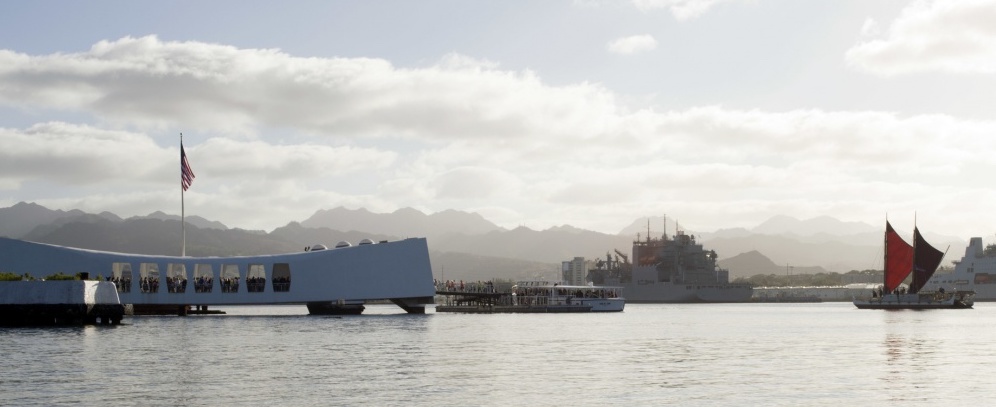
  • Hōkūle‘a renders honors as it passes by the USS Arizona Memorial (Photo by MC1 Jeff Troutman)

    Sunday, August 23, 2015

    Ten Sterling Insights in Life of Pearl Harbor Survivor

    Review by Bill Doughty

    Another Pacific Historic Parks (2014) booklet focuses on "A True American: The Story of a Pearl Harbor Survivor, World War II, Korean and Vietnam War Veteran." Here are ten insights in a remarkable life of a member of the "Greatest Generation" narrated by Sterling R. Cale to his son Sterling V. Cale.

    1.  Medical: Cale served as a Pharmacist's Mate, forerunner to Navy Hospital Corpsman. Early in his career he passed out during a circumcision when the patient, supposedly anesthetized, started screaming. He thought of himself first as a farm boy from Illinois, but he had dreams of one day becoming a surgeon, dreams that were cut short later in life when he injured his thumb.

    2.  Dec. 7, 1941: Cale worked the night shift at the Pearl Harbor naval dispensary, a shift that ended in the morning of Dec. 7. He walked outside to witness Japanese planes attacking Battleship Row. He broke into the armory and helped hand out Springfield rifles to fellow Sailors.

    Cale salutes during a wreath presentation in 2010.
    3.  Rescue: During the attack, Cale rushed toward USS Oklahoma and helped with the rescue of Sailors from the waters of Pearl Harbor. "Some of them were already dead, some burned, some wounded and some were just tired," he remembers.

    4.  Recovery: After the attack, he was assigned – along with 10 other men – to "ride out to the USS Arizona and start recovering bodies." Cale climbed into a heavy suit and diver's helmet, something out of Jules Verne's "Twenty Thousand Leagues Under the Sea." His description of what he finds beneath the surface is disturbing and haunting.

    5.  Risk: Cale took risks. He was written up for breaking into the armory (even though Pearl Harbor was under attack). And he was court-martialed (but cleared) for keeping a war diary. " I meticulously recorded the precise location of every item and body part" to help with identification. He eventually earned commendation instead of condemnation; luckily, common sense would trump military bureaucracy.

    6.  Action: During World War II he served with the 1st Marine Division at Guadalcanal, then saw action at Saipan, Tinian, Bougainville and Espiritu Sato, later serving aboard USS Panang (AG 41), named for "the U.S. gunboat that had been sunk [by Imperial Japan's military] in Chinese waters."

    7.  Love: Sterling Cale met beautiful Victoria Vienna Ventula in Honolulu in 1941. They courted, married and started a family. "We managed to live with two children on my $21 monthly military salary," he said. Cale shares poignant family photos in the booklet.

    Marines in Korea.
    8.  Korea: Cale left the Navy for the Army "with no break in military service" and headed to Korea with the 5th Regimental Combat Team serving with the 24th (later 25th) Infantry Division as a field medic. "The North Koreans booby trapped everything: cans, bodies, vehicles and foxholes ... I remember sleeping with a grenade in each hand because North Korean soldiers would come in to the sleeping areas to slit throats." It's no wonder that Cale was affected.  "Later in life, my family could not touch me when I was asleep or I would jump up, prepared to kill them." He faced and overcame "post traumatic stress disorder."

    9.  Vietnam: Like the war itself, Cale's involvement in Vietnam was complicated. It started in 1955 and continued through the 60s, with assignments that included military advisor, intelligence, logistics, medic and hospital administrator. Cale briefly discusses his work in Da Nang and support missions to the Philippines, Taiwan and Hong Kong.

    With Naval Academy Women's Glee Club aboard USS Arizona Memorial, 2012.
    10. Legacy: "A True American concludes with an epilogue from Sterling Cale that shows his acceptance of the realities of life. "Pearl Harbor haunted me, but I did my best to put the past behind me, focus on the present and be positive about everything. Today, Sterling Cale volunteers at the Pearl Harbor Visitor Center where he can talk about his role in the Pacific War and other wars in the Pacific.

    This booklet offers other interesting tidbits about Sterling Cale's life: as an orphan, working with the Tom Mix circus, book binding and repair at the public library, musician (trumpet and drums), Eagle Scout, Navy "frogman" training, partying with "gold hair" tobacco heiress Doris Duke Cromwell aboard her yacht, and serving as NCOIC of the honor guard and burial detail at Punchbowl National Cemetery of the Pacific.

    Thanks, once again, to YNCM (ret.) Jim Taylor, Pearl Harbor Survivors Liaison and honorary USS Utah Survivor, for recommending this read. See a related Navy Reads post about another PHVC volunteer, Uncle Herb Weatherwax: "From Street Gang to WWII Veteran."

    Friday, February 13, 2015

    From Street Gang to WWII Veteran

    by Bill Doughty

    In "Counting My Blessings: The Autobiography of a Native Hawaiian Pearl Harbor Survivor," "Uncle Herb" Weatherwax tells his story of humble beginnings – from homeless street gang to life in the military during World War II, then success as a business owner.

    As to his humble beginnings as a child raised on the outskirts of Hilo on the Big Island of Hawaii:
    "There was no stove in our house. Instead, we had a couple of rocks placed outside with metal bars across them. We would build a fire underneath and place the food across the bars. We didn't have running water, either. In those days, one of the staple foods was salted salmon from Alaska, which was shipped in large barrels. We used the barrels to collect water ... Our outhouse was built over underground lava tubes. All you had to do was locate one of those tubes, knock a hole in it, and put the outhouse over it! There would be spider webs in there and it wasn't too pleasant."
    Hilo, Hawaii in 1928.
    Weatherwax picked up the nickname "Spider" when he subsequently ran the streets with the Hotel Street Gang and later the Bethel Street Gang as a young man who became addicted to alcohol and spent "numerous nights in jail."

    His first steady job was with President Franklin D. Roosevelt's Civilian Conservation Corps, building roads around Mauna Kea, home today of the world's largest astronomical observatory.

    He also worked for Hawaiian Electric as an apprentice electrician for 30 cents an hour. It was a trade that would help him in the Army and later as a veteran.

    Weatherwax was drafted into the Army in June 1941 and was stationed at Schofield Barracks in Wahiawa. He was on a weekend pass in Honolulu on December 7, 1941 and heard the thunderous attack in Pearl Harbor. He was recalled to his duty station during the attack and ordered to prepare an invasion of the islands.
    "As the bus was passing above Pearl Harbor I saw the whole thing. The attack was still going on and there was confusion everywhere. The USS Arizona was enveloped in flames; the USS Oklahoma was on its side. Those who managed to escape from being trapped inside those ships were up on the hull, but the ocean was on fire from the spilled oil and fuel. Those men couldn't even go into the water. There was smoke all over and a lot of commotion."
    The invasion never came, but war was declared the next day. President Roosevelt called it an "unprovoked and dastardly attack" and "a day of infamy."
    U.S. Army troops move through the "dragon's teeth" of the Siegfried Line.

    "Counting My Blessings" tracks Weatherwax's journey during the war from the Pacific to the Atlantic, landing in Europe and facing Germany's Siegfried Line where "the sound of strafing was like 1,000 stampeding horses." He said his 272nd Regiment advanced into Germany and freed dying prisoners in labor camps. A highlight was meeting up with then-Allied forces from Russia who, instead of the Americans, marched into Berlin.

    In August 1945 Weatherwax was preparing to redeploy to the Pacific Theater when word came that Japan had surrendered. In the years that followed he reflected on the death and destruction he witnessed, he said, and "the lasting effects of combat experience."

    After the war, the Army veteran worked at Kwajalein and Subic Bay in the Philippines in harbor dredging and runway construction jobs before starting businesses back in Hawaii and running unsuccessfully for political office. His association with Alcoholics Anonymous helped him, he said.

    As a member of the 69th Infantry Division veterans, Herb along with his wife, Lehua, traveled back to Europe to see former battlefields in 1995. "The highlight of the whole trip was meeting up again with the Russian veterans at the Elbe River on the 50th anniversary of the original meeting."

    ("Uncle Herb" and Lehua played cupid with a Russian immigrant in Hawaii, which is a nice aside in the book.)

    Weatherwax lost his brother Eddie at a relatively early age to the scourge of Hansen's Disease, leprosy. The experience had a profound effect on Herb and his outlook on life.
    "Towards the end, when I visited him in Kalaupapa, he was hospitalized and had his own room. They had operated on him to remove his eyeballs ... When I visited him, we'd talk and despite his unfortunate circumstances he had a good sense of humor and philosophy. I gained a lot from him by observing what he had to go through. It made me appreciate what I had. Despite his affliction, he never seemed despondent or depressed. He gave me the impression that he was living each day as best he could. I began to count my blessings. I knew that It could just as easily have been me. Why he got it and not me, no one will ever know. Realizing that fact gave me the fortitude to carry on and realize how fortunate I was in comparison to other people. I realized that I should be more grateful for what I had."
    "Uncle Herb" has been a familiar, perpetually smiling presence at the Pearl Harbor Visitor Center," where he has volunteered and where his autobiography, published by Pacific Historic Parks, is available for purchase.

    "It is up to Survivors to perpetuate the history until we are gone," he said. "I am always learning from others and thought that someone might pick up one or two little things from what I have gone through."

    Special thanks to retired Master Chief Jim Taylor, Pearl Harbor Survivor Liaison, who made me aware of Uncle Herb's book!

    Sunday, November 21, 2010

    USS Arizona’s Last Band, Thanksgiving Day Reflection, & A Promise Fulfilled

    Review by Bill Doughty

    Seventy years ago today -- Nov. 21, 1940 -- Molly Williams and her family sat down to Thanksgiving dinner in Okmulgee, Oklahoma. Her brother, Clyde “Proke” Williams, would leave soon after, to duty as a member of the U.S. Navy Band Number 22. Within months, his band would be serving aboard the battleship USS Arizona.

    Molly (Williams) Kent pays tribute to Clyde and all the other members of the band -- young men killed in Imperial Japan’s attack on Pearl Harbor on Dec. 7, 1941.

    USS Arizona’s Last Band chronicles the history of the band through hundreds of interviews, letters, citations, news clippings and other sources. Kent’s comprehensive research and commitment to the 21 members of Band 22 document their short journey to immortality.


    “As far as the United States Navy can ascertain, it was the only U.S. Navy band which was formed together, trained together, transferred together, reported aboard a ship together, fought together, and died together,” she writes.

    Kent shows how relatively simple life was before WWII, before television, before air conditioning. Music and dancing were important pastimes, as was listening to radio programs like Jack Benny, The Shadow, Amos ‘n Andy and Fibber McGee and Molly, where Ms. Kent got her nickname.

    “We lived in the middle of the Bible Belt,” she writes. “Our churches taught very strict morals. They also taught us bigotry and prejudice, and it would be many years before we overcame their teachings.”

    The Class of 1940 had limited options: Dark clouds of war formed in Europe because of Hitler’s imperialism; “warfare” in Washington between Congress and President Roosevelt pointed toward a mandatory military draft; and a lack of jobs throughout the country was a legacy of the Depression.

    In USS Arizona’s Last Band the author tries to answer the question on behalf of all the families who asked, “How long did they live, how did they die, and did they suffer?”

    Ms. Kent acknowledges, “Caution must be used in writing about the Pearl Harbor attack, since so many books offer so many opposing opinions.”

    Nearly half of the 2,403 people recorded killed on the island of Oahu, Hawaii on Dec. 7, 1941 were from the Arizona. Arizona lost 1,177 of her reported 1,511 men. (Of the 334 Arizona Sailors who survived, fewer than 20 remain alive today.)


    USS Arizona Dance Band at Bloch Arena, Nov. 22, 1941. (Official Navy photo by Tai Sing Loo)

    Introductions of each band member near the beginning of the book, listing hometowns, nicknames, instruments, and other personal insights, contrast starkly with obituaries at the end of the book.

    In between, Kent takes us to the Navy’s music school in Washington, to the ammunition ship USS Lassen (AE-3), which carried the band to Panama and then to Pearl Harbor, Territory of Hawaii.

    Kent describes the band’s role playing ceremonies, concerts, marches, dances and daily performances at colors. And, she tells us what life was like back on the homefront.

    “Thanksgiving Day 1941 was difficult for the families of Arizona’s bandmembers. For most of us, it was our first Thanksgiving without our boys,” she writes.


    I, Franklin D. Roosevelt, President of the United States of America, do hereby designate and set aside Thursday, the twentieth day of November, 1941, as a day to be observed in giving thanks to the Heavenly Source of our earthly blessings.
    Our beloved country is free and strong. Our moral and physical defenses against the forces of threatened aggression are mounting daily in magnitude and effectiveness.
    In the interest of our own future, we are sending succor at increasing pace to those peoples abroad who are bravely defending their homes and their precious liberties against annihilation.
    We have not lost our faith in the spiritual dignity of man, our proud belief in the right of all people to live out their lives in freedom and with equal treatment. The love of democracy still burns brightly in our hearts.
    Through Clyde’s and the other musicians’ letters home, Ms. Kent shows a surprising view of Hawaii. She takes us into the weeks-long “Battle of Music” and describes how the USS Arizona Band competed. They would not be able to compete in the Dec. 20 finals.

    Read Molly Kent’s loving but sometimes bitter tribute to the USS Arizona Band to learn the depth of confusion, grief, resentment and anger that she and others experienced nearly seven decades ago.

    Some of the strongest resentment is toward the treachery of Imperial Japan in 1941. But, anger is also directed toward those who don’t try to sort truth from myth. There is no evidence, for example, despite some reports in recent decades that the band was asleep on the morning of the attack; rather, Ms. Kent shows how they were most likely at their battle stations.

    One “gossipmonger” was the minister of the church in Okmulgee, who reportedly “arose in his pulpit on Sunday, December 14, just a week after the attack, and thundered that all our servicemen were taken by surprise by the Japanese because they were all lying around on the beach drunk, after carousing all night in Honolulu. Just how that minister could possibly know that, living as he did in Oklahoma and having never been to Hawaii, is one of the mysteries we often encountered.”

    This is just one of the fascinating insights in Ms. Kent’s heartfelt accounting, written “in loving memory” for “the best band in the Pacific” and dedicated to her family and the families of Arizona’s musicians.

    The depth of the loss, she shows, must be matched with a commitment to remembering the sacrifice and loss of so many brave young Americans, our reflection for this Thanksgiving Day and the weeks ahead.

    On Dec. 5, 2010 at 4:30 p.m., the U.S. Pacific Fleet Band will perform U.S. Navy Band Number 22’s set, with 1941 period music. On Dec. 7, 2010 Pearl Harbor Day will be honored at the WWII Valor in the Pacific Monument’s Pearl Harbor Visitor Center. The theme is, “A Promise Fulfilled.”
    ------------------------------
    I asked Ms. Kent what she and her brother Clyde read prior to 1941. She shared the following with Navy Reads:

    I do not remember many specific books that we read - In our young years, we had several Mother Goose books, Black Beauty, Little Women, Little Men, etc. As we grew up, I always had my nose in a book, but Clyde was more active. We had long walks to and from school, practice on three musical instruments each, homework and dates.
    Although we lived in a small town of about 17,000 people, we had excellent teachers who did not allow us to speak bad English or to misspell anything. They also gave us a love of great literature which has lasted all these years.
    I remember our Speech teacher making me stand up and repeat In Flanders Fields over and over to show the other students how to phrase that poem. I have always thought that turned out to be very ironic.
    Since I met all of the Arizona musicians in Washington as they were shipping out and danced with many of them, they have remained "my boys."
    So, speaking for "my boys," I thank you very much for your interest in their book.
    Sincerely,
    Molly Kent


    From the first chapter of In Flanders Fields and Other Poems (a 1919 collection of poems by John McCrae):
    In Flanders fields the poppies blow
    Between the crosses, row on row,
    That mark our place; and in the sky
    The larks, still bravely singing, fly
    Scarce heard amid the guns below.

    We are the Dead. Short days ago
    We lived, felt dawn, saw sunset glow,
    Loved and were loved, and now we lie,
    In Flanders fields.

    Take up our quarrel with the foe:
    To you from failing hands we throw
    The torch; be yours to hold it high.
    If ye break faith with us who die
    We shall not sleep, though poppies grow
    In Flanders fields.


    A rainbow over the aircraft carrier USS Ronald Reagan (CVN 76) falls onto the USS Arizona Memorial at Joint Base Pearl Harbor-Hickam on July 2, 2010 at the beginning of Rim of the Pacific (RIMPAC) exercises. (U.S. Navy photo by Mass Communication Specialist 2nd Class N. Brett Morton/Released)