Showing posts sorted by relevance for query serwer. Sort by date Show all posts

Monday, April 11, 2022

‘The Cruelty Is the Point’

                                                                                                                                                (Shealah Craighead)
Review by Bill Doughty–– 

Such is human nature. 


When privileged people in power mock victims of hate, it serves as an adhesive to their group, according to Adam Serwer. Smiles at lynchings. "Lock her up" chants and belittling of others at rallies. 

“Taking joy in that suffering is more human than most would like to admit. Somewhere on the wide spectrum between adolescent teasing and the smiling white men in the lynching photographs are the Trump supporters whose community is built by rejoicing in the anguish of those they see as unlike them, who have found in their shared cruelty an answer to the loneliness and atomization of modern life.”

Serwer is author of “The Cruelty Is the Point: The Past, Present and Future of Trump’s America” (OneWorld, Random House; 2021), a compilation of essays that fit together surprisingly well as parts of a coherent whole.


Serwer contends, “A strange kind of historical amnesia has obscured the American lineage of this white nationalist ideology.”

In fact, that amnesia is sometimes blatant and purposeful, as exemplified in the cynical banning or burning of books, a growing trend with historic roots.


And in examining historic roots, we see how the Supreme Court of the United States verified policies of white supremacy, including the Chinese Exclusion Act of 1852, the banning of immigrants from Asia and the Middle East in 1917, and various rulings about the rights of women, indigenous people, and African Americans in the first century-plus of our history.


Serwer says, “The justices had unwittingly acknowledged a consistent truth about racism, which is that peace is whatever those in power say."


Two things can be true: Our country began with a foundation promising liberty, justice, and equality for all, yet it was created by founders who were all white, all male, and in some cases owners of enslaved people. Deal with it. A failure to acknowledge that paradox –– or, conversely, a failure to celebrate our progress –– is like standing in quicksand.


We can choose to get stuck in arguments for or against teaching Critical Race Theory, or we can move forward, free to study the reality of our history –– bad, good, and (though in fits and starts) getting better.


The name “Grant” in American history brings to mind the remarkable general and president who led the nation after the failed, impeached presidency of Andrew Johnson, Ulysses S. Grant. But there’s another Grant, largely forgotten by the public, who may have had a more profound impact on world history. His name was Madison Grant, a scientist, eugenicist, and writer who is considered simultaneously a great environmentalist and horrible racist. [See related post of January 14, 2022, a review of Isabel Wilkerson’s excellent “Caste: The Origins of our Discontents.”]


Adolf Hitler
Madison Grant wrote “The Passing of a Great Race” in 1916. His book argued for laws against race-mixing, for segregation, and even for mandatory sterilizations. Adolf Hitler said he considered it his bible, and used parts of Grant’s thesis in his Mein Kampf. Grant’s thinking greatly influenced Nazi Germany’s policies in the 1930s and into the Second World War., when purity of the “volk” was paramount, by any means necessary. Serwer writes:

“The danger of Grantism, and its implications for both America and the world, is very real. External forces have rarely been the gravest threat to the social order and political foundations of the United States. Rather, the source of greatest danger has been those who would chose white purity over a diverse democracy. When Americans abandon their commitment to pluralism, the world notices, and catastrophe follows.”

Russia’s President Vladimir Putin, who ironically calls Ukrainians “nazis” and tries to exterminate them is starting to act like Hitler. Cruelty is his point.


But, like Hitler, Putin is underestimating his enemy. The Ukrainians –– backed by the United States, the United Kingdom, the European Union, and other allies and partners –– are valiantly fighting and winning battles against the Russian military as Putin consolidates his offensive in eastern Ukraine.


Putin thought NATO and the West were fractured and weak (after he, himself, created divisions through social media and interference in elections).


Hitler thought the same about the United States eight decades ago –– that we were weak and divided, South and North.


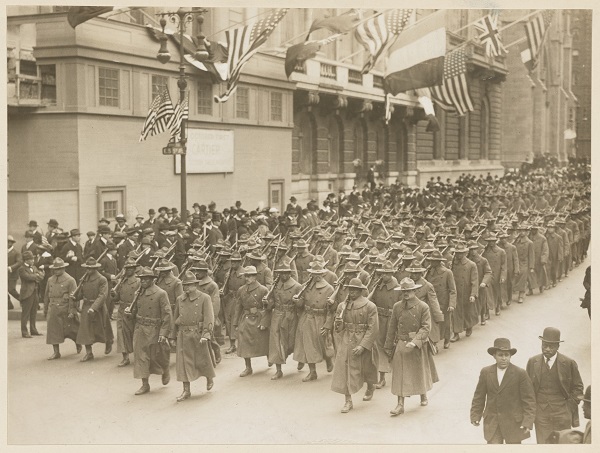
American's move through Fountainebleau on their way to Paris, France, on their way to liberate Europe from the Nazis. (LOC)
Hitler misperceived white supremacy in America, as expressed by Madison Grant and right wing fundamentalists, as a desire to live under a fascist government; he and the Nazis “failed to appreciate the significance of that ideological tension.”

“They saw allegiance to the American creed as a weakness. But U.S. soldiers [sailors and marines] of all backgrounds and faiths fought to defend it and demanded that their country live up to it. Their valor helped defeat first the Nazis and then the American laws that the Nazis had so admired. What the Nazis saw as a weakness turned out to be a strength, and it destroyed them.”

Serwer sees the rise of Trumpism as the reinvigoration of Grantism.


There is an overlapping in the Big Lies of the Confederacy’s Lost Cause, Madison Grant’s and Adolf Hitler’s white superiority, and Donald Trump’s coup attempt, personified in the violence of January 6, 2021. “Racism is at the core of Trumpism,” Serwer writes. “Under Trumpism, no defense of the ‘volk’ is a betrayal, even if it undermines the republic, and no attack on the ‘volk’s’ hegemony can be legitimate, even if it is a defense of democracy.”


Serwer points out the connections between Trumpism and support for the Confederacy, including his “very fine people on both sides” comment about the tragedy in Charlottesville in 2017 and his steadfast support for Confederate namesake monuments and military bases. By contrast, in the wake of violence against black people, Mitch Landrieu, Mayor of New Orleans, ordered the removal of Confederate monuments from the city.

In 1990 nearly half of Louisiana voted for a Klansman, David Duke, for governor. After the vote Trump discussed Duke on CNN’s The Larry King Show. “It’s anger. I mean, that’s an anger vote.” In 2016 after getting Duke’s endorsement, Trump said, “Well, just so you understand, I don’t know anything about David Duke. Okay?”


Like Trump, Duke’s support was based on fear, anger, and a desire for more police on the streets. But two things can be true: we can reduce crime and improve policing.

Army veteran Eugene Goodman defends Capitol.
Serwer warns about police “who think they are soldiers at war.” And the sad fact is that an estimated 14 percent of the Capitol rioters were either military veterans or current/former law enforcement personnel.

Yet, the J6 insurrectionists assaulted Capitol Police officers with various weapons, including metal flag poles with Trump flags, American flags, and Blue Lives Matter flags.

Ironically, Trump supporters who attacked police officers on J6 confronted many true patriots, such as Iraqi War veteran Eugene Goodman. Goodman “led a crowd away from an unprotected wing of the Senate and in doing so may have prevented lawmakers from being lynched.” Serwer writes, "One rioter [Air Force veteran Ashli Babbitt] was shot when she tried to breach a hallway 'just yards' away from federal law makers. Several dozen Capitol Police officers were injured by the mob, which reportedly included a number of off-duty police and former military."


Sadly, some Capitol defenders were suspended after siding with the rioters, and several dozen were under investigation for their action or inaction. The vast majority, though, upheld their oath and tried to defend the Capitol and rule of law.
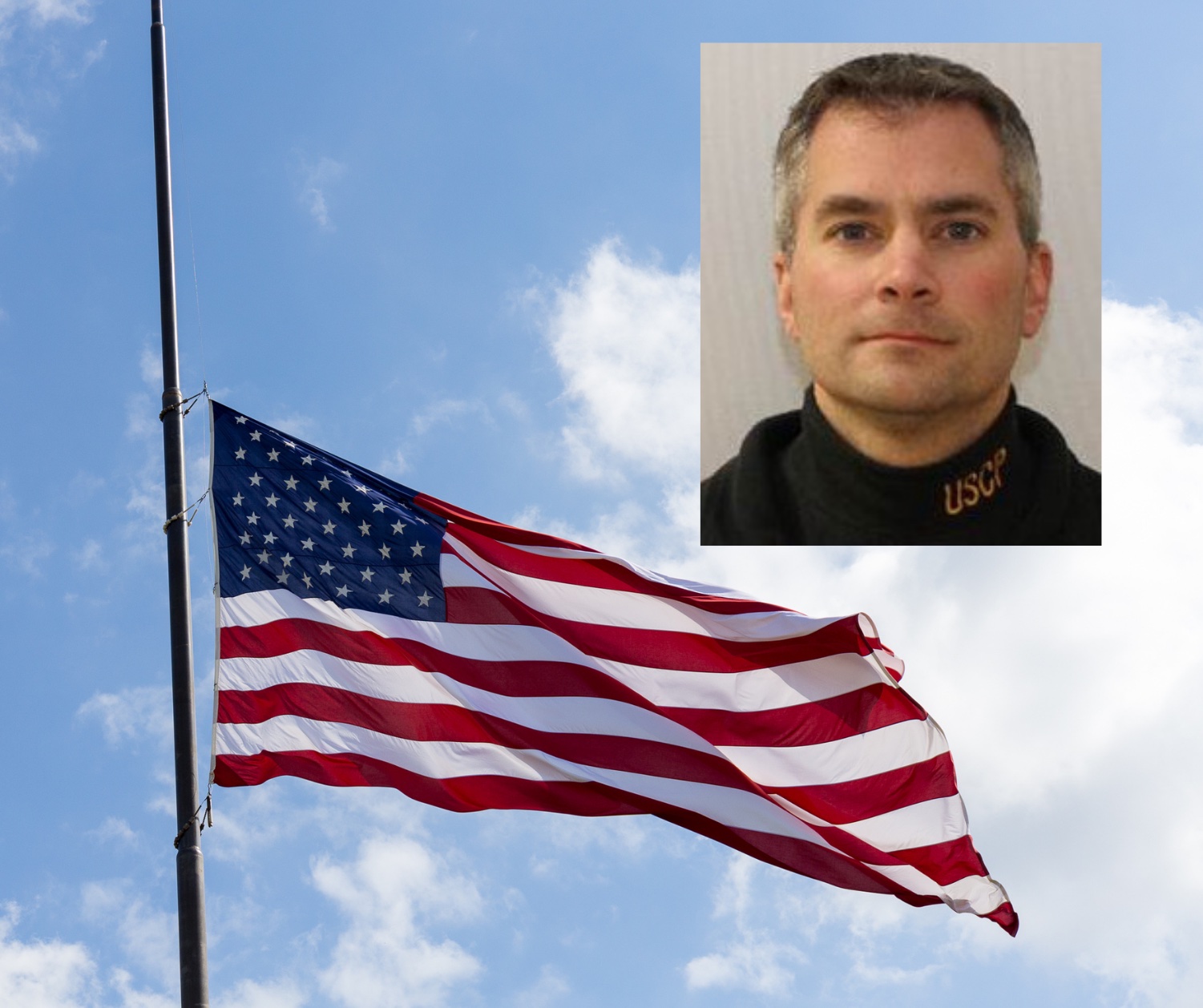

Brian Sicknick
After the attack, Trump delayed lowering the White House flag in honor of Brian Sicknick for several days. Sicknick was killed by some of the rioters who had followed the president's direction and marched on the Capitol.

“Trump’s reluctance to honor a police officer who fell in the line of duty –– one who was also an outspoken supporter of his –– may seem strange. But in repelling the rioters’ assault on democracy, the Capitol Police who resisted the mob had breached their contract with the Trump supporters drawn to Blue Lives Matter…” 

“The Capitol Police officers who did their duty became traitors, because they placed the oaths they swore to the Constitution over the corrupt bargain that Trump had offered them, and over their responsibility to maintain America’s traditional racial harmony.”

Some Trump supporters redesigned the POW/MIA flag to incorporate jailed J6 insurrectionists and an image of the Capitol. Not surprisingly, Trump said he would pardon rioters if he's reelected in 2024.


Serwer said some of Trump’s pardons as he left office were acts of impunity and against accountability.

“When Trump pardoned service members who committed war crimes or police officers in prison for abusing their authority, he was reiterating the message that certain people are exempt from the protection of the law, while others are immune to its restrictions. Trump was also rewarding a constituency he expected to reward him in return. From his rhetoric, it was clear that in exchange for his unwavering support, Trump expected the police and military to aid him in punishing his political foes.”

That observation ties to other strong “law and order” authoritarian leaders, including in U.S. history. Serwer brings up President Richard Nixon, who cracked down on “anarchy” protests,  and Governor George Wallace, who in 1967 called for a literal police state. Wallace told the Fraternal Order of Police convention that the police should run the country for two years to restore order.


The crowd at the lynching of Thomas Shipp and Abram Smith in Marion, Indiana, Aug. 7, 1930. (PD)
I find it hard to process images of righteousness in the faces of white supremacists at lynchings of black people a century ago –– or in the faces of German supporters of Hitler’s Third Reich –– or in the faces of Russian citizens supporting Putin’s war Ukraine –– or in the faces of Trump supporters who still believe his misinformation, disinformation, and Big Lie of a stolen election. Unfortunately, as Serwer point out, there’s a common link.

Hope and optimism, however, remains. And progress continues.

Recognizing and confronting exclusionary racism in our history is possible. We can be both aware of the past and, with the proper perspective, have hope in the future. That’s especially true as we see the nation’s first African/Asian American vice president, Kamala Harris, announce the nation's first female African American Supreme Court associate, Ketanji Brown Jackson, on the Senate floor last week. 


President Joe Biden and Judge Ketanji Brown Jackson celebrate the moment she is confirmed by the Senate, Apr. 7, 2022. (WH)
Both Harris and Jackson were selected by President Joe Biden, who Serwer notes is an unlikely hero to such progress, given his record as a U.S. senator.

President Ulysses S. Grant (Brady)
Serwer also mentions the redeemed leaders of President Ulysses S. Grant, who married into a slave-owning family and who inherited a slave from his father-in-law, would “smash the first Ku Klux Klan and become the first American president to champion the full citizenship of black men, and President Lyndon B. Johnson, the former Southern segregationist, who went on to sign the Civil Rights Act and Voting Rights Act in the mid-1960s.

Celebrating achievement and progress is the best antidote to hateful mocking, anger, and cynicism.


By the way, “The Cruelty Is the Point” opens with “A Note to Readers” that I find inspiring and thoughtful:

“Throughout this book, I use lowercase when referring to racial terms such as ‘black’ or ‘white.’ This is against the prevailing trend in letters, but I do it because I fear that capitalization reinforces the notion that race is a biological reality rather than a social reality. Racism and bigotry are very real, but race itself is a biological fiction.”

 Well said.

Saturday, July 15, 2023

‘Second’ Thoughts: ‘Race and Guns’

Review by Bill Doughty––

“This is not a pro-gun or anti-gun book,” Carol Anderson writes.


It’s a book about disparate treatment, discrimination, and outright racism when it comes to the application of –– and even the creation of –– the Second Amendment: “The Second: Race and Guns in a Fatally Unequal America” (Bloomsbury Publishing, 2021).

How and why is there a “right to bear arms” in the Constitution’s Bill of Rights? What is a “well-regulated militia”? How has the United States military been part of or affected by the Second Amendment and its application? How is disparity as obvious as black and white?


Anderson explores the origins of the Second Amendment and the Constitution itself. Madison worked tirelessly to build the document that would replace the rickety Articles of Confederation and set forth the ethos and ideals of the new nation based on equality and freedom.

“But those intentions of creating a strong, viable republic committed to its lofty ideas crashed headlong into the unspoken reality of America: ‘Slavery was the largely unmentioned monster in the basement of the new nation.’ It was so fearsome that its name, like a dreaded demon, was never to be mentioned in the Constitution lest it erupt out from its darkened and dank lair and tear the fragile nation apart. There was something else besides fear, though, that required slavery to remain like a terrifying wrath haunting the nation’s founding document: guilt. John Dickinson, a delegate from Pennsylvania who drafted the original Articles of Confederation, noted that the very omission of ‘the WORD slavery…[from the Constitution was to] conceal a principle of which we are ashamed.’”

As many Northern states were eliminating slavery from within their borders, southern states, especially South Carolina, was doubling down on the institution, threatening no support for the Constitution if the Atlantic slave trade were curtailed by legislation. Politicians from the Deep South showed extreme hypocrisy: on one hand forbidding enslaved people from citizenship, and on the other hand demanding they be counted in a census so the South would have more representation in Congress (leading to the cursed Three-Fifths Compromise by the Supreme Court).


Anderson shows how the Second Amendment was also a compromise under the shadow of States’ Rights: the resistance to pay for a standing army and the fear, not just of government tyranny, but also primarily of slave revolts.

An armed “well-regulated militia” was a whites-only concept meant to protect landowners from their chattel slaves who might seek freedom by any means necessary.


Wealthy landowners two hundred years ago had every right to be afraid, considering violent slave rebellions in Haiti, Richmond, and New Orleans. Anderson describes the horrors associated with the revolts and what happened to captured insurgents: torture, mutilation, heads on poles.


In the South in the 1800s homes of black people were routinely searched. Guns and books along with other educational material were confiscated. Anderson writes, “Gun control laws, to be clear, were everywhere in antebellum America. Indeed, ‘the South was the gun control center of the United States…’”


The “bravado” of a well-regulated militia was revealed in the War of 1812 against Great Britain. The British captured and burned the White House and U.S. Capitol, including the Library of Congress, in 1814. The young nation, under attack, in fact needed a standing army and navy.


As the British did in the Revolutionary War, they promised freedom to enslaved people in the War of 1812. Nevertheless, the American military recruited African Americans who fought and helped win the war. Of the three thousand soldiers and sailors who fought in the Battle of New Orleans, for example, six hundred were black.


Immediately after the war, General Andrew Jackson ordered blacks to be “summarily dismissed.” People of color were again banned from owning guns or ammunition. If found with a firearm, they were whipped. Endemic racism prevailed and was exacerbated by the Fugitive Slave Act of 1850, which “was supposed to be part of a sectional compromise that would keep the United States actually united. Instead, it was a law that was so hated that the seams in the American fabric began to visibly tear apart.”

The Civil War, which should have been a turning point for African Americans and their freedoms –– including the right to bear arms –– was largely a met with “nearly impenetrable barriers” of racism: Jim Crow laws, disparate treatment, and bigotry. “Andrew Johnson, who ascended the presidency after Lincoln’s assassination, was instrumental in sabotaging efforts to craft a political and legal environment in which the formerly enslaved and free blacks could live fully.” Johnson pardoned many Confederacy leaders and supported States’ Rights to restrict citizenship, gun ownership, and other rights of African Americans.


Using carefully sourced documentation, Anderson presents the history of lynchings, massacres, and other violences committed against blacks, including black soldiers in the early 1900s. “The United States was a nation locked into a prison of anti-blackness absolutely unsafe for democracy and also for African Americans.


Many Americans who lived through the Civil War were still alive when the United States entered World War I. As the United States prepared to fight in Europe, the military had trouble filling its ranks so opened recruitment to black American men via the 1917 Selective Service Act, still ensuring units were segregated but led only by white officers. Even then, some politicians from former Confederate states opposed the initiative, which allowed blacks to carry, train, and use weapons.

Imagine the tension in Houston, Texas (the last state to acknowledge in 1865 the emancipation of enslaved people) when black soldiers were ordered to be stationed there in 1917 during WWI. Troops of the Army’s Third Battalion, Twenty-Fourth Infantry Regiment –– who had fought for the United States in Cuba, the Philippines, and Mexico –– were assigned to guard duty at a Houston army base. 


The soldiers faced intense racism and discrimination by the local population, including the police, who referred to them in derogatory terms and dehumanizing disrespect. Clashes were frequent with law enforcement and white contract workers, who refused to show I.D.s to or “obey” black soldiers.


After civilian police officers beat two soldiers, shooting at one, dozens of members of the Twenty-Fourth armed themselves and marched to confront the police. The resulting confrontation resulted in the deaths of four soldiers and more than a dozen whites, including some police.


“Military justice was swift,” Anderson writes. “Nineteen of the soldiers were executed immediately after the trial and fifty-four were sentenced to prison.”


Anderson’s book is rich in history of the Second Amendment –– especially related to the Constitutional Convention, events in the divisive 19th century, and milestones in the turbulent early 20th century.


“The Second” loses steam, though, by the time the chronology reaches the Second World War and Civil Rights movement of the 1950s and 60s, with a comparative dearth of discussion about that era. Nevertheless, Anderson finishes strong in bringing the issue to the 21st century: no-knock warrants, stand-your-ground laws, open-carry and concealed weapon legislation –– and how they impact African Americans today.

Readers are left to contemplate: How does freedom to own, carry, and use firearms balance with the freedom from being shot? Who is responsible for a tyranny of gun violence in the United States?


This may not be “a pro-gun or anti-gun book,” but it is a fascinating, disturbing, and enlightening examination of the origins of the Second Amendment and its surprising relevance to the military and American wars as well as the meaning of true freedom.


[Anderson capitalizes “Black” but lower-cases “white” when writing about people. While I understand the rationale for that style choice, I but don’t agree with the premise and prefer lower-case for both, in the spirit of Adam Serwer and Isabel Wilkerson.]