Showing posts sorted by relevance for query nazi. Sort by date Show all posts

Tuesday, November 21, 2023

Military Role in Fascism ‘Prequel’

Review by Bill Doughty––

It wasn’t until Imperial Japan attacked Pearl Harbor and Germany declared war on the United States in December 1945, that the burning embers of fascism dimmed and hot coals of active antisemitism, Christian nationalism, and Nazi support –– even in the U.S. Congress –– lost their glow.


But the fire never completely went cold.


Prior to World War II and even after, brave Americans sought to root out the supporters of fascism who went so far as to try to recruit members of the military as well as military veterans to their cause. One fighter of domestic fascism was a WWI veteran named Leon Lewis. 

Lewis sought to uncover a conspiracy of violent extremism targeting Jewish Americans and institutions. It’s one of the stories recounted in “Prequel: An American Fight Against Fascism” by Rachel Maddow (Crow, Penguin Random House, 2023).


“What Leon Lewis decided to do was something incredible. And incredibly dangerous. He went out and recruited a small group of men, picked from the exact same pool the Nazis were after –– disgruntled non-Jewish American veterans of the recent war [World War I],” Maddow writes.

“But the Lewis operation did more than simply investigate and report. Before long, Lewis and his team scuttled a plot by U.S. Marines to sell guns and ammunition to the American fascists. Lewis and his underground team could not be credited in public for their part in this operation, but it did earn them the enduring and crucial admiration of high-ranking naval intelligence officers. They also exposed an elaborate inside-job scheme to take control of U.S. military armories on the West Coast. That plan was run by Dietrich Gefken, a German national who had been one of the early organizers of Hitler’s Brownshirts in Munich. After joining the California National Guard and inventorying the cache of rifles, machine guns, and coastal artillery pieces on hand at the San Francisco armory, Gefken had drawn up ‘the Armory plans, floor plans, location of ammunition and lockers and rifles, the list of addresses of the officers and all that was needed to take over the Armory on a given notice.’ Lewis’s spies handed over their evidence of Gefken’s plot to military intelligence officials, who shut it down.”

How Naval intelligence officers at the Navy base in San Diego helped bring the wider plot to light is almost an aside, but the story should be of great interest to military readers.


On the East Coast, more than 20,000 people attended an antisemitic pro-Nazi rally at Madison Square Garden in 1939. One of the banners visible in the above photo reads, "Stop Jewish Domination of Christian America." The rally was dubbed a patriotic pro-American event tied, without irony, to George Washington’s birthday. [General/President Washington rejected calls from supporters to become dictator of the young United States.]

How could the rising flames of fascism in the United States in the 1930s be forgotten in time? In interviews promoting “Prequel,” Maddow notes how the bigger story of the war in Europe (and the Pacific) eclipsed the story of homegrown fascism and Nazism and the quiet patriots who battled the threat to democracy here.

Brave and truly patriotic men such as Lewis, O. John Rogge, Dillard Stokes, Henry Hoke, Eric Sevareid, Drew Pearson, and William Power Maloney stood up and spoke out against antisemitism and against indifference and obstruction by the Truman Administration, as demonstrated by Attorney General Francis Biddle and FBI Director J. Edgar Hoover.
Federal prosecutor Rogge

“The plain truth is that the FBI was missing in action as fascism and Nazism took root and grew  in the United States in the mid-1930s,” Maddow notes.


Despite having the rug pulled out from under them in their prosecution of the fascists, both Maloney and Rogge continued with honor, courage, and commitment to uncover and report domestic enemies and violent extremists.


“Maloney and his investigators had discovered the double helix of the violent, Nazi-supporting, and Nazi-supported threat in the United States; it was part foreign and part domestic, part propaganda and part armed paramilitary movement.” He had led the investigation into Nazi propagandists using frank privileges at taxpayers’ expense. After federal service, he continued a career as a colorful and successful prosecutor.

“Rogge’s new charging document, like Maloney’s, alleged violations of the Smith Act –– an effort to demoralize America’s armed forces. But Rogge had sharpened the case, alleging targeted effort by the defendants to recruit National Guardsmen, reservists, and even active-duty U.S. troops into these ultra-right groups, where they could use their military skills, connections, and access to weapons to help arm and train paramilitary fascists for the overthrow of the U.S. government.”
Rogge uncovered evidence against American fascists and Nazi-supporters when he provided support to the Nuremberg trials after the war.

Men of character like Lewis, Rogge, Stokes, Hoke and others were seemingly outnumbered by questionable characters –– men (and some women) who placed greed, power, and religion above the Constitution, people like:

  • George Deatherage: “He saw himself a red-blooded, real-American patriot, a dedicated Christian, a fierce protector of (white) Western civilization.”
  • Huey Long: This Louisiana politician was an early version of the charismatic narcissistic populist and would-be dictator who formed his own militia and embraced violence against his detractors.
  • Father Charles Coughlin: The Rush Limbaugh or Alex Jones of his generation, he was a Catholic priest with a wildly popular radio show who called for violence against “tyrants” after naming FDR and jews as tyrants.
  • John Cassidy: He was a self-described "Christian martyr" who wanted to become the "American Fuhrer."
  • Senator Ernest Lundeen (R) of Minnesota: Was as corrupt as they come, even taking payroll kickbacks from his own staff, instrumental in promoting support for Hitler in America. Maddow’s description of his death in a suspicious plane crash is as graphic and horrible as can be imagined. Readers may want to look away.
  • George Sylvester Viereck: The Nazi agent. He was convicted in June 1943 for violating the Foreign Agents Registration Act. While he was in jail, Viereck's eldest son and namesake, a corporal in the U.S. Army, fought and died for the Allies in Italy.
  • Major General George Van Horn Moseley: He was pro-gun but against FDR and anti-redistribution of wealth; he called for the sterilization of any jews who immigrated to the United States.
  • Senator Robert Rice Reynolds (D) of North Carolina: He wanted to build a wall around the entire United States, in part to keep out Jews.
  • Representative Hamilton Fish (R) of New York: He supported Hitler’s Germany and “was hopeful that tensions over Germany’s designs on Poland could be resolved peacefully, and that Germany’s claims were ‘just.’” His calls: “AWAKE CHRISTIAN AMERICA” and “LET’S SAVE U.S. FOR US.”
  • Senator William “Wild Bill” Langer (R) of North Dakota: As governor he was charged, convicted, and sentenced to 18 months in prison, but who declared martial law and tried to declare North Dakota’s independence from the United States. As senator, he sabotaged the investigation of rising fascism.
  • Senator Burton K. Wheeler (D) of Montana: an isolationist and propagandist for Germany who was eventually accused of treason. He attempted to use his position in Congress to influence the military, especially the Lend-Lease Act, and prevent America’s support to Britain in WWII.
  • Henry Ford and Charles Lindbergh: Both were champions of Adolf Hitler and vice versa. Lindbergh zeig heiled at an America First rally with Wheeler. Ford was lauded by Adolf Hitler, who kept a photo of the white Christian nationalist CEO in his office.

America Firsters Wheeler and Lindbergh
There were many more who sought to weaken the Constitution and democracy in favor of autocracy and theocracy.

Expressions of outright antisemitism and fascism by elected officials led to plots of violence on the home front.

Groups such as the “Christian Front” and “Country Gentlemen” planned an armed insurrection, including bombings of Jewish and Leftist establishments as well as newspaper offices. Their hope was similar to Timothy McVeigh’s goal –– to start a race war that would bring down the federal government.


“It was what we’d call today an ‘accelerationist’ strategy,” Maddow explains.

“Much as white supremacists hope terroristic, spectacular, cruel acts toward racial minorities will provoke retaliation and reprisal to touch off a wholesale race war that they are sure they will win, the Christian Fronters believed American could easily be tipped into a war against Jews and communists in which they themselves not only would end up on the winning side, but would be hailed as a heroic vanguard.

“George Van Horn Moseley’s name kept coming up in planning meetings for the attack, because they were still counting on the general to take the reins as America’s new military dictator after the coup was complete.”

There are numerous parallels from the 1930s and ‘40s that continue to smolder: the coup attempt of January 6, other acts of violent extremism in the name of the former President (who calls opponents “vermin” that poison the “blood” of America), and Trump’s desire to call for the Insurrection Act in order to use the military against U.S. citizens in violation of posse comitatus.


Germany justified war in Europe based on grievances and a Big Lie about Jews. Putin did the same thing. And Trump builds his power and funding on perceived grievances and the Big Lie of a stolen election. It is no accident that Trump launched his current presidential campaign at Waco, Texas, on the 30th anniversary of the Branch Davidian tragedy, which was the basis for Timothy McVeigh's grievances.

There are other parallels and similarities linking past and present. Accusers and their two dozen or more sympathizers in Congress chose to investigate the investigators. They called for President Franklin D. Roosevelt’s impeachment based on conspiracies and conjecture without evidence. They used various tactics to disrupt and delay justice in the courts. And they attacked the free press.


The propagandists supported Germany’s efforts to divide American citizens: “A partisan, bickering, demoralized America, the Nazis believed, would be incapable of mounting a successful war effort in Europe.”


Fascists and fundamentalists –– past and present –– tried to recruit military service members and veterans. Eighty and ninety years ago a disproportionate number of law enforcement (“law and ORDER”) personnel supported fascists. Meanwhile, Hollywood –– led by MGM –– and the mainstream media –– led by the Washington Post –– shined a light on the lawbreakers and seditionists. When caught up in the scandal, perpetrators tried to burn evidence, (albeit not in a White House fireplace).


In 1942, federal prosecutors indicted 28 people and charged them (almost RICO-style) with sedition with “intent to interfere with, impair, and influence the loyalty, morale, and discipline of the military and naval forces of the United States.” Prosecutors received hate mail and death threats.


Greedy and self-serving politicians stoked conspiracies and fears to hold on to power, especially fear of immigrants, communists, socialists, and Jewish people. Father Coughlin and others attempted to form a third party of Christian nationalists to compete against President Roosevelt, claiming FDR was a Jew.


But there could be signs of hope: The election of Nov. 7, 1944 proved the strength of democracy over the glowing coals of fascism, when FDR won a landslide victory. “The president who had been leading the country in the war against the Nazis, Franklin Delano Roosevelt, won an unprecedented fourth term, with 432 electoral votes to Thomas E. Dewey’s 99,” Maddow writes. “Roosevelt’s Democrats gained twenty-two seats in the House and protected their whopping nineteen-vote cushion in the Senate.”


Rachel Maddow speaks with Lt. Col. Andy Gerlach of the South Dakota Army National Guard in Afghanistan in July 2010. (Sgt. Rebecca Linder)

Maddow is also author of “Bagman” and “Drift.” She is a big supporter of military service members, veterans, and the Constitution. She bemoans the gap between civilians and their military, and she calls for accountability, transparency, and maximal diplomacy before American men and women are sent into war.


Both the Prequel book and preceding Ultra podcast feature Maddow’s storytelling at its best, but the book may better. While the serialized Prequel podcast broke ground on the compelling story of the threat to democracy from within, the book really fleshes out the story as only a book can, complete with extensive notes, a helpful index, compelling photos, and detail we can read and will want to re-read. This is a book that can help every American understand the threat of the fires of antisemitism, fascism, and authoritarianism.

In 2023 and 2024 the embers are glowing brighter.

Thursday, July 11, 2019

How Navy & Marines Reached the Moon 50 Years Ago

Glenn and Armstrong, survival training in Panama, 1963. NASA
Review by Bill Doughty

July 20, 1969: A Sailor (Neil Armstrong) became the first human to step on the moon. 

Earlier in the decade, another Sailor (Alan Shepard) was the first American to travel in space, and a Marine (John Glenn) was the first American to orbit Earth.

A United States president and vice president (both Navy veterans) along with a NASA administrator (a former Marine) provided key leadership so Americans could plant the American flag in the Sea of Tranquility fifty years ago this month.

That flag – once red, white and blue – is now bleached white by UV radiation, according to Douglas Brinkley in "American Moonshot: John F. Kennedy and the Great Space Race" (HarperCollins, 2019).

From War/Destruction to Peace/Discovery

Writing with a journalist/historian's touch, Brinkley shows how the influence of World War II – and the resultant Cold War – brought about the Space Race between the United States and the Soviet Union. It was a race that the Soviets proved to dominate – hare to tortoise – in the early 1960s.

"Space was America's Cold War Manifest Destiny," Brinkley writes, "and the Mercury astronauts wore its rough-and-ready trailblazers, following in the footsteps of Kennedy's own World War II Generation and almost two centuries of American adventurers before."

America's moonshot would not have happened in 1969 without JFK's drive.

John F. Kennedy, who had some health issues even as a young man, was at first rejected from service, but he used his father's influence to help him get into the Navy. 
"When the Japanese bombed Pearl Harbor on December 7, 1941 – 'a date that will live in infamy,' as President Roosevelt termed it – Jack and Joe Kennedy were already in uniform and ready for combat duty. They would never have to scrub off the taint of using their father's influence to avoid military service. Four days after Pearl Harbor, Nazi Germany and the Axis partners declared war on the United States. 'Industrial Mobilization' became an urgent catchphrase across the nation. Military bases were built on empty land. Factories were adapted to switch from manufacturing consumer goods to producing war matériel. Between 1940 and 1943, enlistment in the U.S. 
Armed Forces expanded from fewer than five hundred thousand to more than nine million. Mobilization efforts swelled in every direction, from far-flung Honolulu to the shipyards of Norfolk."
A young JFK.
JFK showed his profile in courage in the War in the Pacific, and was profoundly affected when his big brother, Joseph Jr., was killed on a combat mission. Joe's plane exploded in mid-air in what proved to be an unsuccessful bombing mission against a Nazi missile base.

Brinkley posits that Hitler's missile program laid the foundation for NASA's success, particularly with the help of former Nazi scientist Wernher von Braun. Kennedy was motivated and propelled by a combination of influences, including his father's drive, his brother's death, and a vision of the future for America and the world.

JFK, followed by LBJ and assisted by NASA administrator James Webb, a Marine major in WWII, presented the vision, the mission and the will to reach the Moon, despite other challenges and sea changes in the 60s – including the Cuban Missile Crisis, civil rights movement and Vietnam.

JFK's visionary leadership, combined with the hard work and creative innovation of an elite civilian-military team, the United States discovered a world of innovation in space, including communication, mapping and global positioning satellites; commercial air transport; and the microchip.

Navy veterans/leaders kept space closed to militarization and turned away from nuclear atmospheric testing and proposals to put nuclear weapons in space.

In Kennedy's challenge to go to the Moon, he said – with speechwriter Ted Sorensen's help in balancing optimism with humility – "we meet in an hour of change and challenge, in a decade of hope and fear, in an age of both knowledge and unforgettable ignorance. The greater our knowledge increases, the greater our ignorance unfolds."

Naval Propulsion Into Space

While the sea services were joined by the Army and Air Force and led by civilians in developing the space program, Brinkley reveals various naval ties – Navy and Marine Corps connections – to putting Americans into space:

CNO Adm. Arleigh Burke joins JFK and LBJ to observe the successful mission by Alan Shepard.
  • Secretary of the Navy James Forrestal mentored Navy veteran-turned-politician JFK on "post-war national security imperatives," preparing him for his next roles in public service.
  • On May 5, 1961 Chief of Naval Operations Admiral Arleigh Burke was with JFK and LBJ to observe news coverage Alan Shepard's successful flight into space.
  • NASA Administrator James Webb was a major in the Marine Corps in WWII, tasked with running the U.S. radar system for the planned invasion of Japan, ultimately unnecessary after the bombing of Hiroshima and Nagasaki and Imperial Japan's surrender.
  • The Naval Research Laboratory announced Sputnik's successful orbit of the Earth on Oct. 4, 1957.
  • The Navy led development of the Vanguard satellite, which experienced fits and starts (though former Nazi Wernher von Braun, supported by Senator Barry Goldwater, favored the Army's satellite hardware and development – as well as militarization of space).
  • Among the hundreds of U.S. Navy ships involved in the recovery of astronauts and development of the space program were USS Lake Champlain (CV-39), USS Decatur (DD-936), USS Intrepid (CV-11), USS Kearsarge (LHA-3), USS Noa (DD-841) and USS Randolph (CV-15). Navy helos, divers, tracking and personnel were also critical to the success of the program. (Check out the extensive list of recovery ships on NASA's history site.)
  • Lt. Cmdr. Victor Prather, a Navy flight surgeon, lost his life testing the full-pressure Mark IV space suit. Other military veterans as well as civilians paid the ultimate price over the years as the space program developed.
  • Shepard was a  Navy test pilot and "military aviation superstar" who had served aboard USS Cogswell (DD-651) during WWII and as a squadron operations officer aboard USS Orinsky (CV-34) during the Korean War. He was a leader among astronauts and became the oldest man to walk on the moon, at the age of 47.
  • Naval aviator Neil Armstrong "had become one of the most respected jet pilots of the Korean War generation, part of an 'ace club' that also included John Glenn and Wally Schirra."
  • Marine John Glenn distinguished himself in World War II and the Korean War. He became a close friend of both President Kennedy and younger brother Robert F. Kennedy. Glenn represented all astronauts at JFK's funeral. After leaving NASA he entered further public service, running for the United States Senate. Jacqueline Kennedy called on Glenn and asked him to comfort her children Caroline and John Jr.  after JFK was killed. Glenn would do the same for RFK's children in 1968 after Bobby Kennedy was murdered.
  • Astronaut Scott Carpenter, a Navy test pilot who followed John Glenn into space, had served in the Korean War, flying "numerous reconnaissance and antisubmarine missions along both the Siberian and Chinese coasts."
  • Astronaut Wally Schirra served aboard Navy cruiser USS Alaska (CB-1) during WWII. After the war he married the stepdaughter of Adm. James L. Holloway, Jr. (father of a future CNO).
  • A big supporter of the Navy in Congress – U.S. Senator John C. Stennis (D-Mississippi) is quoted: "Whoever controls space controls the world." is the namesake for the aircraft carrier USS John C. Stennis (CVN-74).
  • SECNAV Fred North, along with LBJ and SECDEF Robert McNamara, accompanied President Kennedy for a visit to Houston, Sept. 11-12, 1962.
  • Although patriarchy and prejudice prevented qualified women (along with non-Christians and non-whites) from becoming astronauts in the early 60s, the Naval School of Aviation Medicine began testing women – seasoned pilots. Dr. William "Randy" Lovelace II, an aeromedical pioneer, "believed that women were better equipped psychologically for NASA space travel because they were, on average, shorter and smaller than men, needed less food and oxygen, and had better blood circulation and fewer cardiac problems." Unfortunately, when NASA and Congress learned about the initiative, the program was shut down, postponing and delaying fulfillment of the promise of equality.
President Kennedy visits Cape Canaveral Nov. 16, 1963.
Cape Kennedy, Vindications, Revelations

Shortly before JFK was killed in Dallas, Texas, he visited Cape Canaveral, Florida, Nov. 16, 1963. "The president's visit to Cape Canaveral had reinforced his faith in exactly what a gargantuan, well-funded, centralized government project could achieve in breakneck time."

Navy, led by USS Wasp (CV-18), recovers Gemini 9 capsule.
Within a week of Kennedy's assassination, LBJ proclaimed a new name for Cape Canaveral: Cape Kennedy.

Interestingly, Brinkley shows how Kennedy was wrong about his claim of a big missile gap with the Soviets, something he proclaimed in what would today be called "fake news." Kennedy made that claim in pointed attacks against President Eisenhower in the late 1950s.

In some ways Ike was vindicated by what Kennedy learned when he came into office (and what was then reported in the New York Times). Eisenhower had quietly kept pace in space in the 50s, deploying reconnaissance and missile-detection satellites.
"All JFK's taunts at Ike had been overdrawn. The fact were that when Eisenhower left the White House, the United States had one hundred sixty operational ICBMs to a paltry four R-7s in the Soviet arsenal. Kennedy now gladly accepted this reality. Later in 1961, Corona satellite intelligence indicated that Khrushchev, expectations aside, had only six ICBMs. Kennedy and Johnson's campaign swipes that Eisenhower and Nixon were the architects of a national security missile strategy of 'drift, delay, and dilution' had clearly been off base. Furthermore, America's three coastal launch sites (Cape Canaveral, Florida; Vandenberg Air Force Base, California; and Wallops Island, Virginia) were already operating around the clock to further spaceflight advancement. Each of these sites had technical facilities, a control center, and the most modern of launchpads. What Kennedy learned was that Eisenhower had actually done an able job of building up U.S. defenses. When Ike was inaugurated for his first term in 1953, the air force still used piston-driven bombers, and navy strategy focused on basing ships around the Pacific. By the time he handed the reins over to JFK, the United States had developed reconnaissance and communication satellite capabilities. And there were nuclear submarines – including the USS George Washington (SSBN-598) – deployed the very month Kennedy was elected and able to carry sixteen nuclear Polaris missiles. Five generations of rockets – starting with the early Vanguard, and then onward with ICBMs like Atlas and Titan – were born in the Eisenhower years. The army had teams designing heavy-launch Saturn rockets, while the air force, not to be outdone, had made headwind with its Space Launching System (SLS), experimenting with a myriad of launch configurations using solid-fuel boosters and hydrogen/oxygen upper states. The Strategic Air Command had more than fifteen hundred jet bombers capable of dropping hydrogen bombs on America's enemies."
Still, JFK was passionate about winning the Space Race for "global prestige" as he fought for peaceful exploration rather than exploitation – for discovery instead of dominance. Already in the 60s there were overtures of joint collaborative missions with the Soviets. But, "For Kennedy, much depended on the United States going to the moon, beating the Soviet Union, being first, winning the Cold War in the name of democracy and freedom, and planting the American Flag on the lunar surface."


Today, as we learned, that flag from 1969 is bleached white. But, rather than being a flag of surrender to the new frontier, perhaps it's a blank slate that could represent a renewable spirit of cooperation and collaboration, reflected in the words of a naval aviator: "one giant leap for mankind."

The American flag planted on the surface of the moon.


Bonus – The U.S. Navy recovers John Glenn:


Wednesday, September 30, 2020

Tragic Fate of a U-Boat Commander

From Kusch's "Merry-go-round."

Review by Bill Doughty––

Imagine a young artist, heartsick about his nation’s suicidal embrace of autocracy yet called to serve in the military, in a job he admired and excelled in as a patriotic duty. “Joining the navy had been Oskar’s dream ever since he was a little boy.”


Now picture that young man as a German submarine captain in World War II, successful but persecuted for talking down his overlords, especially Adolf Hitler. Oskar Kusch’s principled stand would see him arrested and put on trial for rejecting “the Nazi leadership ideology, practices, and propaganda.”


The story of what happened to Kusch is artfully told by Eric C. Rust in “U-Boat Commander Oskar Kusch: Anatomy of a Nazi-Era Betrayal and Judicial Murder” (Naval Institute Press; 2020).

Rust has strong bonafides to tell this story. A native of Lübeck, Germany, and veteran of the Bundesmarine, Dr. Rust is a professor of history at Baylor University; his father was a submariner for Germany in World War II, and his mother was the widow of a submarine captain killed in the war.


Rust gives us a real feel for submarine duty and the (universal) life of a submariner, for example the CHENG:

“On any submarine, no matter its type, size or nationality, a competent chief engineer was then and remains today key to the boat’s safety, survival, and any successes in combat. Simply understanding and handling the complex technical equipment could be a daunting task. The engineer’s know-how and calm self-control was especially in demand when the boat was diving or surfacing and in keeping its desired trim under all circumstances by manipulating the boat’s fuel tanks, diving cells, and hydroplanes. Given the ever-lurking danger of a sudden attack from the air, U-boats had to dive frequently and fast. For a Type IX boat like U-153, from the moment of the order to dive until the boat was completely under water, ideally no more than 35 seconds were to elapse. Every crew member had to carry out his pre-assigned duties fast and with absolute precision: clearing all personnel from the bridge and the antiaircraft weaponry platforms; flooding the living cells; lowering the angle of the hydroplanes; turning off the diesels and switching to the battery-powered electrical motors for underwater propulsion; shutting airtight all hatch covers and values through which water might otherwise enter the boat; and rushing as many men as possible through the long passageway to the forward torpedo compartment to accelerate the momentum of the dive.”

It is no environment for anyone with claustrophobia or paranoia. And it's no place for back-stabbing subordinates.


Kusch salutes aboard U-154.

In that cramped and sometimes deadly environment, shipmates often develop deep and trusting relationships. They can speak openly about their dreams, fears, and opinions. “The U-boat arm was notoriously forgiving and generous in tolerating idiosyncrasies among its officer and men as long as these did not diminish the combat eagerness and readiness of their boats, or worse, involved cowardice, treason, or desertion.”


But in Kusch’s case, he removed a portrait of Hitler from the officers’ mess (replacing it with a picture he created of a schooner); he also openly criticizing ”the Führer” and his policies. Officers serving with Kusch reported him to authorities, and he was arrested. Rust makes a convincing case that Kusch did not demonstrate cowardice or lack of aggressiveness, even in the face of Grand Admiral Karl Dönitz’s desperate kamikaze-like strategies as “Germany’s war effort was failing spectacularly.”


Grand Admiral Karl Dönitz meets with Adolf Hitler in the Führerbunker in 1945.  Hitler named nitz as his successor before committing suicide.


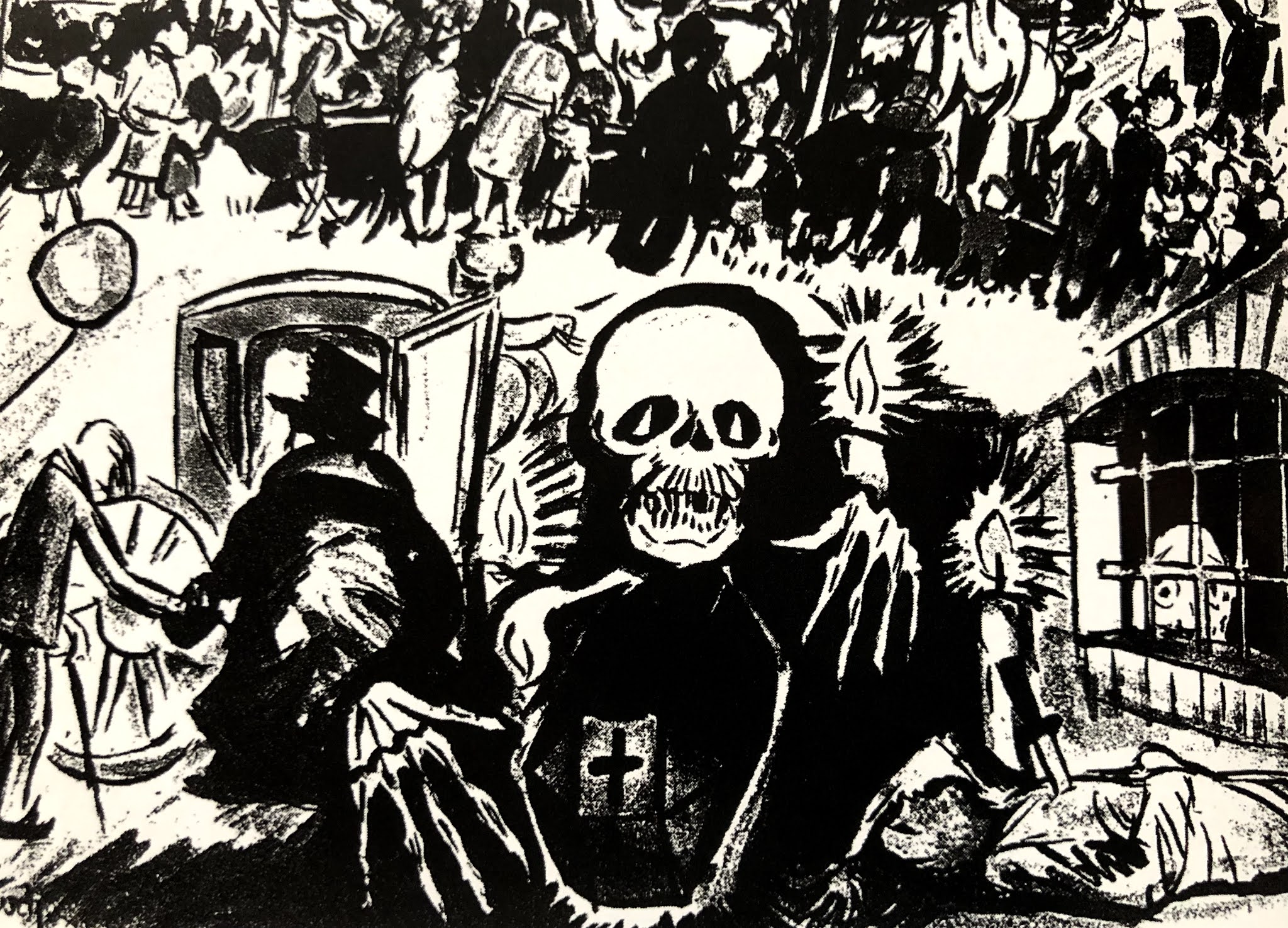
Some of Kusch's apocalyptic art was created while he was in prison.
Referencing historian-author Dieter Hartwig, Rust paints a devastating portrayal of Dönitz:

“The picture that has emerged from (Hartwig’s) inquiries reveals Dönitz as a cold and calculating opportunist, a strategic dilettante with a limited grasp of modern technology, and above all as a many exercising a slavish subservience to Hitler and his ideology. Any admiration for Dönitz’s ‘people skills’ vis-à-vis his U-boat men must be balanced against the grand admiral’s perfect willingness to sacrifice them after 1943 to an overpowering Allied supremacy at sea when his earlier concept of a ‘tonnage war’ had lost every meaning or prospect for success –– something Kusch’s experience richly confirmed at the time. The same disdain for human life and suffering governed Dönitz’s directives to abandon shipwrecked enemy sailors to their fate as a desirable measure to weaken Allied manpower resources.”

Rust also describes Germany’s failing totalitarian cause in the final months of the war, “None of the miracle weapons promised by the Nazi propaganda machine had ever materialized.”


"U-boot" by Ferrer Dalmau (NHHC)
In this fascinating book we get a love story of Kusch and his beautiful fiancé, Inge von Foris. We get samples of Kusch’s remarkable art, much of it produced in prison. We learn of a wild joke involving brown-shirted Nazis told by Kusch (“Question: What do the German people and a tapeworm have in common? Answer: Both are surrounded by a brown mass and are in constant danger of being killed.”). We discover U-boat strategy failures along the East Coast of the United States and in the Gulf of Mexico. We read a heartbreaking letter from Kusch to his father, written just before Kusch’s murder by firing squad.


Rust reveals a “spineless naval brass” unwilling to stand up to “the totalitarian character and ideological infiltration of Germany’s military justice system in World War II.”


According to Rust, "Kusch encouraged the midshipmen in their capacity as future officers, to form their own opinions, to seek and speak the truths at all times, and not to allow their views to be influenced by manipulated propaganda trash. He wanted to "broaden his men's perspectives on history and politics."


Kusch’s tragedy provides lessons for all sailors, leaders, and citizens as an example of what can be done in the face of totalitarianism and autocracy.

“How does one balance patriotic duty as a soldier in a democratic state with the demand that carrying out orders and engaging in military actions should be accompanied and tempered by an ever-active and well-trained conscience? Does Oskar Kusch’s legacy not invite every soldier for all times to come to ask: Are my actions ethical and right? Am I a good comrade? Is my behavior in line with the highest principles of a free and tolerant society? Are the orders I am carrying out just and compatible with the lessons learned from that terrible struggle against totalitarian regimes in the 1930s, 1940s, and others since?”

The life of Oskar Kusch shows us that ethical patriotism is an art to be cherished. His death illustrates the need to learn lessons of the past. Rust's book is a study in core values and is a relevant part of history needed for the present and future.


Kusch illustrated his own impending death by firing squad. Today, Kusch is revered in Germany for his principled stand against Nazi totalitarianism.


Monday, May 25, 2015

KL

Review by Bill Doughty

USNS General C. H. Muir
The Navy ship USNS General C. H. Muir (AP-142), launched by Kaiser Co. in 1944, was among American transport vessels that brought immigrants across the Atlantic from Europe after American and Russian troop liberated World War II concentration camps in Germany.

Allies liberate Dachau.
Referred to by the Nazis as KL (from the German Konzentrationslager), the camps "embodied the spirt of Nazism like no other institution in the Third Reich," author Nikolaus Wachsmann writes in "KL: A History of the Nazi Concentration Camps" (2015; Farrar, Straus and Giroux).

Using primary sources, including recently accessible SS and German police reports, Wachsmann describes the horror and terror in the camps, where both guards and prisoners were dehumanized.

Liberated prisoners. (photo courtesy Truman Library)
"Terror stood at the center of the Third Reich, and no other institution embodied Nazi terror more fully than the KL," he writes, noting anti-semitism was at the core of the "racial war" carried out by Hitler, Himmler and their followers.

The Nazis used an Orwellian term, "protective custody," to describe their reason for establishing the KL. Eventually targeting Jews and other groups, the initial target was political enemies of the State, especially Communists, according to Wachsmann.

Wachsmann's chronology begins in 1933, the year Adolf Hitler rekindled a fascist dictatorship the ashes of Germany's failed early democracy. The Nazis practiced "radical repression of all internal enemies." The chronology examines the complicated nature of the different kinds of camps, describes how they were run, and shows how they were liberated.

Along with terror, at the heart of the reason for the camps was fear and hate. Even after liberation, Wachsmann describes the fear some German soldiers and citizens had of the men, women and children who were imprisoned. "Fear sometimes turned into paranoia and panic, with apocalyptic visions of escaped prisoners."

Wachsmann writes about memorials at Auschwitz, Buchenwald, Dachau, Mauthausen and Berlin. Nearly 200 pages of this 865-page book are devoted to notes and sources.

This book is a new authoritative standard on the history of concentration camps in Nazi Germany, showing different facets from the point of view of captors and captives, alike.

Gen. Charles H. Muir
As for USNS General C. H. Muir, the ship not only served to bring troops and survivors back from Europe in 1945 but then also brought troops to Pearl Harbor, Eniwetok, Ulithi, and Leyte and in the following decade served in the Korean War. General C. H. Muir received two battle stars for Korean War service, according to the Naval History and Heritage Command.

The ship's namesake was born in 1860, the year before the Civil War began.  According to NHHC:
"Following duty at various posts in the United States, including service in the Indian Wars, [General Muir] took part in the capture of Santiago during the Spanish-American War and fought in the Philippines – during the insurrection which followed. Muir was also a member of the China Relief Expedition of 1901. Staff duty and service in the Philippines followed; and, with America's entrance into World War I, he was given command of the 28th Division. Muir was awarded the Distinguished Service Medal for his service during the Meuse-Argonne Offensive."
Muir died December 8, 1933, the same year Hitler came to power in Germany.