Showing posts sorted by relevance for query "robert h. jackson". Sort by date Show all posts

Sunday, July 8, 2018

Destroyers for Democracy / SCOTUS Legacy

Review by Bill Doughty


U.S. and British sailors examine destroyers prior to transfer in 1940.
It's hard to imagine the depths of fear and fascism washing over the world in the wake of the Great Depression and approach of war in the 1930s, a fear that intensified in 1941 when Imperial Japan attacked Pearl Harbor and Hitler declared war on the United States.

America had sided with Great Britain, with President Franklin D. Roosevelt providing 50 World War I navy destroyers to fight German submarines in exchange for the use of military bases on British territories in the Caribbean and western Atlantic.

The man who made that deal happen, despite entering a "sea of troubles" was new U.S. Attorney General and head of the Department of Justice, Robert Houghwout Jackson.

Jackson's story, intertwined with FDR's, is captured in "That Man: An Insider's portrait of Franklin D. Roosevelt" by Robert H. Jackson, edited and introduced by John Q. Barrett (Oxford University Press, 2003). Barrett cobbles together Jackson's manuscript with Jackson's oral history narrations and adds key documents and explanations.

The destroyers for bases deal, including the behind-the-scenes machinations between FDR and Churchill, will be interesting to Navy readers. So will Jackson's insider insights as WWII became a reality.

By the summer of 1941 Hitler had crushed Poland, Denmark, Norway, Belgium, the Netherlands, Luxembourg, France, Yugoslavia and Greece. Jackson writes:
"By June 15, conquest and demoralization had so far subdued France that the French fleet, under the ambiguous Admiral Jean Francois Darlan, seemed likely to be surrendered and thus added to the German and Italian navies. Churchill again cabled Roosevelt ... The specter of overwhelming German naval power, added to her seemingly irresistible air and land forces, deeply troubled the President. If the Germans should capture the French fleet, it – with Germany's own and that of Italy, and with probably cooperation from Japan – would leave the United States to face alone a most formidable naval and air power. But in the early days of July, Britain, defying what seemed to be forces as inexorable as fate and risking alienation fo the French people, boldly attacked and largely disabled the French fleet so that it could no longer be of any substantial service to Hitler. Britain won not only our admiration for her courage and audacity but our gratitude as well."
By the way, a great movie released last year, highly recommended, is "The Darkest Hour," directed by Joe Wright, written by Anthony McCarten and starring Gary Oldman as Winston Churchill. It's a slice of history as Churchill deals with challenges and the need for toughness in his first weeks as Prime Minister. Churchill was elected to the position after serving as First Lord of the Admiralty, the U.S. counterpart to Secretary of the Navy.

In "That Man" Jackson shows the back and forth between Churchill and FDR. 
"Churchill," Jackson writes, "seemed not to comprehend the very different constitutional and political position of President Roosevelt, who was bound by a written Constitution separating executive from legislative power and putting in Congress the control of disposal of government property."


Churchill reads
Eventually, Jackson worked out a legal transaction that helped both nations and navies. His artful deal assisted European Allies at a critical time and helped set the stage for American involvement in the war.

"That Man" gives us a front-row seat to the impact of the attack on Hawaii of Dec. 7, 1941 and its reverberations across the world to the White House.
"I think Pearl Harbor was a great shock to the President – that with all the war talk there had been, he did not believe Japan would make a surprise attack. Of course it was a great embarrassment to him ... How long the war would last and what the prospects were, I did not have much opinion. I was baffled. Our intelligence had proved to be wrong on nearly everything. American intelligence services let us down at every point. I had heard in Cabinet discussions the views that had come from our intelligence services. We had enormously underestimated the strength and striking power of Hitler. We had overestimated the staying power of France. We had overestimated the strength of England. We had overestimated the attitude and stamina of Belgium. We had terribly underestimated Japan, at least her immediate striking power. We had terribly underestimated the power of Russia ... The conquest of Russia was expected to be a very short matter. Based on such information as I had, it was a very dark prospect indeed. I was very pessimistic about it. It looked like a very long war and a war that would be terrifically costly in lives because Hitler would have to be dislodged from the position that he held. We had to wage a war of attack. The foolish optimism that had prevailed, such as the invincibility of the American navy and this and that, all went out of Washington very fast. In place of it, a very deep pessimism came in. There was talk about a war of a decade and all that. In the early part of December and the following months, spirits were pretty low here."
Daughter Mary and son Bill flank Irene and new Supreme Court Justice Robert Jackson, June 2041.
During the war, FDR appointed Jackson to the Supreme Court, but Jackson did not always side with the president. He recognized the importance of balance and separation of powers and the overriding authority of the Constitution.

For example, Jackson was in the minority in the Korematsu decision by the Court, arguing against the constitutionality of FDR's decision to imprison Americans of Japanese Ancestry in concentration "internment" camps, an order based on unfounded fear of a racial minority and one FDR would later admit was a mistake.

Robert H. Jackson had close personal ties to the Navy and the extended Roosevelt family. He knew "quite well ... the old gentleman" Josephus Daniels, Secretary of the Navy, who he first met in 1913. He conferred with Secretary of War Henry Stimson, Under Secretary of State Sumner Welles and newspaper editor and Secretary of the Navy Frank Knox.


Jackson at FDRs naval conference with Henry Stimson, Sumner Welles and Frank Knox.
Jackson's daughter, Mary, married a Navy physician. Jackson's son, Bill, earned a law degree and entered the Navy as an ensign. Bill later married Theodore Roosevelt's grandaughter. 

Both TR and FDR served in the position of assistant secretary of the Navy early in their government service. According to Jackson, FDR embraced innovation in the 30s and 40s:
"Roosevelt was not over-awed by military or naval rank and did not feel any sense of inferiority in the presence of a general or an admiral ... The Navy was his special interest, and at Cabinet meetings we sometimes referred to it as his branch of the service. He had the general conception of naval power that was set forth in the late nineteenth century by Admiral Alfred Thayer Mahan, but he was not blind to the significance of the growth of air power. He knew that that opened a new chapter and called for new techniques. He was interested in the most minute developments of new weapons and new strategies, even new tactics. My impression was that Roosevelt had no lack of respect for the training, judgment and advice of his generals and his admirals on the special subjects that were within their technical competence, but that as Commander-in-Chief he was more apt than most presidents to assert his personal authority over the military, naval and air authorities."
Jackson is a fascinating figure in history for his role in the New Deal, as solicitor general and attorney general, as Supreme Court justice and then for a time as chief prosecutor for the United States in the Nuremberg Trials of Nazi leaders.


Jackson, who began a successful career as a country lawyer, never finished law school.

A justice for the people, Jackson opposed indiscriminate wiretapping and invasions of citizens' privacy.

"It seemed to me that wire tapping was a source of real danger if it was not adequately supervised, and that the secret of the proper use of wire tapping was a highly responsible use in a limited number of cases, defined by law, and making wire tapping criminal outside of those purposes or limits," Jackson said.

A Wave-Top Read on Jackson

A wonderful book for young readers makes a good companion read to "That Man." It's Gail Jarrow's "Robert H. Jackson: New Deal Lawyer, Supreme Court Justice, Nuremberg Prosecutor" (Calkins Creek, 2008).

Jarrow explores Jackson's early life in western Pennsylvania and New York as a devoted reader and, in high school, a skilled debater, often benefiting from the wisdom of mentors. In just just a couple of hundred pages we get a wave-top view of his life, culminating in his role at Nuremberg and final years on the Court. She writes:
"Nuremberg had shown Robert Jackson how easily a dictator like Hitler could seize power. The lesson stayed with him when he returned to the Supreme Court. He was determined to protect each person's rights and freedoms from an overpowering government. Yet Jackson didn't want the government to be so weak that it couldn't keep the country secure. Twice in his lifetime, he watched Germany take over Europe. Now Communist Soviet Union was moving to control the free countries in Eastern Europe."
Earlier in his tenure in a First Amendment case he led the majority 6-3 opinion in West Virginia State Board of Education v. Barnette, siding with Jehovah's Witness schoolgirl plaintiffs against the West Virginia Board of Education. The students had been suspended for not putting their hands on their hearts and participating in the Pledge of Allegiance.

Jackson took a different stand in Terminiello v. City of Chicago. The case involved a priest issuing what today would be considered hate speech.


Gail Jarrow
"Catholic priest Arthur Terminiello gave a political speech in a Chicago auditorium in February 1946," Jarrow writes. "During his speech, Terminiello verbally attacked Jews and blacks and called former First Lady Eleanor Roosevelt a Communist." More than a thousand angry people protested outside. Some pounded on the doors and threw rocks. The priest "urged his supporters to use violence against the 'slimy scum' protestors."

In the ensuing riot Terminiello was arrested and fined $100. He took his case through the judicial system to SCOTUS. The Court sided 5-4 against Chicago and for the priest, saying the First Amendment protected his freedom of speech.

"Jackson strongly opposed the majority's decision," Jarrow reports.

She quotes Jackson: "No mob has ever protected any liberty, even its own, but if not put down it always winds up in an orgy of lawlessness which respects no liberties ... The choice is not between order and liberty [of the citizen]. It is between liberty with order and anarchy without either. There is a danger that, if the Court does not temper its doctrinaire logic with a little practical wisdom, it will convert the constitutional Bill of Rights into a suicide pact."

In the same year as the Terminiello decision was announced, by the way, the United States formed the North Atlantic Treaty Organization. NATO was created by the United States, Canada, and several Western European partner nations after WWII to provide collective security against the Soviet Union.

Jackson, who lived through two world wars and the Cold War, was on the Supreme Court during the Korean War. 

He heard a pivotal case called Youngstown Sheet & Tube Company v. Sawyer. President Truman had ordered the government to take over the steel mills during the war in response to threats of a steelworkers' strike. By 6-3, the Court decided the Constitution did not give the president the authority to take private property without the consent of Congress.
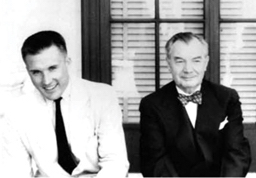
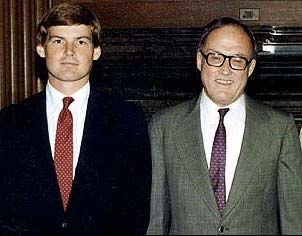
Above: Rehnquist and Jackson; below: Roberts and Rehnquist.

"This ruling," Jarrow said, "brought the three branches of government into balance again and became the basis for many later Court decisions."

In one of his final cases, recovering from a heart attack, Jackson was part of one of the most important cases in U.S. history, Brown v. Board of Education.
The year before he'd heard the reasoned arguments of then-attorney Thurgood Marshall against school segregation. "Jackson made up his mind that the Court should reverse the 1896 Supreme Court ruling Plessy v. Ferguson," Jarrow writes. The decision, issued by Chief Justice Earl Warren, was unanimous.
Jackson did not achieve his dream of becoming chief justice, but his legacy was profound.
"Although Robert Jackson never became chief justice, he is connected to a line of chief justices. His law clerk in 1952-1953 was William Rehnquist, who served as chief from 1986 to 2005. When Rehnquist died in 2005, his former law clerk John Roberts took the position. Robert Jackson dedicated his life to the law, first as a lawyer, then as a judge. He believed that the basis of a government was its laws, not the whims of its leaders. Shortly before his death, he wrote: 'There are only two real choices of government open to a people. It may be governed by law or it may be governed by the will of one or of a group of men. Law, as the expression of the ultimate will and wisdom of the people, has so far proven the safest guardian of liberty yet devised.'"
Jarrow's biography includes a timeline, notes, bibliography, index and resources for more information. Among the resources are oral histories, presidential libraries (Wilson, Hoover, Roosevelt, Truman and Eisenhower) and the Robert H. Jackson Center of Jamestown, New York – www.roberthjackson.org – a site with comprehensive coverage of the Nuremberg trials of Nazi war criminals.

Jackson saw the value of working closely with Allies. He recognized the dangers of totalitarianism and fascism. And he believed in the awe-inspiring power of Constitutional Democracy. He embraced freedom, rejected fear, spoke truth to power and put his faith in critical thinking.


Robert H. Jackson, Associate Justice of the Supreme Court, in 1953: second from the left, in the back row. Also pictured are, from left, in the bottom row: Felix Frankfurter; Hugo Black; Earl Warren (Chief Justice); Stanley Reed; William O. Douglas. Back row: Tom Clark; Jackson; Harold Burton; Sherman Minton.

Friday, April 5, 2019

A White House Insider's Advice

Review by Bill Doughty
Ted Sorensen, Special Counsel to the President, at work in the White House Jan. 25, 1961.
Photo by Abbie Rowe. John F. Kennedy Presidential Library and Museum, Boston.

The man who wrote some of the most famous speeches in modern history had plans to join the Navy when he was in high school during the Second World War. But after some soul-searching, he found his calling in a different kind of government service.

As one of the closest advisers to President John F. Kennedy, Ted Sorensen wrote several books that give an insight about leadership at the highest level.

Sorensen analyzed advantages of a "team of rivals" approach in his short book, "Decision Making in the White House: The Olive Branch or the Arrows" (Columbia University Press, 1963).

Some highlights for Navy readers and other critical thinkers:
  • An inside look at how the Kennedy administration handled the Cuba Missile Crisis, deciding: "An air strike on military installations in Cuba, without any advance warning, was rejected as a 'Pearl Harbor in reverse.'"
  • How, during the Cold War, Kennedy wished to name a nuclear submarine after a famous Indian Chief – Red Cloud – but "the Navy protested that this name had undesirable foreign-policy implications."
  • Why the president must understand how his words and expressions can tip the balance in strategy discussions. "... a President must carefully weigh his own words" or risk shutting off "productive debate."
  • The hazardous "whirlpools" created by resignations and trouble that can be caused by "the violent resignation of almost any Secretary of State, Secretary of Defense," etc.
  • This quote from Alexander Hamilton about a president consulting with advisers: "the Constitution presumes he will consult them ... It must be his own fault if he be not surrounded by men who, for ability and integrity, deserve his confidence."
President John F. Kennedy meets with members of his administration November 24, 1961 regarding the budget for the Department of Defense at the Joseph P. Kennedy residence in Hyannis Port, Massachusetts. Clockwise, from top: President Kennedy; David E. Bell, Director, Bureau of the Budget; Roswell Gilpatric, Deputy Secretary of Defense; Jerome B. Wiesner, Special Assistant to the President for Science and Technology; Theodore C. "Ted" Sorensen, Special Counsel to the President; McGeorge Bundy, National Security Advisor; unidentified man; General Lyman Lemnitzer, Chairman of the Joint Chiefs of Staff; General Maxwell D. Taylor, Military Representative of the President; and Robert S. McNamara, Secretary of Defense. (JFK Library)
Sorensen advised openness to new ideas, diverse perspectives and responsible decision-making as intended under the Constitution:
"Unlike the leaders of autocracy, the President of our democracy must contend with powerful pressures of public opinion, with co-equal branches of the government, and with a free and critical press. He cannot allocate resources, or ignore traditions, or override departments in whatever manner he wishes. His allies cannot be treated as satellites, his mistakes cannot be concealed, his critics cannot be silenced."...Great and lasting decisions in human affairs can only be made by those exposed to human value judgments. Consistently wise decisions can only be made by those whose wisdom is constantly challenged. The voluntary unity of free men [and women] and nations is ultimately more solid than the forced uniformity of repression. In the long run, there can be no wisdom without dissent, no progress without diversity, no greatness without responsibility."
In the book's foreword, President Kennedy wrote: "A President must choose among men [and women], among measures, among methods. His choice helps determine the issues of his Presidency, their priority in the national life, and the mode and success of their execution. The heart of the Presidency is therefore informed, prudent, and resolute choice – and the secret of the presidential enterprise is to be found in an examination of the way presidential choices are made."

JFK offered high praise for his speechwriter and special counsel: "Mr. Sorensen, more than any recent American writer, has helped illuminate the scene with skill and judgment," Kennedy writes. "His careful observations have been made with skill and judgment and I am sure his work will become a permanent addition to the small shelf of indispensable books on the American Presidency."


Kennedy and Sorensen
There's a Navy tie linking Ted Sorensen with Navy veteran U.S. presidents Kennedy, Johnson and Carter. 

Jack Rosenthal wrote this about Sorensen in a New York Times review in 2008: "At the age of 17, Sorensen had intended to enlist in the Navy — but he changed his mind the day after World War II ended. He wound up registering as a conscientious objector, a fact later denounced by critics when President Jimmy Carter nominated him, unsuccessfully, to be the director of central intelligence."

Sorensen, a key adviser in Kennedy's inner circle, chose not to continue as part of LBJ's administration as Johnson stepped up the war in Vietnam.


Sorensen receives the National Humanities Medal from President Obama.
According to a profile at the Sorensen Center for International Peace and Justice at the City University of New York School of Law:  "From his pivotal work in crafting President Kennedy’s letter that helped avert nuclear war between the United States and the Soviet Union during the 1962 Cuban missile crisis to his efforts to shape Kennedy’s civil rights speeches and legislation, Sorensen had a devotion to world peace and justice for all."

This Sorensen quote is featured on the CUNY Sorensen Center website: "We shall listen, not lecture; learn, not threaten. We will enhance our safety by earning the respect of others and showing respect for them."

President Obama presented Ted Sorensen with the National Humanities Medal in a ceremony at the White House on Feb. 25, 2010, eight months before Sorensen's death in New York City.

Sorensen's advice to the Presidency in "Decision-Making" deserves repeating: "In the long run, there can be no wisdom without dissent, no progress without diversity, no greatness without responsibility."

Sorensen is part of a pantheon of scholars-in-service who provided a window to the world and the possibilities – visionaries including Elliot Richardson, Richard Goodwin, Rachel Carson, Grace Hopper, Admiral Elmo Zumwalt and Robert H. Jackson.

President John F. Kennedy and others watch television coverage of astronaut Lieutenant Colonel John H. Glenn, Jr.'s lift-off from Cape Canaveral, Florida, Feb. 20, 1962, aboard Mercury-Atlas 6 (also known as Friendship 7) on the first U.S. manned orbital flight. (L-R) Special Counsel to the President Ted Sorensen (with pencil), Congressman Hale Boggs of Louisiana, Speaker of the House of Representatives John W. McCormack (mostly hidden, with his hand on Congressman Albert's shoulder), Congressman Carl Albert of Oklahoma, Senator Hubert Humphrey of Minnesota, Vice President Lyndon B. Johnson, President Kennedy, and Senator Mike Mansfield of Montana (with arms crossed at far right). Family Dining Room, White House, Washington, D.C. (JFK Library)

Tuesday, January 27, 2026

‘Seen and Unseen’ Ties to 1942

Review by Bill Doughty

This award-winning book about the federal government’s incarceration of people of Japanese ancestry during World War II has remarkable ties to what is happening today in the United States:


“Seen and Unseen: What Dorothea Lange, Toyo Miyatake, and Ansel Adams’s Photographs Reveal About the Japanese American Incarceration” by Elizabeth Partridge and Lauren Tamaki (Chronicle Books, 2022).

After Imperial Japan attacked Pearl Harbor and other military sites in Hawaii, FDR called for the incarceration of Japanese immigrants and Japanese American citizens, including children.


The government’s Western Defense Command and Fourth Army Wartime Civil Control Administration ordered evacuation of whole areas and required disposal of property, including family farms. Families were assigned a number and were no longer known by their proper name. 


Author Elizabeth Partridge shows how prisoners were shamed and ostracized.


When first arrested, detained, and forced on trains and buses to the camps, families, including American citizens, had been treated like prisoners of war, allowed to keep only what they could carry.


Upon first reporting to at least one of the camps, they had been forced to fill bags with hay and sleep in horse stables that smelled of horse manure and urine.


“Seen and Unseen” 
is filled with distinctive art by Lauren Tamaki augmenting the photos.


Partridge is the goddaughter of Dorothea Lange. Her dad was a Navy veteran who served in World War II and later became a photographer and assistant to Lange after the war.


With the help of Lauren Tamaki’s distinctive and provocative art, Partridge introduces readers to the work of three photographers. Most of the photography is from within the Manzanar concentration camp in eastern California near the border of Nevada.


The first photographer featured is Lange (above), who became famous for her iconic photography during the Great Depression. The U.S. government hired her to take propaganda photos of what they called “internment” of Americans of Japanese ancestry and Japanese immigrants.

Lange tried to show everyday life of her subjects who were forced to leave their homes and travel in secrecy to faraway camps under armed guard.


Many of Lange’s photographs were impounded because they were deemed to show captivity in a negative light. She was forbidden from taking photos of barbed wire, machine guns, searchlight towers, or crowded conditions with little or no privacy.


“Dorothea wanted to show how hard the Japanese and Japanese Americans wanted to make their situation bearable,” Partridge writes. Resilient captives created furniture from scraps of wood. They cleared sagebrush to start vegetable gardens. And they continued to conduct school studies despite no desks and limited supplies.


One of her most powerful photos was of farmer Torazo Sakawye with grandson Walter (below).


Ten months after the photo was taken, Torazo died in the camp.

“All Dorothea could do was hope her photographs carried a strong message. ‘This is what we did,’ she said. ‘ How did it happen? How could we?’”


Next, Partridge introduces readers to Toyo Miyatake, a professional photographer whose family was incarcerated at Manzanar through the entire war.

At first, Miyatake surreptitiously took photos using an ingenious box camera disguised as a lunchbox. Eventually he was allowed to take photos but at first was told only caucasian helpers were allowed to push the shutter button.


The third photographer whose work Partridge showcases is Ansel Adams, who was attracted to the stark beauty of the desert and mountain terrain surrounding Manzanar. Adams focused on the “hardworking, cheerful, and resilient people.”


According to Partridge, “Ansel believed the faces of earnest, young Japanese Americans would convince other Americans how trustworthy and patriotic they were.”


Most of Adams's photos show smiling faces of young people.


"Everything in a picture is not necessarily true."

– Taira Fukushima, Manzanar, Block 5


Adams was on hand to capture some departures from Manzanar in 1945. Prisoners were given a change ticket and $25. A generation later those who had been incarcerated –– and were still alive –– were awarded reparations of $20,000 each under the Civil Liberties Act.

“The money was a small fraction of what they had lost,” Partridge observes.

“At least the federal government acknowledged that the incarceration had been a profound injustice, but it could not erase the heavy emotional and physical cost to the prisoners of what had been done.”

Readers might wish for more of the photographers’ work. Fortunately many of their photos are easily found online. And the National Archives has many incarceration photographs available –– at least for now –– including previously “impounded” images.


Those who are inspired to learn more won’t be disappointed if they read this book cover to cover. Among the treasures are the back pages of essays, commentary, notes, footnotes, photo credits, and biographies of each photographer, and more. This book is rich with primary sources, critical thinking, and documentation of censorship and history.


One of the essays in the back is titled “Civil Liberties and the Constitution.” The essay addresses one of the four cases brought by Japanese Americans that went before the Supreme Court: Korematsu v United States. In 1944 the Court ruled in favor of the government, but a generation later a federal court overturned that ruling when new evidence was uncovered that the military had lied about the need for incarceration,

“However, In 2018, several Supreme Court justices wrote about the Korematsu case in what are called ‘dicta’ –– statements made in written court opinions that do not affect the outcome of the case being heard. In a ruling restricting travel and immigration to the United States, Chief Justice John Roberts wrote, ‘The forcible relocation of US citizens to concentration camps, solely and explicitly on the basis of race, is objectively unlawful. ... Korematsu was gravely wrong the day it was decided, has been overruled in the court of history, and to be clear has no place in law under the Constitution. (He referred back to Justice Robert H. Jackson's dissent in the 1944 Korematsu Supreme Court case and quoted Jackson's words.)

Justice Sonia Sotomayor went one step further than Justice Roberts. ‘Today, the Court takes the important step of finally overruling Korematsu,’ she wrote, denouncing it as 'gravely wrong the day it was decided.’

Despite the dicta, Korematsu v. United States still stands, a painful symbol of our country's racial prejudice. And how can we be sure it will never be looked upon favorably in the future and used to violate the rights of another group of American citizens?”

Another essay/commentary is “Keeping Our Democracy Strong.” The keyword is “our.”

“As important as our leaders and our institutions are in our democracy, it depends on all of us to keep it safe. Even in the United States, built on strong democratic ideals, deliberate violations of people's civil rights can and do occur. No matter what kinds of inaccurate words are used to hide these violations, we can name them for what they are, and speak out against them, loud and clear. We can bear witness to old injustices, learn from them, and do our best to ensure they never happen again.

In the 194os, taking photographs was complicated.

Cameras could be cumbersome, film expensive, and developing and printing photographs a complex process. Today, we can use our cell phone cameras to capture injustice when we see it, and quickly let others know. These images cannot be marked

‘impounded’ and left hidden in a filing cabinet.

We each have in our pocket a tool for social justice that earlier generations never could have dreamed of.”

Photo by Toyo Mayatake
Cameras –– bulky and rare then, handy and pervasive now –– are one of the remarkable ties to history. Images, and now video, are compelling evidence of the crimes of violence against people who are targets or who practice their First Amendment rights to protest. Witness the shootings of Renee Good and Alex Pretti this month in Minneapolis.

Among other ties to history:

  • Then (and now), migrants and immigrant families were targeted by race.
  • U.S. citizens were also arrested, detained, or worse.
  • Officials used (and use) propaganda to lie about processes, procedures, and outcomes of a massive operation.
  • People were required to show their “papers.”
  • Uniformed law enforcement used chemical agents against protesters.
  • Fear was a weapon.
  • Those who protested often faced beatings, arrests, and even shootings.
  • Families were often separated and given no information about the whereabouts of their loved ones.
  • Fort Sill, used for past incarcerations of Native Americans and then Japanese Americans is now used again by the Trump Administration to incarcerate immigrants from Central America.
  • Other sites, such as Fort Bliss and Terminal Center, once used as concentration camps for  Japanese immigrants and Japanese Americans, are now used to incarcerate hispanic immigrants.
  • White supremacists and Christian nationalists supported “law and order” despite violations of the rule of law, Constitution, morality, and civil liberties.
  • Some military service members and law enforcement personnel followed illegal orders.
  • There was no accountability or justice for victims for decades.
  • The negative impact on families lasted for generations.
  • Then as now, officials covered up facts and prevented investigations.

"My question is always, why was I, a child, put into a

concentration camp? I was a citizen. 

That's against the Constitution."

– Joyce Yuki Nakamura Okazaki


This book and others came onto Navy Reads reading list after listening to Rachel Maddow’s podcast production “Burn Order,” a story about how some leaders in the military justified racist persecution of people of Japanese ancestry in the United States during World War II, while others, including a Navy intelligence officer told the truth. Maddow documents heroic efforts by a woman and a lawyer to uncover the true reason for the illegal incarceration.


A key takeaway from then and now: Each person has the opportunity to make a difference.