Showing posts with label women. Show all posts

Friday, March 31, 2023

‘Lethal Tides,’ Lifesaving WAVES and Science


Review by Bill Doughty––

Two western Pacific storms –– one in 1274 CE and another seven years later –– saved Japan from conquest by Kublai Khan and the Mongol Fleet.  The invading wooden ships were crushed by typhoons as they neared the Japanese coast. Tens of thousands of Mongols were killed in the invasion attempts.


Raijin
Back then, most Japanese people believed that a god or gods, including Raijin, had intervened on their behalf and had ordained the storms.

Superstition reined in Asia, as it did throughout most of the world for centuries. God or gods were the reasons for the actions of nature and of humans.


More than six hundred years after the storms, Imperial Japan, became the invader.  Headed by a revered god-like emperor, Nippon’s military invaded its neighbors, including Korea, Mongolia, and Indochina. On December 7, 1941, Imperial Japan attacked U.S. territories, including Pearl Harbor and other bases on Oahu.


But…


The United States Navy, Marine Corps, and Army/Air Force, with help from Allies, used science instead of superstition to win the war in the Pacific in World War II. How they did it is at the heart of “Lethal Tides: Mary Sears and the Marine Scientists Who Helped Win World War II” by Catherine Musemeche (HarperCollins, 2022).


Early in the last century, women had to fight against prejudice, discrimination, and another type of superstition: the belief that if women served aboard ships –– even aboard scientific research vessels –– it could bring about storms, shipwreck, pirates, or other calamities.

“The prohibition of women sailing on oceanographic vessels grew out of ancient taboos that originated in myths and legends, like Homer’s Odyssey, where after the Trojan War, Odysseus sails home with his all-male crew. Although he encounters numerous female characters during his stops along the way, nary a one dares to set foot on his ships. Ships are where men exercise their manly skills like war mongering and fending off monsters while simultaneously battling storms and rogue waves. Allowing women on board would only distract the crew from their duties and incite the wrath of an angry sea, leading to certain misfortune. For hundreds of years sailors clung to these beliefs and preserved the all-male domain at sea even while perpetuating the striking paradox that a female body carved into the bow of a ship would bring good luck on a voyage.”

“But not every woman was willing to adhere to this nonsensical restriction,” Musemeche writes. She presents a brief but good history of women breaking barriers on behalf of science, for greater equality, and to have opportunities for careers, including in the nascent field of oceanography.


Mary Sears
Fortunately, the hero of this story, Mary Sears, achieved quiet greatness thanks to her initiative, expertise, and record of achievement. She was helped indirectly by pioneers and champions of equality, including Naval Officer Joy Bright Hancock, Representative Edith Nourse Rogers, and First Lady Eleanor Roosevelt. Male mentors gave her a chance to excel. But she had to pay her dues at Woods Hole Oceanographic Institute, with opportunity ultimately provided by Lt. Robert Revelle, an oceanographer from Scripps Institute in San Diego.

Other men, though, stuck with old-fashioned views of “a woman’s place.” Senator David I. Walsh, chairman of the Senate Naval Affairs Committee, for example, declared “that to permit women to become members of the armed forces would destroy their femininity and futures as ‘good mothers.’” As a result, the Navy was slow to fully accept help from women who wanted to serve but eventually turned toward actively recruiting women for non-combat roles.

Sears persisted in her work and earned a leadership position at the Hydrographic Office during World War II, where, with other WAVES (Women Accepted for Volunteer Emergency Service) and scientists, she provided mapping, analysis, and much-needed intelligence, especially helpful to submariners and amphibious assault operations. “Her colleagues realized Sears could be depended on to provide the answers the military needed to wage war in the oceans.”


Though her background was anchored in biology, she and her team provided key and essential information about tides, waves, surf zones, reefs, currents, underwater obstructions, and the composition of shorelines –– analyzing “a fusion of hazards” for the military.


Such information, formulated in Joint Army Navy Intelligence Studies (JANIS) reports, was found to be much needed after the Battle of Tarawa, which revealed flaws in planning. “The resulting lack of preparation manifested on the blood-stained beaches of Tarawa,” Musemeche writes.


Marines wade ashore at Tinian, July-August 1944. (NHHC)
The Oceanographic Unit team Sears led became indispensable to war planners in the Palaus (Peleliu), Philippines (Luzon), and Marianas (Tinian was “a model amphibious assault”). Sears and her mixed gender team –– especially stalwarts Fenner Chace, Dora Henry, Mary Grier, and Roger Revelle –– helped guide ship captains who navigated unknown offshore waters and warned "of every possible danger to the troops risking their lives to go ashore in hazardous waters.”

“As the Pacific Campaign unspooled, getting the troops to shore presented a range of problems, confirming what Sears had said about the Navy’s lack of preparation. They had gone to war knowing very little about the ocean, at least about the offshore challenges of launching amphibious landings. But there was no stopping the action so American forces could rehearse and get better. The march to Japan would not wait.

The Americans had not fought this way or at this pace before. In World War I troops had sailed across the Atlantic into welcoming harbors, docked at piers, and unloaded without enemy resistance. Those operations were easily achieved without oceanographic information. The Allies rarely had such advantages in World War II. Harbors, if they existed at all at island targets, were not welcoming. There were no piers at which to dock. There was nothing simple about dropping marines into boats and tractors bucking in the grasp of heaving waves and sending them over jagged coral reefs, under a barrage of machine-gun fire and artillery shells toward plunging waves. The problem was, there didn’t appear to be any other way to win the war in the Pacific.

The success of the Pacific Campaign mandated capturing one island after another in far-reaching locales, as the military worked its way toward Japan.”

Musemeche tells of a set-back in planning for the assault of Iwo Jima. She writes of the hardship of rationing on the homefront, which impact the ability to do research. And, she shows how the war impacted everyone as the loss of loved ones in the Pacific and in Europe touched the lives of colleagues and friends.


Her description of the action on Palau is heart-pounding and searing. Admiral William H. McRaven endorsed the book: “Magnificently researched, brilliantly written, Lethal Tides is immensely entertaining and reads like an action novel.” (The book is lovingly dedicated, by the way, to Musemeche’s father, QM3 Frank M. Musemeche, who served in WWII.)


USNS Mary Sears (T-AGS-65) at Yokosuka, Japan. (MC2 Travis Bailey)
While Iwo Jima was a setback thanks to the special challenge of the volcanic island’s geography, the Battle of Okinawa demonstrated the team’s success at innovative research and applied science.

Imperial Japan’s military refused to surrender, with many leaders and troops and even some civilians preferring to commit suicide.


The kamikaze pilots who crashed their planes into U.S. Navy ships, were named “divine winds” after the storms that superstition said were brought about by the gods to protect Japan from invasion. It took the science of the atom to finally bring forth a surrender after the President Truman authorized nuclear attacks on Hiroshima and Nagasaki.


Fleet Admiral Chester Nimitz credited Lt. Cmdr. Mary Sears and her team more than once for contributing to successes in the Pacific War.


In 1946, Nimitz issued a postwar commendation crediting her “technical knowledge and administrative skill.” Sears’s use of science, data, and analysis, provided exceptional assistance to warfighters.


USNS Mary Sears, the first oceanographic survey ship named for a woman, was christened in 2000 by Mary’s younger sister Leila, who herself served as a WAVE in the Navy’s code decryption department.


Packed with under-reported facts, compelling photos, and actual data reports, this is a wonderful book for anyone interested in appreciating the depth of women’s history, the power of science and technology, and the strength of diversity and inclusion. BZ!


Pathfinder-class oceanographic survey ship USNS Mary Sears (T-AGS 65) hosted U.S. Ambassador to Australia Caroline Kennedy during the ship’s scheduled visit to Sydney, Australia, Nov. 8, 2022. Ambassador Kennedy toured USNS Mary Sears and received a Naval Oceanography overview from Commander Jonathan Savage during her time aboard. The visit was Ambassador Kennedy’s first to an oceanographic survey vessel and her first visit to a U.S. Navy ship since taking office as U.S. Ambassador to Australia in July 2022. Kennedy is former U.S. Ambassador to Japan. She is the daughter of Navy hero President John F. Kennedy. (Photo by Lt. Cmdr. Bobby Dixon)

Sunday, March 19, 2023

‘Wings’ of First Women Naval Aviators

Four of the first six women aviators (NHHC)
Review by Bill Doughty––

In celebrating the achievements of women in the Navy over the past fifty years we remember the struggles involved in reaching equality and justice. Career opportunities for women were not the same as for men just a generation ago.


One of the things that bugged the first women naval aviators, for example, was inequality of training opportunities. While their male contemporaries learned sea service skills such as navigation and operations, women were often restricted to classroom lectures on administration.


Women officer candidates in the unrestricted line had to wear skirts and heels, even when marching in the snow. Women’s restrooms were few and far between. Pregnancy was punished.


As for training, a retired captain remembers how, while her male shipmates were learning how to operate patrol boats, she and her female classmates had to listen to “a representative from Max Factor instruct us on the proper wearing of makeup.”


In the early 1970s women were not permitted to serve aboard ships. Women were also not allowed to serve as Navy pilots.


But thanks to brave women and men –– military and civilian –– equality was achieved beginning in the 70s and over the following decades.


Beverly Weintraub, a winner of the Pulitzer Prize, tells the story of the fight for equality in “Wings of Gold: The Story of the First Women Naval Aviators” (Lyons Press, 2021). The book centers on the challenges, ordeals, and achievements of naval aviation’s first women pilots: Barbara Ann Allen Rainey, Judith Ann Neuffer Bruner, Jane Skiles O’Dea, Joellen Drag Oslund, Rosemary Bryant Merims Conatser Mariner, and Ana Maria Scott. (All but one of the women were military brats –– daughters of service members or veterans).

The first women in naval aviation faced a calcified male-centric culture within the Navy that was often either patriarchal or predatory, or both.


But the predicate for women serving in the military, even as aviators, had been made half a generation earlier.


The first class of WAVES to graduate from Aviation Metalsmith School in Norman, Oklahoma, July 30, 1943. (NHHC)
In “Wings” Weintraub presents a brief history of WAFS, WASP, and WAVES. She offers lots of first-person testimonials and snippets of oral history. And she carefully recounts the milestones achieved in the 70s, 80s, and 90s, thanks to activist women, fearless politicians, and forward-thinking military leaders.

“Fortunately for the female aviators determined to make the navy their career, there were officers up the chain of command willing to become not only mentors, but friends,” Weintraub writes.


Adm. Elmo "Bud" Zumwalt
Among the strongest pillars who championed integration and equality of opportunity (both for people of color and for women) was CNO Elmo Zumwalt, who famously said, “Equal means exactly that. Equal.”

Zumwalt released his Z-gram #116 in August 1972: “Equal Rights and Opportunities for Women in the Navy.” His Z-gram #116 eventually became the blueprint for ensuring women could serve in aviation, aboard ship, and eventually in combat and aboard submarines. Zumwalt was supported by Secretary of the Navy John Warner and later by Senators William Cohen, John McCain, William Roth, and Ted Kennedy, as well as Representatives Beverly Byron and the Patricia Schroeder (a champion of women in the military who passed away last week).


Another key reformer and champion for women’s rights was the remarkable Adm. William P. Lawrence, considered by some a “radical feminist.” USS William P. Lawrence (DDG-110) is home-ported in Pearl Harbor, Hawaii. The ship’s commanding officer is Cmdr. Kellie Smith.

USS William P. Lawrence (DDG-110) participates in RIMPAC 2022 last summer. (MC3 Aleksandr Freutel)
Incremental change might have been accepted at first, but as more and more women came into the military, there was an inevitable backlash (similar to “replacement theory”). “While there is strength in numbers, there is also potential peril … As their ranks started to increase, broader resistance began to mount.” Some military men and some of their spouses felt threatened and aggrieved and took their anger out on those who championed equality.

Former SECNAV Jim Webb
On the other side were leaders who slow-rolled change or favored the male-dominated status quo: CNOs Adm. James Holloway, Adm. Thomas Hayward, Adm. Carlisle Trost, and Adm. James Watkins. Outside of the Navy, right-wing conservative Christian Phyllis Schlafly, who helped defeat the Equal Rights Amendment, said that a woman’s place is in the home, not in the cockpit. Perhaps the worst harm to women’s equality was caused inadvertently by Secretary of the Navy Jim Webb, who had come out forcefully against women serving in combat, saying “women can’t fight.” (Webb later expressed regret for publishing his opinion.)

Weintraub shows how Webb’s position fortified discrimination and justified harassment of women in the minds of some men, even helping lead to the watershed event that became a profound catalyst for change within the Navy: the Tailhook Convention at the Las Vegas Hilton in 1991.


Courageous women –– feminists, activists, and military members seeking justice –– accelerated change. “It would take a series of lawsuits by military women to bring policies, if not attitudes, in synch with the times,” Weintraub writes.

Change came within the executive and legislative branches as well as the judiciary, with key rulings by Justice Ruth Bader Ginsburg and Judge John Sirica. Women themselves formed networks of support. And organizations such as DACOWITS and Women Military Aviators assisted in bringing about change.

"Wings" fills a void in the important history of the advancement of women in the Navy. One of the best features of this book is the inclusion of interviews and testimonials of the first women aviators as well as other women who pioneered progress. Weintraub does a great job of following the lives of the first women naval aviators, including into retirement.

“I will always miss the smell of jet fuel and salt air,” said Jane Skiles O’Dea.


Rosemary Mariner, who once wrote “Adm. Zumwalt changed my life,” said in an interview about women being allowed to serve on submarines, “We will have made progress when this is not a newsworthy event.”


The book opens and concludes with a historic flyover on February 2, 2019, in which the Navy executed the first all-women missing man formation flyover in navy history.


That flyover may remind readers that an all-women team from California performed a flyover at Super Bowl LVII last month to honor fifty years of women in the Navy.


The All-Women flyover team for Super Bowl LVII poses for a group photo at Luke Air Force Base, Feb. 10, 2023. (MC1 Bobby Bladock)

Happy Women’s History Month.

Monday, July 18, 2022

Smashing Ideas About Monuments

Review by Bill Doughty––

More than 250 years ago the federal government hired sculptor Clark Mills to cast a statue called Freedom, pictured above, that would be placed atop the U.S. Capitol Building in Washington D.C.


The first plaster model of Freedom, created in 1854, was rejected by then-U.S. Secretary of War (SECDEF) Jefferson Davis (future president of the Confederacy) because it wore a “liberty cap,”as Erin L. Thompson explains in “Smashing Statues: The Rise and Fall of America’s Public Monuments” (W.W. Norton, 2022).


Davis insisted the cap, which represented emancipation, be replaced with a helmet. But the new design looked “more suited to a Vegas showgirl than a warrior, with a starry headband topped with feathers sprouting from a popeyed eagle.” Eventually the symbol of liberty created by Clark Mills and his team of workers moved forward and upward, headgear and all:

“When Freedom was finally hoisted into place in December 1863, it was hailed as a symbol of the universal liberty the Emancipation Proclamation had declared in January of that year. More than 150 years later, many avowed white supremacists undertook a deadly invasion of the Capitol building to dispute the results of the presidential election. You might think that a symbol of the liberty America is supposed to offer to all would have dissuaded or at least shamed them. Looking more deeply into Freedom’s history reveals why the monument instead inspired them. It is a white supremacists vision of freedom.”

To help create the cast and melt bronze for Freedom, Mills depended on his workmen, including Philip Reed, a man born into slavery in South Carolina, who was paid $1.25 per day by Mills, but was considered his property. As Mills gained fame and made more money he purchased more enslaved people.


The symbol of Freedom was, in actuality, a symbol of slavery. “Slavery shaped everything about her,” Thompson writes.


Despite an attempt to promote emancipation and liberty, seditionists in the South staged the ultimate insurrection, led by Jefferson Davis. Construction of the Capitol Building stopped for a while, but was restarted under orders from President Abraham Lincoln, who said, “If people see the Capitol going on, it is a sign we intend the Union shall go on.”


The supreme irony of the statue atop the Capitol –– symbolizing liberty but built by enslaved people –– is matched in the story of Horatio Greenough, eugenic “father of our monuments,” whose “blatant racism” is found in his work.


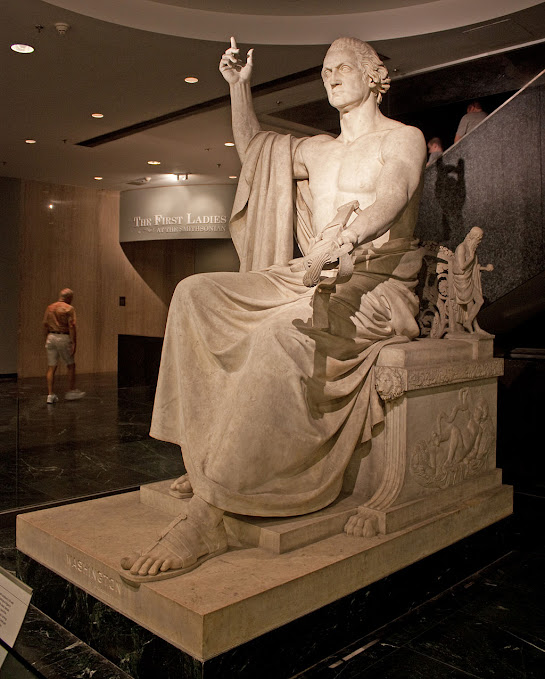
Greenough's George Washington (Wikimedia)
Greenough created a bizarre god-like statue of George Washington that includes a subjugated indigenous “Indian chief” in the design, under Washington’s hips, as the first president holds a sword and points to the sky. Greenough had planned to include “a negro” along with the indigenous figure, but abolitionist Charles Sumner convinced him not create a tie to slavery. The sculptor included a depiction of Christopher Columbus instead.

The public and press mocked the semi-nude statue of the first president. “American audiences paid less attention to deciphering the meaning of Washington’s symbolic sword and more to his nipples.” The statue, Thompson notes, "is on display at the Smithsonian’s National Museum of American History, awkwardly wedged next to an escalator. Today, the sculptures upraised hand looks as though it points the way up to the next floor."


Greenough's "Rescue." (LOC)
Greenough’s next work was received more favorably, at least by white Americans. In many ways it was even more bizarre and offensive. Like other monuments to follow, Rescue celebrated the genocide of Native Americans, particularly after President Andrew Jackson’s “Indian Removal Act” of 1830.

Rescue is in effect a monument to Manifest Destiny –– the idea of a god-given right of white people to subjugate indigenous people –– and for men to have an ordained role as dominant protectors of women. Thompson explains the scene of a white settler holding a dying indigenous warrior he'd just shot; his wife and child hover beneath him, and a dog watches balefully. The symbolism is clear and cringe-inducing.


At Abraham Lincoln’s inauguration in 1861, Rescue was prominently on display. It was removed from the eastern front of the Capitol Building in 1958 after decades of complaints. Thompson writes, “The removal of Rescue is another example of what happens when enough people decide that the messages encoded in a monument are unacceptable to them.”

“Greenough’s sculptures, the first thoroughly American national monuments, were also the first in a long line of public artworks to address questions of how much Black and Indigenous lives matter in America. He and his monuments claimed these lives didn’t matter at all. Greenough’s monuments assert that only people of a certain gender, class, and race deserve honor.

“Greenough’s beliefs informed not only his own sculpture but all the subsequent American public monuments based on his influential examples.”

A natural progression to other monuments highlighting white supremacy extended in the wake of the Civil War, even in Thomas Ball’s controversial Freedmen’s Memorial, dedicated in 1876.


Also known as Emancipation Memorial, it depicts a fully clothed Lincoln standing over a nearly naked kneeling black man. One interpretation is of a gracious leader bestowing freedom, but another view is of ongoing patriarchal and racial inequality.

Freedmen’s Memorial was unveiled on the eleventh anniversary of Lincoln’s assassination. President Ulysses S. Grant, members of Congress, and Supreme Court justices all attended and listened to Frederick Douglass’s speech. Several days later, Douglass wrote a letter to the editor of the National Republican in which he said, “What I want to see before I die is a monument representing the negro, not couchant on his knees like a four-footed animal, but erect on his feet like a man.”


Douglass’s descendants would live to see many hundreds of monuments erected to honor the seditionists of the Confederacy.


The rise of many of those monuments coincided with the rise of the rights and equality of African Americans as guaranteed under the Constitution.


An example is the statue of Robert E. Lee erected in Charlottesville, Virginia, in 1924, shortly after Virginia’s Racial Integrity Act made segregation lawful and outlawed in interracial marriage (not overturned by the Supreme Court until 1967 in Loving v. Virginia).


“The conflict at the heart of America,” Thompson writes, is “the conflict between the freedom for all and freedom for some.”


Thompson enlightens readers with the psychology, politics, and intent of Civil War monument creators. She delves into the meaning of statues’ poses, shows the influence of donations in creating profit motives for monuments, and explains the role of the Ku Klux Klan and other white supremacists.


Then there's Christopher Columbus.


Columbus Fountain in Washington D.C. (NPS)
Thompson reminds readers about Columbus’s contemporary, the priest Bartolemé de las Casas, who wrote about the real Christopher Columbus during his cruel reign as governor of Hispaniola (now Dominican Republic and Haiti). Columbus is condemned for overseeing torture, rape, slavery and genocide. Columbus shipped young girls back to Spain to be sold into slavery.

In recent years more people have assembled, protested, and demanded statues honoring Columbus, like monuments to the Confederacy, be taken down.


Thompson explores how, despite widespread opposition to their presence, some monuments remained in place for years. “We think our monuments celebrate our democracy, but really, they are held in place by some of America’s least democratic uses of power.”

Complacency and willful ignorance kept monuments up until catalysts of violence created a backlash: “Unite the Right” white supremacists' march (and killing of Heather Heyer) in Charlottesville; the horrific mass murder at a church in Charleston, South Carolina; and the senseless murder of George Floyd in Minneapolis, Minnesota, as examples.


Acts of civil disobedience are often the result of willful acts of bureaucratic lethargy, intransigence, and not listening to peaceful protesters. Thompson writes, "Talking about monuments is not easy. But we need to do it. We need to come together as communities to make sure our monuments leave room for everyone's life, liberty, and pursuit of happiness."


Towering over all the monuments to the Confederacy is the incomparable Stone Mountain in Georgia. Cut into the face of the mountain, it is the world’s largest bas-relief sculpture: images of Confederate President Jefferson Davis, along with Civil War generals Stonewall Jackson and Robert E. Lee on horseback. The sculpture inspires white racists and believers in the Lost Cause Big Lie, including the KKK.

Thompson writes about eccentric anti-semitic sculptor and con artist Gutzon Borglum, who was involved in creating the Stone Mountain monument. Borglum would go on to create the monument at Mount Rushmore, South Dakota, on land that was sacred to indigenous people.

There’s a lot more in this book about Borglum and Stone Mountain –– stories “to startle us out of our assumptions,” as Thompson writes.


[While reading this book I came across a new Americana CD by Bill Edwards, “61356,” with a great song from the perspective of a statue of a Union soldier on a Civil War monument in Illinois: “We Don’t See It Yet.” Edwards sings: “Since nineteen hundred and thirteen/I’ve stood in my place on this stone/In the middle of my Bureau County/But I haven’t stood here alone/Above me, a guardian angel/To my right, left and back, over Vets/We watch the horizon for justice/Alas, we don’t see it yet.” It’s a terrific song and album, highly recommended. Read more about "61356" on The Stratton Setlist.]


In “Smashing Statues” Thompson laments the lack of monuments to African Americans who fought for the Union in the Civil War.


There are also a relatively small number of monuments to women in the United States, but last week Speaker of the House of Representatives Nancy Pelosi unveiled a statue of Mary McLeod Bethune in the Capitol Building. Behune was “an unyielding force for racial justice, a pioneering voice for gender equity” from Florida, who was also “a devoted advocate for education,” Pelosi said in her remarks.


Bethune statue unveiled at Capitol Building July 13, 2022. (CNN)
The statue of Bethune joins statues of Rosa Parks, Sojourner Truth, Frederick Douglass and Martin Luther King, Jr. in the Capitol’s Statuary Hall. Bethune’s statue replaces that of a Confederate general.

On January 6, 2021, Trump-supporting insurrectionists, many wearing helmets or other headgear, walked through Statuary Hall during the coup attempt. Some rioters carried Confederate flags into the Capitol. High above them, on top of the building stood the statue in plumed helmet with an American eagle, mouth agape, eyes bulging –– Freedom.


This is an indispensable book for military readers interested in the reasons for the initiative to rename installations, facilities, and ships named for Confederate white supremacists or Confederate battle victories.

Thursday, June 30, 2022

QAnon, Jan. 6th, & Putin’s Real Motive

Review by Bill Doughty––

Jewish elders supposedly gathered in a cemetery in Prague at the beginning of the last century to discuss their plan to rule the world. The cabal of Jewish elders reportedly wrote down their plan in a document that would become known as “The Protocols of the Elders of Zion,” published as “Anti-Christ” in Russia. The book injected an idea that would spread fear of replacement of white Christians through various extremist groups.


The trouble is, the document was not real. Russian secret police forged it under the reign of Czar Nicholas II. Nicholas needed to distract the public from his failures as a leader. Mia Bloom and Sophia Moskalenko call “The Protocols” “the original fake news” in “Pastels and Pedophiles: Inside the Mind of QAnon” (Stanford University Press, 2021).


The authors take readers along a poisonous vein leading from “The Protocols” to replacement theory, apocalyptic terrorism, the J6 Capitol insurrection coup attempt, and various overlapping COVID conspiracies, including conspiracies involving Navy hospital ships USNS Mercy and USNS Comfort.

“In April 2020, Eduardo Moreno, a train engineer from San Pedro, California, derailed a train because he believed the USNS Mercy hospital ship was part of suspicious plot to spread (and not cure) the coronavirus.

“On April 30, 2020, Jessica Prim, a 37-year-old QAnon supporter from Illinois, was arrested after live streaming on Facebook her journey to New York City to ‘take out’ Joe Biden and Hillary Clinton … Prim, a stripper, was traveling with a dozen knives. She said she was driving to the USNS Comfort, a hospital ship docked in New York harbor, but accidentally ended up at the USS Intrepid aircraft carrier museum … She claimed to have been inspired by President Trump. ‘I was watching the press conference with Donald Trump on TV and felt like he was talking to me.’”

It wouldn't be the last time Trump followers were incited to attempt violence.


Hospital ship USNS Comfort (T-AH 20) returns to Norfolk, May 2, 2020, after treating COVID-19 patients in New York and New Jersey (MC1 Joshua D. Sheppard)

A Woman's Place: In QAnon?


Bloom and Moskalenko make an eyebrow-raising assertion: That women were a “driving force” of the failed insurrection of January 6, 2001, and that they play a “pivotal role in bringing together an ad hoc network of far-right militants, Christian conservatives, and adherents of the QAnon conspiracy theory.”


Women have a protective instinct about children (who are supposedly threatened by vampirish pedophiles), according to the authors, and many white women have a vested interest in maintaining a white patriarchy. “Women have been at the forefront of white racist movements for the past 100 years."


It's hard to agree completely with the authors’ contention about a prominent role of women in domestic extremism when considering the male-dominated so-called “militias.”

And it should be noted that strong, patriotic women have stood up for democracy, as personified this week by Cassidy Hutchinson (pictured above). Hutchinson testified to the U.S. House Select Committee investigating the January 6 Attack on the U.S. Capitol.

Another patriot, Representative Liz Cheney (pictured at top),  places the Constitution and the truth above political power.

The ranks of the Proud Boys, Oath Keepers, Three Percenters, Patriot Front, and other militia groups are apparently overwhelmingly male.


Many of these white supremacists, Aryan Nation believers and Christian nationalist extremists have embraced global conspiracies and targeted the federal government as the enemy. They focus on prominent Jews like George Soros, and they justify their beliefs, in part on the antisemitic “The Protocols of the Elders of Zion.”


Although “The Protocols” isn’t real, it hasn’t stopped true believers from thinking otherwise –– and acting on their beliefs. QAnon promotes theories that Democrats drink the blood of babies and that lizard people are in positions of power in various countries. QAnon believers, led by people such as retired Army Lt. Gen. Michael Flynn (disgraced former National Security Advisor  to President Trump) think they must “save the children” from evil nonbelievers.


Then-National Security Advisor Michael Flynn returns a salute upon his arrival at MacDill, AFB, FL, Feb. 6, 2017, with President Trump. (D. Myles Cullen)

Bloom and Moskalenko take a compassionate approach in understanding and explaining how QAnon believers like Ashli Babbitt and Roseanne Boylan (both killed in the January 6, 2021 attack on the Capitol) came under the spell of QAnon after their own personal setbacks and trauma. The authors show there is a tie to PTSD as they offer help in mindfulness therapies. In fact, the authors devote the last part of their book, in a section called FAQs, to strategies and tactics to help friends and family members.


Russia Connection, Putin's Motive


Russia figures prominently in the origins of the conspiracies on which QAnon is based –– and promoted. 


Russia has been using QAnon to advance its interests,” Bloom and Moskalenko write. Russia promoted Pizzagate, Michael Flynn, Trump, and online misinformation related to Q, including COVID disinformation.

"With ample evidence of Russia supporting and amplifying QAnon social media conflict, it is important to identify the man behind the curtain. Q may not have been directly controlled by Russia, but Russia has been using QAnon to advance its interests. Vladimir Putin has ruled Russia for over 20 years…

“Putin’s reign has become famous for the way he constructed a ‘vertical of power,’ with him at the top, and anyone below either heeding his command or suffering the consequences. Twenty years into this effort, it is safe to assume that Russian foreign policy efforts are Putin’s foreign policy efforts. In this sense, QAnon’s speed is a well-executed psyop –– a psychological operation to influence ‘hearts and minds’ –– a specialty of Putin’s KGB training.”

Just as Czar Nicholas had tried to distract the Russian people, Putin did the same with bogeymen creations 120 years later, according to the authors. He targeted the United States, Ukraine, the World Health Organization, and NATO with stories of victimization and conspiracy theories. Putin embraced fascism and Orwellian schemes to justify his revanchism and ethno-nationalism.

“Russia’s efforts in amplifying QAnon have promoted Vladimir Putin’s primary interest in ‘Making Russia Great Again,’” the authors write, “as well as his master plan of undermining democracy in the United States and abroad.”


Often Russia’s efforts targeted elections, both in the United States and Europe, with Putin and Q followers targeting progressive democracies, supporting authoritarians, and stoking anti-vaccine conspiracies.There are parallels with what QAnon did during the COVID pandemic.

“Thus, the ‘manufactured virus’ –– that in the American QAnon version originated in a Chinese bio lab in Wuhan –– in the Russian version originated in a U.S. lab and was brought to China by NATO soldiers. The NATO soldiers were carrying the virus around the world, the narrative explains, because it serves the deep state’s purpose to get rich off the mandated masks and the lockdowns, This story was followed up in the Russian-controlled informational space by fear-mongering stories about the dangers of collaborating with the United States in the area of biochemistry. These follow-up stories supplied a list of ‘dangerous’ laboratories in Ukraine, Georgia, and Kazakhstan –– post-Soviet countries that Russia has attempted to bring back under its influence. The nature of the folQlore is the same: Use the real threat of the virus, add to it a sinister component of plotting governments, and point the finger at potential targets of public anger. Only the main characters are recast to better fit the audience’s mindset. The Russian version of QAnon folQlore blames NATO, an organization Putin detests, and directs public fear and outrage at countries that reject Russian control.”

The authors note, “Both narratives fan public distrust in science and fear of vaccines.” And, with Putin’s devotion to Russian Orthodox Christianity, there are strong parallels related to religion. QAnon is popular among American evangelicals.


“What made evangelicals especially vulnerable to QAnon was that the language and terminology that QAnon used sounded explicit Christian, debating the existence of good and evil,” Bloom and Moskalenko say.


Can it be that Putin’s purported reasons for invading Ukraine –– to rid the former Soviet territory of Nazis –– is actually an Orwellian Big Lie? Like QAnon, is it fake News?


Remember QAnon’s roots in “The Protocols of the Elders of Zion,” replacement theory, and especially antisemitism and Christian nationalism. Is it possible that Putin’s hatred of Ukraine and his unprovoked attack on innocent civilians is fueled by the fact that President Volodymyr Zelensky is a Jew?


Ukraine President Volodymyr Zelenskyy participates in an Armed Forces Full Honors Wreath-Laying Ceremony at the Tomb of the Unknown Soldier at Arlington National Cemetery, Arlington, Virginia, September 1, 2021. (Elizabeth Fraser)

Friday, June 24, 2022

Rejecting Gilead, Embracing Carson

Review by Bill Doughty––

Retired Admiral James Stavridis writes this about author and environmentalist Rachel Carson, author of “The Sea Around Us”: “I’ve read many, many books that try to describe the power and glory of the deep ocean, but none eclipses the writing of Rachel Carson.”


Stavridis offers that highest praise to Carson in the first part of his four-part collection, “The Sailor’s Bookshelf,” reviewed late last year on Navy Reads. Great writers are drawn to other great writers.


Such is the case of Margaret Atwood, who also highlights Rachel Carson’s “The Sea Around Us” (as well as three other classics, including “Silent Spring”) in the final essay of her latest collection: “Burning Questions: Essays and Occasional Pieces 2004 to 2021.”

Just as Stavridis and Carson believe, Atwood writes, “The oceans are the living heart and lungs of our planet. They produce most of the oxygen in our atmosphere, and through their circulating currents they control climate. Without healthy oceans, we land-dwelling, air-breathing mid-sized primates will die.”


In her 2021 essay “The Sea Trilogy,” Atwood celebrates the republication of Carson’s first three books –– “Under the Sea-Wind,” “The Sea Around Us,” and “The Edge of the Sea.”


Atwood writes: “In all three of these books there is one underlying refrain: Look, see. Observe. Learn. Wonder. Question. Conclude. Rachel Carson taught people to look at the sea, and to think about the sea, in fresh ways.”


Atwood herself is perhaps best known for her fresh observations about the rise of authoritarianism and her imaginings of what might come. She is the author of “The Handmaid’s Tale” and “The Testaments.” She’s the mind behind the demented mind of Aunt Lydia and the darkness of Gilead. Her concern about the rise of authoritarianism continues.


In the midst of the COVID pandemic, she reflected, “Totalitarianisms were preoccupying me; the worldwide drift in that direction was alarming, as were various authoritarian moves made in the United States. Were we yet again witnessing the crumbling of democracy?”

Two years earlier Atwood wrote a scathing essay called “A Slave State” about the effects of restricting reproductive freedom and a woman’s right to an abortion. Here’s a timely excerpt, in light of today’s United States Supreme Court ruling to overturn Roe v. Wade after fifty years as established precedent in U.S. law:

“Nobody likes abortion, even when safe and legal. It’s not what any woman would choose for a happy time on Saturday night. But nobody likes women bleeding to death on the bathroom floor from illegal abortions either. What to do?

“Perhaps a different way of approaching the question would be to ask: What kind of country do you want to live in? One in which every individual is free to make decisions concerning his or her health and body, or one in which half the population is free and the other half is enslaved?

“Women who cannot make their own decisions about whether or not to have babies are enslaved because the state claims ownership of their bodies and the right to dictate the use to which their bodies must be put. The only similar circumstance of men is conscription into the army…

“No one is forcing women to have abortions. No one either should force them to undergo childbirth.“

In a gripping 2015 essay, “Reflections on The Handmaid’s Tale,” Atwood writes this:

“As a generalization, let us say this: absolutist governments have always taken an inordinate interest in the reproductive capabilities of women. In fact, human societies have taken such an interest. Who shall have babies, which babies shall be ‘legitimate,’ which shall be allowed to live, and which shall be killed (in ancient Rome it was up tot he father, etc.), whether abortion shall be allowed or not, or up to what month; wither women should be forced to have babies they didn’t want or couldn’t support, and so forth.”

While many fundamentalists want to restrict a woman’s right to choose, most Americans, according to numerous polls, are not in favor of overturning 1973’s Roe v. WadeAs today’s SCOTUS decision sinks in, so does anger and resentment.


Atwood discusses the anger she witnessed in the early 1970s, “at the time of the second-wave feminist movement.”


Atwood and Le Guin
In her 2018 obituary essay “We Lost Ursula Le Guin When We Needed Her Most,” Atwood turns to Le Guin to explain the outrage women felt after decades of “suppressed anger” from “being treated as lesser –– much lesser…” Atwood quotes from Le Guin’s 2014 essay, “About Anger”:

“Anger is a useful, perhaps indispensable tool in motivating resistance to injustice. But I think it is a a weapon –– a tool useful only in combat and self-defence … Anger points powerfully to the denial of rights, but the exercise of rights can’t live and thrive on anger. It lives and thrives on the dogged pursuit of justice … Valued as an end in itself, it loses its goal. It fuels not positive activism but regression, obsession, vengeance, self-righteousness.”

About Le Guin, Atwood writes, “The long-term goal, the dogged pursuit of justice –– that took up a lot of her thought and time.”


Le Guin was a premiere voice in science fiction and speculative fantasy. She's the author of "The Left Hand of Darkness" and the "Earthsea" series.


Atwood’s collection of essays is a tribute to a wide spectrum of iterature and free-thinking wisdom. Readers will be rewarded with deep dives into the works of Shakespeare, Alice Munro, Ray Bradbury, Gabrielle Roy, Homer, Dickens, Graeme Gibson, Richard Powers, and, of course, Rachel Carson.