Showing posts with label Ukraine. Show all posts

Monday, January 20, 2025

‘On Freedom’ Found Haiku, Finding Wisdom

Review by Bill Doughty

Timothy Snyder dedicates “On Freedom” (Crown New York, 2024) “to those who wish to be free.” He attempts to define “freedom” –– positive freedom –– as not destruction and absence of things, but creation and presence of values, including the right kind of moral and political values.


“Virtue,” he writes, “is an inseparable part of freedom.”


So, too, is accountability, honesty, humility, and rule of law.


His book begins on a train in Ukraine, one of three trips to the democratic country he writes about after Putin’s Russia invaded its neighbor.

Snyder takes us along as he travels to and through Ukraine and contemplates the birth of the idea of freedom and democracy in ancient Greece. His writing is beautiful, poignant, and painful –– especially in light of the current state of affairs in the United States and the world where storm clouds seem to be gathering.


He condemns the rise of autocracy, oligarchy, inequality, and what he calls “sadopopulism.” And he offers prescriptions for standing up to greed, grift, and the abuse of power.

“As the future crashes in, we can panic and blame others. Those predictable reactions make us part of the mob and the catastrophe. Or we can, as free people, take responsibility, look deep into Earth’s past, and save the world.”

Freedom must be fought for. It is not a birthright, and it is not preordained. “The moment you believe that freedom is given, it is gone,” he warns.


A recurring theme in “On Freedom” is the need to confront racism in a free country. The military, up till now, has made a concerted effort to increase diversity and reject racism.


World War II was a watershed event: defeating fascism and creating democracies in Japan and Germany while also confronting bigotry, prejudice and discrimination on the home front. Snyder cites examples of veterans of the Second World War who returned to face hate and segregation. He discusses the Freedom Fighters of 1961 and the role of Martin Luther King Jr. and John Lewis in the peaceful fight for freedom, equality, and voting rights. 


We must engage, he asserts, writing on a train ride within Ukraine.


Snyder
And we must reject complacency, supplication to authority, leaders' hypocrisy, and our own lazy thinking, including confirmation bias (treating information as evidence only when it confirms what we already believe).

It is also important to recognize “the false tragedy of choice” presented by social media algorithms — between entrepreneurship and social justice, for example.


“On Freedom” includes an appendix that compares positive and negative freedom. The positive view: Government must be made for freedom; the negative view: Government must be dismantled for freedom. Science is either (positive) how we engage with the world or (negative) “one opinion among others.” Racism is either a historical fact requiring reflection or strictly “personal, irrelevant to freedom.”


Extrapolating from the appendix, security and prosperity are achieved through rule of law and accountability (positive freedom) or strictly imposed through strong-arm policing (negative).


We cannot sacrifice liberty for safety, Snyder advises.


“We believe that we can trade freedom for security. This is a fatal mistake.” A government of, by, and for the people should not be shunned or belittled.


Snyder writes, “We enable freedom not by rejecting government, but by affirming freedom as the guide to good government. Reasoning forward from the right definition of freedom, I believe, will get us to the right sort of government.”


He describes “five forms of freedom” as the “logical, moral, and political links between common action and the formation of free individuals.”

“The five forms are sovereignty, or the learned capacity to make choices; unpredictability, the power to adapt physical regularities to personal purposes; mobility, the capacity to move through space and time following values; factuality, the grip on the world that allows us to change it; and solidarity, the recognition that freedom is for everyone.”

Sometimes the best way to see oneself is through the eyes of others. That applies to people specifically and nations generally. Snyder says his book is for the United States, but, as a historian, he draws comparisons with western Europe, eastern Europe, the Soviet Union, and Nazi Germany.


Synder relies on other Western historians, philosophers, and critical thinkers: Frantz Fanon, Václav Havel, Leszek Kolakowski, Edith Stein, and Simone Weil. And he calls on more familiar names such as Socrates, Thomas Jefferson, George Orwell, and Ray Bradbury to help illustrate his point.

This vital book answers some of the questions brought up in Snyder’s “On Tyranny.” 


In this follow-up, he shows how to fight oligarchy (reject disinformation) and confront climate change (embrace to search for fusion power).


He champions actual infrastructure initiatives, real freedom of speech, and a commitment to civil rights.


We discover hidden unintentional “found haiku” in Snyder’s writing. Seventeen syllables, 5-7-5, displayed in three lines, that capture and focus an insight or truth like a laser. Here are a few:


Freedom is not just

an absence of evil but

A presence of good


Empathy is a

precondition for certain

knowledge of the world


Overconfidence

makes us vulnerable to

the propaganda (of tyrants)


A free person sees

the world in color, as through

a kaleidoscope


Synder’s prose travels effortlessly through countries, eras, and moods, both light and stormy. One moment he writes of oppression in the former Soviet Union and hope in Cold War-era Czechoslovakia; the next moment he expounds on the roots of rock and roll, the Velvet Underground, Louie Louie, and Frank Zappa’s Mothers of Invention. “On Freedom” is a fun, enlightened, but ultimately serious ride on Snyder’s train of thought. 


(Top photo of Ukraine's Carpathian Mountains courtesy of Pixabay)

Wednesday, March 29, 2023

Putin is a Cartoon. Literally

Review by Bill Doughty––

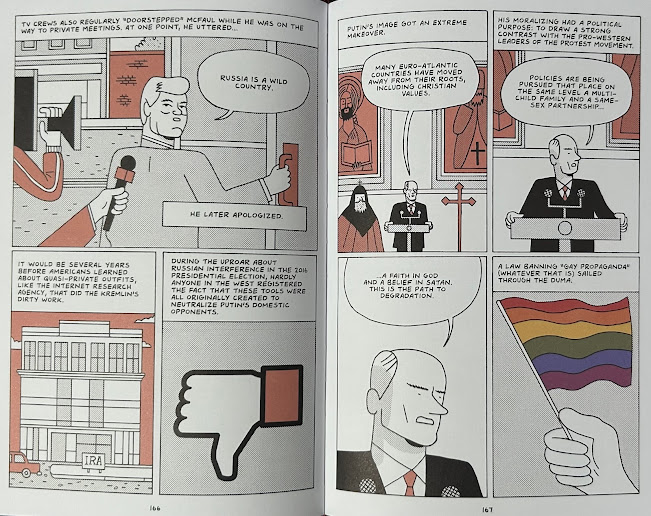
Russia’s President Putin is a cartoon in the seriously insightful “Accidental Czar: The Life and Lies of Vladimir Putin” by Andrew S. Weiss and Brian “Box” Brown, First Second, 2022).


Like the best graphic novels and graphic nonfiction, much is communicated in few words. For example ––

  • “For Russia, geography is destiny”: With no natural defenses including oceans, unlike the United States, “Russia safeguarded its security through conquest and territorial expansion.”
  • Quoting Gene Sharp, author of “The Politics of Nonviolent Action”: “Dictators are never as strong as they tell you they are, and people are never as weak as they think they are.”
  • Fomenting fear, conspiracies, and disinformation: “Russian leaders simply can’t accept that brave people sometimes shape history all on their own.”
  • Again quoting Sharp: “The extreme repression comes when a dictatorship really is frightened and therefore they act ruthlessly.”
  • Irony: In May 2007 in a Victory Day speech in Moscow, Putin said, “We have a duty to remember that the causes of any war lie above all in the mistakes and miscalculations of peacetime.”
  • Putin compared the United States to Nazi Germany and said, “These new threats, just as under the Third Reich, show the same contempt for human life.” Irony meets hypocrisy (condemning “contempt for human life”) when considering what Putin is doing to the people of Ukraine.

Weiss’s insights are succinct but deep. Brown’s simple art is both evocative and informative.


This book follows the rise of Putin from childhood to KGB apparatchik in East Germany, to Communist Party hack, to opportunistic sycophant, to power-mad leader. Picturing Russian history, Weiss and Brown show how Putin put forth grandiose ideas for restoring the “glory” of the Russian Empire and Russian Orthodox Christianity. Nearly 40 years ago, in 1989, Russian territory covered “one-sixth of the earth’s landmass.”


Faith in Russia’s system of nepotism, cronyism, and corruption is baked into its history, where serfdom was a close equivalent to slavery. The czar and the State were held above the individual or rule of law.

Putin’s invasion of Georgia in 2008 and Crimea in 2014 were telling signs that he would commit further international crimes. “Territorial expansion is at the core of Russia’s national identity,” according to Weiss.


We learn about the roles of a whole host of characters who endorsed Putin: former Russian President Boris Yeltsin, former Ukrainian President Viktor Yanukovych, Alexandr Torshin and Maria Butina, retired Lt. Gen. Michael Flynn, evangelist Franklin Graham, actor Steven Seagal, Republican representative Steve King, and Trump advisor Steve Bannon.


Putin v. McCain
On the other side, we see Putin’s nemeses, including former President Barack Obama, entertainers Pussy Riot, philanthropist George Soros, and late Senator John McCain, who was a “perennial nemesis of Putin.” Navy hero McCain was pro-Ukraine and pro-democracy; he saw Putin as an autocratic war criminal.

The late former Secretary of State Madeleine K. Albright endorsed: “Accidental Czar is an absorbing and visually stunning account of Vladimir Putin’s rise and take-no-prisoners approach to wielding power on the world stage. Andrew S. Weiss and Brian Brown have made one of the most consequential stories of our time more accessible and engaging for readers of all backgrounds. I would urge anyone who wants to better understand the forces shaping modern Russia, and disrupting our world, to open up this extraordinary book.”


Fiona Hill offers this endorsement: “This biography of Vladimir Putin deftly combines entertainment and serious analysis. Renowned Russia scholar Andrew S. Weiss and artist Brian Brown have found the perfect means to introduce the complexities of Russian politics and Putin’s peculiarities to a new set of audiences. Everyone should have a copy of Accidental Czar on their bookshelf.” Hill is senior fellow at the Brookings Institution and co-author of "Mr. Putin: Operative in the Kremlin." (She also authored the brilliant “There Is Nothing for You Here: Finding Opportunity in the 21st Century.”)

“Accidental Czar” is also blurbed by other notable thinkers, including former ambassador to Russia Michael McFaul, former President Bush speechwriter David Frum, conservative historian Max Boot, and New Yorker staff writer Susan B. Glasser. Author Gary Shteyngart blurbs: “A witty and comprehensive takedown of the annoying Putin-is-a-genius myth.”


In fact, Weiss and Brown show how Putin the cartoon is actually a deranged, dangerous, and destructive war criminal.

Tuesday, February 14, 2023

Frederick Douglass Speaks to Us in 2023: Part 1, Liberty


By Bill Doughty––

As a former slave, Frederick Douglass stood on a righteous stage when he observed, documented, and commented on history in the mid-to-late 1800s. Nearly two centuries later, his voice is still relevant in addressing our own controversial issues.


Here are some examples of that relevance from Douglass’s “Speeches and Writings” (Library of America, 2022, edited by David W. Blight.


On Liberty –– Consider why Ukraine fights for freedom and why we support their fight:

  • “The existence of this right is self evident. It is written upon all the powers and faculties of man. The desire for it  is the deepest and strongest of all the powers of the human soul. Earth, sea and air –– great nature, with her thousand voices proclaims it.” (12/08/1850)
  • “I have said that the right to liberty is self evident No argument, no researches into mould records, no learned disquisition, are necessary to establish it. To assert it, is to call forth a sympathetic response from every human heart, and to send a thrill of joy and gladness round the world. Tyrants, oppressors and slaveholders are stunned by its utterance; while the oppressed and enslaved of all lands hail it as an angel of deliverance. Its assertion in Russia, in Austria, in Egypt, in fifteen states of the American Union, is a crime. In the harems of Turkey, and on the Southern plantations of Carolina, it is alike prohibited; for the guilty oppressors of every clime understand its truth, and appreciate its electric power.” (12/08/1850)
  • “Americans! your republican politics, not less than your republican religion, are flagrantly inconsistent. You boast of your love of liberty, your superior civilization, and your pure Christianity, while the whole political power of the nation (as embodied in the two great political parties) is solemnly pledged to support and perpetuate the enslavement of three millions of your countrymen. You hurl your anathemas at the crowned headed tyrants of Russia and Austria, and pride yourselves on your Democratic institutions, while you yourselves consent to be the mere tools and bodyguards of the tyrants of Virginia and Carolina …You glory in your refinement and your universal education yet you maintain a system as barbarous and dreadful as ever stained the character of a nation—a system begun in avarice, supported in pride, and perpetuated in cruelty. (07/05/1852)
  • “Those who have undertaken to suppress and crush out this agitation for Liberty and humanity, have been most woefully disappointed. Many who have engaged to put it down, have found themselves put down. The agitation has pursued them in all their meanderings, broken in upon their seclusion, and, at the very moment of fancied security, it has settled down upon them like a mantle of unquenchable fire.” (05/1857)
  • “Man is man, the world over. This fact is affirmed and admitted in any effort to deny it. The sentiments we exhibit, whether love or hate, confidence or fear, respect or contempt, will always imply a like humanity A smile or a tear has not nationality; joy and sorrow speak alike to all nations, and they, above all the confusion of tongues, proclaim the brotherhood of man.” (12/07/1869)
  • “I, therefore, leave off where I began, with hope. While drawing encouragement from the Declaration of Independence, the great principles it contains, and the genius of American Institutions, my spirit is cheered by the obvious tendencies of the age. Nations do not now stand in the same relation to each other that they did ages ago. No nation can now shut itself up from the surrounding world, and trot round in the same old path of its fathers without interference. The time was when such could be done. But a change has now come over the affairs of mankind. Walled cities and empires have become unfashionable. The arm of commerce has borne away the gates of the strong city. Intelligence is penetrating the darkest corners of the globe. Wind, steam, and lightning are its chartered agents. Oceans no longer divide, but link nations together. From Boston to London is now a holiday excursion. Space is comparatively annihilated. Thoughts expressed on one side of the Atlantic are, distinctly heard on the other.” (07/051852)

Think about that line above: “Oceans no longer divide, but link nations together.”


That concept is at the heart of the U.S. Navy’s Maritime Strategy for generations, protecting liberty and ensuring freedom on the global commons. Douglass delivered the line in one of his quintessential speeches, Our Composite Nationality: An Address, in Boston, Massachusetts on December 7, 1869. On that date, the great naval strategist Alfred Thayer Mahan was a 29-year-old lieutenant commander. Mahan’s influential books on the influence of sea power and the need for a strong American Navy on the world’s oceans would be written more than two decades later.


Mahan and Douglass came from wildly different origins toward a common point of view about the moral imperative of liberty for all humanity.


For nearly 14 years Navy Reads has offered many reviews and commentary about both Mahan and Frederick Douglass, including Douglass’s ties to the Navy and the sea.

Friday, January 27, 2023

Navy Reads Holocaust Remembrance

By Bill Doughty

Over the years, we’ve offered a number of reviews and commentaries about anti-semitism, Nazism, fascism, and the holocaust. Today, we remember the victims, warning signs, and parallels today on Holocaust Remembrance Day, January 27, 2023.


Among the champions of critical thinking we have featured on Navy Reads who have addressed the horrors of the Holocaust: Hannah Arendt, author of "The Origins of Totalitarianism;” Diane Ackerman, author of “The Zookeeper’s Wife: A War Story;” and Timothy Snyder, author of “On Tyranny;” among others.


Snyder observes similarities between Russia’s aggression and “genocide” in Ukraine with Nazi Germany’s targeting of Jews in the Holocaust. He warns that it could happen here; the rise of Nazism began with a Big Lie, too, that Jews were responsible for Germany losing the First World War. Feelings of victimization can lead to disorder, violence, authoritarianism, and terrorism.


Snyder says U.S. military contributions to the defense of Ukraine, confronting Putin's terrorism and genocide are an investment in peace – both in Europe and as prevention of war in Asia. China, he notes, is watching the resolve of free nations in the West to help support the people of Ukraine.

Wednesday, January 25, 2023

Does Taiwan Rhyme with Ukraine?

Review by Bill Doughty––

In “War and Peace in the Taiwan Strait” (Columbia University Press, 2022), Scott L. Kastner examines the likelihood of conflict in Asia. However, readers may find themselves thinking about the actual war in Europe. More about that in a moment…


Kastner’s well-researched book considers the possibility that the People’s Republic of China will take military action –– in the form of a military blockade or outright invasion –– against the democratic citizens of Taiwan (a country which has has been, in reality, an independent nation since 1949).

Kastner presents a brief history of the formation of Republic of China after the civil war of 1949, including Taiwan's flirtation with autocracy and martial law and eventual full embrace of democracy. Then he gets to the heart of his thesis: that there is a balance between sovereignty and reunification, with “status quo” as the fulcrum keeping peace, and with ambiguous options clouding an uncertain future.


The power balance in the region, he notes, has changed in recent years as China’s economy and military have grown –– along with nationalism. “Although the balance of power has clearly shifted in Beijing’s favor, attempting to seize and occupy Taiwan would still represent a highly risky and costly undertaking that might fail spectacularly.”


A key to preventing war, many analysts believe, is deterrence, predicated on the strength of the economy and military of the United States, which is committed to maintaining peace and cooperation on the global commons.


U.S. Chairman of the Joint Chiefs of Staff Gen. Mark Milley said recently, “As long as we remain number one, then we will deter the war that people worry about, a great power war between China and the United States.”

Kastner writes:

“The U.S. Navy has announced numerous transits through the Taiwan Strait over the past few years, including several by guided missile destroyers; these high-profile transits could also indicate some strengthening of U.S.-Taiwan security ties. The frequency of transits has varied considerably over time, however, and long-term trends (at least over the past decade and a half) are ambiguous. Transits occurred on average 5.5. times per year from 2007 to 2010, increased to nearly 10 per year from 2011 to 2016 on average, and dropped to 4 per year from 2017 to 2018, before increasing sharply in 2019 and 2020. On the other hand, the recent uptick in transits is notable, and it is worth highlighting as well that U.S. officials have begun to announce these transits on a regular basis –– whereas in the past they typically went unannounced.”

Kastner also examines the commitment by the U.S. Congress and American presidents to supporting Taiwan's security. (This book was apparently published just before former Speaker of the House Nancy Pelosi’s notable visit to Taipei last year.)

Kastner notes, “U.S. Secretary of State Anthony Blinken warned in April 2021 that it would be ‘a serious mistake for anyone to try to change the existing status quo by force.’”


Still, XI and Communist China threatens invasion by force if the One-China policy is not realized. While Kastner contends “war is not inevitable,” he has an ominous observation:

“Were armed conflict to occur in the Taiwan Strait, at its root would be an intractable sovereignty dispute that has persisted since the end of the Chinese Civil War. In its current manifestation, the dispute centers on Taiwan’s status: whether Taiwan should be considered part of China now, and whether it should be formally unified with mainland China in the future. The PRC views itself as the sole legal government of China, Taiwan as part of China in principle, and formal unification as an important national goal. While Beijing has embraced a policy of ‘peaceful unification,’ it has refused to renounce the use of force and has explicitly threatened to go to war if Taiwan were to formally declare its independence from China, be occupied by foreign forces, or delay –– indefinitely –– negotiations over formal unification. In Taiwan, even though individuals have widely divergent views on cross-Strait policy, and even though the two major parties differ considerably in their approach to China, there nevertheless exists wide agreement that Taiwan (or the ROC) is a sovereign state, and there is very little support for near-term unification with the PRC.”

Kastner concludes ominously, “Absent a dramatic change in circumstances, then, there is little prospect for the two sides peacefully resolving the underlying dispute.”


Does Taiwan rhyme with Hong Kong?

The citizens of Taiwan see what is unfolding in Hong Kong –– as China cracks down on democracy and independence there. They want no part of the loss of freedom they see there and in Tibet, another formerly autonomous region, as a result of China's political system, management, and control.


In Hong Kong, new PRC laws allow interference in the judicial system and schools. Independent newspapers and voices are shut down. Security officers patrol the streets. "The undercutting of autonomy in Hong Kong sends an especially troubling signal to Taiwan given that Beijing also calls its proposed formula for Taiwan "one China, two systems."


Does Taiwan rhyme with Korea?

In North Korea, “Supreme Leader” Kim Jong-un threatens ethnically identical South Koreans. Kastner compares the U.S. promise to support Taiwan with the “iron-clad” commitment to defend the Republic of Korea if attacked by autocratic Communist North Korea, as happened in 1950.


[Recently, the world learned that North Korea, which is still supported by China, is providing weapons to Russia’s Wagner Group in support of Putin’s war of terrorism in Ukraine.]


Does Taiwan rhyme with Ukraine?

In Europe, Putin kills and terrorizes the people of Ukraine despite their same ethnicity.


Just as the PRC sees Taiwan as critical to its expansion throughout Asia, Putin sees Ukraine as a strategic bulwark against the West and his revanchist goals in Eastern Europe.


Meanwhile, the Communist Party observes Ukraine and sees how Putin’s war continues to backfire: instead of an easy takeover, he has lost tens of thousands of soldiers; instead of weakening NATO and the West, he has strengthened the free world’s resolve; and instead of reunification, he is causing deep rifts within his own country.


One year ago, the world was still hopeful that Putin’s threats, maneuvers, and calls for “unification” would not lead to war despite his previous invasions of Georgia and Crimea. Today, we see Russia’s campaign of terrorism and violence continue as the war nears its one year anniversary.


China must be as surprised as Putin in seeing Ukraine's resolve and the free world’s coalition led by President Biden with the support of the U.S. Congress. So far.


Just this week, the Biden administration authorized sending 30 Abrams tanks to Ukraine; Germany announced it is sending dozens of Leopard 2 tanks.


Does Taiwan rhyme with Finland?

Seeing the parallels between Taiwan and Ukraine becomes clearer through the lens of the history of the Soviet Union, including what happened in the Winter War between the USSR and Finland in 1939 (ten years before Chinese nationalists fled to Taiwan). The Soviets invaded ethnically similar Finland, at the same time that Germany did the same to its neighbors in Central Europe.


Citing the conclusions of Stanford’s James D. Fearon, Kastner writes about the dangers of accommodation and appeasement and why a country may choose to “roll the dice” and accept war over loss of territory or independence.

“Fearon suggests the Winter War between the Soviet Union and Finland can be explained in part by this dynamic, where Finland preferred to fight rather than yield to Soviet demands to cede some small islands in the Gulf of Finland that Moscow viewed as strategically important: here, Helsinki feared that ceding the islands would give the USSR more leverage to demand further concessions in the future, and Stalin presumably couldn’t be trusted to honor a promise not to do so. Leaders in Taiwan will likewise be reluctant to accommodate the PRC by yielding ground on the island’s sovereign status, unless they can be confident that Beijing could be trusted to honor commitments not to take advantage of the increased bargaining power such accommodation would provide. Unfortunately, there are a number of reasons to doubt the credibility of PRC promises in this regard…”

As for the possibility of actual war between China and Taiwan, Kastner admits pessimism but says conflict is not inevitable. He notes the precariousness of Taiwan’s position: unable to declare total independence as a sovereign nation but also unable to appease China, which would risk losing freedom and democracy for its people.


USS Antietam (CG-54) and USS Chancellorsville (CG-62) transit the Taiwan Strait in August 2022. (MC2 Justin Stack)
Prevention of conflict, Kastner says, depends on good communication and information, as well as continued credible commitment to deterrence in the name of peace [to echo Gen. Milley].

“If the United States were to abandon Taiwan,” Kastner writes, “the risk of cross-strait war would likely increase.” There may be no evidence that Mark Twain ever said, “History never repeats itself, but it does often rhyme.” But in an unpublished manuscript, “Mark Twain in Eruption,” he did write that “It is not worthwhile to try to keep history from repeating itself, for man’s character will always make the preventing of the repetitions impossible.”


In “War and Peace in the Taiwan Strait” Kastner includes a huge section of historical and analytical notes and another lengthy set of references, including Shelley Rigger, Michael Beckley, Jessica Chen Weiss, Qiang Xin, Robert Sutter, Alan Romberg, Russell Hsiao, Richard C. Bush, Thomas J. Christensen, T. Y. Wang, and James D. Fearon, among dozens of other experts.


Unfortunately, there is a dearth of analysis in this book of the role and importance of Japan, not to mention other nations such as the Australia, New Zealand, and the Republic of the Philippines and as part of the strategic balance in the region. Kastner admits early in his introduction that his work is an overall analysis, not an evaluation of military strategy, weapons systems, or potential PRC planning. Still, for Navy readers this book presents a worthwhile examination of ambiguity and precariousness in the Taiwan Strait.


Secretary of Defense Lloyd J. Austin III and Chairman of the Joint Chiefs of Staff Gen. Mark Milley speak at the eighth Ukraine Defense Contact Group meeting at Ramstein Air Base, Germany, Jan. 20, 2023. The meeting brought together representatives from more than 50 nations and organizations to determine the best way to get the military capabilities that Ukraine needs to repel Russian forces from their sovereign territory. (DoD photo by U.S. Air Force Tech. Sgt. Jack Sanders)

Monday, January 2, 2023

Power of a Woman in Power

Review by Bill Doughty––

She was born March 26, 1940, nine months before Imperial Japan attacked Oahu and Pearl Harbor. The Second World War had already been waging for years in Europe and Asia. Like millions of Americans, she came from a family with deep roots in Europe.


Nancy D’Alesandro’s father was U.S. Representative Thomas D’Alesandro Jr., of Baltimore, Maryland., a second-generation American whose own father had immigrated to the United States from Italy. He was a vocal activist on behalf of Jews in Europe who were targeted by the Nazis, and his advocacy had a profound influence on his daughter, the future Nancy Pelosi.

Susan Page writes in “Madam Speaker: Nancy Pelosi and the Lessons of Power –– a Biography” (Hachette Book Group, 2021) about Pelosi’s father’s strong defense of European jews, including in a speech on the House floor in 1943:

“‘Daily, hourly, the greatest crime of all time is being committed.’ D’Alesandro had declared. ‘A defenseless and innocent people is being slaughtered in a wholesale massacre of millions.’

Years later, Nancy Pelosi would cite the influence that her father’s support of the Bergson Group had on her. It was a factor when she decided to break with another Democratic president, Bill Clinton, on the issue of China and human rights. She was Clinton’s ally on most issues but a thorn in his side on this one. She had been a little girl when World War II ended, but she remembered with pride the example her father had set. ‘His enthusiasm came from doing what he believed was right,’ she said.”

Page’s biography of Pelosi is a fully satisfying examination of her beliefs, ethics, strategies, and embrace of power. “Madam Speaker” covers Pelosi’s early years growing up in Baltimore’s Little Italy, her ties to politics from an early age, her devout Catholic faith, and her legacy as the first woman Speaker of the House.


One of the many great and unexpected photos in this book is one from 1957 of 16-year-old Nancy with then-Senator from Massachusetts John F. Kennedy, Navy hero of WWII, whose “Profiles in Courage” had recently been published.


Pelosi came of age during the Cold War and in the Civil Rights era. She would meet JFK again in 1961 when then-President Kennedy appointed her father as a member of the Renegotiation Board.

Though she was always close to politics, her first priority was to her own immediate family in San Francisco. She and Paul Pelosi have five children. In her autobiography (which could serve as an inspiration for military servicewomen and spouses), “Know Your Power: A Message to America’s Daughters” (Doubleday 2008), Pelosi writes, “Raising a family is challenging. I want women to know that the skills I acquired as a mother and homemaker have been invaluable to me. These same skills –– so often undervalued –– are transferable to many other arenas in life, including the United States Congress.”

Pelosi says her leadership skills were forged by her children, even more than by her parents. She had five kids in six years, which forced her to develop her modus operandi: “efficiency, teamwork, and organization.”


Among her favorite axioms are:

  • “Let’s have some cooperation.”
  • “Proper preparation prevents poor performance.”
  • “Seize the moment when you can; play the long game when you can’t.”
  • “Our diversity is our strength; our unity is our power.”
  • “Be ready to seize power.”
  • And, of course, “Know your power.”

With five young children, she says she had good practice dealing with temper tantrums, a skill that helped her deal with some members of Congress and with other senior elected leaders.


Pelosi, who arrived in the U.S. House of Representatives at the age of 47, credits mentors –– women and men –– for contributing to her success and ability to gain power and influence. Susan Page writes about one of those mentors:

“Representative John Murtha, Democrat of Pennsylvania, was a general in the Old Guard. The blunt-spoken former Marine, the recipient of two Purple Hearts and the first Vietnam veteran elected to Congress, had been serving in the House for a quarter of a century. He was a powerhouse on the Appropriations Committee, especially on military issues. In more ways than one, his district in south-central Pennsylvania, dependent on steel and coal, was as distant from San Francisco as it could be.

Yet Murtha and Pelosi somehow hit it off.”

Pelosi had opposed the Vietnam War. And, while she supported the war in Afghanistan, she became a powerful voice against Bush’s war in Iraq, calling it “one of the biggest mistakes in American history.” Page writes, “They were at war over the war in Iraq.”


Reps. Jack Murtha and Nancy Pelosi
At first, Pelosi’s position was also at odds with that of Rep. Murtha, “a leading voice on defense policy” who had voted to go to war after being contacted by then-Vice President Dick Cheney. But eventually Murtha came around to Pelosi’s position and regretted his vote. “He called the war ‘a flawed policy wrapped in illusion,’” Page writes. (Murtha was a recipient of the John F. Kennedy Profile in Courage Award in 2006.)

Pelosi stepped up her campaign against the war after Bush’s “Mission Accomplished” landing on USS Abraham Lincoln, May 1, 2003, suggesting to Bush that he change course, reach out to the Islamic world, and work with Allies instead of deploying a preemptive “go-it-alone foreign policy.” Page writes, “Pelosi said he impatiently dismissed the idea.”


Throughout her two terms as Speaker, Pelosi championed Veterans issues, especially those related to health care. Six months ago (a year after publication of Page’s book), Pelosi oversaw House passage of the PACT act, to help Veterans exposed to toxic substances during military service. She made many visits to military bases over the years, both in Asia and Europe. She visited Camp Leatherneck on Mother's Day in 2012 (top photo by Spc. Chelsea Russell).

(PO1 Jonathan Carmichael)

Murtha retired in 2008, two years before he passed away at 77. He wrote in notes for an intended memoir that Pelosi had as “good a political mind as anyone I have ever seen,” and once remarked that she was “one of the premier leaders in America today.” Other leaders, including U.S. presidents, world leaders, and colleagues have had similar praise for her skills and achievements. According to Page:

“Through the first two decades of the twenty-first century, Nancy Pelosi would stand at center stage during an era of domestic and global disruption.

She was the senior Democrat on the House Intelligence Committee in the aftermath of the 9/11 terror attacks that started the century, in 2001. She was the senior member of Congress to oppose the Iraq War from its beginning. She was the most persistent congressional critic of China on human rights, challenging both Democratic and Republican presidents on the issue. She was the irresistible force pushing through controversial pieces of major legislation, most notably the Wall Street bailout and the Affordable Care Act. She was the top fund-raiser and strategist who twice led Democrats to wrest back control of the House, in 2006 and 2018. She took the lead in negotiating massive relief packages in response to the coronavirus pandemic in 2020.”

Pelosi initiated several congressional efforts to hold ex-President Trump accountable for his actions while in office –– including two impeachments and creation of the bipartisan House select committee inquiry into the January 6, 2021 insurrection. Since publication of Page’s “Madam Secretary,” Pelosi led House efforts to pass landmark bills such as the American Rescue Plan Act of 2021, the Infrastructure Investment and Jobs Act, the CHIPS and Science Act, the Inflation Reduction Act of 2022, and the Respect for Marriage Act. She moved gun safety legislation successfully through the House, but was blocked by the Senate. She made a trip to Taiwan and Ukraine to demonstrate support for those democracies. Pelosi has been a steadfast champion of military defense aid and humanitarian assistance to Ukraine in the wake of Putin’s invasion and Russia’s war.


Congresswoman Nancy Pelosi, Speaker of the United States House of Representatives, addresses the audience during the Congressional Gold Medal Ceremony held to honor Merchant Mariners of WWII at the U.S. Capital, May 18, 2022. During WWII Merchant Mariners put their lives on the line for their country, braving German and Japanese submarines, in their Liberty Ships, as they delivered critical supplies for service members serving in the European and Pacific theaters. (U.S. Navy photo by Bill Mesta)


“Not everyone sees her legacy in a positive light, of course,” Page observes. “Republicans have demonized her as a rigid ideologue and deployed her as a weapon to raise funds.”


Speaker Pelosi steps down officially from House leadership when the 118th Congress begins its term this week. She has already handed the reins of her caucus’s power to a new generation, led by her successor, incoming Minority leader Hakeem Jeffries, whom Pelosi mentored. She stands out in history for her courage, conviction, and conscientious use of her power.


Both “Madam Secretary” and “Know Your Power” are inspirational reads for women and men in the 21st century.


Speaker of the House Nancy Pelosi meets with military service members during her visit to Yokota Air Base, Japan, Aug. 5, 2022. During her visit to Japan, Speaker Pelosi met with Japanese Prime Minister Fumio Kishida to discuss strengthening the U.S.-Japan alliance and a free and open Indo-Pacific. (U.S. Air Force photo by Senior Airman Hannah Bean)