Showing posts with label CNO. Show all posts

Sunday, May 14, 2023

The Nimitz We Need Now

Review by Bill Doughty––

Historian Ian Toll calls Clyde Symonds’s new book “The greatest biography yet written about the greatest admiral in American history.” The book is “Nimitz at War: Command Leadership from Pearl Harbor to Tokyo Bay” (Oxford University Press, 2022).


This book compiles well-known Nimitz information during the war in the Pacific and spices the narrative with new flavors: what Nimitz was saying to colleagues, writing in letters to family, and doing in his limited spare time with friends in Hawaii during the war. Symonds seems to get into the mind of the great admiral “behind those cool blue eyes, impassive expression, and enigmatic demeanor.”

Nimitz was serious but did not take himself too seriously. He was known for storytelling, and he enjoyed 

a good ribald joke, which Symonds relays in “Nimitz at War.” Readers will smile at Nimitz’s hotel joke, what he said to his daughter about praying in church, how he joked about his missing half ring finger, and how he labeled his toilet paper at his Makalapa home.


This biography is bracketed almost entirely to the war years, starting with Nimitz’s arrival to a devastated Pearl Harbor. It’s divided into four parts: Taking Command, The South Pacific, The Central Pacific Drive, and Dénouement. Using excellent sources, including contemporaneous correspondence and messages, oral histories, and especially the Nimitz Graybook, Symonds takes readers to Nimitz’s side during battles and campaigns in the Marshall Islands, Coral Sea, Midway, Guadalcanal, Aleutians, Philippine Sea, Saipan, Leyte Gulf, Okinawa, and more.


Marines at Betio during Battle of Tarawa
We get a gripping recounting of the intelligence preparations, training challenges, command tensions, and communications frustrations in the early 1940s. We read about Nimitz’s quiet “anxiety” in the lead-up to the Battle of Midway, for example, where Nimitz decided to trust Rochefort’s intelligence and ambush the then-powerful Imperial Japanese Navy. “It is difficult in hindsight to appreciation the boldness of that decision,” Symonds writes.


Nimitz had high regard for the Sailors and Marines he sent in harm’s way, including the heroic Marines who assaulted Betio and the fearless Marines who stormed Iwo Jima. Nimitz famously reported, “Among the Americans who served on Iwo Island, uncommon valor was a common virtue.”


The lives of Sailors, Marines, and Soldiers lost in combat weighed heavily on him, yet he was able to “compartmentalize” thanks to words of wisdom from his grandfather: “never to worry about things that were beyond his control.”


We read about Nimitz’s love for hiking and long walks, swimming in the ocean, playing horseshoes, and shooting at a pistol range at Makalapa.

Toll may be right that this is the best Nimitz biography considering the depth of the analysis, the plethora of photos, and the 15 fantastic maps and charts by Jeffrey L. Ward. What makes this book extra special is the way Symonds weaves relationships between Nimitz and other contemporary leaders: How E.J. King underestimated Nimitz, how Spruance and Halsey could be as different as ice and fire yet still be friends, and how MacArthur could be so obstinate and belligerent but still fail to steamroll Nimitz and the Navy despite continual efforts to challenge command authority.


Nimitz was in firm control of strategy during the U.S. Navy’s advancement across the Pacific. We see how he trusted and was supported by Spruance, Lockwood, Layton, Mitscher and others –– and how he met the challenges of dealing with Towers, Holland “Mad” Smith, Halsey, and especially MacArthur.


When Nimitz received his fifth star as Fleet Admiral he wanted Spruance to also receive a fifth star, but Washington instead awarded it to Halsey, whose brash and bombastic style caught the media’s attention much more so than Spruance’s quiet, diplomatic, and cerebral way. Symonds makes the case that Spruance deserves his more respected place in history.

Of course, like all humans, Nimitz was not a perfect person. Symonds calls the Texas hill country admiral “a product of his time and his culture” in that he avoided African American service members (with the notable exception of Messman Doris “Dorie” Miller, to whom Nimitz presented the Navy Cross for December 7 heroism). In 1943 there were no black officers in the Navy. And Nimitz also wanted no part in having women service members on his staff, disallowing WAVES from serving in the Pacific.


Relocating Americans of Japanese Ancestry (AJAs) to concentration camps.
Still, Nimitz resisted persecution of Americans of Japanese ancestry (AJAs).

At the outset of the war, Secretary of War Henry Stimson and Army General John DeWitt pushed for relocation of AJAs.


DeWitt “instituted a program that eventually relocated some 120,000 Japanese Americans from California and other western states, miles inland.


In March of 1942 FDR approved a recommendation to remove 158,000 AJAs from Hawaii as well.


Although some relocation camps were set up in Hawaii, Nimitz thought the idea of removing AJAs from Hawaii was “neither necessary nor desirable.” Symonds writes: “It was not out of an enlightened concern for the civil rights of Japanese Americans; he simply recognized the practical limitations of such a policy.” Nimitz realized AJAs played a critical role in the local Hawaii economy.


Symonds shows how Nimitz dealt with many respected high-profile visitors, first in Hawaii and later in Guam. One of the guests who visited Pearl Harbor was first-lady Eleanor Roosevelt, who also toured Bora Bora, Aitutaki, Tutuila, and even Guadalcanal, helping raise the morale of fighting men there.


At the end of the war, Nimitz took a statesmanlike stance in ordering his officers enlisted Sailors and Marines to utter no more insults or epithets and to treat the defeated people of Japan with dignity: “Neither familiarity and open forgiveness nor abuse and vituperation should be permitted,” he ordered. 

Nimitz ended his career as Chief of Naval Operations, working for prickly Secretary of the Navy James Forrestal. As CNO, Nimitz successfully fought for Navy independence during efforts to downsize and consolidate the military services after the war. “As strong a champion as he was of joint service and joint command, he fought hard to prevent the Navy from being subsumed altogether … His calm, non-confrontational manner acted as a balm to the fierce and sometimes better inter-service rivalries concerning unification, budgets, and national policy.”


Nimitz’s priorities, plans, and abilities –– especially his skill in dealing with challenging colleagues, subordinates, and senior leaders –– were the mark of brilliance. Though Ian Toll calls “Nimitz at War” a biography, Symonds claims it’s not:

“This is not a biography of Chester Nimitz. It is, instead, a close examination of his leadership during his three and a half years directing World War II in the Pacific Theater when his actions and decisions guided the course of the war and helped determine its outcome, the legacy of which we still live with today. In many ways, it is remarkable that he assumed such a role. National trauma –– social, political, economic, and military –– produces a cultural tension that can challenge democratic norms. In such circumstances, the loudest, most aggressive voices often assume leadership roles. During World War II, military and naval leaders such as Admiral Ernest J. King, General Douglas MacArthur, Admiral “Bull” Halsey, and General George Patton all rose to prominence. All were talented and competent. All were also larger-than-life figures whose temperament, stubbornness, self-assurance, and impatience characterized their leadership. They were, and are, polarizing figures.

“Nimitz, like Generals George Marshall and Dwight Eisenhower, exemplified another leadership style, a quieter one that depended on intelligent listening, humility, and patience. Nimitz did not shrink from hard decisions –– he was, at critical moments, as bold as any commander in the war. Yet he believed that ultimate success depended on accommodation as well as determination, on humility as well as aggressiveness, on nurturing available human resources as well as asserting his authority. Rather than impose orders, he elicited solutions; he sought achievement, not attention. He unified. His was a quiet, calm, yet firm hand on the tiller during an existential crisis, and his leadership style reinforced rather than challenged democratic norms. It is a leadership template more relevant than ever.”

Symonds says his “focus and purpose” is to “re-create and evaluate” what Nimitz experienced and achieved in the 1,341 days of the war in the Pacific as he “commanded, directed, and supervised the largest naval force ever assembled in the largest naval war ever fought.”


As a result of his excellent presentation, Symonds also succeeds in profiling the type of leader we need not only in the Navy, but also for the United States itself: indeed, “a leadership template more relevant than ever.”

Sunday, March 19, 2023

‘Wings’ of First Women Naval Aviators

Four of the first six women aviators (NHHC)
Review by Bill Doughty––

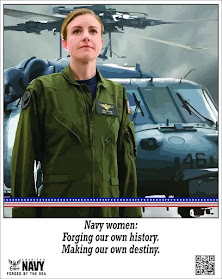
In celebrating the achievements of women in the Navy over the past fifty years we remember the struggles involved in reaching equality and justice. Career opportunities for women were not the same as for men just a generation ago.


One of the things that bugged the first women naval aviators, for example, was inequality of training opportunities. While their male contemporaries learned sea service skills such as navigation and operations, women were often restricted to classroom lectures on administration.


Women officer candidates in the unrestricted line had to wear skirts and heels, even when marching in the snow. Women’s restrooms were few and far between. Pregnancy was punished.


As for training, a retired captain remembers how, while her male shipmates were learning how to operate patrol boats, she and her female classmates had to listen to “a representative from Max Factor instruct us on the proper wearing of makeup.”


In the early 1970s women were not permitted to serve aboard ships. Women were also not allowed to serve as Navy pilots.


But thanks to brave women and men –– military and civilian –– equality was achieved beginning in the 70s and over the following decades.


Beverly Weintraub, a winner of the Pulitzer Prize, tells the story of the fight for equality in “Wings of Gold: The Story of the First Women Naval Aviators” (Lyons Press, 2021). The book centers on the challenges, ordeals, and achievements of naval aviation’s first women pilots: Barbara Ann Allen Rainey, Judith Ann Neuffer Bruner, Jane Skiles O’Dea, Joellen Drag Oslund, Rosemary Bryant Merims Conatser Mariner, and Ana Maria Scott. (All but one of the women were military brats –– daughters of service members or veterans).

The first women in naval aviation faced a calcified male-centric culture within the Navy that was often either patriarchal or predatory, or both.


But the predicate for women serving in the military, even as aviators, had been made half a generation earlier.


The first class of WAVES to graduate from Aviation Metalsmith School in Norman, Oklahoma, July 30, 1943. (NHHC)
In “Wings” Weintraub presents a brief history of WAFS, WASP, and WAVES. She offers lots of first-person testimonials and snippets of oral history. And she carefully recounts the milestones achieved in the 70s, 80s, and 90s, thanks to activist women, fearless politicians, and forward-thinking military leaders.

“Fortunately for the female aviators determined to make the navy their career, there were officers up the chain of command willing to become not only mentors, but friends,” Weintraub writes.


Adm. Elmo "Bud" Zumwalt
Among the strongest pillars who championed integration and equality of opportunity (both for people of color and for women) was CNO Elmo Zumwalt, who famously said, “Equal means exactly that. Equal.”

Zumwalt released his Z-gram #116 in August 1972: “Equal Rights and Opportunities for Women in the Navy.” His Z-gram #116 eventually became the blueprint for ensuring women could serve in aviation, aboard ship, and eventually in combat and aboard submarines. Zumwalt was supported by Secretary of the Navy John Warner and later by Senators William Cohen, John McCain, William Roth, and Ted Kennedy, as well as Representatives Beverly Byron and the Patricia Schroeder (a champion of women in the military who passed away last week).


Another key reformer and champion for women’s rights was the remarkable Adm. William P. Lawrence, considered by some a “radical feminist.” USS William P. Lawrence (DDG-110) is home-ported in Pearl Harbor, Hawaii. The ship’s commanding officer is Cmdr. Kellie Smith.

USS William P. Lawrence (DDG-110) participates in RIMPAC 2022 last summer. (MC3 Aleksandr Freutel)
Incremental change might have been accepted at first, but as more and more women came into the military, there was an inevitable backlash (similar to “replacement theory”). “While there is strength in numbers, there is also potential peril … As their ranks started to increase, broader resistance began to mount.” Some military men and some of their spouses felt threatened and aggrieved and took their anger out on those who championed equality.

Former SECNAV Jim Webb
On the other side were leaders who slow-rolled change or favored the male-dominated status quo: CNOs Adm. James Holloway, Adm. Thomas Hayward, Adm. Carlisle Trost, and Adm. James Watkins. Outside of the Navy, right-wing conservative Christian Phyllis Schlafly, who helped defeat the Equal Rights Amendment, said that a woman’s place is in the home, not in the cockpit. Perhaps the worst harm to women’s equality was caused inadvertently by Secretary of the Navy Jim Webb, who had come out forcefully against women serving in combat, saying “women can’t fight.” (Webb later expressed regret for publishing his opinion.)

Weintraub shows how Webb’s position fortified discrimination and justified harassment of women in the minds of some men, even helping lead to the watershed event that became a profound catalyst for change within the Navy: the Tailhook Convention at the Las Vegas Hilton in 1991.


Courageous women –– feminists, activists, and military members seeking justice –– accelerated change. “It would take a series of lawsuits by military women to bring policies, if not attitudes, in synch with the times,” Weintraub writes.

Change came within the executive and legislative branches as well as the judiciary, with key rulings by Justice Ruth Bader Ginsburg and Judge John Sirica. Women themselves formed networks of support. And organizations such as DACOWITS and Women Military Aviators assisted in bringing about change.

"Wings" fills a void in the important history of the advancement of women in the Navy. One of the best features of this book is the inclusion of interviews and testimonials of the first women aviators as well as other women who pioneered progress. Weintraub does a great job of following the lives of the first women naval aviators, including into retirement.

“I will always miss the smell of jet fuel and salt air,” said Jane Skiles O’Dea.


Rosemary Mariner, who once wrote “Adm. Zumwalt changed my life,” said in an interview about women being allowed to serve on submarines, “We will have made progress when this is not a newsworthy event.”


The book opens and concludes with a historic flyover on February 2, 2019, in which the Navy executed the first all-women missing man formation flyover in navy history.


That flyover may remind readers that an all-women team from California performed a flyover at Super Bowl LVII last month to honor fifty years of women in the Navy.


The All-Women flyover team for Super Bowl LVII poses for a group photo at Luke Air Force Base, Feb. 10, 2023. (MC1 Bobby Bladock)

Happy Women’s History Month.

Friday, September 30, 2022

Nimitz the Artist

Review by Bill Doughty––

Among the unexpected joys of reading “Mastering the Art of Command: Admiral Chester W. Nimitz and Victory in the Pacific” by Trent Hone (Naval Institute Press, 2022) is imagining the great leader as an artist.


Which art is the real surprise.


In “Mastering the Art” Hone examines the Pacific war years (1941-45) and presents the people, operations, and challenges Nimitz confronted.


Most fascinating is Nimitz’s relationship with egotists Admiral “Bull” Halsey and General Douglas MacArthur –– interactions rife with tension and friction. Hone also delves into the complicated leadership dynamics between Nimitz at Pearl Harbor and Admiral Ernest J. King and the joint chiefs in Washington D.C. And, we see his smooth connection with Admirals Raymond A. Spruance, Thomas C. Kinkaid, Marc A. Mitscher, and Charles A. Lockwood.


Whenever possible, Nimitz surrounded himself with people he trusted and who, like him, believed in the relentless and aggressive pursuit of perfection in planning, equipping, and understanding circumstances in order to act, react, and adapt as circumstances changed.


Through Hone’s narrative and in tables and maps, he portrays Operations Galvanic, Flintlock, Granite, Hotfoot, Causeway, Detachment, and Iceberg, among others.

“During those operations, Nimitz displayed inspirational leadership that created opportunities for his subordinates to excel. He delegated extensively, but when major decisions called for his authority or expertise, he took in the best advice available and acted decisively. With responsibility resting on his shoulders, he then invited his subordinates to cocreate positive outcomes through dialogue and conversation. Leadership for Nimitz was not a position of authority but an ‘emergent, interactive dynamic’ that created new possibilities.”

Nimitz inspects Midway Atoll, March 1942. (NHHC)
This book offers dozens of maps, figures, and tables; a list of abbreviations; selected code names of WWII, and extensive notes, bibliography, and index. There are also more than a dozen wartime photos, mostly of Nimitz's visits across the Pacific. It’s a worthy addition to any naval leader’s bookshelf. And it’s a celebration of quiet, competent, humble, and ethical leadership.

The author’s brilliant writing is at its best in chapter 4, “Seizing the Opportunity.” We feel the precariousness of defending Guadalcanal and how Nimitz handled leadership challenges on both ends of the Pacific –– with Adm. Robert A. Theobald in the Northeast and Adm. Robert L. Ghormley in the South. Fortunately, he had leaders he could count on in Adm. John S. McCain, Alexander A. Vandegrift, and Richmond Kelly Turner.


Nimitz balanced three flows: information, logistics, and combat forces. He achieved balance with three tenets: collaboration, trust, and unity. Hone shows how Nimitz capitalized on his interpersonal skills, judge of character, and lessons learned over decades, including in the early months of the war.


“After Midway, Nimitz and his staff built on a learning system developed in the interwar period,” Hone writes. That insight made me glad I recently read about the legacy of Adm. Joseph Reeves in “All the Factors of Victory: Adm. Joseph Mason Reeves and the Origins of Carrier Airpower” by Thomas Wildenberg, also from Naval Institute Press (see our previous Navy Reads post). Nimitz capitalized on the innovations in carrier aviation developed by Reeves and others. He also embraced amphibious warfare, joint operations, and –– thanks to his own experience ––submarine power.


“By the end of September (1944), Nimitz’s command was like a coiled spring, ready to release its new and increasingly capable potential against Japanese defenses in the central Pacific.”

Hone concludes that Nimitz was indispensable to victory by America and its Allies in the Pacific in under four years of intense action.

“We must acknowledge how the core characteristics of Nimitz’s command structure were essential to victory. Without Nimitz’s sense making capabilities, relentless pursuit of options, and sustained operational tempo, the war in the Pacific would have been quite different. The offensive that flowed across the Pacific, neutralized enemy strongpoints, and brought the war to the shores of Japan was a result of Nimitz’s command structure.”

A highlight and insight into Nimitz’s character appears in Chapter 10, “Achieving Victory,” in which Hone presents the admiral’s message to his command in August 1945 when it was clear that Japan would surrender after King told Nimitz to cease attack operations. Nimitz directed officers of the Pacific Fleet to “take steps to require of all personnel under their command a high standard of conduct” ––“dignity and decorum.” “Neither familiarity and open forgiveness nor abuse and vituperation should be permitted.” He rejected the concept of “us and them.”


In Nimitz we see balance between strategy & tactics, reason & emotion, and science & art. Nimitz demonstrated how a good ethical structure can allow creativity to thrive and how progress can be achieved and sustained.

And in that vein Hone introduces us to Nimitz the artist.


Admiral Nimitz embraced collective action, effective collaboration, and rapid learning. He always kept the flow moving in synergistic rhythm by modifying and adapting –– in other words “riffing.”


As a leader, he harmonized, sometimes took the lead, and whenever possible let others solo.


His art? Jazz!


––––––––––––––––––––––––––


“In ‘Learning War,’ Trent Hone described the elements of success for the Navy as a complex learning system before and during WWII. In ‘Mastering the Art of Command,’ he focuses on Admiral Nimitz himself and the leadership qualities he demonstrated to achieve the Navy’s learning potential and win the war in the Pacific. Together, these two books are a master class in leading complex learning systems, and should be required reading for every aspiring leader.” —Adm. John Richardson, USN (Ret.), 31st Chief of Naval Operations

Tuesday, September 6, 2022

Part II: Hornfischer’s One Ocean…

Review by Bill Doughty––

James D. Hornfischer’s final book, “Who Can Hold the Sea,” opens with a poignant message from Jim’s widow, Sharon Hornfischer.


Sharon includes this advice:

“Jim believed, as I also do, that others of this generation and future generations will carry on telling the stories of our great nation’s history. Share your stories with your children and grandchildren, nieces and nephews, so that they are engaged in our nation’s history and our country’s continued fight for freedom and democracy. Encourage our next generation, take them to air shows, museums, and libraries; ignite the spark of curiosity in our future historians and writers so that they can continue to tell stories for us all to read.”

Hornfischer
It’s both sad and inspiring to read Jim Hornfischer’s final work. As both a gifted writer and historian, he created vivid true stories of Sailors and Marines and their leaders. This book’s preface, introduction, and acknowledgements bookend the story of the Cold War with tender personal messages.

Hornfischer’s “Who Can Hold the Sea” (Bantam Books, 2022) opens in the gray aftermath of World War II.


After confronting and defeating fascism, the United States and most of the Allies moved toward greater democracy, peacekeeping, rule of law, and liberty for all. The Soviet Union, on the other hand, held on to autocracy, aggression, violations of laws, and control of its citizens’ freedoms.


“For Truman,” Hornfischer observes, “the Soviet Union was a treacherous and malignant betrayer.”


Americans adjusted to postwar realities –– not only fear of spreading communism and Soviet expansion, but also budgetary turmoil that reached into the military. Some politicians proposed doing away with the Marine Corps and Navy and merging the service branches.


None other than Adm. William “Bull” Halsey spoke out against the merger in a speech thankfully excerpted by Hornfischer.


Halsey said, in part:

“Merger is not necessary. It is not desirable. It is plainly dangerous. It would destroy the initiative of individual services. It would hamstring their right to advance. It would deprive them of representation before Congress and the people. It would substitute military for civilian control. It might lead to military dictatorship.”

Admirals Chester Nimitz, Ernest J. King, Marc Mitscher, and Edward L. Cochrane –– along with Secretary of the Navy (and first Secretary of Defense) James V. Forrestal –– persuaded President Truman and others that the Navy had a strategic role in the Atomic Age; merger of the services, along with loss of the Marine Corps, would be a bad idea.


President Truman is welcomed aboard USS Franklin D. Roosevelt (CV-42) by SECNAV Forrestal and Adm. Nimitz. Adm. Leahy pictured in background. (NHHC)
Truman visited Norfolk, Virginia, in April 1946 at the invitation of Commander in Chief, U.S. Atlantic Fleet Adm. Mitscher. Truman witnessed the power of naval aviation and capabilities of aircraft carriers USS Franklin D. Roosevelt (CV-42) and the seemingly ubiquitous USS Midway (CV-41). Mitscher’s chief of staff was Capt. Arleigh Burke.

Then-SECNAV Forrestal was one of the principal architects of the post-war modern Navy. His global vision was based on peace through freedom and democracy, not communism or autocracy. Hornfischer writes, “If that world was to become a community, it would be possible, Forrestal thought, only with U.S. leadership, the victorious democracy investing its credibility and standing in the world to promote self-determination and freedom wherever it showed aspiration.” Hornfischer explores the role Forrestal played and delves into Forrestal’s controversial death at Bethesda Naval Hospital.


“Who Can Hold the Sea” vividly covers how Burke, Nimitz and Forrestal shaped the Navy during the Cold War. And strategic thinker and diplomat George Frost Kennan influenced the influencers, as Mahan had done for the first half of the century. Kennan recognized early the “perverse brutality and terror” of Joseph Stalin and Communism’s threat to Capitalism and democracy.


Watercolor of scorched USS Nevada (BB-36) as Nagato and Sakawa sink.. (Arthur Beaumont, 1946)
As a result of those fears, including the real fear that the Soviets were developing nuclear weapons, the United States rushed to conduct atomic bomb tests in the Pacific just a year after the war. In Operation Crossroads, the Navy positioned hundreds of pigs and goats, as well as 4,000 rats, aboard a target ship to test the results of radiation from a nuclear “cauliflower head.” The results were staggering and crippling.

The flagship of Adm. William H. “Spike” Blandy, who headed up Operation Crossroads, was contaminated with radiation, so “hot” it needed to “cool down” before it could be boarded.


After "Able" and "Baker," Blandy had to cancel a third "Charley" stage of the test, Hornfischer notes. “The radioactive mess had become impossible to manage.”


Later, he would celebrate the operation with a bizarre cake-cutting ceremony.


Vice Adm. Blandy and his wife cut into an Operation Crossroads cake shaped to look like a radioactive geyser, as Rear Adm. Frank J. Lowry looks on, Nov. 7, 1946.

The Navy forged forward in developing deployable nuclear weapons, supported by John L. Sullivan, Secretary of the Navy.

The atomic bomb would shape the entire forty-four-year span of the Cold War. Made even smaller and more easily deployable, with larger and larger payloads, it would place every crook and crevice of the world under threat of ruin. War planners schemed to win atomic exchanges, even as they and every policy maker had no sense of consequences, and prudence demanded keeping the weapon in Pandora’s box. Humility, terror, curiosity, eager innovation, and abject paranoia would be the diverse by-products of the bomb.”

Louis A. Johnson
Sullivan would fight for the Navy but would resign in the face of cutbacks, cancellation of construction of the CVA-58 class aircraft carrier USS United States, and favoritism for the Air Force by SECDEF Louis A. Johnson. “The new defense secretary was an equal opportunity irritant, abrasive and arrogant and making no effort to filter it,” Hornfischer writes. “Johnson’s animus toward the Navy was an open secret.”

Despite obstacles, the Navy forged ahead in developing deployable nuclear weapons and nuclear-powered ships, including submarines. 


Hornfischer reveals how close the world came to nuclear war in the decade-and-a-half after bombs were dropped on Hiroshima and Nagasaki.


Leaders contemplated using nuclear weapons after Communist China threatened Formosa (Taiwan), after Communist North Korea invaded the South, and after Communists took power in French Indochina (Vietnam). Eisenhower was a voice of reason in nixing the idea of using the Bomb. Though not covered in this book, the Bay of Pigs incident comes to mind, when President John F. Kennedy, Navy veteran and WWII hero, proved to be the voice of reason in preventing nuclear war after the Soviet Union threatened to position nuclear weapons in Cuba.


Admittedly incomplete and somewhat unfinished, Hornfischer’s history of the Cold War is a compelling book thanks to the author’s distinctive style and grace. His writing shines in descriptions of not only events but also people, such as the great Arleigh Burke, “the son of a humble Colorado farmer,” a leader who embraced an ethos of good leadership.

“[Burke] had taken integrity, self-discipline, and strong principles from his father and mother, a teacher. In 1923, the year he graduated from the U.S. Naval Academy, the faculty had just compiled the first textbook on naval leadership. It listed the ‘essential qualities’ of a naval officer as personal dignity, honor, courage, truthfulness, faith, justice, earnestness, assiduity, judgment, perseverance, tact, self-control, simplicity, and loyalty –– to country and to service, to both one’s seniors and juniors. ‘Loyalty up and down was important because of the natural independence and self-reliance of the American sailor,’ and naval officers had to earn the respect of their men [and women] through their personal merit and example. Burke had been trained as a specialist in ordnance, earning a master’s degree in chemical engineering and becoming a design and production specialist in explosives. This background exposed Burke to the most advanced naval technologies of his time and would prepare him as CNO to promote the development of nuclear weapons, nuclear power, and guided and ballistic missiles.”

Burke helped guide the Navy through rough seas during the Cold War.


CNO Arleigh Burke on the bridge of USS Forrestal (CVA-59) March 12, 1956 as ship's CO Capt. Roy L. Johnson points out distant aircraft. (NHHC)

It’s bittersweet to read this excellent book about the Cold War knowing that Hornfischer is gone. He died last summer after a valiant fight with cancer. As mentioned, his wife Sharon offers a beautiful tribute to him and his legacy in the book’s preface.

Both Jim and Sharon offer acknowledgements at the end of this book. They thank retired Navy Admiral “Fox” Fallon, former commander of both U.S. Pacific Command and Fleet Forces Command and current board chairman of the Naval Historical Foundation. They also acknowledge and thank other graybeards, including retired Rear Admiral Samuel Cox, director of Naval History and Heritage Command and Curator of the Navy. The Hornfischers pay special tribute to the Nimitz Museum in Fredericksburg, Texas, hometown of the great admiral who led the winning strategy in the Pacific War.


This terrific book brought other books to mind that would make good companion reading: “Atlantic” and “Pacific” by Simon Winchester; "The Second Most Powerful Man in the World: The Life of Admiral William D. Leahy, Roosevelt's Chief of Staff" by Phillips Payson O'Brien; “Revolt of the Admirals: The Fight for Naval Aviation, 1945-1950” by Jeffrey G. Barlow; "The Silent War: The Cold War Battle Beneath the Sea” by John Piña Craven; “This Kind of War: The Classic Korean War History” by T. R. Fehrenbach; “Gangsters of Capitalism: Smedley Butler, the Marines, and the Making and Breaking of America’s Empire” by Jonathan M. Katz; “Opening the Great Depths: The Bathyscaph Trieste and Pioneers of Undersea Exploration” by Norman Polmar and Lee J. Mathers; and “The Blue Age: How the US Navy created Global Prosperity –– and Why We’re in Danger of Losing It” by Gregg Easterbrook. It goes without saying that every book by Hornfischer should be on the reading list for anyone interested in American maritime history.


The Hornfischers valued libraries, museums, research institutes, and, of course, books. As Jim writes, “Those interested in national and maritime affairs ought to be mindful of the major events of the past.”


Top Photo: Operation Crossroads "Baker Day" A-bomb underwater explosion, seen from shore of Bikini Atoll, 25 July 1946. NHHC


(In Part I of this review, we presented Hornfischer's view of "one global ocean." We also compared Gorbachev and Putin, discussed the rise of NATO, and presented some coincidental milestones that happened in August and September decades ago.)