Showing posts with label aviation. Show all posts

Tuesday, June 24, 2025

Escape in Avoiding WWIII

Review by Bill Doughty

Armed missiles incoming. Artificial Intelligence at the controls. USS Gerald R. Ford (CVN 78) is the target. A hit…


Punk’s Force, a novel by Ward Carroll and Tony Peak (Naval Institute Press, 2025) hits hard from the very start and builds to a nail-biting climax. This book will especially appeal to tail-hook warfighters and the military’s test-and-evaluation community.


But, in the tradition of Tom Clancy and Stephen Coontz, Punk’s Force is also accessible and rewarding to civilian readers, especially anyone interested in international espionage and contemporary issues facing the United States in general and U.S. Navy in particular. It’s a jolt of a thrill ride.

Former Chairman of the Joint Chiefs of Staff Admiral Mike Mullen, USN (Ret.), agrees:


Punk’s Force is a tour de force of international intrigue and edge-of-your-seat flying action,” says Mullen. “It also accurately captures the high-stakes challenges facing the U.S. Navy today. I couldn’t put it down.”


Among the novel’s topical issues and themes: drones, hypersonic missiles and counter technology, cryptocurrency, and use of kompromat to corrupt leaders.


Some key lines that stick:

  • Avoid “the cardinal sin of underestimating rivals,”
  • AI abuse means “Dr. Frankenstein has lost control of his monsters,” and 
  • Bad guys profit even though “war, climate change, and injustice would destroy the planet if allowed to continue unchecked.”

The authors present believable characters with complicated psychological challenges and 3D family dynamics. Readers will enjoy the fun call signs, strong women characters, and realistic portrayal of life aboard an aircraft carrier: “That smell –– a combination of fuels, metal, and humanity.” Smells evoke other senses for any reader who has been aboard a CV or CVN –– the sounds of heavy metal punctuated by the 1MC; the sight of clean bulkheads and dirty hands; the feel of ladder rails and non-skid surfaces.


Realistic rivalries are also themes, including Navy vs. Air Force and brown shoe officers (aviators) vs. black show officers (surface warriors). Pecking orders within the military and between individual services are not only rank-based.

But true leadership is shown when there is universal respect and selfless support. The admiral participates in a FOD (foreign object debris) walk-down on the flight deck; he dines with junior enlisted Sailors and Chief Petty Officers; and he volunteers as a patient in a medevac drill.


The authors work in a reference to “the COVID Cruise” with details (but no names mentioned) of the heroic self-sacrifice of Capt. Brett Crozier, CO of USS Theodore Roosevelt (CVN 71), and how he took care of his Sailors in the early weeks of the pandemic. Such leadership is heralded in the writings of Stavridis, McRaven, and McChrystal.


Character counts in large amounts.


Ultimately, this book is a yin-yang of good vs. evil, service vs. greed, and devotion vs. betrayal. All the while, it builds with action and intrigue in a shadow of avoiding WWIII and the sinking of America’s lynchpin aircraft carrier. This is a good summer read and a proper escape from current chaos.


A blurb by former Director of Air Warfare Rear Adm. Mike “Nasty” Manzanir, USN (Ret.) reads, “From the throat-catching first chapter through the twists and turns, loops and breaks you’ve become used to flying with Punk, Punk’s Force is a constant full-grunt catsuit. Whether you’ve read all the books in the series or just pick this one up for your flight, you won’t put it down.”


In the authors' Acknowledgements, Ward Carroll, creator of the Punk series, thanks his wingman, Tony Peak, a gifted science fiction writer. Peak, in turn, thanks both Carroll and USNI: The Naval Institute's pedigree is impeccable, and I feel privileged to become a part of it."


Top photo: Aviation Boatswain's Mate (Aircraft Handling) 1st Class Sam Smith, assigned to air department aboard the world's largest aircraft carrier, USS Gerald R. Ford (CVN 78), directs an E/A-18G Growler, attached to the "Grey Wolves" of Electronic Attack Squadron (VAQ) 142, on the flight deck, April 14, 2025. (U.S. Navy photo by Mass Communication Specialist 3rd Class (Photo by MC3 Tajh Payne)

Second photo: An F/A-18E Super Hornet, attached to the "Tomcatters" of Strike Fighter Squadron (VFA) 31, launches from the flight deck of the world’s largest aircraft carrier, USS Gerald R. Ford (CVN 78), April 14, 2025. (Photo by MC2 Maxwell Orlosky)


Sunday, March 19, 2023

‘Wings’ of First Women Naval Aviators

Four of the first six women aviators (NHHC)
Review by Bill Doughty––

In celebrating the achievements of women in the Navy over the past fifty years we remember the struggles involved in reaching equality and justice. Career opportunities for women were not the same as for men just a generation ago.


One of the things that bugged the first women naval aviators, for example, was inequality of training opportunities. While their male contemporaries learned sea service skills such as navigation and operations, women were often restricted to classroom lectures on administration.


Women officer candidates in the unrestricted line had to wear skirts and heels, even when marching in the snow. Women’s restrooms were few and far between. Pregnancy was punished.


As for training, a retired captain remembers how, while her male shipmates were learning how to operate patrol boats, she and her female classmates had to listen to “a representative from Max Factor instruct us on the proper wearing of makeup.”


In the early 1970s women were not permitted to serve aboard ships. Women were also not allowed to serve as Navy pilots.


But thanks to brave women and men –– military and civilian –– equality was achieved beginning in the 70s and over the following decades.


Beverly Weintraub, a winner of the Pulitzer Prize, tells the story of the fight for equality in “Wings of Gold: The Story of the First Women Naval Aviators” (Lyons Press, 2021). The book centers on the challenges, ordeals, and achievements of naval aviation’s first women pilots: Barbara Ann Allen Rainey, Judith Ann Neuffer Bruner, Jane Skiles O’Dea, Joellen Drag Oslund, Rosemary Bryant Merims Conatser Mariner, and Ana Maria Scott. (All but one of the women were military brats –– daughters of service members or veterans).

The first women in naval aviation faced a calcified male-centric culture within the Navy that was often either patriarchal or predatory, or both.


But the predicate for women serving in the military, even as aviators, had been made half a generation earlier.


The first class of WAVES to graduate from Aviation Metalsmith School in Norman, Oklahoma, July 30, 1943. (NHHC)
In “Wings” Weintraub presents a brief history of WAFS, WASP, and WAVES. She offers lots of first-person testimonials and snippets of oral history. And she carefully recounts the milestones achieved in the 70s, 80s, and 90s, thanks to activist women, fearless politicians, and forward-thinking military leaders.

“Fortunately for the female aviators determined to make the navy their career, there were officers up the chain of command willing to become not only mentors, but friends,” Weintraub writes.


Adm. Elmo "Bud" Zumwalt
Among the strongest pillars who championed integration and equality of opportunity (both for people of color and for women) was CNO Elmo Zumwalt, who famously said, “Equal means exactly that. Equal.”

Zumwalt released his Z-gram #116 in August 1972: “Equal Rights and Opportunities for Women in the Navy.” His Z-gram #116 eventually became the blueprint for ensuring women could serve in aviation, aboard ship, and eventually in combat and aboard submarines. Zumwalt was supported by Secretary of the Navy John Warner and later by Senators William Cohen, John McCain, William Roth, and Ted Kennedy, as well as Representatives Beverly Byron and the Patricia Schroeder (a champion of women in the military who passed away last week).


Another key reformer and champion for women’s rights was the remarkable Adm. William P. Lawrence, considered by some a “radical feminist.” USS William P. Lawrence (DDG-110) is home-ported in Pearl Harbor, Hawaii. The ship’s commanding officer is Cmdr. Kellie Smith.

USS William P. Lawrence (DDG-110) participates in RIMPAC 2022 last summer. (MC3 Aleksandr Freutel)
Incremental change might have been accepted at first, but as more and more women came into the military, there was an inevitable backlash (similar to “replacement theory”). “While there is strength in numbers, there is also potential peril … As their ranks started to increase, broader resistance began to mount.” Some military men and some of their spouses felt threatened and aggrieved and took their anger out on those who championed equality.

Former SECNAV Jim Webb
On the other side were leaders who slow-rolled change or favored the male-dominated status quo: CNOs Adm. James Holloway, Adm. Thomas Hayward, Adm. Carlisle Trost, and Adm. James Watkins. Outside of the Navy, right-wing conservative Christian Phyllis Schlafly, who helped defeat the Equal Rights Amendment, said that a woman’s place is in the home, not in the cockpit. Perhaps the worst harm to women’s equality was caused inadvertently by Secretary of the Navy Jim Webb, who had come out forcefully against women serving in combat, saying “women can’t fight.” (Webb later expressed regret for publishing his opinion.)

Weintraub shows how Webb’s position fortified discrimination and justified harassment of women in the minds of some men, even helping lead to the watershed event that became a profound catalyst for change within the Navy: the Tailhook Convention at the Las Vegas Hilton in 1991.


Courageous women –– feminists, activists, and military members seeking justice –– accelerated change. “It would take a series of lawsuits by military women to bring policies, if not attitudes, in synch with the times,” Weintraub writes.

Change came within the executive and legislative branches as well as the judiciary, with key rulings by Justice Ruth Bader Ginsburg and Judge John Sirica. Women themselves formed networks of support. And organizations such as DACOWITS and Women Military Aviators assisted in bringing about change.

"Wings" fills a void in the important history of the advancement of women in the Navy. One of the best features of this book is the inclusion of interviews and testimonials of the first women aviators as well as other women who pioneered progress. Weintraub does a great job of following the lives of the first women naval aviators, including into retirement.

“I will always miss the smell of jet fuel and salt air,” said Jane Skiles O’Dea.


Rosemary Mariner, who once wrote “Adm. Zumwalt changed my life,” said in an interview about women being allowed to serve on submarines, “We will have made progress when this is not a newsworthy event.”


The book opens and concludes with a historic flyover on February 2, 2019, in which the Navy executed the first all-women missing man formation flyover in navy history.


That flyover may remind readers that an all-women team from California performed a flyover at Super Bowl LVII last month to honor fifty years of women in the Navy.


The All-Women flyover team for Super Bowl LVII poses for a group photo at Luke Air Force Base, Feb. 10, 2023. (MC1 Bobby Bladock)

Happy Women’s History Month.

Sunday, September 18, 2022

Not Forgotten: Adm. Joseph M. Reeves

Review by Bill Doughty––

Saratoga’s bow cut through the black water, her stern leaving a luminescent trail in her wake as she moved through the darkness in the early hours of 26 January 1929 … On her flag bridge, standing in the cool night air, stood Rear Adm. Joseph Mason Reeves, the commander of the Aircraft Squadrons, Battle Fleet.”

That’s from the opening paragraph of a book that takes readers back nearly a hundred years to the nascent development of aircraft carrier warfare tactics and strategies: “All the Factors of Victory: Adm. Joseph Mason Reeves and the Origins of Carrier Airpower” by Thomas Wildenberg (Naval Institute Press, 2003).


This not-to-be-overlooked book covers more than a half-century of Admiral Reeves’s service in a Navy uniform and beyond.


Aboard Saratoga, as described in the book’s prologue, Reeves demonstrated the power of a carrier task force. It was “a stunning success of the aerial operations” under his command, according to Wildenberg, who presents an indispensable biography and history of Reeves and his achievements.


The author takes us into the U.S. Naval Academy with Reeves, who became a star on the Navy’s football team, especially against Army. Wildenberg describes how Reeves developed his own football headgear –– made of moleskin –– the first helmet used in collegiate football.


As a junior officer, Reeves saw action in the Spanish-American War at the Battle of Santiago. His career was “intertwined” with that of his colleague and fellow junior officer aboard USS Oregon (BB-3), William D. Leahy. Leahy would later become Reeves’s chief of staff in the spring of 1946.


Reeves and Leahy (NHHC)
This book shows Reeves’s connections with cryptanalyst Joseph Rochefort, well-before the intelligence officer reported to Station Hypo, Pearl Harbor, and cracked the code to help the Navy win at the Battle of Midway. We see the admiral's influence on Adm. "Bull" Halsey, Adm. Marc Mitscher, and Adm. Ernest J. King, among others.

In an unadorned style, Wildenberg introduces us to the people, places, and events that shaped the early days of naval air power and the man considered “the father of carrier warfare” and a stickler for training and preparedness. “[H]e was a major, if not the leading, proponent of readiness in the entire prewar Navy.”


Reeves's aggressive style was a double-edged sword, winning praise from some but alienating others, especially those who were stuck to the past or worried only about making rank. One of the best Reeves quotes is: “A commander who stops to appraise the impact of a military decision upon his personal fortunes has no right to be entrusted with command.”


Prior to USS Saratoga becoming his flag ship, Reeves commanded the U.S. Fleet aboard USS Pennsylvania (BB-38).


Admirals assemble aboard USS Pennsylvania, which would become flagship of Adm. Reeves (front, second from left). The full caption is at the bottom of this post.
Reeves, Wildenberg notes, was the first U.S. naval officer qualified in aviation promoted to flag rank; the first officer in the Navy to carry the title of Carrier Commander, U.S. Fleet; and the first flying officer to be selected as Commander in Chief, U.S. Fleet.

President Franklin D. Roosevelt appointed Reeves to lead “lend-lease” efforts to supply Navy ships to Great Britain.


Lend-lease was FDR’s way to legally equip Churchill’s Royal Navy in the early months of World War II, prior to United States’ entry into the war after the attack by Imperial Japan on Hawaii on Dec. 7, 1941.


Reeves also played a pivotal role for the Navy and the nation in the aftermath of the attack on Pearl Harbor and other targets on Oahu.


SECNAV Frank W. Knox and Secretary of War Henry L. Stimson selected Reeves, along with Admiral William H. Standley, as Navy representatives on a commission directed by FDR to investigate readiness failures at Pearl Harbor. The Army appointed two senior general officers. Supreme Court Associate Justice Owen J. Roberts led the commission.


At Fort Shafter, an Army base near Pearl Harbor, the commission members interviewed their first witness, Lt. Gen. Walter C. Short, commander of all Army forces in Hawaii.

“It was obvious from his responses to the commission’s questions that Short, veteran infantry officer, did not have a good grasp of the Army’s mission to protect the fleet while it was anchored in Pearl Harbor. When Reeves’s turn came, he ‘raked the general over the coals’ with his probing questions about the status of Hawaii’s air defense system, the Army’s inability to detect the threat of a carrier attack, and its communication procedures with the Navy. Short, who had been obsessed with sabotage and training, freely admitted that he had made a serious mistake by not placing his forces on alert against the threat of an all-out attack.”

Adm. Joseph M. Reeves
The commission also heard from Adm. Husband E. Kimmel, the Navy commander of Pearl Harbor who was faulted for lack of preparedness, even though the Navy had held simulated air attacks on Pearl Harbor, led by Reeves himself. Kimmel was faulted for not protecting the harbor against torpedo attacks and his failure to order 360-degree air patrols.

Reeves insisted on the need for accountability for the military’s lack of readiness at Pearl Harbor. Wildenberg writes, “Reeves regarded the debacle at Pearl Harbor as a disgrace to the United States Navy.”


You’ll find captivating vignettes, photos, leadership examples, and a sweep of history in this excellent and timeless book.


In All the Factors of Victory's: epilogue, Wildenberg discusses the leadership qualities that made Reeves a great admiral:

“...knowing the job thoroughly, setting examples, and taking care of one’s personnel, gaining their confidence, and then making them feel stronger than they actually are.” Reeves, he said, could both take initiative and delegate authority, always thinking about new, innovative ways to achieve goals. Wildenberg lists a number of other key qualities Reeves possessed, “well-versed in all aspects of naval science … a teacher and a tactician who had a lifelong commitment to learning.”

“Perhaps Reeves’s greatest legacy to the Navy, however, lay in the contribution he made to carrier warfare. As historian William F. Trimble was quick to note, ‘Reeves more than any other single figure, pointed the way to making carrier aviation an indispensable part of the fleet.’ He was a farsighted man who did more to shape the future role of carrier aviation than any other officer in the Navy. His ‘Thousand and One Questions’ fostered the development of a host of innovative doctrines and tactics that laid the foundations for all of the major tenets of modern carrier doctrine. He was the first flag officer to employ the aircraft carrier as an offensive weapon that could be used to mount long-range attacks on an enemy’s coast. Under his leadership, carrier commanders began to exercise the freedom of movement that later [would] become the hallmark of U.S. naval operations in the Pacific during World War II. Most important of all, Reeves deftly fashioned an offensive role for carrier aviation that did not threaten the supremacy of the battleship, thereby assuring that the resources needed to further the development of carrier-borne air power would continue to be allocated during the lean years of the Depression.”

In other words, Reeves’s insistence in readiness and training, coupled with his commitment to innovation in carrier aviation, would lead to the U.S. Navy’s success in the Pacific War, especially in the Battle of Midway. That success would be carried forward into the Cold War by USS Midway (CV-41), among other great aircraft carriers.


USS Reeves (CG-24) underway in the Indian Ocean, Aug. 20, 1975. (PH1/AC R. H. Green, NHHC)
I was working for the Navy when USS Reeves (CG-24), namesake of the great admiral, transferred from Pearl Harbor, Hawaii, to Yokosuka, Japan, arriving Aug. 14, 1980. Reeves swapped with USS Worden (CG-18), to become “the Only Cruiser in Town” of the Forward-Deployed Naval Forces.

Reeves was the anti-aircraft warfare (AAW) picket for Battle Group Alpha for Midway.


USS Pennsylvania photo caption: Aboard USS PENNSYLVANIA, flagship of the U.S. fleet. Quoted from the Long Beach Press-Telegram: The largest gathering of flag officers of the United States Fleet was recorded aboard the USS PENNSYLVANIA. Twenty Rear Admirals, Vice Admirals, and Admirals assembled at the request of Admiral David Foote Sellers, Commander in Chief of the Unites States Fleet, to discuss final details of the Atlantic Cruise which begins Monday morning. L to R (seated): Vice Admiral Harris Laning, COM Cruisers, Scouting Force; Admiral Joseph M. Reeves, COM Battle Force; Admiral Sellers; Vice Admiral Frank H. Brumby, COM Scouting Force; Vice Admiral Walton R. Sexton, COM Battleships, Battle Force. (Standing): Rear Admiral Manley H. Simons, Chief of Staff to Vice Admiral Laning; Rear Admiral Sinclair Gannon, Ordered AS COM Minecraft, Battle Force; Rear Admiral A.E. Watson, COM Destroyers, Scouting Force; Rear Admiral H.E. Lackey, COM CRUDIV 4, Scouting Force; Rear Admiral Edward B. Fenner, COM CRU Battle Force; Rear Admiral John Halligan, COM Aircraft, Battle Force; Rear Admiral Henry V. Butler, COM Battleship DIV 3; Rear Admiral Charles P. Snyder, Chief of Staff to Admiral Sellers; Rear Admiral Thomas T. Craven, COM Battleship DIV 1; Rear Admiral W.T. Tarrant, COM 11th N.D; Rear Admiral E.C. Kalbfus, COM DES, Battle Force; Rear Admiral C.E. Courtney, Ordered as COM CRU, Battle Force; Rear Admiral Frederick J. Horne, COM Base Force; Rear Admiral Adolphus Andrews, Chief of Staff to Admiral Reeves; Rear Admiral W.S. Pye, Chief of Staff to Vice Admiral Brumby. Photo taken April 6, 1934. (NHHC)

Wednesday, November 11, 2020

Veterans Day Courage: ‘Rain of Steel’

Review by Bill Doughty––

The courage it takes: fighting on the other side of an ocean, often at night, relying on relatively primitive radar and spotty information, facing death-cult suicidal attacks from a fierce enemy unwilling to accept the reality of defeat.

Such was the fate of Sailors and Marines at the end of World War II, fighting in the Battle of Okinawa. Stephen L. Moore describes the warfare in “Rain of Steel: Mitscher’s Task Force 58, Ugaki’s Thunder Gods, and the Kamikaze War off Okinawa” (Naval Institute Press, 2020).


In many ways, his narrative is a tribute to courage, which makes this a great read for Veterans Day. This is also a fitting tribute to a titan of U.S. Naval aviation, Vice Adm. Marc Andrew Mitscher.

“The wrinkles in his pug face, chiseled from years of wind exposure and chain-smoking, creased as the short, frail-looking man tugged hard on another cigarette. A sly smile nipped at the corners of his mouth as the morning breeze rushed across the open air wing outside Flag Plot, his tactical control center high atop his flagship aircraft carrier. Sporting a signature duckbilled hat to protect his hairless scalp and shade his eyes from the sun, he was a staple figure, frequently sitting on a stool on the elevated island structure of his ship to watch the takeoffs and landings of the naval aviators he commanded.”

Adm. Marc Mitscher
"Rain of Steel" presents a narrative of Naval Academy bad boy Mitscher (reminiscent of John S. McCains, especially McCain III) taking on the stoic samurai and follower of a suicidal pact, Matome Ugaki, leader of kamikaze pilots. We see the role of Senator McCain’s grandfather, Adm. “Slew” McCain, Adm. Raymond A. Spruance, Fleet Adm. Chester Nimitz, and other brown shoe and black shoe leaders in the Pacific War.

But, Moore also gives us the heroic narratives of American veterans –– patriots like Dean Caswell, Gene Valencia, Clinton Lamar “Smitty” Smith, Archie Glenn Donahue, James Joseph “Jocko” Clark, Harris “Mitch” Mitchell, Frank Sistrunk, Dean Caswell, Tilman “Tilly” Pool, Charles Edward “Billy” Watts, and Marshall Ulrich Beebe. In fact, the book’s prologue opens with Beebe being awakened at 0400 for his Composite Squadron 39 (VC-39) call of duty.


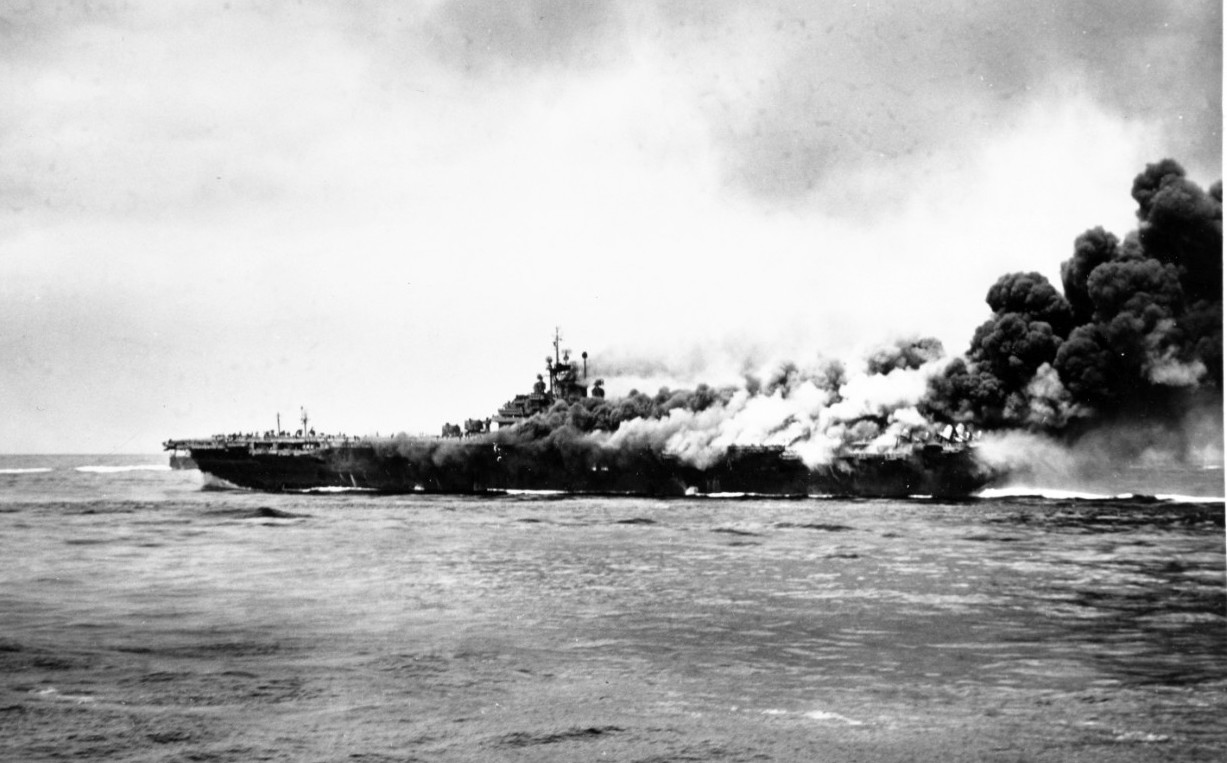
USS Bunker Hill (CV-17) burning after being hit by a Kamikaze, off Okinawa, 11 May 1945. Photographed from USS Bataan (CVL-29), NHHC.


The danger to the warfighters is palpable and their courage and commitment is inspiring.

“Berube’s F6F was smoking badly, its engine was sputtering, his canopy was so badly shattered that the hatch was jammed closed and unable to be jettisoned, and the rest of the plane was riddled with holes. The ensign announced to Clark that he would crash-land on Okinawa. Before friendly territory could be reached, however, his engine died, and Berube was forced to ditch. The impact must have torn off his copy, for in about twenty seconds he emerged from the cockpit with his Mae West inflated.

Clark circled Berube and broadcast his position over the radio to a lifeguard submarine until an acknowledgment was received. Despite his Hellcat being badly damaged as well, Clark selflessly dropped his own life raft. His heart sank as he saw the deflated raft sink before Berube could reach it. Clark remained in radio contact with the lifeguard sub, finally dropping his dye markers as he headed home due to low fuel, going up with another Essex pilot en route … A PBY rescue plane scoured the seas at the last-reported position of the downed VF-84 pilot, but Ensign Berube was never seen again.”

Marines on Okinawa, 1945.
Moore tells the story of the last great battle of the War in the Pacific with masterful grace. His detailed narrative is factual and specific, and includes dozens of Marine Corps and Navy squadrons, U.S. air groups, task groups, and task forces.

He features the courage of Marines on the ground, often in hand-to-hand combat, as well as Sailors aboard, among others, USS Essex (CV 9), USS Hancock (CV 19), USS Hornet (CV 12), USS Bennington (CV 20), USS San Jacinto (CVL 30), USS Yorktown (CV 10), USS Lexington (CV2/CV16), USS Enterprise (CV 6), and USS Belleau Wood (CVL 24).


Fortunately, we get both the U.S. an IJN (Imperial Japanese Navy) perspectives, as Mitscher and Ugaki face off even as “Japan’s once mighty carrier fleet was a ghost of its former self.”


Ugaki Matome
With hardened resolve despite their obvious defeat, the IJN aviators –– believing they were fighting with God’s providence as a “divine wind” –– crashed their planes into Allied targets, aiming especially to disable American aircraft carriers. Courage on both sides is obvious and profound.

Moore’s work is clearly a labor of love, describing a one-of-a-kind, now-unimaginable warfare coordinated by a peerless leader in Adm. Mitscher. This book is packed with extensive notes, references, photos, glossary, and information from both historical records and witness interviews. Moore provides context and nuance in an objective and steady style that is a pleasure to read, especially on this Veterans Day 2020.


A little more than two months after the thunderous Battle of Okinawa, but not until more lives were lost on both sides, Japan accepted defeat. That acceptance of defeat led to the end of revanchist colonialism, military controlled government, and divine leader worship –– replaced by constitutional democratic rule of law in the Land of the Rising Sun.


Commodore Arleigh Burke, Mitscher's chief of staff and future Chief of Naval Operations, would help Japan develop its own naval service, modeled after the United States Navy: the Japan Maritime Self-Defense Force.


Commodore Arleigh Burke and Adm. Marc Mitscher


Wednesday, April 8, 2020

An Interview with 'Crimes of Command' Author

by Bill Doughty–

Naval War College professor CAPT Michael Junge is a forward-thinking former CO (of USS Whidbey Island), who has strong feelings about how the Navy can improve its culture and continue to develop good leaders without losing well-trained, capable and courageous commanders – leaders who aren't afraid to lean forward. As a follow up to the Navy Reads review of his "Crimes of Command," we present this interview with Professor Junge. It's about leadership, a post-COVID Navy, artificial intelligence, transparency, and critical thinking. We also asked him for some of his favorite reading and online recommendations. The interview was conducted online earlier this week.

BD: Would a culture of institutional forgiveness promote less risk-averse leadership/leaders?

MJ: This is a really difficult question AND one I had to spend some time thinking about.

First of all, the idea of a culture of institutional forgiveness is something we have to think about – what that looks like – and then the second thing is what it means to be risk-averse. Around 20 years ago there was a movement within the Department of Defense to eliminate accidents, a movement away from the previous idea of reducing accidents. Now, we should all know that you can't get rid of all accidents, there is always going to be some small percentage of things that go wrong. We can make them rare. We can reduce them to almost nothing. We cannot eliminate them. So I think that might be the first thing we would have to look at – what are we willing to forgive and what is unforgivable?

Then-CDR Junge helms USS Whidbey Island’s personnel launch during a 2008 port visit to Camden, ME.
The second thing culturally would be taking a look at how Naval Aviation handles their human factors boards and possibly moving that across more of the fleet. In Human Factors boards, and I hope I get this right, any pilot can be challenged on an action or can admit to an action and then have it discussed amongst the group of fellow pilots in the ready room. This includes the commanding officer. The surface Warfare Community does not have anything like that and I don't think the submarine community does either, so that would that would be a place to start.

Finally, we have to remember that every institution is made up of individuals and too often we conflate the two. Senior officers are not the Navy, and when they protect themselves, thinking they are protecting the Navy, they do a disservice to everyone. Forgiveness needs to be both individual and institutional and neither is an easy thing to grant. 

BD: Do you think some senior leaders, now more than in the past, use the Rickover-expressed view of responsibility/culpability to scapegoat the commanders below them? If so, how can that be stopped?

MJ: I'm not so sure if it's using a subordinate as a scapegoat or the fear that if someone junior isn’t sacrificed, then the superior commander is the one who's going to get fired. Either one is a really poor way to look at command.

Adm. Arleigh Burke, Nov. 23, 1960, at pep rally on eve of Navy-Army football game.
The area that I think could really really have impact on removals is just basic communications between immediate superiors in command and their subordinates. Both of the Navy-wide reports that looked at commanding officer detachments for cause indicated lack of communication and lack of discussion between commanders and their subordinate commanders. This is definitely something that is a more modern Navy problem than we saw in the past. 

There's an anecdote of Arleigh Burke as Chief of Naval Operations going from Norfolk to Key West aboard ship – all told, I think the trip was two weeks. I have no idea who the last Chief of Naval Operations was that spent the night afloat at sea. Now most ship visits are a couple of hours – a brief visit with commanding officer, a brief visit with the Chiefs Mess, then an all-hands call on the flight deck or in the hangar bay and move on. That's no way to maintain contact with what's going on in the deck plates. If that's also what’s happening between 06 and 05 commanders, that minimal level of contact and not getting to know the officers of a ship’s wardroom or the Chiefs; that's going to cause a level of unfamiliarity that then removes the benefit of the doubt for a ship.

I had command a decade ago, and of the four bosses I had, I only really felt close to one of them – and he got underway with us…repeatedly. Nelson's subordinates are referred to as a “Band of Brothers” and I really wonder whether or not we have that any longer amongst our commanders. 

BD: Considering the smaller number of personnel needed to operate newer ships and other platforms, would there be a commensurate need for Sailors who have achieved Kohlberg's third level of moral development: the postconventional level?

A Sailor removes deck material aboard USS George H.W. Bush in July 2019 (MCSA Bodie Estep)
MJ: I kind of reject the opening premise of this question. I served on five different hull types and saw smaller crews and larger crews and I don't agree that a smaller number of personnel are needed to operate newer ships. I do agree that we are moving towards a smaller number of people operating newer ships, but when we do that we start losing track of who is doing the basic maintenance. Who is doing the cleaning, the painting, the corrosion control? Those are things that still have to happen, and as you reduce the crew size you increase workload on individual sailors.

I'll also be brutally honest and say that the vast majority of sailors will never need to achieve the third level of moral development. The vast majority of sailors are OK operating in the rules following environment, doing what is right based on norms and rules. And that's part of why we have to have rules that can be followed ...

BD: Do you think artificial intelligence can assume the role of rote-operating Sailors as described in Herman Wouk's "The Caine Mutiny": "If you’re not an idiot, but find yourself in the Navy, you can only operate well by pretending to be one"? Will deployment of AI accelerate after this pandemic?

MJ: This quote is one that has come up a lot in the last 10 years among conversations I've been in but a lot of it has to do with the other part of that quote – “The Navy is a master plan designed by geniuses for execution by idiots." That made perfect sense, especially to a very junior officer serving in World War II. From that level, the entire organization of the Navy looked like it was smart and well put together. The more I study the Second World War, the more I think it was really a Navy of resilient individuals who made things work rather than unintentional creation.

I'm also skeptical of AI in general. One of the first problems is we can’t agree on a definition of what AI is – and if we can’t define it then we really can’t talk about it. You can't talk about whether you're going to use it or not if you don’t know what “it” is. But if artificial intelligence can do things to take some of the cognitive load off of sailors then it's possible we'll see more but I think we're a long way away from having ships that are unmanned or even optionally manned or even the level of, say, a modern cargo ship.

HTFN Allyson Shay welds aboard USS Whidbey Island, July 7, 2016. (MC2 Nathan McDonald)
Regardless of how good artificial intelligence becomes, unless the AI is capable of cleaning, corrosion control, or painting, someone's going to have to do those. I think we'd be far better served to spend time figuring out a better design for a watertight door or better and longer lasting paint or better design to prevent corrosion like ensuring that the deck drains are actually the lowest point of a deck and not the highest point than worry about finding artificial intelligence to help reduce the cognitive load for a combat scenario where we don't even have sufficient ordnance to launch against a notional enemy.

BD: Why should senior leaders welcome transparency, especially in peacetime, as long as it doesn't violate operational security?

MJ: The important part about transparency is that transparency is how seniors educate subordinates on how and why a decision is made. That way, when speed of execution is needed, the subordinate understands the rationale behind how the boss thinks and can execute both the stated and intended mission.

When a commander just says “go do it” and doesn't explain why or doesn't allow for questions to be asked then that's what the subordinate learns – tell people to execute a decision. Then you lose that resilience we need. So that's where transparency is important.

One of the things found in the Greeneville/Ehime Maru collision was junior watchstanders knowing something was wrong, but either trusting the captain, or afraid to question a captain known for his operational acumen. But, he was wrong, those people didn't speak up and that led to disastrous results.

Capt. Brett Crozier, commanding officer of the aircraft carrier USS Theodore Roosevelt (CVN 71), addresses the crew during an all hands call on the ship’s flight deck Dec. 15, 2019. Theodore Roosevelt was underway conducting routine training in the Eastern Pacific Ocean. (Photo by MCSN Kaylianna Genier)
BD: The current COVID-19 pandemic presents threats, disruptions and changes. What do you foresee changing in the Navy when we all get back on our feet after this?

MJ: I'm not sure I really see anything changing in the Navy when we all get back on our feet after this. Mostly because, as I say this, as I write this, the operational Navy has really tried to go about business as usual. But that's the operational side; the shore side should and could be taking some serious lessons here about telework and the opening up of more jobs to more telework.

There’s a chance for some tremendous solutions for efficiency, better work-life integration, and overall productivity if we just look for them. Lots of people in DC commute two to four hours each day; that’s just plain-old lost time and productivity that can be regained for all sorts of things.

Rear Adm. Shoshana S. Chatfield, president of U.S. Naval War College, attends Quartermaster 1st Class Jessie Jowers’s reenlistment ceremony via FaceTime at NWC, March 20, 2020. Jowers reenlisted for an additional four years. Friends and colleagues attended in support of his dedication to the U.S. Navy and practiced social distancing by remaining at least six feet apart due to the COVID-19 virus. (Photo by Mass Communication Specialist 2nd Class Tyler D. John)
BD: Re critical thinking: What books do you recommend to people to help them think about thinking?

MJ: I recommend first and foremost any of the Freakonomics books. Secondly, I recommend two books by Ashley Merryman and Po Bronson. The first is “Nurtureshock” and the second is “Top Dog.”

“Nurtureshock” is about child raising, which may seem an unconventional recommendation, but the basic fact is that half of our Sailors are below 26 years of age and many of them are just out of high school so understanding how they grew up and what impacted them is important.

“Top Dog” is a scientific look at success.

Both Bronson-Merryman books take a kind of a Freakonomics, unconventional wisdom approach to the subjects. After that, anything on behavioral economics. 

BD: Who are some of your favorite all-time, any genre authors and books?

Neil Gaiman (Wikipedia Commons, Kyle Cassidy.
MJ: I grew up largely reading fantasy and science fiction and have read and reread “The Hobbit,” “The Lord of the Rings,” “Starship Troopers,” and “Ender's Game.” Robert Heinlein is probably my single favorite author. Neil Gaiman is my favorite living author. 

BD: Any specific recent books on online resources you'd recommend for these stay-at-home days?

MJ: I start with a YouTube channel called the “School of Life” and another called “Crash Course.” I find videos are easier to help me make connections and all these episodes are fairly concise – so much more comprehensible than longer writings.  They don’t substitute for those longer writings, but they do complement them.

BD: Are you considering another book? What does the future hold for you?

Michael Junge, courtesy photo
MJ: That’s a really good question. I am working on a revised, expanded, and largely new version of “Crimes of Command” – likely even with a new title. So much happened in 2017, 2018, 2019, and now in 2020 that I think I can add some more insight into what's going on. I’m also want to write a book on the USS Belknap and USS John F. Kennedy collision. I have a concept for that in my head, so that's also in the works.

But, before all that happens I need to find a post-Navy retirement job and that is taking up a lot of my thinking time, so we'll see where things go.

###

A big thanks and Aloha to CAPT Junge for this interview, a follow-up to our post earlier this week on his insightful book "Crimes of Command," which includes Junge's biography.

(My previous Navy Reads blogpost also included a commentary about the firing of CAPT Brett Crozier, CO of USS Theodore Roosevelt. Since that post, Acting Secretary of the Navy Modly flew to Guam to address the crew on the 1MC, during which he called Crozier "stupid" and "naive" and complained repeatedly that Crozier had complained and used poor judgment for how he tried to get help for his crew during a COVID-19 outbreak. On April 7, however, Modly apologized and resigned, reportedly at the direction of his chain of command. In COVID-19 press conferences this week, Commander in Chief President Trump mocked CAPT Crozier, first on April 6 – "this isn't a literature class" – and again on April 7 (after claiming he "would not have asked for" Modly's resignation), saying Crozier "didn't have to be Ernest Hemingway." That comment reminded me that Hemingway was Senator John S. McCain's inspiration, especially when McCain, a naval aviator and hero, was a POW in Vietnam. In fact, we published a post Aug. 12, 2018 about McCain's Hemingway inspiration. A related recommended read is Yahoo News reporter Michael Walsh's Aug. 26, 2018 remembrance of McCain: "The bell tolls for John McCain: How Hemingway's antifascist hero shaped the man." – Bill Doughty)

McCain and Hemingway photo illustration from Yahoo News