Showing posts with label leadership. Show all posts

Tuesday, July 16, 2024

Interesting Situation…

Review by Bill Doughty––

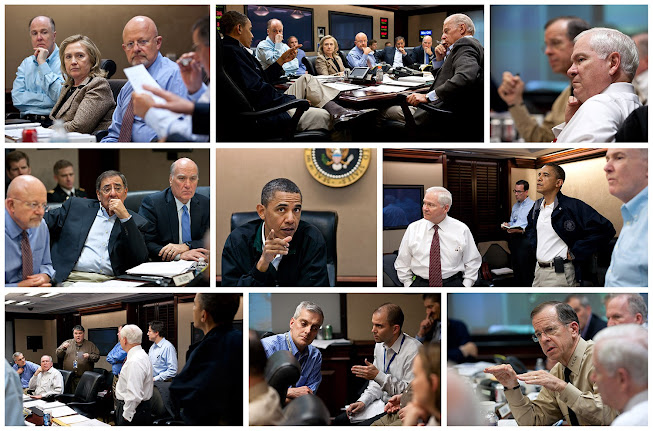
George Stephanopoulos pulls back the curtains of secrecy surrounding one of the most important rooms in the world: The White House Situation Room is his momentous and relevant book for the “interesting times” in which we live.


Through vignettes, descriptions, and photos, we get to look into the room where key decisions are made and history is forged.


In “The Situation Room” (Hachette Books, 2024), author and pundit Stephanopoulos shows its creation by JFK during the Cold War, its role in the infamous Iran-Contra affair under Reagan and Bush Sr., and its iconic place in history during killing of Osama bin Laden under leadership of Obama, Biden, Gates and McRaven.


The book weaves together the importance of an integrated military-civilian team as part of the federal government, especially in intelligence. Stephanopoulos describes the importance of open and honest discussion in which every voice is heard, and no one is afraid to speak truth to power.

“This is the Situation Room at its best: a place of sober discussion, informed thinking, apolitical attitudes and an absence of grandstanding,” he writes. There is no place for loyalty tests or fear of retribution. The room was critical in the wake of 9/11 and dozens of other crises. In recent years the Situation Room was used by Vice President Pence and Drs. Fauci and Birx during the Covid pandemic under President Trump.


Repeatedly, we see the important tenet of good leadership: surround yourself with good people who can help shape good decision-making, especially in a crisis situation. We also see the opposite.


“This book examines crisis management in the modern presidency. During the Trump administration, the president was the crisis to be managed.

It took a toll on those who had to do it. Trump tore through and wore out his national security team: Four secretaries of defense. Four directors of national intelligence. Four White House chiefs of staff and five secretaries of homeland security. The most damning judgments of his competence and character come from those he appointed to these most sensitive positions. His first secretary of state, Rex Tillerson, famously told colleagues that Trump was a ‘moron.’ James Mattis, the former Marine Corps general who served as Trump’s first secretary of defense, described him as a threat to the Constitution ‘who does not try to unite the American people –– does not even pretend to try.’ Fellow Marine general and White House chief of staff John Kelly called Trump ‘the most flawed person I have ever met in my life.’”


Tillerson, Mattis and Kelly

Now, in the wake of the tragic attempted assassination of the former president, the situation may have changed, according to some pundits who hope for more understanding, unity, and comity. Yet, this week’s Republican National Convention showcases the rise of Christian Nationalism as many of Trump’s loyal associates and January 6 insurrectionists are in prison or under a cloud of indictments and accountability. That includes Trump himself. It’s a strong contrast to Biden, most of his associates, and particularly his national security team.


Stephanopoulos and Lester Holt recently interviewed President Biden in the wake of Biden’s abysmal debate performance. The interviews have apparently not allayed concerns about Biden’s ability to communicate effectively, fight threats to the Constitution, or defend his record of achievements on behalf of the middle class, women’s rights, bipartisan infrastructure, environmental issues, CHIPS and Science Act, reduced unemployment, and gun safety. This reality magnifies the importance of Biden's ability to surround himself with good people of honor, compassion, integrity, and dedication.

That is the current situation and the curse we are under: living in “interesting times.”

Tuesday, October 31, 2023

Capt. Brett Crozier’s Book: Scary Good

Review by Bill Doughty––
It’s almost frightening how good and relevant this book is.

“Surf When You Can: Lessons in Life, Loyalty, and Leadership from a Maverick Navy Captain” by Captain Brett Crozier with Michael Vlessides (Atria Books, Simon & Schuster, 2023).


This book about lessons of leadership would make a great gift for anyone who loves the Navy and the sea. Here’s an excerpt to show why.

“If my wife, Mary, is my one true love, then the ocean is my mistress. Ever since I was a kid, I’ve been fascinated with its power, its beauty, and its possibilities.

As a Navy captain, I had the privilege of experiencing the ocean in all her moods. At times it was so calm we could carve slow circles in the water with the carrier and eventually catch up with the white and blue mosaic of the ship’s wake before it faded into the depths below. At other times, the sea was an unforgiving bedfellow, with waves so massive they crashed over the flight deck, sixty feet above the surface. (In some cases, fighter jets have actually been damaged by water crashing over the flight deck.)

Yet no matter what the sea threw at me over the course of those thirty years, I never stopped appreciating the perspective she offered: from my place on the bridge, with the horizon stretching forever before me, I realized just how small I was in the world.

The excerpt is reminiscent of some of the works of Adm. James Stavridis (ret.), who speaks about Crozier in one of his own books. Also like some of our favorites such as Stavridis and Adm. William McRaven (ret.), Crozier offers terrific life lessons and superb leadership advice.


Stavridis blurbs: “Surf When You Can” is utterly compelling, authentic, and relatable –– simply superb advice in life and leadership!” Here on Navy Reads we have featured several posts related to Crozier and the challenges he faced.

Saluting TR's new CO Capt. Crozier, Nov. 1, 2019. (MC3 Sean Lynch)
Crozier, who was inspired to attend the U.S. Naval Academy after watching the original Top Gun movie, reflects on lessons learned as a junior officer, a helicopter pilot, a jet pilot, the executive officer of USS Ronald Reagan (CVN-76), the commanding officer of USS Blue Ridge (LCC-19) and the CO of USS Theodore Roosevelt (CVN-71). He became CO of TR exactly four years ago from tomorrow, Nov. 1, 2019.

What shines through in this book are the sometimes eye-watering sea stories that help Crozier make his points about what it takes to be a good leader and, in fact, a good person of character.


Unintentionally relevant to what’s happening now between Netanyahu’s Israel Defense Force and Islamist Hamas in Gaza, Crozier shares a story about going out of his way to prevent civilian casualties while flying his jet in combat over Iraq during Operation Iraqi Freedom. Using creative and flexible tactics, he and his wingman came to the aid of Marines while preventing collateral damage to innocent people who had no where else to go.


In “Surf,” Crozier teaches about humility, being willing to apologize, and the need to praise in public and reprimand in private. One key story is about his role as XO aboard USS Ronald Reagan, showing the importance of empathy and kindness in a recounting of a “pot-positive” captain’s mast. He tells humane stories about authorizing Sailor parents to attend their sons’ and daughters’ high school graduation in Yokosuka, Japan, ensuring his ship’s softball teams received the support they needed, and supporting a junior Sailor who took the initiative of immediately reporting what he thought was a “man overboard.”


Far from being angry because a young Sailor took initiative to do the right thing, Crozier showed compassion and appreciation for the young man’s courage to stand up and speak out. In another sea story he shows how a wingman’s failure to inform him of something he observed almost cost Crozier his life. Though angry over the incident, Crozier framed it as a teaching moment and one he kept for the rest of his career: If a thing is “not quite right,” see something, say something. His creative way of making this point, learning about “NKR,” is worth a read.


Capt. Brett Crozier, then-CO of USS Theodore Roosevelt (CVN 71), addresses the crew at an all hands call in the Eastern Pacific Ocean. (MCSN Kaylianna Genier)

But his key leadership point is this: Take care of your Sailors and they will take care of the rest.


I started this book at the last few chapters (before reading and re-reading from the beginning) because I wanted Crozier’s take on what happened to him: being fired at the direction of then-President Trump, Secretary of Defense Esper, and acting Secretary of the Navy Modly for actions Crozier took to minimize the spread of Covid aboard his ship. Trump even ridiculed Crozier in public.


At the time, during the early days of the pandemic, the Trump administration did not take the outbreak seriously and was offended when a Navy captain in the forward-deployed naval forces did. The vindictive response that followed was and is a warning.


When Captain Crozier saw something not quite right and spoke out to get help for his Sailors, he was removed from his position and ultimately forced to retire. What a tragedy. What a loss.


Not surprisingly, Crozier does not hold a grudge against the Navy he loves. He expresses no animosity to the feckless chain of command that facilitated his removal and then failed to reinstate him.


Here are just a few of the thoughts of this good and great leader:

  • “Rank isn’t as important as being true to yourself and the people you’ve sworn to take care of.”
  • “Perfection is an elusive goal, and part of being a good leader is recognizing your mistakes and owning them.”
  • “I have always operated on the fundamental belief that most people want to do good in the world.”
  • “We are stronger when we pull together.”
  • “I think we’re better people when we open our hearts and minds to others.
  • “If you’re willing to take a risk and operate outside your comfort zone, you’re going to learn and grow … (and) achieve things you may not have imagined possible.”

There are many more words of wisdom and inspiration.


For Crozier, it’s most important for himself and his Sailors to find balance in life: Job, family, and self. It’s no accident that “Surf When You Can” is the title of the book.  He says people can and should take time for themselves to recharge, whether it be through sports, gardening, or reading!

I found special resonance in this book. My kids also attended school in Yokosuka. I was a military brat, as were Crozier’s kids and his resilient wife, Mary. 


I see how much Crozier valued PAOs (public affairs officers) –– and vice versa. He obviously respected the role of a free media, of Navy mass communication specialists, and of the lasting impact of photo ops. The same can be said of books. Books such as “Surf When You Can.”


There is also a personal connection for me in how Crozier talked about his time in Hawaii (my chosen home) earlier in his career. From his connection with Barber’s Point, Russ “Rusty” Keaulana, and surfing at White Plains Beach he learned about pono, the Hawaiian concept of righteousness, kindness, and respect for others.


Crozier praises Sailors. Big time. He respects petty officers and chief petty officers as well as junior enlisted and junior officer personnel. The three most important values as a Navy leader, which he learned from a Navy chief in Hawaii are: Take care of your Sailors. Take care of your Sailors. Take care of your Sailors.


That’s what Capt. Brett Crozier did.

Fearlessly.


According to the book, a portion of the profits from "Surf When You Can" will go to "nonprofit organizations focused on supporting our nation's service members and veterans. To learn more about these and several other outstanding charitable organizations please visit www.surfwhenyoucan.com."

Wednesday, September 13, 2023

McRaven’s ‘Simple’ Bullfrog Advice

Review by Bill Doughty––

Seventy-three years ago, September 15, 1950, Gen. Douglas MacArthur landed at Inchon, Korea. In the following weeks, U.S. forces began to rout the communist North Korean army and push them almost to the Yalu River near China. Then, in November the Americans encountered well-armed Chinese interventionists supporting the North Koreans.


“Hill 205 seemed an unlikely place for an Army legend to be born,” writes Admiral William H. McRaven (U.S. Navy, Ret.) at the beginning of chapter 7 of “The Wisdom of the Bullfrog: Leadership Made Simple (But Not Easy). McRaven recounts the actions of Army Ranger First Lieutenant Ralph Puckett, who in 2021 received the Medal of Honor, presented by President Joe Biden for actions in Korea. At great personal risk, Puckett helped his Rangers locate and attack camouflaged Chinese machine gun nests and mortar teams that pinned them down.

“Puckett, who had positioned himself at the front of the advancing Rangers, knew there was only one thing he could do. With complete disregard for his own life, Ralph Puckett rose from his foxhole and dashed out into the open field, forcing the Chinese to take aim at the young lieutenant. As the machine gunners began to fire a the sprinting Puckett, the Rangers spotted their positions and engaged them. Puckett returned to his foxhole only to catch his breath, and then leaped out and ran into the open again. With each dash by Puckett into the exposed terrain, the Rangers were able to isolate and destroy more enemy machine gunners.

“Having suppressed the small arms fire, the Rangers proceeded to take Hill 205. History would show that over the next two days, the Rangers under the command of Ralph Puckett would fight off wave after wave of Chinese assaults that took the lives of ten Rangers and left thirty-one wounded, including Puckett.”

Puckett would again serve with honor in Vietnam, where he earned the Distinguished Service Cross and two Silver Stars and was personally recognized by President Lyndon B. Johnson.


McRaven uses the story of Puckett’s heroism at Hill 205 to illustrate the Ranger motto “Sua Sponte” (“Of Your Own Accord”).  “In other words, doing what needs to be done without being told to do so,” McRaven explains.

“There is often the misguided belief that soldiers only follow orders, but the strength of the American military is that the great soldiers, the truly great leaders, do what is right without being told. They do what is right to protect their men and women.”


Senior military leaders expect even young and relatively junior service members to take the initiative when necessary. Such integrated empowerment is a cornerstone of leadership, and can be effective not only in the military but also in business, sports, medicine, citizenship, and developing a healthy family.


A simple, powerful concept. Which is also a good descriptor for this small but excellent book.


Memorial statue of Basilone in New Jersey
“Sua Ponte” is just one of the ideas presented here by the author of “Make Your Bed,” “The Hero Code,” and “Sea Stories.”

McRaven opens his latest book with a discussion with the most important aspects of being a good leader: Honor and integrity, captured in legendary United States Marine hero Sgt. John Basilone’s motto: “Death before Dishonor.” Honor and integrity are the foundation of a trustworthy leader.


Another motto explored in “Bullfrog” is the British Special Air Service’s Qui Audet adipiscitur: "Who dares, wins."


An honorable leader who demonstrates commitment, hard work, and initiative, will earn the trust of their followers, according to McRaven. Stamina, a willingness to sacrifice, and confidence, along with humility and the ability to make hard choices, are also important leadership qualities. Commanders “must have perseverance and, above all, confidence in ourselves.”


All the above qualities and more were personified by Adm. Chester W. Nimitz in World War II, particularly in the Battle of Midway: The great admiral faced a difficult choice about whether to ambush the Imperial Japanese Navy at Midway. “The fate of the entire Navy, and perhaps our nation, rested on this decision,” McRaven writes. “But history would show that the Battle of Midway was the single most decisive naval battle of the war and turned the tide in the Pacific.


Other legendary leaders highlighted in this outstanding book include father of the Navy SEALs, Adm. Chuck LeMoyne; WWII British officer and father of the SAS, Col. David Stirling; U.S. Special Operations leader Gen. Stanley McChrystal; Air Force visionary Billy Michell; Vietnam War hero Col. Elliot “Bud” Sydney; and former president Barack Obama, who, like Nimitz and Midway, faced a difficult decision, with uncertain information, about launching the mission to capture Osama bin Laden.


“It was an enormous risk, but one the president knew he had to take. I admired his guts –– Who Dares Wins –– but more importantly,” McRaven reflects about Obama, “I admired his intellect for understanding the nature of the risks he was assuming.”

Good leaders attack problems aggressively. “Mistakes of action are far less consequential than mistakes of inaction,” he notes. Hope, luck, and desire are important, but they are not a strategy. “Be a risk-taker, but manage the risk through extensive planning, preparation, and proper execution.”

All Hands: McRaven speaks to service members at Bagram Air Field, Afghanistan, Thanksgiving Day, 2013. (Army Staff Sgt. Osvaldo Equite)
Each chapter features an insightful epigram quotation by well-known and sometimes surprising people: Abraham Lincoln, Marie Curie, Alvin Toffler, Oprah Winfrey, Michael Jordan, William Shakespeare, Tacitus, Booker T. Washington, Coach Mike Krzyzewski, and Taylor Swift.

Yes, Taylor Swift.


In fact, her epigram quote for chapter ten, titled “No Plan Survives First Contact with the Enemy,” is a found haiku:


Just because you made

a good plan doesn’t mean that’s

what’s gonna happen


McRaven discusses the importance of planning, inspecting, and always having a plan B.

When one of their helicopters became damaged in the bin Laden raid, the well-trained and ready SEALs adjusted, overcame, and accomplished their mission. Training mitigates risk and saves lives.

Importantly, McRaven notes that even the best leaders will have setbacks and seemingly insurmountable challenges. But how they deal with failures and obstacles makes all the difference.

This is a great book for any new leader, would-be commander, and anyone interested in the importance of character, competence, and ethical behavior –– integrity –– in military and national leadership.


There are many references in “Bullfrog” to Basic Underwater Demolition/SEAL training, Coronado, and San Clemente. But there is an unexpected thread throughout the book leading through Hawaii, which help illustrate key leadership principles.


“The Wisdom of the Bullfrog” concludes with a spotlight on Navy SEAL Lt. Michael Murphy’s favorite book, “Gates of Fire” by Steven Pressfield"Gates of Fire" is also a favorite of Gen. James Mattis (USMC, Ret.) and is a recommendation by Adm. James Stavridis (USN, Ret.). The novel is or has been on the reading lists of many military leaders, including the Commandant of the Marine Corps (currently a vacant position).


Pressfield speaks to Marines and fellow veterans at Camp Pendleton in 2011. (Sgt. Skyler Tooker)
“Gates of Fire” imagines the 300 Spartans who fought valiantly in the Battle of Thermopylae in 480 BCE. In the fictionalized account, Pressfield, a former Marine, channels what the last Spartan may have said about his king, King Leonidas, and what made his king such a great leader: “A king does not abide within his tent while his men bleed and die upon the field. A king does not dine while his men go hungry, nor sleep when they stand at watch upon the wall, A king does not command his men’s loyalty through fear nor purchase it with gold; he earns their love by the sweat of his own back and the pains he endures for their sake. That which comprises the harshest burden, a king lifts first and sets down last. A king does not require service of those he leads but provides it to them…”

While not always easy –– and often extremely hard to live by –– McRaven’s leadership principles are actually “simple” he says. He offers a list of sayings taken from his chapter headings and a QR code at the end of the book for readers to obtain a printable version of the “Wisdom of the Bullfrog.” (The term Bullfrog refers to the the longest serving Navy SEAL on active duty, which McRaven once was for nearly 40 years.)


Sometimes advanced age has its leadership advantages.

Sunday, September 18, 2022

Not Forgotten: Adm. Joseph M. Reeves

Review by Bill Doughty––

Saratoga’s bow cut through the black water, her stern leaving a luminescent trail in her wake as she moved through the darkness in the early hours of 26 January 1929 … On her flag bridge, standing in the cool night air, stood Rear Adm. Joseph Mason Reeves, the commander of the Aircraft Squadrons, Battle Fleet.”

That’s from the opening paragraph of a book that takes readers back nearly a hundred years to the nascent development of aircraft carrier warfare tactics and strategies: “All the Factors of Victory: Adm. Joseph Mason Reeves and the Origins of Carrier Airpower” by Thomas Wildenberg (Naval Institute Press, 2003).


This not-to-be-overlooked book covers more than a half-century of Admiral Reeves’s service in a Navy uniform and beyond.


Aboard Saratoga, as described in the book’s prologue, Reeves demonstrated the power of a carrier task force. It was “a stunning success of the aerial operations” under his command, according to Wildenberg, who presents an indispensable biography and history of Reeves and his achievements.


The author takes us into the U.S. Naval Academy with Reeves, who became a star on the Navy’s football team, especially against Army. Wildenberg describes how Reeves developed his own football headgear –– made of moleskin –– the first helmet used in collegiate football.


As a junior officer, Reeves saw action in the Spanish-American War at the Battle of Santiago. His career was “intertwined” with that of his colleague and fellow junior officer aboard USS Oregon (BB-3), William D. Leahy. Leahy would later become Reeves’s chief of staff in the spring of 1946.


Reeves and Leahy (NHHC)
This book shows Reeves’s connections with cryptanalyst Joseph Rochefort, well-before the intelligence officer reported to Station Hypo, Pearl Harbor, and cracked the code to help the Navy win at the Battle of Midway. We see the admiral's influence on Adm. "Bull" Halsey, Adm. Marc Mitscher, and Adm. Ernest J. King, among others.

In an unadorned style, Wildenberg introduces us to the people, places, and events that shaped the early days of naval air power and the man considered “the father of carrier warfare” and a stickler for training and preparedness. “[H]e was a major, if not the leading, proponent of readiness in the entire prewar Navy.”


Reeves's aggressive style was a double-edged sword, winning praise from some but alienating others, especially those who were stuck to the past or worried only about making rank. One of the best Reeves quotes is: “A commander who stops to appraise the impact of a military decision upon his personal fortunes has no right to be entrusted with command.”


Prior to USS Saratoga becoming his flag ship, Reeves commanded the U.S. Fleet aboard USS Pennsylvania (BB-38).


Admirals assemble aboard USS Pennsylvania, which would become flagship of Adm. Reeves (front, second from left). The full caption is at the bottom of this post.
Reeves, Wildenberg notes, was the first U.S. naval officer qualified in aviation promoted to flag rank; the first officer in the Navy to carry the title of Carrier Commander, U.S. Fleet; and the first flying officer to be selected as Commander in Chief, U.S. Fleet.

President Franklin D. Roosevelt appointed Reeves to lead “lend-lease” efforts to supply Navy ships to Great Britain.


Lend-lease was FDR’s way to legally equip Churchill’s Royal Navy in the early months of World War II, prior to United States’ entry into the war after the attack by Imperial Japan on Hawaii on Dec. 7, 1941.


Reeves also played a pivotal role for the Navy and the nation in the aftermath of the attack on Pearl Harbor and other targets on Oahu.


SECNAV Frank W. Knox and Secretary of War Henry L. Stimson selected Reeves, along with Admiral William H. Standley, as Navy representatives on a commission directed by FDR to investigate readiness failures at Pearl Harbor. The Army appointed two senior general officers. Supreme Court Associate Justice Owen J. Roberts led the commission.


At Fort Shafter, an Army base near Pearl Harbor, the commission members interviewed their first witness, Lt. Gen. Walter C. Short, commander of all Army forces in Hawaii.

“It was obvious from his responses to the commission’s questions that Short, veteran infantry officer, did not have a good grasp of the Army’s mission to protect the fleet while it was anchored in Pearl Harbor. When Reeves’s turn came, he ‘raked the general over the coals’ with his probing questions about the status of Hawaii’s air defense system, the Army’s inability to detect the threat of a carrier attack, and its communication procedures with the Navy. Short, who had been obsessed with sabotage and training, freely admitted that he had made a serious mistake by not placing his forces on alert against the threat of an all-out attack.”

Adm. Joseph M. Reeves
The commission also heard from Adm. Husband E. Kimmel, the Navy commander of Pearl Harbor who was faulted for lack of preparedness, even though the Navy had held simulated air attacks on Pearl Harbor, led by Reeves himself. Kimmel was faulted for not protecting the harbor against torpedo attacks and his failure to order 360-degree air patrols.

Reeves insisted on the need for accountability for the military’s lack of readiness at Pearl Harbor. Wildenberg writes, “Reeves regarded the debacle at Pearl Harbor as a disgrace to the United States Navy.”


You’ll find captivating vignettes, photos, leadership examples, and a sweep of history in this excellent and timeless book.


In All the Factors of Victory's: epilogue, Wildenberg discusses the leadership qualities that made Reeves a great admiral:

“...knowing the job thoroughly, setting examples, and taking care of one’s personnel, gaining their confidence, and then making them feel stronger than they actually are.” Reeves, he said, could both take initiative and delegate authority, always thinking about new, innovative ways to achieve goals. Wildenberg lists a number of other key qualities Reeves possessed, “well-versed in all aspects of naval science … a teacher and a tactician who had a lifelong commitment to learning.”

“Perhaps Reeves’s greatest legacy to the Navy, however, lay in the contribution he made to carrier warfare. As historian William F. Trimble was quick to note, ‘Reeves more than any other single figure, pointed the way to making carrier aviation an indispensable part of the fleet.’ He was a farsighted man who did more to shape the future role of carrier aviation than any other officer in the Navy. His ‘Thousand and One Questions’ fostered the development of a host of innovative doctrines and tactics that laid the foundations for all of the major tenets of modern carrier doctrine. He was the first flag officer to employ the aircraft carrier as an offensive weapon that could be used to mount long-range attacks on an enemy’s coast. Under his leadership, carrier commanders began to exercise the freedom of movement that later [would] become the hallmark of U.S. naval operations in the Pacific during World War II. Most important of all, Reeves deftly fashioned an offensive role for carrier aviation that did not threaten the supremacy of the battleship, thereby assuring that the resources needed to further the development of carrier-borne air power would continue to be allocated during the lean years of the Depression.”

In other words, Reeves’s insistence in readiness and training, coupled with his commitment to innovation in carrier aviation, would lead to the U.S. Navy’s success in the Pacific War, especially in the Battle of Midway. That success would be carried forward into the Cold War by USS Midway (CV-41), among other great aircraft carriers.


USS Reeves (CG-24) underway in the Indian Ocean, Aug. 20, 1975. (PH1/AC R. H. Green, NHHC)
I was working for the Navy when USS Reeves (CG-24), namesake of the great admiral, transferred from Pearl Harbor, Hawaii, to Yokosuka, Japan, arriving Aug. 14, 1980. Reeves swapped with USS Worden (CG-18), to become “the Only Cruiser in Town” of the Forward-Deployed Naval Forces.

Reeves was the anti-aircraft warfare (AAW) picket for Battle Group Alpha for Midway.


USS Pennsylvania photo caption: Aboard USS PENNSYLVANIA, flagship of the U.S. fleet. Quoted from the Long Beach Press-Telegram: The largest gathering of flag officers of the United States Fleet was recorded aboard the USS PENNSYLVANIA. Twenty Rear Admirals, Vice Admirals, and Admirals assembled at the request of Admiral David Foote Sellers, Commander in Chief of the Unites States Fleet, to discuss final details of the Atlantic Cruise which begins Monday morning. L to R (seated): Vice Admiral Harris Laning, COM Cruisers, Scouting Force; Admiral Joseph M. Reeves, COM Battle Force; Admiral Sellers; Vice Admiral Frank H. Brumby, COM Scouting Force; Vice Admiral Walton R. Sexton, COM Battleships, Battle Force. (Standing): Rear Admiral Manley H. Simons, Chief of Staff to Vice Admiral Laning; Rear Admiral Sinclair Gannon, Ordered AS COM Minecraft, Battle Force; Rear Admiral A.E. Watson, COM Destroyers, Scouting Force; Rear Admiral H.E. Lackey, COM CRUDIV 4, Scouting Force; Rear Admiral Edward B. Fenner, COM CRU Battle Force; Rear Admiral John Halligan, COM Aircraft, Battle Force; Rear Admiral Henry V. Butler, COM Battleship DIV 3; Rear Admiral Charles P. Snyder, Chief of Staff to Admiral Sellers; Rear Admiral Thomas T. Craven, COM Battleship DIV 1; Rear Admiral W.T. Tarrant, COM 11th N.D; Rear Admiral E.C. Kalbfus, COM DES, Battle Force; Rear Admiral C.E. Courtney, Ordered as COM CRU, Battle Force; Rear Admiral Frederick J. Horne, COM Base Force; Rear Admiral Adolphus Andrews, Chief of Staff to Admiral Reeves; Rear Admiral W.S. Pye, Chief of Staff to Vice Admiral Brumby. Photo taken April 6, 1934. (NHHC)