Showing posts with label France. Show all posts

Monday, November 21, 2022

‘Dawn Light’ on Water

Review by Bill Doughty––

Diane Ackerman shares this with us:

In Ireland there are many names for rain depending on the temperature, duration, or season.  Germans use words “designed to capture the sound of rain: pladdern (heavy rain with big drops), prasseln (heavy rain but smaller drops), giessen (pouring rain), sprühen (spray-like rain), trop fern (dripping).” “Hawaiians require over a hundred names for rain, including kolele ua, a light moving rain; ‘olulo, a storm beginning out at sea; and Kahio o ke aka, rain that’s so beautiful it must be the adornment of the gods.”

Word artist Diane Ackerman writes about rain, clouds, seas, skies, and seasons –– and "the experience of being alive –– in her radiant “Dawn Light: Dancing with Cranes and Other Ways to Start the Day” (W. W. Norton, 2009). Among other topics and musings, she interprets Claude Monet and impressionism, focusing on Monet’s Impression, Sunrise.

“Surely Monet has been up for hours painting this watercolor sky in full cloud regatta. He limned many weatherscapes, but like the other Impressionists, preferred the sparkling blue skies of early morning when the air is tranquil. One can tell the time of day by the small puffy clouds that stalk their paintings, sometimes with wispy clouds higher above. Even in Paris, where pollution chalked the view, they tended to paint nearly empty skies with small well-behaved cumuli that haven’t had time yet to swell in the hot humid afternoon haze.”


Impressionism was Monet’s, Renoir’s, and Pissarro’s ways of expressing life as they perceived it in the moment.

“The experience of being alive is only one impression after another, a feast for the senses in ever-changing light, one now seamlessly flowing into the next moment of being. How do you explore the texture of being alive? In Impression, Sunrise, Monet paints the lavish spell of the senses detained by a pink and blue sunrise, colors that create purple where they meet, in a softly puzzling war of blue and red that’s not so much hue as emotion, as the eye struggles to make sense of it but pleasures in the ambiguity, and where a slightly out-of-focus fisherman floats in his own reality (no doubt occasionally eyeing the painter on the dock), and the rising sun is a watery fireball at the end of a long path of copper cobblestones.”

The harbor, Ackerman notes, was painted “at dawn, on a misty morning, when sun and sky shone equally luminous and a simple squiggle of black was enough to create a fisherman in the foreground.”


One of Monet’s influences was the eccentric nature-centric Japanese artist Katsushika Hokusai. Monet supposedly happened to see Hokusai’s work in a food shop in Amsterdam, “where cheap paper decorated with Japanese prints was being used to wrap purchases.”


Hokusai was born in then closed-to-the-world Japan in 1760 and produced his most iconic works late in life as Japan was about to be opened to the world.

“It was in his seventies that he began the stunning series Thirty-six Views of Mount Fuji, which also included The Great Wave off Kanagawa, probably the most reproduced print on earth, a scene of turbulent foam-tipped waves of cyan and pale blue clawing at three small fishing boats in which frightened men frantically bend to their oars. In the flat golden sky, billowy clouds promise a placid morning, and a tiny Mount Fuji sits calmly in the background. It’s the foreground that holds all the drama, though I think most people miss the nearly capsized swift boats that carry fresh foodstuffs at dawn to the Tokyo markets from nearby villages. That the mood of the ocean and the sky don’t match –– galloping chariots of carnal blue under a fair-weather sky –– creates a sinister beauty that alarms the senses at the same time that it reassures the psyche. To the men, the wave is much taller than the volcanic mountain, a perspective that fits. With a faint echo of the fishermen, we’re swept up onto the waves, knowing that at any moment the waves are going to crash.”

USNWC Color Guard at M.C. Perry statue, Newport, RI. (Haley M Nace)
Note: Hokusai was a teenager living in feudal Japan when America’s founders declared independence from Imperial England. He died in 1849, three years before President Millard Fillmore assigned U.S. Navy Commodore Matthew C. Perry the mission of sailing to Japan to open the country to trade with the West. The Convention of Kanagawa (the same Kanagawa in Hokusai’s iconic work) was signed in 1854. Monet was a teenager in 1854; he painted Impression, Sunrise in 1872.

Commodore M.C. Perry (namesake of the high school at Marine Corps Air Station Iwakuni, my alma mater, by the way), is honored by Japanese and American friendship groups each year both in the United States, particularly in Newport, Rhode Island, Perry’s hometown, and in Shimoda, Japan, at the Black Ship (Kurofune) Festival. Marines and Sailors often participate in the annual festival with parades, concerts, school visits, and other community outreach events.


U.S. Marines from Camp Fuji and Sailors from USS Stethem (DDG-63) march in a parade at the Black Ship Festival in Shimoda, May 18, 2019 (MC2 T. Fraser)
In “Dawn Light” Diane Ackerman connects seasons and cultures, people and animals, prose and poetry, sound and silence, nature and nurture, and cold perception with warm imagination.

Ultimately this is a book about literal and figurative enlightenment in Ackerman’s world, hoping for a better appreciation and respect for life, nature, and our precious time alive in the cosmos. A time for Love.


Ackerman shares her views as well as those of poets who appear throughout the book. She also includes more than a dozen beautiful full-color photos and prints.


Returning to the recurring images of water and the sea, as well as West (Monet) meets East (Hokusai), here are Ackerman’s choices for epigraphs to this book:


This grand show is eternal. It is always sunrise

somewhere; the dew is never all dried at once;

a shower is forever falling; vapor is ever rising.

Eternal sunrise, eternal sunset, eternal dawn and

gloaming, on sea and continents and islands,

each in its turn, as the round earth rolls.

–– JOHN MUIR


This world of ours ––

To what shall I compare it?

To the white waves of a boat

That disappear without a trace

As it rows away at dawn.

–– SHAMI MANSEI, EIGHTH CENTURY


This is a book for anyone who'd care to wake up to the experience of being alive.


Spectators observe Shimoda City's firework show during the 83rd annual Shimoda Black Ship festival, May 21, 2022. The Shimoda Black Ship Festival celebrates Commodore Matthew C. Perry's arrival to Japan, Japan's subsequent opening to international trade, and the U.S.-Japan alliance. (MC1 Kaleb J. Sarten)

(A nice accompaniment to this post: Neil Young & Crazy Horse's new album, "World Record.")

Thursday, April 21, 2022

Timely ‘How Civil Wars Start’

Review by Bill Doughty––

Here's a fascinating revelation: “Blacktivist” on Facebook was “one of more than 470 accounts linked to a Kremlin effort to infiltrate the Black Lives Matter movement.” The Russians' goal was to foment hate and division along racial, religious, and ethnic lines. [Just some of ways to create division, especially via social media.*]

Vladimir Putin and his Russian operatives were not just interested in helping elect their chosen candidate in the presidential election of 2016; they were also actively promoting general discord and division in America and Europe.


But they are not the only actors on the world stage using social media platforms to create and accelerate discord, as Barbara F. Walter reveals in “How Civil Wars Start: And How to Stop Them” (Crown, Random House; 2022). She presents a world history of civil wars with a special focus on recent history –– that is thorough, comprehensive, and well-written. It's scholarly without being narcoleptic.


We learn about “anocracy” (neither full democracy nor full autocracy),“factionalism” (countries split along political parties based on ethnic or other identity factors instead of ideology), “superfactions” (groups that share identity factors as well as a different religion, class and geographic location), and “accelerationism” (“the apocalyptic belief that modern society is irredeemable and that its end must be hastened so that a new order can be brought into being.”).

According to Walter, “Two variables –– anocracy and factionalism –– predicted better than anything else where civil wars were likely to break out.” Studies show that superfactions are twelve times more likely to start a civil war. Superfactions use a lot of symbols, phrases, flags, and other paraphernalia to appeal to national pride and their leader. Walter notes, “One of the greatest fault lines that tend to emerge among super factions: the urban-rural divide.”


Accelerationism is a core part of modern American extremism, according to Walter. We see it expressed by some "end times" Christian nationalist extremists, white supremacists, and other right wing militia especially in the tragedies of the Waco and Ruby Ridge sieges in the early 1990s. We also see it in Michigan militiaman Timothy McVeigh’s bombing of the Alfred P. Murrah federal building in Oklahoma City in 1995.


A scary thought: What if Vladimir Putin’s main motive in his war on Ukraine is based on accelerationism –– a desire to bring on armageddon? Who will stop him?


Putin orders, condones, and excuses genocide from a distance.
As Putin's war atrocities in Ukraine continue to come to light, the West condemns and documents his war crimes and charges of genocide. Walter introduces us to the “Ten Stages of Genocide,” according to Gregory Stanton of GenocideWatch.com.

Another revelation in Walter’s book is the sheer number of civil wars in history and throughout the world, including in Russia just over one hundred years ago. She presents a history of civil wars –– battles often over Left and Right ideology –– in Mexico in 1910, China in 1921, Greece in the 1940s, Yugoslavia in the 1990s, and Burundi in 1993. Civil wars have been fought in recent times in Syria, Iraq, Yemen, Afghanistan, Ukraine, Sudan, Ethiopia, Rwanda, Myanmar, Lebanon, and Sri Lanka.


She notes, “Immigration is often the flashpoint for conflict. Migrants come into a country and compete with poorer, more rural populations –– sons of the soil –– fueling resentment and pushing these groups toward violence. It is especially alarming, then, that the world is entering an unprecedented period of human migration, in large part due to climate change. As sea levels rise, droughts increase, and weather patterns change, more and more people will be forced to relocate to more hospitable terrain. By 2050, the World Bank predicts, over 140 million “climate migrants” will likely flee Southeast Asia, sub-Saharan Africa, and Latin America. Experts have also warned that climate change is likely to lead to scarcity of resources, which could also fuel conflict.”


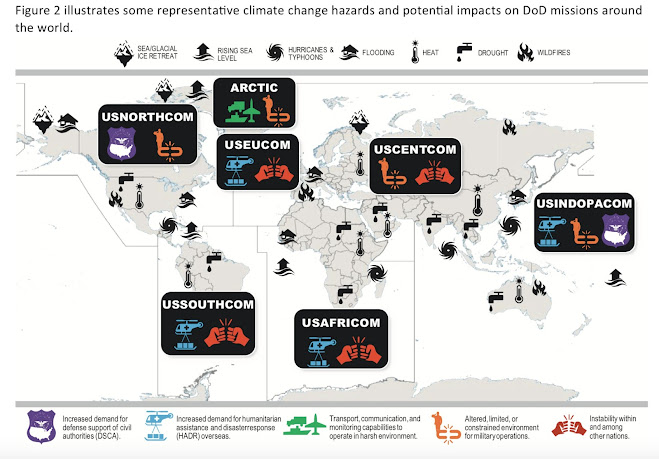
DoD spells out similar security implications, including competition for resources and the potential for civil unrest in its updated October 2021 “Department of Defense Climate Risk Analysis.” It's worth reminding ourselves of these realities as we approach Earth Day, April 22, 2022.


Another key point by Walter: “In the 21st century the most dangerous factions are once-dominant groups facing decline.” People who feel left out of the political process and who feel they’ve been “downgraded” in a trajectory away from power can be rich or poor, black or white, Christian or Muslim, Walter says.

Using the Catholic-Protestant “Troubles” in Northern Ireland as a case study, Walter shows that when a government violently cracks down on protests, it creates a loss of hope and more violence. In the face of peaceful protests, leaders should choose reform over belligerence, tolerance over violence.


Long periods of protests, along with anger over elections, make a country ripe for civil war, she says. “Elections are potentially destabilizing events in highly factionalized autocracies –– especially when a downgraded group loses.”


“The government should obviously take a zero tolerance stance on hate, and punish domestic terrorism, but it would weaken support for extremism by addressing the legitimate grievances that many citizens have.” She notes, “Civilian deaths at the hands of the government can tip conflicts into all-out war.”


As citizens in Putin’s Russia experience hardships due to international sanctions and significant military casualties, one wonders if there will be more protests and, if so, how the Kremlin will crack down on the protesters. For now, using propaganda especially on TV and in social media, Putin seems to be keeping his country largely in the dark about the realities of his war.


Walter calls social media a “pandora’s box” used by authoritarians such as Russia’s Putin, Philippines’s Duterte, India’s Modi, Turkey’s Erdogan, Brazil’s Bolsonaro, Venezuela’s Maduro, and Hungary’s Orban to influence their own citizens and citizens of other countries.

“Now any country, any group, and any individual can use the internet to destabilize an adversary. Rivals of the United States are deeply invested in stoking civil conflict., through support for a preferred group or by inciting both sides. Vladimir Putin, an ex-KGB officer, has long understood the power of disinformation. Others have caught on. The Empirical Studies of Conflict Project –– together with a team of scholars at Princeton –– found that Russia, together with China, Iran, and Saudi Arabia, used clandestine social media campaigns fifty-three times between 2013 and 2018 to try to influence the internal politics of another country. Most of the campaigns examined by the Princeton team (65 percent) aimed to denigrate a public figure, usually a politician, in order to get his or her opponent elected. (Between 2012 and 2017, for example, seven of the ten most-read online pieces about Angela Merkel were fabricated, according to BuzzFeed.) The United States was the main target of these attacks but not the only one. Great Britain, Germany, Australia, and others were also targeted. Almost all the attacks were aimed at democracies.”

Even France is experiencing an erosion of its democracy –– due in part to the use of social media to rile up yellow vest protestors to become violent, and in the rise of pro-Putin French National Front Party politician Marine Pen, who is challenging Emmanuel Macron for the presidency. “The party has spread its message –– exploiting and inflaming racial tension –– with the most sophisticated social media operation of any major political party in France.”


Social media achieves success in fomenting divisions by using behavioral algorithms. Walter puts Facebook and YouTube, in particular, under the microscope. It’s been shown that these platforms are incentivized to provide false, inflammatory, angry, and outrageous content because that gets more likes, clicks, and investment of time. The Pew Research Center reveals that “posts exhibiting ‘indignant disagreement’ received nearly twice as many likes and shares as other types of content.”

“Worse, the behavioral algorithms began creating self-reinforcing, increasingly outlandish information silos that led users down dangerous paths: toward conspiracy theories, half-truths, and extremists seeking radical change. These recommendation engines, as they are called, ensured that users were channeled toward more narrow and more extreme information. If a user “liked” a post on a police officer helping a kitten, say, Facebook would funnel additional posts to the user on police benevolent associations, then pro-police stories, then increasingly more fanatical material. Walter Quattrociocchi, a computer scientist at Sapienza Università di Roma, analyzed fifty-four million comments over four years in different Facebook groups. He found that the longer a discussion continued, the more extreme the comments became. One study found that YouTube viewers who consume the kind of ‘mild’ right-wing content created by provocative talk show host Joe Rogan, whose audience in 2020 was 286 million, are often pulled into much more radical alt-right content. The study concluded that YouTube is a ‘radicalization pipeline.’

“It’s this business model of engagement that makes social media so terrifying to those of us who study civil wars.”

Fortunately, after insurrectionists rioted on the Capitol of January 6, 2021, the military updated its review of extremism in its ranks. In December 2021 Secretary of Defense Lloyd Austin released his Report on Countering Extremist Activity Within the Department of Defense, which addressed, in part, not only increased education and training, but also greater screening and investigation of “electronic platforms,” including social media resources.


“The overwhelming majority of the men and women of the Department of Defense serve this country with honor and integrity," Austin said. "They respect the oath they took to support and defend the Constitution of the United States. We are grateful for that dedication.” He added, “We owe the men and women of the Department of Defense an environment free of extremist activities, and we owe our country a military that reflects the founding values of our democracy.”


Walter notes that military leaders, especially former SECDEF Mark Esper and Chairman of the Joint Chiefs of Staff Gen. Mark Milley, were among the institutional or human guardrails that prevented a coup attempt immediately before and after the 2020 presidential election. Both apologized for taking part in former President Trump's march to a photo-op at St. John's Church, where he posed holding a Bible.


Then-President Trump directs AG Barr, SECDEF Esper, and CJCS Milley to march to St. John's Church. (Shealah Craighead)

After failing to overturn results in state election offices and courts (including the Supreme Court) but before turning to his supporters and directing them toward the Capitol, Donald Trump attempted to influence the military (and then delayed responding to the insurrection).

“Trump catered to America’s generals throughout his time in office, but rather than validate his bids for more power, they distanced themselves from his agenda at key moments. In 2020, Secretary of Defense Mark Esper refused to use active-duty troops to control black Lives Matter demonstrators (he was later fired). And on January 3, 2021, the ten living former defense secretaries, including James Mattis, Mark Esper, Dick Cheney, and Donald Rumsfeld, issued a statement in The Washington Post making clear that they would defend the Constitution, not the president. They concurred with a statement made months earlier by General Mark Milley, chairman of the Joint Chiefs of Staff: ‘There’s no role for the U.S. military in determining the outcome of a U.S. election.’”

New reports are coming to light about Trump's attempts to use the Insurrection Act to deploy the military along the border and on American streets in the months leading up to the 2020 election but DoD guardrails held. According to news reports this week, Congress is looking for ways to strengthen the Insurrection Act so it cannot be easily abused by a commander in chief.


Walker says extremism has grown to a pre-insurgency level probably since Ruby Ridge, Waco, and Oklahoma City. She briefly examines groups such as the Proud Boys, Three Percenters, and Oath Keepers, but she notes how unwise it would be if militia again tried to overturn the government.


Barbara F. Walter
“It was not crazy for Confederates to think they could take on the American military in 1860,” Walter writes. “It is crazy for militias to think that today.”

Nevertheless, we can expect militia groups and other disaffected Americans to continue to be targets of Putin’s campaign of disinformation, misinformation, and division, particularly via the internet.


Walter offers hope, advice, and a stirring patriotic conclusion in this very timely and now essential book.


[*Russia has used social media to divide Americans along lines of race, religion, politics, energy and environmental issues. The U.S. Senate has presented extensive information on Russian interference in the U.S. elections, including via heavily redacted reports. In 2018 the House of Representatives revealed how Russia also creates division among conservatives and liberals in the United States through social media in views about energy and environmentalism.]

Saturday, July 10, 2021

‘Opening the Great Depths’ for What?

Review by Bill Doughty

At the end of John Piña Craven’s masterful memoir, “The Silent War,” Craven praises the team of military and civilian warriors who supported the silent service and helped win the Cold War: “They taught us that eternal vigilance is not enough. They taught us that society must organize for the deterrence of nuclear war and the preservation of world peace. These are still missions of the people of the world’s free democracies, and we must again organize a band of individuals whose lives are dedicated to these missions.”


I reached for Craven’s book, subtitled “The Cold War Battle Beneath the Sea,” after reading a new comprehensive history of deep-sea exploration: “Opening the Great Depths: The Bathyscaph Trieste and Pioneers of Undersea Exploration” by Norman Polmar and Lee J. Mathers (Naval Institute Press, 2021).


Polmar and Mathers credit Craven’s innovative role in leading key Cold War tactics including creating systems to “rescue trapped crewmen in sunken submarines down to crush depth, allow divers to work at 600 feet, and locate and recover small objects down to 20,000 feet.” The Navy deployed Craven’s brainstorming ideas in classified intelligence missions, according to the authors. In 1964 “Craven had succinctly defined a program that the Navy would pursue until the end of the Cold War and beyond.”

The first practicable idea for a vessel capable of reaching the bottom of the ocean came from an eccentric European scientist who served as a balloonist in the Swiss Army in the First World War. Auguste Piccard was at the center of the “excitement and turmoil that physics was experiencing” one hundred years ago. Piccard “rubbed elbows with” Albert Einstein, Max Born, and Marie Curie, among other revolutionary scientists and explorers.


“Opening the Great Depths” opens with a get-together in New York hosted by Amelia Earhart, where Piccard meets fellow adventurer Charles Lindbergh. Piccard envisioned a metal “balloon” that could sink to the bottom of the ocean and then –– with a system of lead pellets and petroleum as ballast –– be able to float back to the surface.


Auguste Piccard’s development of the first bathyscaphe, spelled “bathyscaph” by Polmar and Mathers (who also present measurements the English rather than metric system), is a story of international cooperation. The first working bathyscaphe was funded by King Leopold of Belgium. Development was led by scientists in Switzerland and supported by the French Navy. It was built in Italy and tested in Portuguese territorial waters and near the Horn of Africa.


Lieutenant Larry Shumaker, Assistant Officer in Charge; Lieutenant Donald Walsh, Officer in Charge; Dr. Andreas B. Rechnitzer, Scientist in Charge; Jacques Piccard, Co-Designer and Technical Advisor of Bathyscaphe Trieste, Nov. 16, 1959.

Jacques Piccard, Auguste’s son, took over for his father and accelerated development of Trieste, named for the town in Italy where it was built. The younger Piccard, who stood 6’5” according to John Craven, reached out to coordinate directly with the United States Navy in further development of the new technology. The Navy acquired Trieste in the mid 1950s through the new Office of Naval Research.


ONR was created after the end of World War II and the beginning of the Cold War. With a bathyscaphe, the “Navy would gain the capability to operate in the deepest ocean depths.” Exploration of the ocean’s depths would be spurred by the Soviet Union’s advances in space, leading to the launch of Sputnik in 1957.


In late 1958, a young submarine officer who saw himself stuck behind a desk in an administrative billet at Submarine Flotilla 1, volunteered to oversea, operate, and maintain Trieste. Lt. Don Walsh conducted the first dives near San Diego. Trieste was “re-welded to Navy standards” and readied for deep dives off Guam. Other key members of the early dives were Dr. Andy Rechnitzer, Navy Lt. Lawrence Shumaker, Giuseppe Buono, and Jacques Piccard.


Polmar and Mathers provide a brief history of discovery of the deepest trenches in the ocean. Their book is comprehensive and detailed, often reading like a logbook filled with names of personnel, places, support ships, and missions. The authors describe “white” and “black” operations, focused on finding either U.S. or Soviet debris or equipment on the ocean bottom.


Walsh and Piccard aboard Trieste
The Navy first deployed the Trieste, in part, to search for life at the deepest part of the ocean for a specific purpose: “Was there a depth below which complex life could not survive? The answer to that question might determine whether the deep-ocean trenches would be used for the long-term disposal of radioactive and other hazardous waste material.”

In the best chapter in the book, Polmar and Mathers describe the tension as Piccard and Walsh took a long “elevator ride” through the thermocline, passing two layers of phosphorescent plankton, and heading into the hadal depths for the first time. The bathyscaphe suffered small leaks and a cracked entry tube window. The temperature inside the bathyscaphe was 45 degrees Fahrenheit. Piccard and Walsh ate chocolate bars and peered out as best as they could, unsure when the bottom would appear. After more than four and half hours they reached the “six-three hundred fathoms” –– 37,800 feet, significantly deeper than anticipated.


Their discovery of “a shrimp and a fleet of madusae proved that the ocean’s deepest depths contain complex life forms.” Piccard thought he saw a "sole" on the bottom, but that sighting was unlikely a fish.


The team received a heroes’ welcome  in Guam, Hawaii, and Washington D.C. President Eisenhower presented Piccard, Walsh, Rechnitzer and Shumaker with awards in the presence of Chief of Naval Operations Adm. Arleigh Burke. Lt. Walsh received the Legion of Merit. He would go on to have a distinguished naval career, retiring as a Navy captain. Jacques Piccard, a non-citizen, was awarded the Navy’s Distinguished Public Service Award.

“Piccard was especially proud of a White House letter dated 9 February 1960 that stated in part, ‘As a citizen of Switzerland, a country admired by all the free world for its love of freedom and independence, you have the gratitude of all the people of the United States for helping to further open the doors of this important scientific field. Sincerely, Dwight D. Eisenhower.”

As the general who led the liberation of Europe from Nazi fascism in WWII, Eisenhower was revered in the free world. America’s commitment to international cooperation –– along with a “major influx of American dollars through the U.S. government’s Marshall Plan” –– led directly and indirectly to the development of shipyards, refineries, and research that helped build the Trieste bathyscaphe.

President Eisenhower dines in the crew's mess aboard USS Seawolf (SSN-575) off Newport, Rhode Island, Sept. 26, 1957. With him are Chief Hospital Corpsman Milton W. Tucker; Press Secretary James Hagerty (partially visible); and Seaman Apprentice W.J. Dooling, the youngest man in Seawolf's crew. (NHHC)

Meantime, the Cold War and space race were heating up at the end of the 1950s and through the 1960s, where relations with the Soviet Union were about competition, not cooperation.


The Navy saw that “advancing undersea technology was vital to the security of the United States,” according to Polmar and Mathers. “Classified operations for the Trieste were suggested in the summer of 1961.” The Navy, Air Force, and CIA reportedly considered using Trieste to locate and retrieve debris from the ocean floor. 


Trieste was deployed for the search of the USS Thresher (SSN-593), a nuclear-powered submarine lost 220 miles east of Boston on Apr. 10, 1963. The Navy was concerned about the sub’s nuclear reactor “potentially contaminating waters close to the U.S. eastern seaboard,” according to the authors. “And, the Navy had to examine the wreckage in an effort to determine the cause of her loss.”


"Overhaul and Refiitting Bathyscaphe Trieste," painting, watercolor on paper, Salvatore Indiviglia, 1961. (NHHC)

Unfortunately, the Trieste itself was subject to numerous casualties and limitations over the years, including fires, leaks, corrosion, mechanical failures, insufficient battery power, and propulsion motor issues –– a “maintenance nightmare.” Mare Island Naval Shipyard architects, under the supervision of chief design engineer Herbert L. Graybeal, designed a more advanced float that was stronger and safer. The Trieste II was born. Eventually three versions of Trieste would serve, but nomenclature was (perhaps deliberately) confusing for what would be Trieste, Trieste II, Trieste III, and/or DSV-1. For simplicity, I’ll refer to all versions of the Trieste bathyscaphe throughout this review as “Trieste.”

As the Cold War heated up, on May 28, 1964, Secretary of the Navy Paul H. Nitze assigned Trieste and the Deep Submergence Program to the Special Projects Office. The “Deep Submergence Systems Project” became a separate agency under the direction of chief scientist Dr. John Piña Craven. (Craven is a descendant of a long line of Navy officers; he served as an enlisted battleship sailor in World War II, and he earned his PhD with help from the G.I. Bill. Craven's Special Projects team developed the Polaris Fleet Ballistic Missile.)


Among other duties leading DSSP, Dr. Craven headed the recovery effort for a hydrogen bomb that had fallen near Palomares after a U.S. Air Force B-25G strategic bomber collided with a refueling tanker off Spain’s Mediterranean coast on January 17, 1966.


USS Scorpion (SSN-589) outside Claywall Harbor, Naples, Italy, 10 April 1968, one of the last known photos of Scorpion before the submarine was lost with all hands in May 1968 while returning to the U.S. from this Mediterranean deployment (NHHC).

Chapter 14 of “Opening the Great Depths” begins with this chilling line: “The year 1968 was a very bad year for submarines.” The authors refer to the losses of Israel’s diesel-electric submarine Dakar and France’s Minerve, both lost in the Mediterranean; the Soviet Golf II ballistic missile submarine K-129, lost in the Pacific; and the USS nuclear-propelled submarine Scorpion (SSN-589), lost in the North Atlantic. Even the U.S. Navy’s deep submersible Alvin, operated by Woods Hole Oceanographic Institution, was lost off the coast of Massachusetts in October, 1968. Response to any recovery operations was complicated by events on the world’s stage involving the Navy: the War in Vietnam and North Korea’s seizure of the U.S. intelligence ship USS Pueblo (AGER-2).


Polmar and Mathers present the history of Trieste’s role in the late 60s matter-of-factly with emphasis on personnel, dates, stats, and details. For a more personal account and for context, readers may want to do what I did and turn to Craven’s “The Silent War.” Craven writes about his lead role in the search for USS Scorpion and then the clandestine search for the missing Soviet submarine.


Always the innovative thinker, Craven proposed a way to go inside a sunk submarine. According to Polmar and Mathers, “Dr. Craven’s idea was that a vehicle small enough to enter one of the Scorpion’s 21-inch torpedo tube might help to determine if her loss had been caused by an internal or external torpedo explosion.” That idea resulted in “flying eyeballs” developed by the Naval Undersea Center in San Diego.


USS Ruchamkin (APD-89) in Hampton Roads, Virginia, with USS Mountrail (APA-213) beyond, Jan. 16, 1967. (NHHC)


Fifty-three years ago this month, above the site of the USS Scorpion, Craven and his team were aboard the support ship
USS Ruchamkin (APD-89) when Neil Armstrong stepped onto the moon, July 20, 1968. They listened to Voice of America's report and thought of how their efforts at reaching the limits of inner space coincided with what was happening in outer space. After all, their team had reached the deepest part of the ocean less than ten years earlier.

“Dr. Craven recorded that when Armstrong placed his foot onto the Moon’s surface everyone in the wardroom thrust their hands above their head –– a sporting celebration for ‘score!’ An anonymous voice shouted out, ‘No, dammit, no! Two small steps!,’ referring to Trieste’s simultaneous work at a depth of 11,100 feet.”

On July 30, the team retrieved some debris from the Scorpion, including the ship’s sextant. Subsequent testing showed that the main battery had exploded; the submarine was not torpedoed.


Trieste and the Deep Submergence Program entered the 1970s in “neglect and decline,” a period when funding trickled away, support evaporated, and billets dwindled. The future would be with unmanned vessels. Nevertheless, Trieste and other submersibles were used in recovery operations off Hawaii as well as monitoring for radiation contamination from transponders near Midway Atoll.


The Navy’s eccentric and ubiquitous Adm. Hyman G. Rickover, who headed the Naval Reactors Directorate, had the bathyscaphe deployed in response to the Marine Protection, Research and Sanctuaries Act of 1972. The mission: investigate USS Seawolf’s nuclear reactor, which had been dumped in 1959 in 9,000 feet of ocean 120 nautical miles off the East Coast.


Among Trieste’s last missions was a series of dives in the eastern Pacific off Acapulco, southern Mexico at a depth of 16,141 feet. The expedition was part of an effort to investigate plate tectonic dynamics, according to Polmar and Mathers. “The effort sought to identify a permanent disposal site for high-grade nuclear waste –– radioactive waste with half-lives in hundreds or thousands of years.”


Acclaimed filmmaker James Cameron, left, and Dr. Don Walsh, a retired U.S. Navy captain, stand at the Trieste research bathyscaphe, which reached the deepest known part of the earth's oceans, the Challenger Deep in the Mariana Trench near Guam, on Jan. 23, 1960. Lt. Don Walsh and scientist Jacques Piccard were original pilots of Trieste, which is now at the National Museum of the United States Navy at the Washington Navy Yard. Cameron piloted his Deepsea Challenger nearly seven miles to Challenger Deep on March 26, 2012. Cameron donated Deepsea Challenger to the Woods Hole Oceanographic Institute in Massachusetts. (MC1 Gina K Morrissette)

Polmar and Mathers wrap up their book with a "post script" mentioning the recent history of deep submersibles, where unmanned vessels have taken over but where people still have a role, including filmmaker James Cameron, astronaut Kathryn D. Sullivan, scientist Howard P. Talkington, and explorer Cmdr. Victor Vescovo, USNR (Ret.).


The authors provide an important history for readers interested in undersea research. This book includes a personal perspective in its foreword by “U.S. Submersible Pilot No. 1” Don Walsh, Captain, U.S. Navy (Ret.), PHD. It also has an introduction from author Polmar; glossaries of abbreviations and designations; comprehensive notes, a bibliography, and two indexes.


"Opening's" dedication, which is similar to the conclusion of Craven’s indispensable “The Silent War,” reads: “This book is dedicated to the adventurers and scientists, both military and civilian, who in frail craft challenge the Earth’s most inhospitable environment –– the deep ocean.”

Tuesday, August 27, 2019

'The Admiral'

Review by Bill Doughty

One hundred years ago, Sept. 1, 1919, Admiral Albert Gleaves, commander of the Asiatic Fleet, broke his flag as a four-star, full admiral. "Four days later we sailed," he writes in his memoirs. "I was glad to get to sea again and into the roaring northeast trade winds which soon blew all the dirt and much of shore out of the ship."


First published in 1934 and republished in 1985 (Hope Publishing House) with a foreword by Adm. James D. Watkins and preface by Vice Adm. William P. Lawrence, Gleaves's autobiography "The Admiral" is a portrayal of a seagoing life and a fascinating portrait of a Navy's transition from sail to coal to oil, from the War of 1812 and Civil War to World War I, and from war to global diplomacy.

During his career Gleaves served under admirals like Barker, Dewey, Coughlan and Walker, "men who had been tried in battle and had served under Farragut and Porter in the Civil War. Without exception they were typical of what is expected of the American sea officers. Even if not always correct in their judgments or methods, they were a fine lot of American gentlemen devoted to their profession, and not one who did not in himself set an example of honor, loyalty and patriotism. All were prime seamen too, adhering perhaps a little too much to the ideas of the sail period, which was natural, but boldly assuming the care and handling of huge modern steel ships, whether singly or in squadron."
"Of course, all these men were not of the same type of mind. Some were prosaic and cautious, strict in interpretation of the regulations, seeing nothing but the letter of the law and following it to the death. Others were a law unto themselves, believing the naval regulations to be intended as a guide for those who carried no light of their own, and more honored in the breach than in the observance. These used their own discretion, never requested instructions, acted on their own and let it go at that. The latter were the better all around officers, and made the better leaders."
Gleaves, who was commissioned an ensign in 1881, writes about the limits of coal consumption at sea, the importance of new "electrical officers" and the dangers of having to bring ice on board (which could mean a deadly typhoid outbreak).

These sentences about the old Navy can bring a smile: "While exercising spars and sails, our main topgallant mast was sprung." And, Admiral Davis "thought the navy was headed to hell ... there wasn't a sailor ... who knew the difference between a topgallant sheet and a topsail reef tackle!"

Old Salts of the Square Rigger Navy aboard USS Mohican in 1888 (Photo by Assistant Surgeon H.W. Whitaker, USN (Navy History and Heritage Command)

Gleaves gives an unvarnished view of enlisted sailors when he first served in the fleet, nearly a century before the modern, all-volunteer, integrated, professional force.
"The crew of the Hartford was a heterogeneous collection of various nationalities. This was usual for that period. Few Americans enlisted in the navy, and those who did were invariably beachcombers and the like. Often they were deserters from other ships who reenlisted under different names. North countrymen, Swedes and Norwegians predominated. They were known as 'square heads' – solid, heavy and dumb – but faithful and, as a rule, excellent seamen. Portugal furnished a large percentage of the stewards, while Norfolk and its vicinity contributed more than half of the colored servants. The worst elements in the ship's company were the degenerate Englishmen, for the most part deserters from their own navy or merchant service. They were known as 'limeys,' and were not liked either forward or aft. The best element beside the few old-timers was perhaps Irish – splendid sailors, hard-drinking and hard-fighting, but ready at all times to reef a topsail in a gale of wind, join a landing party or man a cutter in a rugged sea."
Frederick Douglass
In 1889 Gleaves married Evelina Heap, daughter of David Porter Heap who was nephew of Commodore David Porter "of USS Essex fame." They would have two daughters. 

Gleaves was a son of Tennessee who attended the Naval Academy just eight years after the end of the Civil War. He was born twelve years before nonwhite American males could vote (thanks to the 15th Amendment), and he was 62 years old – and six months from retirement – before ratification of the 19th Amendment acknowledged a woman's right to vote.

As a young officer Gleaves served aboard USS Dolphin, captained by future rear admiral Charles O'Neil, a survivor of the Cumberland's battle with the Merrimac. Their first cruise was a mission to pick up a distinguished American at Puerto Rico and take him on a tour of inspection around Haiti. The Navy provided escort to the new minister of Haiti: Frederick Douglass.
"One day during the morning watch, while lying off Gonave, Mr. Douglass was talking to me on the quarterdeck about the future of the islands and said, 'As long as the natives have only to get their breakfast off the trees they will never work. Frederick Douglass was a most interesting person. He had belonged to Col. Edward Lloyd of the eastern shore of Maryland. When he was at the New York yard, waiting for the man-o'-war which was to take him to Hayti (sic), it was said the Colonel Lloyd's son, an ensign in another ship at the yard, called on his father's former slave and that Douglass said of this visit, he had received many honors in his life, but none had touched him so deeply as this attention shown by the son of his old master."
Gleaves recounts times spent with Assistant Secretary of the Navy and later President Theodore Roosevelt. In his career he deployed to the Falklands, Europe, Aden, Bombay (now Mumbai), Ceylon, Central America, Philippines, Formosa (now Taiwan), China, Japan, Russia and Hawaii.

He was in Hawaii aboard USS Boston shortly before the overthrow of the monarchy.


"The Sandwich, or Hawaiian, Islands, as they are now called, are strategically the most important outpost of the United States," Gleaves writes. "For years they were a tempting prize to the nations of the world, but all feared to take them. Every European nation knew that the rape of those islands would mean immediate restitution, or war, with the United States."
"On the 24th of August (1894) we arrived at Honolulu and moored inside the reef. The San Francisco, flagship of Adm. George Brown, was in port awaiting our arrival, and went to sea that afternoon. The admiral was very popular in the islands and had made several cruises there. He had brought the body of the late King Kalakaua back to Honolulu after his death in San Francisco ... When we had been in Honolulu for several days we were presented to Queen Liliuokalani at the palace. She was coldly polite and did not appear to be overjoyed to see either our minister, Mr. Stevens, or Captain Wiltse. The queen, a pureblooded native, had traveled in Europe and the United States and was a woman of the world. Evidently she sensed the approaching political storm which was inevitable and was about to blow her off her tinsel throne."
Gleaves was also a witness to history at the beginning of the Spanish-American War.

Torpedo boat USS Cushing
In fact, his next ship, the torpedo boat USS Cushing, would have been tied up to the ill-fated USS Maine in Havana Harbor if he hadn't been delayed by the death of his close friend Ens. Cabell Breckenridge on the eve of the explosion of the Maine and start of the war in April 1898. Breckenridge's replacement was Midshipman Henry Mustin.

Adm. Albert Gleaves
Gleaves provided critical communication, patrols, scouting and blockading during the short war, and was commended by Rear Adm. Charles D. Sigsbee for his assistance during "troubled times."

At the turn of the century Gleaves took command of USS Mayflower, "the vessel selected by President Roosevelt (T.R.) for his special use." It was considered a plum assignment and "a great prize in the Navy. I was lucky enough to be the first to get it."

He helped develop torpedoes for the Navy and commanded the North Dakota in the early part of the century. In 1914, Gleaves took command of USS Utah and in 1915 he was promoted to rear admiral.


German sailors of U-53 visit U.S. in 1917.
Admiral Mayo ordered the Distinguished Service Medal be presented to Gleaves for his actions as Commander, Destroyer Forces in 1917 calling for immediate readiness review of all destroyers and destroyer crews. After an interaction with German U-53 submarine sailors Gleaves recognized America's imminent involvement in the Great War.

He would achieve international fame for his service as Commander, Cruisers and Transport Force. According to Adm. Watkins, "That organization ferried approximately one million American soldiers to France. Remarkably, not a single soldier lost his life at sea during this demonstration of American sea power. Their unique story is a classic example of naval power projection."

Return of the Mayflower, as the United States Navy brings assistance to Europe in the First World War. (painting by Bernard F. Gribble)
In his memoirs, Adm. Gleaves calls it "the most important command I ever had." He pays tribute "to the men who carried me through so loyally." In the preface to his 1919 book, "The History of the Transport Service," Gleaves recognizes "the officers and men of the American Transports, and my admiration for their unsurpassed skill and endeavor in the performance of their duties. At sea for many years, these Master Mariners of the United States lived up to the highest traditions of the sea, and brought credit to their country."

St. Nazaire Monument, France commemorating 1917 convo
President Franklin D. Roosevelt wrote, "Admiral Gleaves had already achieved distinction in the Navy before his eminent stature was further revealed by his service as commander of the cruiser and transport force during the World War. He organized the strategy of our transport service and completed the enormous task assigned to him without the loss of a single soldier. For this service he won the admiration of the world. His long naval career was characterized by great versatility and by the utmost tact and diplomacy in the discharge of the varied duties which fell to him to perform."

Gleaves was an intense reader and prolific writer.

Because he was a such a good writer and a great witness to history, it is rewarding to read his perspective from Vladivostok, Shanghai and Hong Kong – when Russia and China were allies or friends and Germany, Japan and Spain were, for a time, our enemies.

After diplomatic work in Russia, China and Japan, Gleaves lowered his admiral's flag for the last time, Feb. 4, 1921, and sailed for home via Vancouver and Seattle.

"My last cruise was ended," Gleaves writes at the end of his memoirs. "For me the lights had twinkled on the rocks for the last time."

Rear Admiral Albert Gleaves (at center, facing right), Commandant of the Boston Navy Yard, oversees the transfer of guns from USS Constitution to the Ancient and Honorable Artillery Company of Massachusetts, 1921. (NHHC)
Gleaves died January 6, 1937, a few days after his 79th birthday. He is buried at Arlington National Cemetery.

His family helped launch his namesake USS Gleaves (DD-423) one month later. His granddaughters, Evelina Gleaves Van Metre and Clotilda Florence Cohen, assisted at the launching ceremony at Bath, Maine. (Clotilda died in 1996. Evelina died earlier this year and was interred last month, July 31, 2019, at Arlington.)

USS GLEAVES (DD-423) joint sponsors Evelina Gleaves Van Metre and Miss Clotilda Florence Cohen at launching of USS Gleaves (DDG-423). (NHHC)